
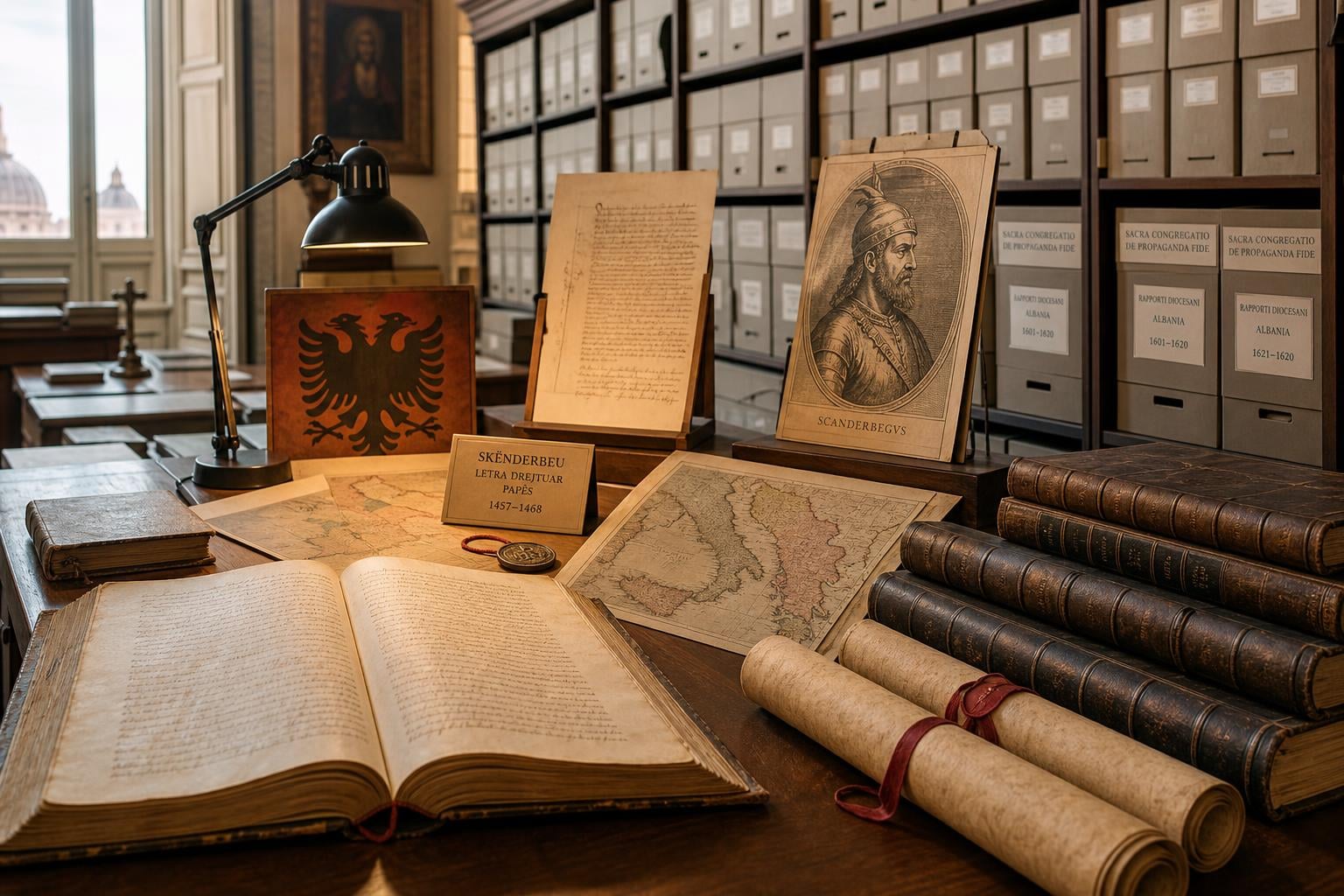
The Vatican Apostolic Archive sits inside the walls of Vatican City, two stories below the Cortile della Pigna, and runs for about 85 kilometers of shelving. Most of those shelves have nothing to do with Albania. The ones that do hold something no other archive on earth can match: the papal half of every consequential conversation between Rome and Albanian Catholic life from the 13th century to the modern era.
That includes Skanderbeg’s letters to four popes during the 1450s and 1460s. The papal bulls that erected and re-erected Albanian dioceses through centuries of Ottoman pressure. The visite ad limina — the mandatory five-yearly reports that every Catholic bishop, including those serving small mountain dioceses in northern Albania, was required to file with Rome. The missionary correspondence of the Propaganda Fide. The records of the Italo-Albanian eparchies that the Arbëresh diaspora founded in southern Italy.
This piece does three things. It explains what the archive is and where it sits in the structure of the Holy See. It walks through what specifically matters to Albanian history — Skanderbeg, the diocesan record, the Propaganda Fide archive, the Arbëresh documents. And it gives an honest picture of how researchers get inside, because the access bar is high and most Albanian Americans curious about this material will be better served by published editions than by booking a flight to Rome.
The Vatican Apostolic Archive happens to hold the Catholic-historical record. Albanian heritage is wider than that — Orthodox, Sunni, Bektashi, secular threads all matter — and this article is about one specific archive, not a claim about which tradition counts most.
What the Archivio Apostolico Vaticano is
The full Italian name is Archivio Apostolico Vaticano. Until 2019 it was called the Archivio Segreto Vaticano — usually translated into English as “Vatican Secret Archive.” Segreto in 17th-century papal Latin did not mean “secret” in the modern sense; it meant “private” or “personal,” in the way a sovereign’s private correspondence is segreto even when its existence is well known. The word’s modern connotation made the archive sound like a conspiracy vault. On October 22, 2019, Pope Francis issued the apostolic letter L’esperienza storica (“Historical experience”) renaming it the Vatican Apostolic Archive to remove that misunderstanding.
The archive was formally founded in 1612 by Pope Paul V (Camillo Borghese), who centralized what had been scattered curial papers into a single institution. Its holdings, however, go back much further — to the 8th century in fragments and to the 13th century in continuous series. Roughly 85 kilometers of shelving span the modern collection. Estimates of individual documents run into the tens of millions.
The archive is administratively part of the Roman Curia, headed by an Archivist who is typically a cardinal. It sits adjacent to the Vatican Apostolic Library (Biblioteca Apostolica Vaticana) and shares some scholarly infrastructure with it, but the two are distinct institutions — the library holds books and manuscripts intended for reading; the archive holds the working records of papal governance.
For Albanian-history purposes, the holdings that matter are concentrated in a handful of series: the Registra Vaticana and Registra Lateranensia (papal letters and bulls), the Archivum Arcis (documents of the Castel Sant’Angelo, including diplomatic correspondence), the Segreteria di Stato (Secretariat of State records from the 16th century onward), and — separately archived but functionally connected — the records of the Congregation for the Propagation of the Faith discussed below.
1881: when the archive opened to scholars
For most of its existence, the archive served papal administration and was effectively closed to outside researchers. That changed under Pope Leo XIII, who in 1881 opened the archive to qualified scholars regardless of religious affiliation. The decision transformed European historiography — including the historiography of Albania.
Before 1881, the working sources for Albanian Catholic history were the documents that had escaped Albania itself: copies in Venetian state archives, Propaganda Fide records in Rome, fragments preserved in Dalmatian and Italian dioceses. After 1881, scholars could read the original papal correspondence. The first systematic compilation of Albanian medieval documents to draw on the newly opened archive was Acta et Diplomata Res Albaniae Mediae Aetatis Illustrantia — usually shortened to Acta Albaniae — edited by Ludwig von Thallóczy, Konstantin Jireček, and Milan Šufflay and published in Vienna in 1913 and 1918. Two volumes, more than a thousand documents, the spine of medieval Albanian historical research to this day.
The 1881 opening also enabled later 20th-century work by Albanian-Catholic clergy-historians like Daniele Farlati (whose earlier Illyricum Sacrum preceded but was supplemented by archive access), the Jesuit historians of the Albanian college in Rome, and post-1990 scholars based in Tirana, Shkodra, and Italian universities. The chain is direct: Leo XIII’s 1881 decision is the reason Albanian Catholic history is something other than a guess.
Skanderbeg and the four popes
Gjergj Kastrioti Skanderbeg (1405-1468) led Albanian resistance to Ottoman expansion for twenty-five years, and his political survival depended on European Catholic support. The Vatican Apostolic Archive holds the documentary record of that diplomatic relationship — letters to and from four successive popes covering roughly the years 1450 through 1467.
Pope Nicholas V (1447-1455) was the first papal correspondent. The exchanges concerned recognition, military aid, and crusade coordination after the fall of Constantinople in 1453. Nicholas treated Skanderbeg as the Christian sovereign of Albania in fact if not in formal title.
Pope Calixtus III (1455-1458), born Alfonso de Borja, made Skanderbeg the centerpiece of his anti-Ottoman policy. In 1457, Calixtus formally named Skanderbeg Athleta Christi — “Champion of Christ” — and Capitaneus Generalis of the Holy See against the Turks. The papal bulls conferring these titles survive in the archive. The Athleta Christi designation became the durable Catholic-European framing of Skanderbeg’s career: a Christian warrior holding the southeastern frontier against Islam. It is one of the most consequential single documents in Albanian historical memory.
Pope Pius II (1458-1464), the humanist Enea Silvio Piccolomini, continued the alliance. Pius’s planned crusade — which collapsed when he died in Ancona in August 1464 waiting for the European fleet he had summoned — depended on Skanderbeg as the land commander. The archive holds Pius’s correspondence laying out the crusade strategy and Skanderbeg’s responses on troop strength, financing, and the political position of the Albanian princes.
Pope Paul II (1464-1471) corresponded with Skanderbeg in the final years of his life, including discussions of further aid as Ottoman pressure mounted after Pius’s death. After Skanderbeg died in Lezhë in January 1468, the correspondence continued briefly with his son Gjon Kastrioti II.
These letters are not abstract diplomatic boilerplate. They include specific requests for ducats, complaints about delayed shipments of grain and gunpowder, debates over which Albanian and Venetian forces would hold which forts, and the personal voice of a leader negotiating with the Holy See as something close to an equal. For anyone curious about how Skanderbeg in fact operated — not the marble statue but the working diplomat — these documents are the closest available evidence.
Albanian Catholic dioceses under Ottoman rule
The Albanian Catholic Church was structured around a small number of historic dioceses in the northern highlands and along the Adriatic coast: Sapë (Sapa), Lezhë (Alessio), Pult (Polatum), Durrës (Durazzo), Shkodra (Scutari), and a few smaller sees that were merged or abolished and re-erected over the centuries. The papal record of those dioceses — every appointment of a bishop, every territorial adjustment, every dispute over jurisdiction — sits in the Vatican Apostolic Archive.
That record matters because Albanian local sources for these dioceses are thin. The northern Catholic regions endured Ottoman pressure from the late 15th century forward — heavy taxation on non-Muslims, periodic violent suppression, structural incentives to convert to Islam, and the destruction or repurposing of churches. The 20th century brought worse: the 1967 atheism campaign under Enver Hoxha closed every functioning church in Albania, executed or imprisoned much of the Catholic clergy, and destroyed parish archives wholesale. What survived in Rome became, by default, the principal documentary record of those communities.
The papal correspondence captures the texture of Catholic life under Ottoman rule. Bishops report on which villages still held to the church, how many priests they could field, where customary Albanian law — the Kanun (the unwritten code attributed to the medieval lawgiver Lekë Dukagjini) — overrode Ottoman kanunname in practice, and where conversion pressure was strongest. The picture is granular and often grim, but it is also documentary in a way nothing else on Albanian Catholic history before the 19th century is.
The Pjetër Bogdani correspondence is one well-known thread. Bogdani (1627-1689), Bishop of Shkodra and administrator of Antivari before becoming Archbishop of Skopje in 1677, was the great 17th-century Catholic Albanian intellectual; his treatise Cuneus Prophetarum (1685) is foundational to Albanian literature. His letters to Rome — preserved in the Vatican archive and the Propaganda Fide archive together — describe the political situation in Kosovo and northern Albania during the Habsburg-Ottoman war and the great migration of Serbs and Albanians north under Patriarch Arsenije III. They are some of the most important political documents in early modern Balkan history.
The Propaganda Fide archive
The Sacred Congregation for the Propagation of the Faith — Sacra Congregatio de Propaganda Fide, usually shortened to Propaganda Fide — was founded by Pope Gregory XV in 1622 to coordinate Catholic missionary activity worldwide. Under Ottoman rule, Albanian Catholic life fell under its direct administrative supervision. The congregation appointed Albanian bishops, funded seminaries (the Collegio Urbano, founded in 1627 specifically for missionary clergy, trained generations of Albanian priests), and received the regular reports that bishops were required to submit.
The Propaganda Fide historical archive is technically a separate institution from the Vatican Apostolic Archive — it remains housed at the congregation’s own premises near the Spanish Steps — but for research purposes the two are functionally one body of evidence. Many of the relevant Albanian-history series have been microfilmed or digitally cataloged across both institutions.
The series that matter most for Albanian history are:
Scritture Riferite nei Congressi — letters from missionaries and bishops in the field, organized by region. The Albanian and Serbian (Servia) volumes contain hundreds of documents on northern Albanian Catholic life from the 1620s through the 19th century.
Visite ad limina — every Catholic bishop is required by canon law to make a visit to the threshold (of the apostles) every five years and file a written report on the state of his diocese. Albanian bishops of Sapë, Lezhë, Shkodra, Pult, Durrës, Bar (Antivari), and other sees filed these reports under often-extreme conditions of travel and Ottoman surveillance. They describe village by village what the bishop found: how many faithful, how many priests, what languages they spoke and preached in, what local customs prevailed, what conversions to Islam or to Orthodoxy were happening. They are among the best ethnographic snapshots of 17th- to 19th-century Albania anywhere in existence.
Collegio Urbano records — admissions, ordinations, and posting assignments for the Albanian clergy trained in Rome.
The Propaganda Fide archive opened to scholars in stages through the late 19th and 20th centuries on a schedule parallel to the broader Vatican opening. Today, both archives operate under similar access protocols.
Arbëresh records and the Italo-Albanian eparchies
The Arbëresh — descendants of Albanians who fled to southern Italy in the 15th and 16th centuries, mostly after Skanderbeg’s death and the fall of Krujë in 1478 — have their own ecclesiastical history, and parts of it sit in the Vatican Apostolic Archive.
The Arbëresh belong primarily to the Italo-Albanian Catholic Church (Chiesa cattolica italo-albanese), an Eastern-rite Catholic church in full communion with Rome that uses the Byzantine liturgy in Albanian. The church is governed by two eparchies and a territorial abbacy:
- Eparchy of Lungro (Calabria), formally erected by Pope Benedict XV in 1919.
- Eparchy of Piana degli Albanesi (Sicily), erected by Pope Pius XI in 1937.
- Territorial Abbacy of Santa Maria di Grottaferrata (Lazio), founded in 1004 and absorbed into the Italo-Albanian church in 1937.
The papal bulls erecting the eparchies, the prior centuries of correspondence with Roman congregations over the Arbëresh communities’ liturgical and disciplinary autonomy (married priests, Albanian-language liturgy, Eastern sacramental calendar), and the 15th- and 16th-century records of the initial Albanian settlements in southern Italy all sit in Vatican holdings.
Day-to-day Arbëresh parish records — baptisms, marriages, burials, confirmations going back centuries — are held by the eparchies themselves at Lungro, Piana degli Albanesi, and Grottaferrata, and by individual parishes. For Arbëresh-descended Albanian Americans seeking specific family records, the eparchial and parish archives are usually the right starting point; the Vatican archive holds the institutional context, not the parish register.
How researchers access the archive
The reading room of the Vatican Apostolic Archive is open to qualified scholars only. The access protocol is largely unchanged in form since the 19th century:
Credentials. Applicants must hold a graduate degree (PhD or equivalent) in a relevant field — history, theology, paleography, archival science — or document equivalent professional standing. Independent scholars without formal degrees can be admitted with substantial publication records.
Letter of recommendation. Applicants must submit a letter of recommendation from a recognized academic or ecclesiastical institution attesting to their research project and qualifications.
Specific research project. Open-ended browsing is not permitted. The application must describe a defined topic and identify the series the researcher intends to consult.
In-person registration. First-time researchers register on-site, present credentials, and receive a reader card valid for the academic year.
Reading-room hours. The archive is open weekday mornings during the academic year (roughly mid-September through early July, closed for major Roman Catholic holidays and the month of August). Hours are typically around 8:30 a.m. to 1:00 p.m., with limited afternoon access in some periods.
Document handling. No photography is permitted in most series. Documents are requested by series and folio reference; the staff retrieves them. Note-taking is by hand or laptop; copying is restricted.
Online finding aids. The archive maintains an online catalog and a growing set of finding aids at archivioapostolicovaticano.va. Many of the Indici (manuscript inventories) prepared over centuries by Vatican archivists have been digitized and are searchable. Digitization of the documents themselves is partial and slow; most material remains accessible only in the reading room.
For Albanian-history researchers, the practical implications are clear. A serious PhD-level project on Skanderbeg’s correspondence, on 17th-century Albanian Catholic life, or on the erection of the Italo-Albanian eparchies will need on-site time in Rome. A general genealogical inquiry by an Albanian American hoping to find a great-grandfather’s baptismal record will not.
What to read instead, if Rome is out of reach
Most Albanian Americans curious about Vatican-archived Albanian history will be better served by published editions than by an attempted research visit. The principal resources:
Acta et Diplomata Res Albaniae Mediae Aetatis Illustrantia (Vienna, 1913 and 1918), edited by Thallóczy, Jireček, and Šufflay. Two volumes, more than a thousand transcribed and annotated documents covering Albanian-related material in Vatican, Venetian, and other European archives from the 4th through the 15th centuries. Available in major university libraries and partially digitized through HathiTrust and the Internet Archive. The starting point for any serious medieval-Albanian research.
Illyricum Sacrum by Daniele Farlati (8 volumes, Venice, 1751-1819). Older and pre-1881-opening, but the foundational Latin reference work on the dioceses of the western Balkans, including the Albanian sees. Still cited.
Acta Albaniae Veneta edited by Giuseppe Valentini (25 volumes, Munich, 1967-1979) — Venetian-archive documents on Albania, complementing the Vatican-focused Acta Albaniae.
Albanian Catholic Bulletin (San Francisco, 1980-2009), the Albanian Catholic Information Center publication that translated and contextualized many later Vatican and Propaganda Fide documents for an English-reading audience. Back issues are findable through Albanian Catholic and Jesuit libraries.
Critical editions of individual visite ad limina have been published in Italian and Albanian for some dioceses — notably Sapë (Sapa), Shkodra, and Bar (Antivari). Italian academic presses and the University of Tirana’s history faculty have led this work since the 1990s.
For a researcher in the United States, the realistic workflow looks like this: identify the published edition that covers your topic, request it through interlibrary loan, work through the Latin or Italian text (or commission a translation), and if a specific document referenced in the edition matters enough to consult in the original, either travel to Rome with a graduate-program affiliation or commission a Rome-based scholar to retrieve it. The Albanian Studies program at the University of Calabria, the Pontifical Albanian College, and the Albanian Catholic Center in Tirana are useful contact points.
Why this archive matters for Albanian-American heritage
The Vatican Apostolic Archive will not produce a baptismal certificate for a great-grandparent who emigrated from Shkodra in 1908. It is not a genealogical archive. What it produces is something different and, depending on the question, more valuable: institutional memory of Albanian Catholic life across centuries when local memory was repeatedly erased.
For an Albanian American whose family was Catholic in the northern highlands, the practical heritage chain runs through the parish, the diocese, and only then through Rome. Local parish books in Shkodra, Lezhë, Sapë, and the surrounding villages — where they survived the 1967 destruction and the wider 20th century — are the place to look for specific family records. The Vatican holdings answer different questions: when was the diocese erected, when did it lose territory, who served as bishop in your grandparents’ generation, what did the bishop report to Rome about the state of the faith in your home village. These are the questions historians work on, and they are what gives genealogical research its broader context.
For Arbëresh-descended Albanian Americans — a smaller but real population in the United States, mostly descended from late-19th- and early-20th-century onward migration of Italo-Albanians — the Vatican holds the chain of papal documents from the original 15th-century settlement through the 1919 and 1937 eparchial erections. Parish records remain with the eparchies, but the institutional story is in Rome.
For anyone working on Skanderbeg’s actual diplomatic career — not the legend, the working history — the Vatican is the principal source. Four popes, twenty-five years of correspondence, and the Athleta Christi designation that shaped how Catholic Europe would remember Albania for the next five centuries.
The honest summary: most people will never set foot in the reading room. Most people don’t need to. What matters is that the record exists, that it has been opened, and that published editions have made the load-bearing pieces of it available in English, Italian, Albanian, and Latin for anyone willing to do the reading.
Get counted alongside the rest of Albanian-American Catholic heritage
The National Albanian Registry counts Albanian Americans across every religious tradition — Catholic, Orthodox, Sunni, Bektashi, secular, mixed. Catholic heritage from the northern highlands and Arbëresh heritage from southern Italy are both part of that count, alongside everyone else’s. If you’re tracing your family through any of these threads — Vatican-archived or not — adding yourself to the count strengthens the community’s documentation of itself. Get counted →
Sources: Wikipedia — Vatican Apostolic Archive; Wikipedia — Skanderbeg; Wikipedia — Catholic Church in Albania; Wikipedia — Propaganda Fide; Wikipedia — Italo-Albanian Catholic Church; Thallóczy, Jireček, Šufflay (eds.), Acta et Diplomata Res Albaniae Mediae Aetatis Illustrantia (Vienna, 1913, 1918); official site of the Archivio Apostolico Vaticano (archivioapostolicovaticano.va). Where dates of papal acts are approximate or where multiple sources differ on detail, we have followed the consensus of the cited published editions.