
The United States is the foreign country most responsible for Kosovo existing as a state in its current form — see our piece on Kosovo and the United States for the NATO campaign, the 2008 recognition, and Camp Bondsteel. This article covers a quieter but related project: the American-style university that opened in Pristina in 2003, four years after the war and five years before independence, and that has graduated more than 900 students into Kosovo’s public sector, private economy, and diaspora since.
The institution has gone by several names. It was registered as the American University in Kosovo Foundation (AUKF) in May 2002 and opened in autumn 2003. It later took the name RIT Kosovo (A.U.K.) to reflect its ownership relationship with Rochester Institute of Technology in upstate New York. Many Kosovars and diaspora Albanians still call it AUK, and the school still uses “(A.U.K.)” in its own materials. We use both names here.
What follows is a sourced guide to what the institution is, how it was built, what it teaches, and why it matters for Albanian Americans whose families have moved between Pristina and the New York metro area for a generation.
What the American University in Kosovo is
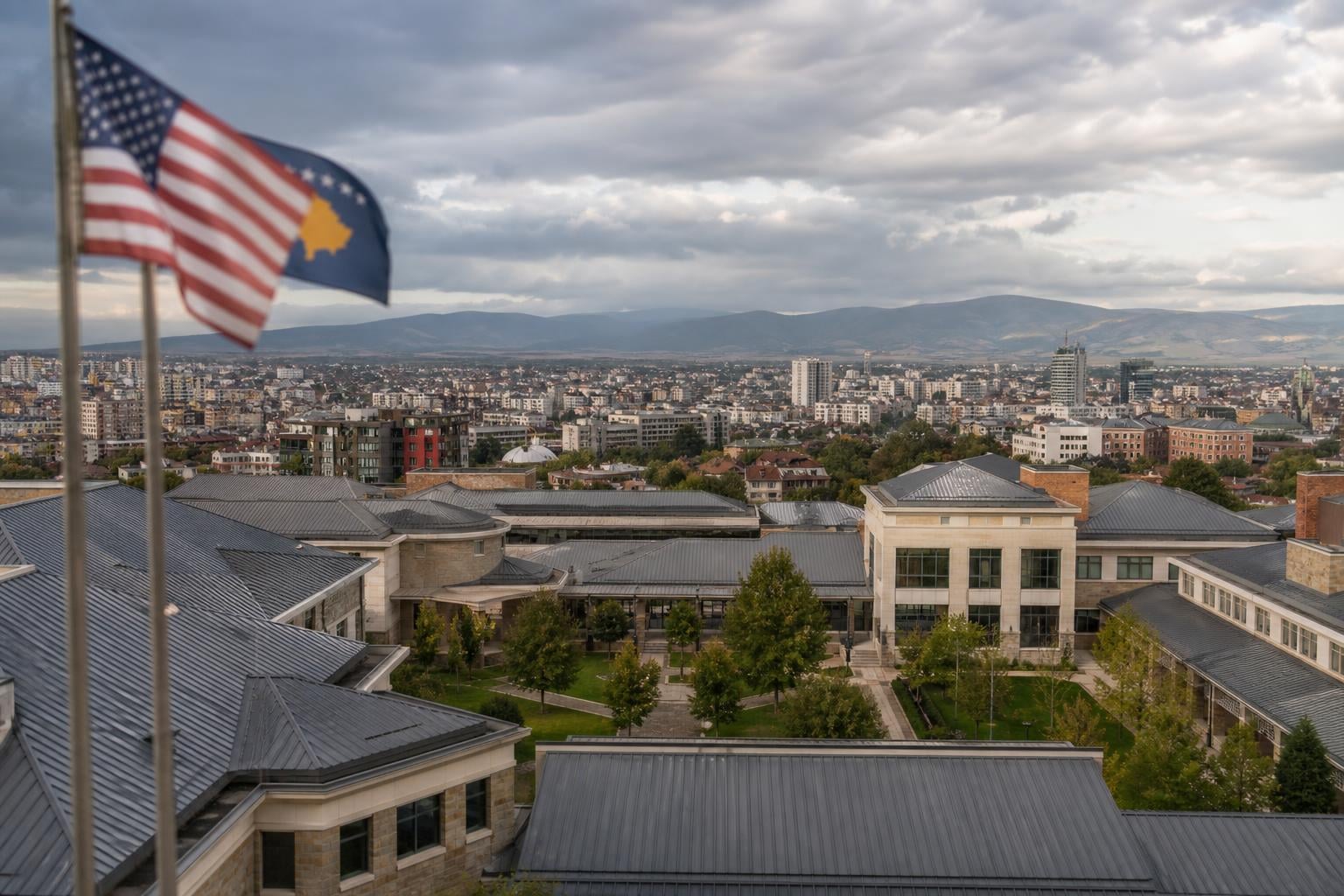
RIT Kosovo (A.U.K.) is a private, nonprofit, English-language university based in Pristina, Kosovo. Its campus occupies roughly 2.1 hectares — about 5.2 acres — in the Germia (Gërmia) neighborhood of the capital. Prishtina is the Albanian spelling of the city’s name; Pristina is the English convention; both refer to the same place.
Academically, the institution is part of Rochester Institute of Technology, a New York-chartered private research university with about 17,000 students at its main Rochester, NY campus. RIT is accredited in the United States by the Middle States Commission on Higher Education, and the Middle States accreditation status sheet lists “The American University in Kosovo, Gërmia Campus, Kosovo” as an Additional Location with full approval. In practical terms that means a bachelor’s degree earned in Pristina is the same diploma — issued under the same accreditor — as one earned in Rochester.
In Kosovo the institution is licensed by the Ministry of Education, Science and Technology (MEST) and accredited by the Kosovo Accreditation Agency (KAA), the local quality-assurance body that reviews higher-education programs in the country. Individual programs also hold professional accreditation from the Association of Technology, Management, and Applied Engineering (ATMAE) in the United States.
The school is small. RIT Kosovo describes its student body as drawn from roughly 17 to 18 different countries, with an alumni network of more than 900 graduates to date. That places the campus closer in scale to a small US liberal-arts college than to either RIT’s home campus or to Kosovo’s flagship public University of Pristina (formally the University of Pristina “Hasan Pristina”, with tens of thousands of students).
The combination — small, English-medium, US-accredited, in Kosovo’s capital — is the institution’s defining feature. There is no other school in Kosovo that combines all four.
The founding context: a post-war country, an American idea
To understand why this university exists, start with what Kosovo’s higher-education system looked like in 1999. Kosova (the Albanian-language name for Kosovo) had emerged from a decade of parallel institutions — schools, clinics, and a government-in-exile that the Kosovar Albanian majority operated outside Serbian state structures during the 1990s — and from a 78-day NATO air campaign that ended Serbian rule in June of that year. The University of Pristina, founded in 1969, had been split along ethnic lines through the 1990s, with Albanian-language instruction conducted in private homes after Albanian faculty and students were excluded from official premises in 1991-92.
After the war, prominent Kosovars and diaspora figures looked at how to invest funds the diaspora had raised during the 1990s for the parallel institutions. Those funds, held in the Union Fund for the Reconstruction of Kosovo (UFORK), were the post-war balance of money collected from the Albanian diaspora — particularly in the United States, Switzerland, and Germany — to keep the parallel state running. The chair of UFORK was Dr. Bujar Bukoshi, who had served as prime minister of the Kosovar government-in-exile from 1991 to 2000, operating largely from Bonn during the war years.
Bukoshi and a circle of Kosovar and American collaborators decided one of the best uses of the fund’s residual capital would be to seed a US-style university in Pristina — both to honor American intervention and to plant a long-term institution of American higher-education practice in the country. The AUK Foundation was registered in May 2002; the first class entered in autumn 2003.
The first years: a house on Sunny Hill, then Germia
The university opened in temporary facilities in 2003, in a house on Sunny Hill in Pristina, with an entering class of roughly 57 to 67 students depending on the source. The first undergraduate cohort graduated in 2007.
By 2005 the school had outgrown the original house. The municipality of Pristina provided land and a building in the Germia neighborhood, on the eastern edge of the city near Germia Park, at no cost, and the school moved into renovated facilities there (a second building followed in 2006). Chris Hall — a former Maine state senator and steel-industry executive who had already been teaching at the school for two years — became president in 2007, four years after the school opened; the president’s office has rotated through several leaders both before and after his tenure.
The early years were not easy. The school was operating in a country with no settled higher-education law (Kosovo’s law on higher education was passed in 2003, the same year the school opened) and no established private-university sector. A US-style admissions process, an English-language curriculum, and an academic-integrity regime had to be built from scratch.
The RIT partnership and the renaming
The partnership with Rochester Institute of Technology is what gave the university its US degree. RIT is a private research university in upstate New York with a long tradition of applied and technology-oriented programs. RIT extended its institutional model to Kosovo, with the Pristina campus operating as an academic location of RIT and Pristina-enrolled students earning RIT degrees on completion.
The institution formally took the name RIT Kosovo (A.U.K.), with “(A.U.K.)” preserved to keep continuity with the original identity. The renaming was the formalization of an arrangement that had effectively been in place for several years.
Under this structure:
- The AUK Foundation is the Kosovo-side legal entity that owns the campus, holds the local license, and raises Kosovo-based and diaspora funds.
- RIT provides the academic framework — degree programs, faculty oversight, accreditation, transcripts, diplomas — and operates Pristina as an Additional Location under its Middle States accreditation.
The dual structure is unusual but not unique. Several US universities operate similar branch campuses overseas (NYU Abu Dhabi and Shanghai, Carnegie Mellon Qatar, Georgetown Qatar). RIT Kosovo is the only such arrangement currently operating in the Western Balkans.
Programs, language, and what students actually study
Instruction is entirely in English. RIT Kosovo describes itself as Kosovo’s only private nonprofit institution that teaches fully in English. Incoming students who don’t yet meet the English-proficiency threshold can take the school’s preparatory English program before enrolling in degree coursework.
The undergraduate offering centers on a Bachelor of Science in Applied Arts and Sciences through RIT’s School of Individualized Study, which lets students build a customized major from a defined set of concentrations: economics; public policy and management; multimedia and visual communication; and applied computer technology / computing and information technologies. A separate Bachelor of Science in Computing and Information Technologies is also offered as a structured major. Below the bachelor’s level, the school offers a two-year Associate in Applied Science. At the graduate level, the campus offers a Master of Science in Professional Studies, with concentrations including data analytics — a direct response to demand from Kosovo’s growing IT and outsourcing sectors.
Coursework is structured on the US semester calendar, with letter grading, a cumulative GPA, and the standard apparatus of office hours, problem sets, mid-terms, and finals. Class sizes are small; faculty are a mix of Kosovar Albanian academics, returning diaspora Albanians, and visiting US and European instructors.
The campus is a stop on RIT’s broader global semester program — main-campus RIT students can spend a semester in Pristina, and RIT Kosovo students can study at the home campus or RIT’s other global locations (Croatia, Dubai, China). A peace-building-and-conflict-studies summer program, run through the Fred Cuny Center for Peace and Conflict Studies at RIT Kosovo, draws students from US universities into a Pristina-based curriculum on post-conflict reconstruction.
Cost, admissions, and who attends
Tuition is set substantially below the rate at RIT’s main Rochester campus, which is roughly $60,000 per year. RIT Kosovo’s tuition guidelines are published annually and cover tuition, lecture and exam fees, library access, and a personal laptop. The dollar figure changes year to year and is best confirmed with the admissions office.
Scholarships and need-based aid are part of the model. The institution maintains scholarship streams from US foundations, EU programs, the Kosovar government, and individual donors, with the explicit aim of keeping the school accessible to students whose families could not pay full sticker price.
Admissions follow a US-style application: secondary-school transcripts, English proficiency (typically TOEFL or IELTS, or completion of the school’s English program), entrance examinations in math and English, and a personal statement. The student body is predominantly Kosovar Albanian, with a meaningful share from the wider region — Albania, North Macedonia, Montenegro, Serbia — and small numbers from elsewhere in Europe, the US, and beyond.
Many students are first-generation university attendees, children of families excluded from Kosovar higher education through the 1990s. That demographic — bright kids from working- and middle-class Kosovar Albanian families, attending a US-accredited program in their own capital, in English — is the school’s defining cohort.
Where the alumni go
The alumni profile has matured since the first cohort graduated in 2007. RIT Kosovo’s own listings include figures across the public and private sectors:
- Hekuran Murati (BSc 2008) served as Minister of Finance and Transfers under Prime Minister Albin Kurti from 2021, after earlier roles at the Central Bank of Kosovo and the World Bank.
- Donjeta Sahatçiu (BSc 2012) was named the first woman deputy mayor of Pristina in February 2022.
- Besianë Musmurati (BSc 2012) served as a Kosovar diplomat at the Embassy of Kosovo in Washington, DC, before being appointed Director of Education in Pristina.
- Kreshnik Bekteshi (BSc 2008), an ethnic-Albanian alumnus from North Macedonia, was appointed Minister of Economy of North Macedonia in 2017.
- A Deputy Chief of Staff to President Vjosa Osmani is among alumni in senior government roles.
- Premtim Shaqiri is Chief of Intelligence and Security at the Kosovo Security Force’s Training and Doctrine Command.
In the private sector, alumni are concentrated in banking (BKT, ProCredit, Raiffeisen Kosovo), in the IT and outsourcing companies that have grown rapidly in Pristina since the 2010s, and in consulting and professional services. Some have gone on to graduate study in the US and Western Europe; others have returned to Kosovo or to diaspora hubs in New York, Detroit, and Switzerland.
The pattern matches what the founders described in 2003: a small school producing graduates fluent in English, trained in a US-style academic culture, who can move between Kosovo and the transatlantic economy without translating themselves at every step.
Why it matters for Kosovo and the diaspora
For Kosovo, the school is one of a small number of institutions producing graduates the country’s growing private sector, donor-funded development sector, and modernizing public administration can absorb without retraining. The English-language model also positions graduates for labor-market alignment with the EU and NATO frameworks Kosovo is pursuing.
For the Kosovar-American diaspora, the school is one of the more direct institutional points of contact between the US and Kosovo. Kosovar Albanian refugees were resettled to the United States in 1999 — including through the reception center at Fort Dix, New Jersey — and many of those families remained — concentrated today in the Bronx, Yonkers, Westchester, Staten Island, northern New Jersey, and metro Detroit. The children and grandchildren of those families now move in both directions: studying at RIT Kosovo, transferring to RIT in Rochester, returning to Pristina to work, or staying in the US after graduation.
The school is a recurring stop for visiting US officials, congressional delegations, and Albanian-American advocacy groups, and it hosts Fulbright awardees and Peace Corps-adjacent volunteer programs that have rotated through Kosovo since the 2000s.
For Albanian Americans more broadly — including Albanians from Albania proper, North Macedonia, and Montenegro — the school is a piece of how the diaspora reproduces itself. A bright nephew or cousin from Pristina, Mitrovica, or Skopje can attend a US-accredited bachelor’s program at home, transfer mid-program to Rochester, or land in US graduate school after Pristina without the family carrying full US-campus tuition.
How AUK fits the broader US-Kosovo relationship
Our Kosovo-US relations explainer covers the security, diplomatic, and recognition pieces — the 1999 NATO campaign, the 17 February 2008 declaration of independence, 18 February 2008 US recognition, Camp Bondsteel, the Clinton statue on Bill Clinton Boulevard, and the ongoing Belgrade-Pristina dialogue. RIT Kosovo sits inside that broader picture as the educational dimension.
It is not the only piece. The University of Pristina “Hasan Pristina” remains the country’s flagship public institution and graduates the largest share of Kosovars holding a degree. Other private institutions — AAB College, UBT (University for Business and Technology), and smaller schools — make up a private-sector higher-education market that has grown substantially since 2003.
What makes RIT Kosovo distinctive in that ecosystem is the directness of the US institutional connection. A graduate holds a degree issued by an American university, accredited by an American regional accreditor, earned in Pristina, taught in English. No other Kosovar institution holds that exact combination.
The school is honest about the limits. RIT Kosovo is not a research university; its mission is undergraduate and professional-master’s instruction. It is small. Its tuition, while subsidized relative to RIT Rochester, is not free, and that limits reach into Kosovo’s lowest-income demographics even with scholarships. It does not displace the University of Pristina; it complements it.
Chronology of names and partnerships
The school’s name and structure have shifted enough times to warrant a quick chronology:
- 2002 — American University in Kosovo Foundation (AUKF) registered in Pristina.
- 2003 — Doors open in a temporary house on Sunny Hill with the first undergraduate class.
- 2007 — First cohort graduates.
- 2005 — School moves into renovated facilities in the Germia neighborhood, on land the city provided at no cost; a second building is added in 2006.
- 2010s — Formally renamed RIT Kosovo (A.U.K.) to reflect the RIT partnership; the “(A.U.K.)” parenthetical is retained.
- Through 2024-2026 — Operating as RIT Kosovo (A.U.K.), with active academic calendars, Erasmus+ exchanges, and continuing enrollment.
Reports of further partnership transitions surface periodically in diaspora media. As of publication in May 2026, the publicly verifiable institutional partner of the Pristina campus remains Rochester Institute of Technology, with the AUK Foundation as the Kosovo-side governance entity. We will update this piece if the institution announces a different US academic partner.
What the school does not claim to be
A few clarifications, since the school sometimes gets discussed as more or less than it is.
It is not a US government project. It is a private nonprofit, founded with diaspora and Kosovar capital, in academic partnership with a private US university. The State Department’s role is supportive, not constitutive.
It is not a substitute for Kosovo’s national university. The University of Pristina remains the country’s largest institution, with degree programs RIT Kosovo does not teach (medicine, law, most engineering disciplines).
It is not identical to RIT in Rochester. Pristina students have access to RIT’s name, accreditation, and certain mobility programs, but the campus is small and the curriculum narrower than Rochester’s full catalog.
A note for Albanian Americans reading from the US
For Albanian American families — Kosovar Albanians in the Bronx whose niece is applying, Albanian Americans in Detroit whose cousin teaches there, 2nd-generation readers who have never been to Pristina — the practical takeaway is that this institution exists as a real path between Kosovo and the US for the next generation. Some students at RIT Kosovo are children of families who arrived through Fort Dix in 1999. Some are returning members of diaspora families who left Kosovo, North Macedonia, or Montenegro decades earlier and want their kids to spend part of their education in their grandparents’ city.
NAR’s count includes many of those families. If you have a connection to Kosovo, to the Albanian diaspora more broadly, or to one of the institutions — like RIT Kosovo — that bridges Pristina and the United States, you can add yourself to the count. The certificate is a recognition document, not a government ID; the count is community-led.
Sources
- Wikipedia — RIT Kosovo
- Wikipedia — Rochester Institute of Technology
- Wikipedia — Bujar Bukoshi
- Wikipedia — Education in Kosovo
- Wikipedia — Kosovo–United States relations
- RIT Kosovo — About, Academics overview, Admissions, Alumni
- RIT Kosovo — Accreditation by ATMAE announcement
- Christian Science Monitor (2008) — An American university in Kosovo
- Middle States Commission on Higher Education — Statement of Accreditation Status, Rochester Institute of Technology (Additional Locations)