
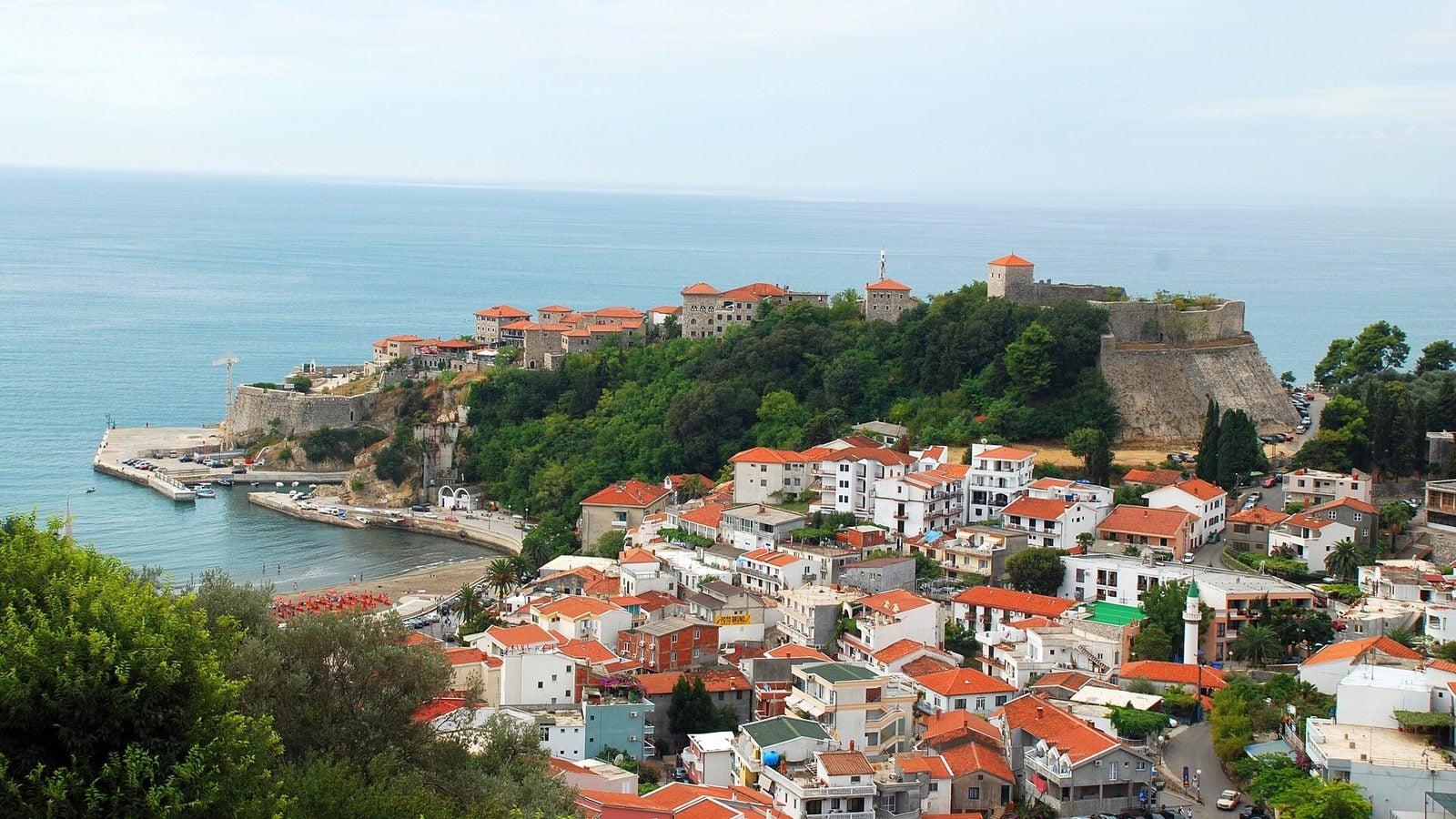
The stone walls of Ulcinj’s Old Town have stood above the Adriatic for over a thousand years. Today, the language in the streets below is Albanian — in the shops, in the mosques, in the municipal offices. Three-quarters of the residents are ethnic Albanians, and the town has been majority-Albanian since at least the Ottoman census rolls of the sixteenth century. It is one of two centers of Albanian life in Montenegro, the other being the Malësia highlands south of Podgorica, where a smaller community of Catholic Albanians has farmed and herded since the medieval period.
Together, these two populations — coastal and highland, Muslim and Catholic, Ulcinj and Tuzi — account for nearly all of Montenegro’s approximately 31,000 ethnic Albanians. That is about 5% of the country. The share has barely moved in seventy-five years of census-taking: 5.15% in 1948, 4.97% in 2023. The community did not arrive recently and is not going anywhere. But the borders that placed it inside Montenegro are less than 150 years old, and the story of how they were drawn is the story of European great-power politics imposed on an Albanian population that did not consent to the transfer.
Where they live
Montenegro’s 2023 census recorded 30,978 people who identified as ethnically Albanian, out of a national population of about 623,000. They are the country’s largest non-Slavic minority.
The geographic concentration is tight. Four municipalities account for almost all of them:
- Ulcinj — 15,078 Albanians, 73.53% of the municipality’s 20,507 residents. The most Albanian place in Montenegro by both raw numbers and share.
- Tuzi — about 62.5% Albanian, with a total municipal population of roughly 13,000. The municipality was separated from Podgorica and restored in 2018.
- Gusinje — 34.4% Albanian (1,354 of 3,933 residents), though Bosniaks are the majority here at 57.1%.
- Plav — 9.4% Albanian (853 of 9,050 residents), also with a Bosniak majority.
Smaller Albanian populations live in Bar (about 4.2%), Rožaje (about 5.1%), and the capital Podgorica.
The religious split tracks geography. Albanians in and around Ulcinj — the larger group — are predominantly Sunni Muslim, a legacy of Ottoman-era conversion. Albanians in the Malësia highlands, centered on Tuzi, are predominantly Catholic, a tradition that predates the Ottoman period. Across all of Montenegro, the census reports roughly 74% of ethnic Albanians as Muslim and 26% as Catholic.
How Ulcinj and Malësia ended up in Montenegro
The Albanian presence in what is now Montenegro predates the modern state by centuries. Venetian commercial records from Kotor and Budva document Albanian-speaking merchants and settlers in the region as early as the thirteenth century. The Balšić family ruled Ulcinj and much of coastal Zeta from 1360 to 1421. Their tower still stands in Ulcinj’s Old Town.
After the Ottoman siege of Shkodra in 1478–79, the region became part of the Ottoman Sanjak of Scutari. Albanian-speaking tribes — Hoti, Gruda, Kelmendi, and others — maintained a continuous presence in the highlands along the Albanian-Montenegrin border, and Albanian settlement in the coastal towns is attested throughout the Ottoman centuries.
The borders that define the Albanian community’s position inside Montenegro today were drawn in 1878 and 1880. The Congress of Berlin (1878) awarded the towns of Plav and Gusinje — then in the Ottoman Scutari Vilayet — to the Principality of Montenegro. The Albanian population resisted. Forces organized through the League of Prizren, the first pan-Albanian political movement, fought the Montenegrin annexation in the Battles for Plav and Gusinje (October 1879 – January 1880), led by Ali Pasha of Gusinje and local commanders.
When Albanian resistance made the Plav-Gusinje handover impractical, the European powers compensated Montenegro with Ulcinj instead. The town’s Albanian defenders refused. Europe assembled an international naval squadron in the Adriatic — British battleships HMS Monarch and HMS Thunderer, plus French, Austrian, German, Russian, and Italian warships — and the Ottoman sultan dispatched Dervish Pasha with approximately 10,000 troops to crush the resistance. By April 1881, the League of Prizren was broken, and Ulcinj was formally in Montenegrin hands.
The Montenegrin government settled approximately 142 Slavic families around Ulcinj afterward, an early attempt to dilute the Albanian majority. It did not work: 145 years later, the municipality is still three-quarters Albanian.
The 1913 London Conference of Ambassadors finalized the borders. Ulcinj, Tuzi, Plav, and Gusinje — all with native Albanian populations — were assigned to Montenegro, which became part of the new Yugoslav state in 1918.
The Malësia highlands and the 1911 revolt
The highlands south of Podgorica — historically known as Malësia e Madhe (the Great Highlands) — straddle the Montenegro-Albania border. On the Montenegrin side, they correspond roughly to today’s Tuzi Municipality: more than forty settlements, a majority-Albanian population, and a Catholic tradition that sets this community apart from both the Muslim Albanians of Ulcinj and the Orthodox Montenegrins of the capital.
The highland clans — Hoti, Gruda, Kelmendi, Shkreli, Kastrati — operated for centuries under a system of tribal self-governance. Ottoman authorities recognized the Hoti bajraktar (chieftain) as the overall military leader of Malësia’s forces, which could field some 6,200 armed men by the late Ottoman period. The Catholic identity of these clans is older than the Ottoman presence and survived through centuries of highland autonomy.
In 1911, the highland tribes rose against Ottoman rule. At the Battle of Deçiq — fought near Tuzi, in Gruda territory — roughly 3,000 Albanian fighters under Ded Gjo Luli, Sokol Baci, and Pretash Zeka Ulaj defeated an Ottoman force estimated at 28,000 men. Ded Gjo Luli raised the Albanian flag on Mount Deçiq. The revolt is celebrated as a turning point in the Albanian national movement and the first raising of the flag since Skanderbeg’s era.
After 1913, the Malësia communities on the Montenegrin side of the border were absorbed into Yugoslavia. Tuzi held municipal status until 1957, when the federal government stripped it and folded the area into the Podgorica administration. The highlands spent the next six decades governed from a city where Albanians were a small minority.
In 2018, after sustained lobbying by the Albanian community, Montenegro restored Tuzi’s municipal status. In March 2019, the municipality held its first elections; math teacher Nik Gjeloshaj became its first mayor. For a community that had lived under someone else’s administration for sixty years, it was the return of a local voice.
From Yugoslavia to independence
The Yugoslav decades were hard on Montenegro’s Albanians. In the immediate aftermath of World War II, the communist regime carried out severe repression in Albanian-populated areas: sources cite a 1945 massacre in Bar in which several thousand Albanian men were killed, and post-war estimates put the total number of Albanians killed in Montenegro’s Albanian areas at roughly 8,300. Martial law was imposed from February to June 1945. Under Aleksandar Ranković’s security apparatus in the 1950s, a systematic weapons-confiscation campaign targeted Albanian and Muslim populations.
The violence subsided under later Yugoslav governance, but structural marginalization persisted. Albanian-language education was limited. Tuzi lost its municipal status. Albanian political participation was channeled through the League of Communists rather than through any distinctly Albanian institution.
Montenegro’s 2006 independence referendum — which created the state that exists today — turned in part on the Albanian vote. The result was 55.5% in favor, barely clearing the 55% threshold the EU had set. In Ulcinj, the vote ran approximately 88–90% in favor. The Albanian community, small as it was, had provided a decisive margin. The Democratic Union of Albanians was part of the pro-independence coalition.
Political representation
Albanian political life in Montenegro has been defined by fragmentation. With roughly 5% of the national population and about 31,000 voters, the community would need to consolidate its vote to win more than one or two of parliament’s 81 seats. It has rarely managed this.
The parties have proliferated: the Democratic Union of Albanians, the Democratic League in Montenegro, New Democratic Force (Forca), Albanian Alternative, Albanian Coalition “Perspective,” and others have competed against each other in successive elections, splitting the Albanian vote and reducing each party’s chances. The Albanian List coalition won a single seat in 2020 with 1.58% of the national vote — MP Nik Gjeloshaj of Albanian Alternative.
In 2022, the community reached its highest-profile political moment: Dritan Abazović, born in Ulcinj in 1985, became the first ethnic Albanian and first Muslim to serve as Prime Minister of Montenegro. Abazović led the United Reform Action (URA) party, a pro-EU green party that positioned itself as multi-ethnic rather than specifically Albanian. He served from April 2022 to October 2023.
In June 2026, three Albanian parties — the Democratic Alliance of Albanians, Albanian Alternative, and Albanian National Union — formally merged into a single party, the Albanian Forum, in a ceremony at Tuzi’s Municipal Council hall. Veteran leader Ferhat Dinosha was a signatory. The stated goal was to end the vote-splitting that had kept the community underrepresented for a generation.
The Albanian National Council, founded in 2008 in Ulcinj, serves as the community’s institution of cultural self-governance, with twelve standing commissions covering education, language, media, and cultural affairs.
The thread to Detroit
Catholic Albanians from the Malësia highlands have been part of the Albanian migration to the United States since the early twentieth century — particularly to Michigan, which hosts the largest concentration of ethnic Albanians outside Europe. Families from the Hoti and Gruda clans, from Ulcinj, from Gusinje and its surrounding villages, settled alongside Albanians from Kosovo and North Macedonia in the Detroit metropolitan area.
The Albanian community in Michigan reflects this mix: both Catholic and Muslim traditions, drawn from across the Albanian lands. Montenegro’s contribution to that community is smaller than Kosovo’s or Albania’s but older than most people realize — highland Catholic families who crossed the Atlantic before the borders between these countries were settled.
That thread still runs. Albanian-American civic organizations in Michigan include members whose families trace to Montenegrin Malësia, and the Albanian Forum merger in Tuzi made news in Detroit-area Albanian media. For a community of 31,000 in a country of 623,000, the connections run far.