
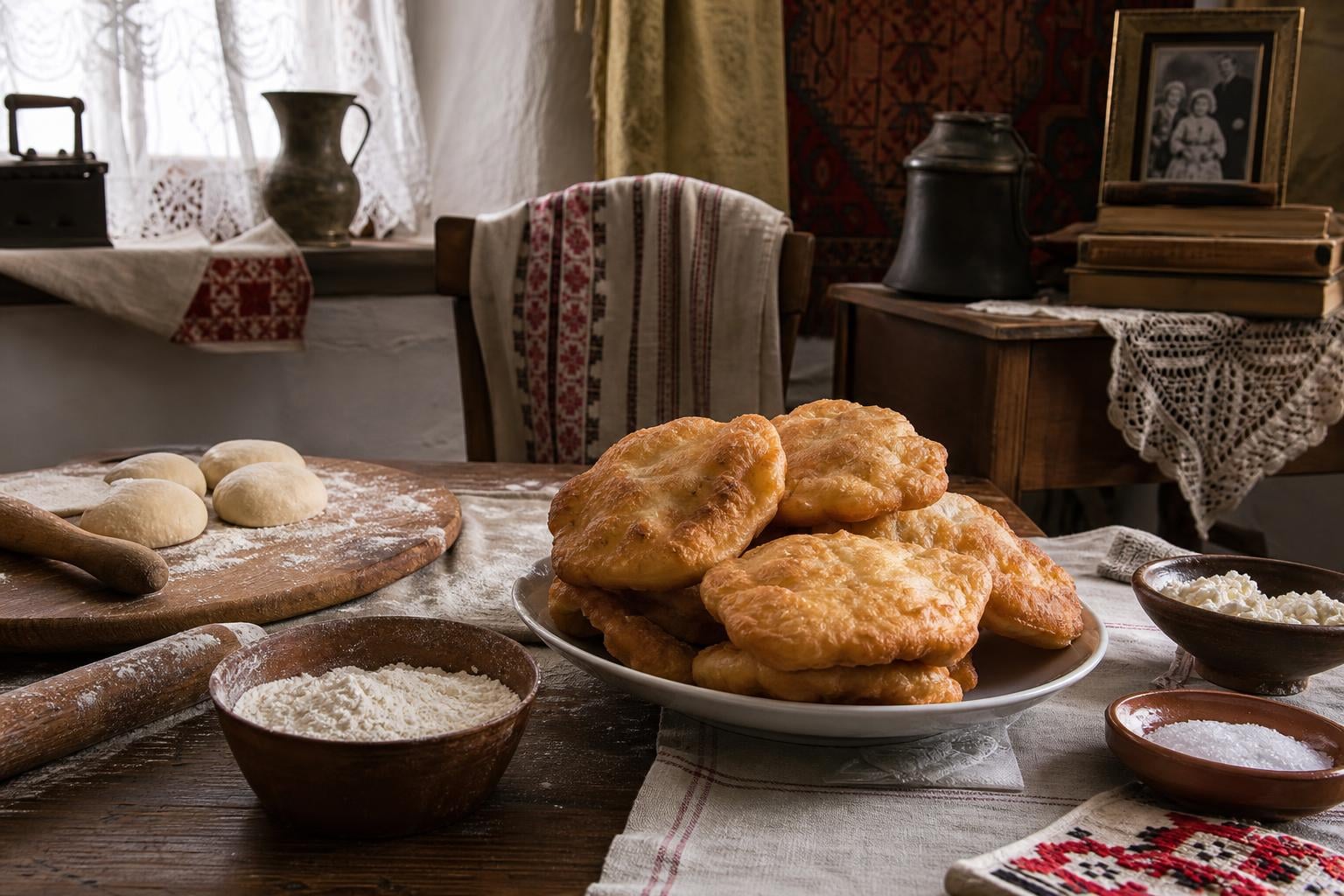
Ask an Albanian grandmother to make pancakes and watch what happens. There is no griddle, no flat batter, no stack with butter melting down the side. Instead a bowl of soft dough comes out, the oil goes on the stove, and within twenty minutes the kitchen smells like frying and the first plate is already disappearing. What she made are petulla (Albanian fried dough) — and they are what nearly every Albanian American means by “Albanian pancakes.”
The naming is a translation snag, not a mystery. English speakers searching for “Albanian pancakes” are usually reaching for a memory of soft, puffy, golden rounds eaten at breakfast — and the Albanian word for those is petulla (singular petull, plural petulla). They are fritters of fried dough, not the flat griddle cakes the English word suggests. Once that is clear, the rest falls into place.
This article covers what petulla are and where they sit in Albanian life — the weekend mornings, the holidays, the plate set down the moment a guest arrives. It walks through the family variations: plain dough, petulla me kos (petulla made with yogurt in the dough), and the yeast-risen version. It explains how they are served, sweet and savory, with cheese or honey or powdered sugar. Then it gives a real recipe scaled for a home kitchen, with the technique notes that separate puffy from greasy. Finally it situates petulla honestly among their Balkan and Mediterranean neighbors, and looks at how diaspora cooks keep the dish alive in American kitchens.
What petulla actually are
Petulla are pieces of leavened dough dropped into hot oil and fried until they puff and turn deep gold. The dough is simple — flour, liquid, salt, a little sugar, and a leavener — and it is wetter and stickier than a bread dough. Cooks pinch or spoon off rough pieces and slide them into the oil, where each one balloons, blisters, and floats. They come out crisp on the outside and soft, almost hollow, inside.
There is no single perfect shape. Some families pull the dough into rough rounds; some flatten it into discs with a hole poked in the center; some just drop irregular spoonfuls and let the oil decide. The result is always a little uneven, and that is part of the appeal — petulla are a homemade food, not a uniform pastry-case item.
The dish belongs to the broader Albanian table that also gives us byrek (the filo pie), flija, and trileçe. Albanian cooking sits where the Mediterranean meets the Balkans (Wikipedia: Albanian cuisine), and fried dough like petulla is one of its simplest, most everyday dishes. Petulla need no oven, no special pan, and no rare ingredient — just flour, oil, and heat. That plainness is exactly why they survived everywhere Albanians went.
The texture is the whole point. A good petull is light enough that the first bite gives a little resistance and then collapses, releasing steam. It should not be dense, and it should not be heavy with oil. Getting there is mostly about the dough being soft and the oil being hot, which the recipe section covers in detail.
Why petulla mean more than breakfast
In most Albanian households, petulla are not an everyday food. They are a Saturday or Sunday food, a holiday food, a someone-is-coming food. The dough takes a little time, the frying takes attention, and the result is meant to be eaten hot and shared — so making petulla is itself a small signal that the morning is not an ordinary one.
For many in the diaspora, the smell is the memory. Hot oil and frying dough on a weekend morning is one of those scents that pulls a grown adult straight back to a childhood kitchen, to a grandmother standing at the stove, to a plate that kept refilling no matter how fast everyone ate. It is a comfort food in the literal sense: it is what gets made when someone is sad, when family arrives, when a holiday lands.
Petulla are also a hospitality food. When an unexpected guest shows up, a cook can have a plate of fried dough, cheese, and coffee on the table faster than almost anything else worth offering. That speed matters in a culture where mikpritja — the duty to receive a guest well — runs deep. You do not let someone sit without food, and petulla are always within reach of the pantry.
They appear at celebrations too. Births, holidays, the end of a fast, the first cold morning of autumn — all of these are occasions a family might mark with petulla. In some households there is a custom of making them to give thanks or to share with neighbors after good news. The dish carries weight far out of proportion to its plain ingredients.
The family variations: plain, yogurt, and yeast
There is no one correct petulla recipe, and any Albanian who tells you otherwise means “my family’s recipe.” The variations break down along a few clear lines, and most cooks have a default they grew up with.
Plain dough. The simplest version uses flour, water or milk, salt, sugar, and a leavener. With baking powder it is a quick dough — mixed and fried within fifteen minutes. This is the everyday version, the one made on a normal Saturday when nobody planned ahead.
Petulla me kos. Petulla me kos (petulla made with yogurt in the dough) fold kos (Albanian-style yogurt) into the mix. The yogurt adds a faint tang and, more importantly, makes the inside softer and more tender. The acidity also reacts with baking soda when that is used, giving a little extra lift. This version is especially common in northern Albanian and Kosovar kitchens, and many cooks consider it the richer, more special option.
Yeast-risen. The yeast version trades speed for height and a lighter, more open crumb. The dough is mixed and left to rise for an hour or more until it is bubbly and slack, then fried. Yeast petulla puff taller and have that faintly bready, doughnut-adjacent quality. When time allows and guests are coming, this is often the choice.
Beyond the dough itself, the split is sweet versus savory — but that is a serving decision, not a dough decision. The same batch can go to the table with feta on one plate and honey on another. Some families even nudge the dough toward one direction: a little more sugar for a sweet morning, none at all when the petulla are headed for cheese.
How petulla are served
Petulla arrive hot, piled on a plate, and the table decides what goes on them. The genius of the dish is that one batch satisfies both the sweet and savory camp at once.
On the savory side, the classic partner is cheese. Crumbled feta — salty, sharp, brined — is the most common, and the contrast of salty cheese against warm fried dough is the flavor most diaspora cooks reach for first. Gjizë (Albanian fresh curd cheese, similar to ricotta) is the softer, milder option, sometimes drizzled with a little honey so it straddles sweet and savory in a single bite.
On the sweet side, the choices are honey, fruit jam, or powdered sugar. Honey is the traditional finish — poured over the top so it runs into the cracks and pools on the plate. Fruit preserves, often homemade reçel, do the same job with more tartness. A simple dusting of powdered sugar is the quickest sweet treatment and the one children tend to vote for.
Whatever goes on top, petulla are eaten with the hands, warm, and usually with something to drink. Strong Albanian or Turkish-style coffee for the adults, tea for a quieter morning, milk for the kids. The drink is not an afterthought — the bitterness of the coffee cuts the richness of the fried dough, and the pairing is half the point.
A practical note on quantity: petulla disappear fast. A batch that looks like plenty for four will be gone before the fifth person sits down. Experienced cooks simply keep the oil hot and keep frying until the bowl of dough is empty, sending plates out in waves rather than trying to plate it all at once.
How to make petulla at home
This is a standard home recipe — plain dough with two leavening options — scaled to serve four to six people. Read the technique notes after the steps before you start; they are where most batches are won or lost.
Ingredients
- 3 cups (about 380 g) all-purpose flour
- 1 cup (240 ml) warm water or warm milk, plus a little more as needed
- 1 teaspoon salt
- 1 tablespoon sugar
- For a yeast dough: 1 packet (2¼ teaspoons / 7 g) active dry or instant yeast
- For a quick dough: 1 tablespoon baking powder (skip the yeast and the rise)
- Optional, for petulla me kos: replace ½ cup of the water with ½ cup kos or plain full-fat yogurt
- Neutral oil for frying — about 3 to 4 cups (enough for 1½ inches in the pan)
- To serve: feta or gjizë, honey, jam, and/or powdered sugar
Method
- Mix the dough. In a large bowl, combine the flour, salt, and sugar. If using yeast, dissolve it in the warm water or milk first and let it sit five minutes until foamy. Add the liquid (and yogurt, if using) to the flour and stir with a spoon. The dough should be soft, sticky, and shaggy — wetter than a bread dough. Add a splash more liquid if it is stiff. Do not knead it into a smooth ball; it is meant to be loose.
- Rest the dough. For a yeast dough, cover the bowl and let it rise in a warm spot for 45 to 60 minutes, until bubbly and roughly doubled. For a baking-powder dough, let it rest just 10 to 15 minutes so the flour hydrates. (See the technique notes on why this matters.)
- Heat the oil. Pour oil into a deep, heavy pan to a depth of about 1½ inches. Heat to 350–360°F (175–180°C). If you do not have a thermometer, drop in a small piece of dough: it should rise and bubble steadily within a few seconds without browning instantly.
- Shape and fry. Wet your hands so the dough does not stick. Pinch off a piece about the size of a golf ball, flatten it slightly between your palms (poke a hole in the center if you like), and slide it gently into the oil. Add a few at a time without crowding the pan.
- Fry until golden. Each petull will puff and float. Fry about 1 to 2 minutes per side, turning once, until deep golden brown all over. Adjust the heat to hold the temperature steady between batches.
- Drain and serve. Lift the petulla out with a slotted spoon onto paper towels or a wire rack. Serve hot, in waves, with cheese, honey, jam, or powdered sugar on the table.
Technique notes
Oil temperature is everything. Too cool and the dough soaks up oil before it can puff — that is the single most common cause of greasy, heavy petulla. Too hot and the outside browns before the inside cooks. Aim for 350–360°F and fry in small batches so the temperature does not crash when cold dough hits the pan.
Why the dough rests. The rest lets the flour fully hydrate and the gluten relax, which makes the dough easier to shape and gives a lighter result. A yeast dough needs the full rise to develop the open, airy crumb. A baking-powder dough needs only a short rest, but skipping it entirely gives a tougher petull.
Keep the dough soft and your hands wet. A wetter dough fries up lighter. The stickiness is normal and correct — fight the urge to add flour until it stiffens. Wetting your hands between pieces keeps the dough from dragging.
Common mistakes. Crowding the pan drops the oil temperature and steams the dough. Frying at too low a heat makes them oily. Over-flouring makes them dense. And serving them late is its own mistake — petulla are at their best within minutes of leaving the oil.
Where petulla sit among their neighbors
Fried dough is one of the most widely shared foods in the Mediterranean and the Balkans, and petulla are honestly one branch of a very old family tree. Albanians did not invent fried dough, and the dish does not need that claim to matter. What matters is that petulla are the Albanian version — the one cooked in Albanian homes, served the Albanian way, and remembered as Albanian by the people who grew up on it.
The closest well-known relative is the Greek loukoumades — small fried dough balls soaked in honey syrup and often dusted with cinnamon (Wikipedia: Loukoumades). The kinship is clear: both are leavened dough fried in hot oil and finished with something sweet. The difference is in the details. Loukoumades are usually small, uniform balls drenched in syrup as a dessert; petulla are larger, more irregular, often eaten savory with cheese, and just as much a breakfast as a sweet.
Across the wider region, the same idea repeats under different names: fried dough served sweet or savory, plain or with cheese and honey, at breakfast or at celebrations. These dishes share a common Ottoman-era and Mediterranean heritage, and the overlap is real rather than a sign that one borrowed from another. The honest way to describe petulla is as Albania’s entry in a shared regional tradition — not the original, not a copy, just the form the food took in Albanian kitchens.
That framing actually makes petulla more interesting, not less. The dish is proof of how connected the region’s food cultures are, and of how each one kept its own version alive. For an Albanian American, the specific shape, the specific way it is served, and the specific kitchen it came out of are what make it petulla rather than something else.
Keeping petulla alive in American kitchens
For diaspora households, petulla are one of the easiest pieces of the food tradition to hold onto — and one of the most worth holding. They need no special equipment, no imported ingredient, and no oven. A bag of all-purpose flour, a bottle of neutral oil, and a heavy pan are enough to put the smell of an Albanian Saturday morning into a kitchen anywhere in the United States.
The hardest part is usually not the cooking but the remembering. Recipes for petulla rarely got written down, because they did not need to be — they lived in the hands of whoever made them. When that person is no longer at the stove, the dish can quietly vanish from a family. Writing down even a rough version, or standing in the kitchen the next time an older relative fries a batch, is how the recipe survives the generation.
Sourcing the extras is straightforward. For petulla me kos, full-fat plain yogurt from any supermarket works, and strained Greek or Bulgarian-style yogurt is closer to real kos. For the savory finish, feta is everywhere; for gjizë, whole-milk ricotta is the easy stand-in. In areas with large Albanian communities — the Bronx, metro Detroit, Worcester, Waterbury, northern New Jersey — Balkan and Greek grocers often carry kos and gjizë made in-house, and that is worth seeking out when you can.
The deeper point is that a dish like this is small enough to teach a child in one afternoon. Petulla are how a lot of second- and third-generation Albanian Americans first cook something from the homeland with their own hands. The dough forgives mistakes, the frying is dramatic enough to be fun, and the result is gone within minutes. It is a low bar to clear and a real piece of heritage to keep.