Staten Island sits at the southern edge of New York City, connected to Manhattan by the orange ferry and to Brooklyn by the Verrazzano-Narrows Bridge, with a population of roughly 495,000 across about 60 square miles. It is the smallest of the five boroughs by population and the most suburban in feel. It is also, quietly, one of the most distinctive Albanian-American neighborhoods on the East Coast — younger than the Bronx core, smaller than Paterson, and built around a different kind of family life than either.
The borough’s Albanian Muslim community is the part of that story most often missed from outside. By recorded count, Staten Island is the city’s second or third largest borough for Albanian-Americans, after the Bronx and close to Queens. By feel — single-family houses on the East Shore, kids in NYC public schools, parents commuting to construction and trades across the bridges — it reads less like a transplanted Balkan neighborhood and more like a settled American suburb that happens to be Albanian on a particular set of streets.
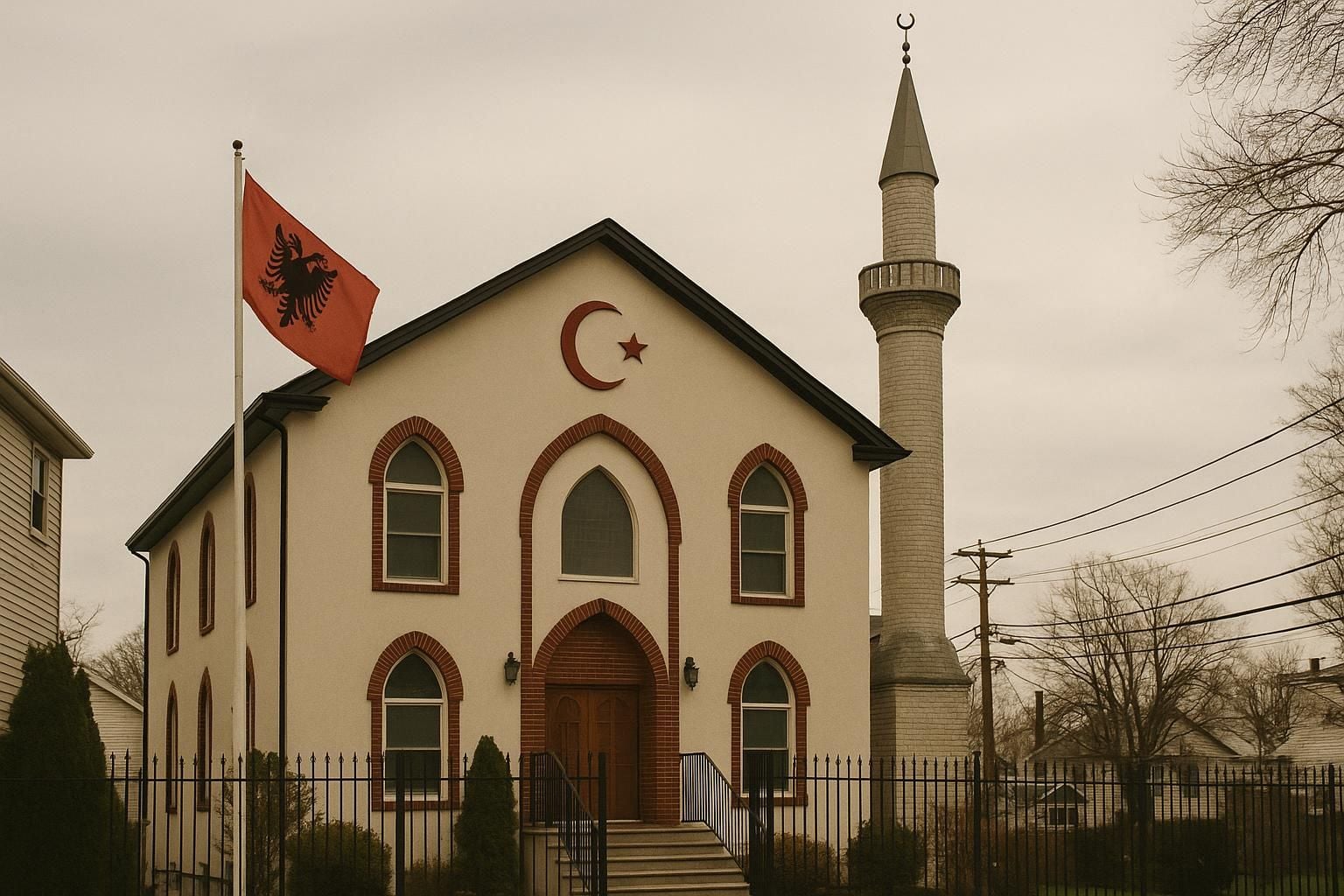
The anchor institution for the Albanian Muslim community on Staten Island is the Albanian Islamic Cultural Center at 307 Victory Boulevard, in the Tompkinsville area on the borough’s North Shore (NYC Tourism). NYC Tourism describes it as Staten Island’s first Islamic community center and home to one of the largest mosques in North America. It is a Sunni xhamia (mosque) and community center serving Albanian-American families across the borough and, in practice, families from Brooklyn and northern New Jersey who cross the bridges for bajram (Eid), weddings, and funeral receptions. It should not be confused with the separately run Albanian American Islamic Center of NY & NJ (xhami.org). The center sits inside a wider NYC Albanian-American religious network — Bronx, Brooklyn, Queens, and Paterson — that is the densest in the country.
This piece does five things: places Staten Island in the U.S. Albanian-Muslim map, describes the center as an institution, traces how the borough’s Albanian-Muslim community actually formed, takes the question of religious pluralism seriously without flattening it, and ends with practical information for an Albanian-American household moving to the borough. For the national network of Albanian-American Islamic centers — Imam Vehbi Ismail’s 1963 Harper Woods, Michigan flagship and the thirteen-plus member centers around it — see the companion piece on the Albanian American Islamic Center.
Where Staten Island fits in the U.S. Albanian-Muslim map
Albanian-American Muslims are concentrated in three big clusters and a long tail of mid-sized communities. The Detroit metro carries the deepest institutional roots — Imam Vehbi Ismail’s Harper Woods mosque, consecrated November 3, 1963, and the Presidency of Albanian Muslim Community Centers that grew up around it. New York City and northern New Jersey hold the largest residential population. Connecticut’s old factory cities — Waterbury, Bridgeport, Hartford — anchor an older Sunni Albanian community per capita than any other New England state.
Inside the New York metro, the Sunni Albanian footprint runs across the Bronx, Queens, Brooklyn, Staten Island, and across the Hudson into Bergen, Passaic, and Essex counties. The Bronx holds the densest residential cluster in the country, anchored by Belmont, Pelham Parkway, and Morris Park (Albanian Bronx). Paterson, New Jersey, often called the second-largest Albanian city in the country by community estimate, holds the post-1999 Kosovar core. Staten Island sits between these — close to Brooklyn and New Jersey by bridge, and a long ferry-plus-train ride from the Bronx.
The U.S. Census numbers tell part of the story. The 2024 American Community Survey records roughly 230,000 Albanian Americans nationally and roughly 57,000 in New York State, by far the largest single-state count (Wikipedia: Albanian Americans). Inside New York City, the recorded county-level distribution places the Bronx first, followed by Queens and Staten Island (Richmond County), with Manhattan and Brooklyn thinner. Albanian-American organizations put the lived NYC-metro community above 100,000 once Kosovar, Macedonian, and Montenegrin Albanians and U.S.-born descendants are added in. The national community estimate runs close to one million.
Religion is not on the ACS form, so the Muslim share inside those numbers is a community estimate rather than a Census count. The Albanian-American Muslim share runs higher than the share in Albania itself — partly because the Gheg-speaking communities of Kosovo, North Macedonia, and Montenegro that sent so many families to New York are overwhelmingly Sunni, and partly because Detroit’s heavily Muslim Albanian community contributes to the national baseline. On Staten Island, the Sunni Albanian community is large enough to sustain its own xhamia (mosque) and small enough that most families know one another by name.
The Albanian Islamic Cultural Center: what it is
The Albanian Islamic Cultural Center is the institutional anchor for Sunni Albanian-American religious life on Staten Island. It sits at 307 Victory Boulevard in Tompkinsville, on the borough’s North Shore, and was originally established in 1973 (as the Islamic Mesjid of Staten Island); the center’s own materials elsewhere cite 1990, and the public record doesn’t fully resolve the discrepancy. NYC Tourism lists it among the largest mosques in North America, and it houses the private Miraj Islamic School alongside the mosque. The institution combines a prayer space, a community hall, religious-education classrooms, and the standard infrastructure for an Albanian-American congregation in 2026: a kitchen sized for bajram (Eid) banquets, audio equipment for the Friday khutbah (sermon), and parking and overflow space for the largest gatherings of the year.
Function-wise, the center looks like most Albanian-American Sunni mosques in the country. The weekly anchor is Friday xhumaja (congregational prayer), with the khutbah historically delivered in Albanian and increasingly bilingual with English translation as second- and third-generation families take their place in the congregation. The two largest gatherings of the year are Eid al-Fitr (the end of Ramadan, called Fitër Bajram in Albanian) and Eid al-Adha (the festival of sacrifice, Kurban Bajram) — both draw families who don’t attend weekly prayer but turn out for the morning bajram namaz and the community hall afterward.
Beyond the religious calendar, the center serves the everyday institutional needs of an Albanian-American Muslim community. Weddings and engagement parties book the hall for valle (Albanian line dances), live çiftelia music, and the multi-course meals that anchor Albanian celebration. Funeral receptions and the dyzet (forty-day memorial) gatherings happen here. So do Ramadan iftarë (the breaking of the fast), youth programs, and the occasional civic event shared with Catholic and Orthodox Albanian-American institutions.
The center operates inside the wider pattern of Albanian-American religious institutions on the East Coast — some affiliate with the Presidency of Albanian Muslim Community Centers (the umbrella body headquartered historically in Harper Woods, Michigan), and others are independently governed by their local board. Leadership and umbrella ties change over time, so a reader planning to attend should confirm current prayer times with the center directly.
How the Staten Island Albanian-Muslim community formed
Staten Island had only a handful of Albanian households before the 1970s. The borough’s Albanian community took shape later than the Bronx core and through a different mechanism. It is largely a secondary settlement — families who first arrived in the Bronx or Queens and later moved south for housing, schools, and a different kind of neighborhood.
The founding wave came from Yugoslav-controlled Kosovo, North Macedonia, and Montenegro, starting in the late 1960s and accelerating through the 1970s and 1980s. Families left under sustained political and economic pressure, most spoke Gheg (the northern Albanian dialect), and most were Sunni Muslim or Catholic. They arrived through New York and settled first in the Bronx — Belmont, Pelham Parkway, Morris Park — where Italian-American landlords were renting to newcomers and where work in construction, restaurants, and building maintenance was within reach.
By the late 1980s and into the 1990s, a sizable share of those families were looking for what the Bronx couldn’t easily provide: single-family houses, off-street parking, smaller schools, and the lower density of a suburban borough. Staten Island had all of it. Neighborhoods opened up to Albanian families one block at a time, often through extended-family networks — Dongan Hills, New Dorp, Grant City, South Beach, Grasmere, Concord, and Rosebank on the East and South Shores, and Tompkinsville and the North Shore around the Victory Boulevard mosque. A cousin bought a house in Dongan Hills, two more bought on the same street, and a small commercial footprint of Albanian-owned construction firms, auto shops, restaurants, and bakeries followed within a decade.
A second flow came after 1991, when post-communist Albania opened its borders. New York pulled a large share of that movement, and Staten Island absorbed some of it directly, especially families with relatives already established on the East Shore. A third surge followed the 1999 Kosovo war, when refugee resettlement programs placed Kosovar families with relatives in the metro. By the mid-2000s, the borough’s Albanian-American community was layered by region and generation — Kosovar, Macedonian, Montenegrin, and Albanian-from-Albania families, often inside the same block, sometimes inside the same extended family.
The Albanian Islamic Cultural Center itself predates most of this residential growth — it traces to 1973 — and it became the borough’s anchor for Sunni Albanian-American religious life as the community around it expanded through the 1990s and 2000s. An Albanian Sunni community of any size needs a xhamia large enough for Friday prayer and a hall large enough for bajram, and the Victory Boulevard center has long provided both.
Pluralism in practice on Staten Island
Albanian-American religious life is plural by tradition. Albania itself has been routinely described as one of the most religiously plural countries in Europe — Sunni Muslim majority, with significant Catholic and Orthodox minorities and the historically Albanian Bektashi Sufi order — and that pluralism travels with the diaspora. Staten Island’s Albanian community sits inside that pattern.
Most Albanian-American Muslims, on Staten Island and nationally, are Sunni, predominantly Hanafi by historical inheritance from Ottoman-era Albanian religious life. The Sunni majority is the population the Albanian Islamic Cultural Center serves. Xhumaja (Friday prayer), bajram prayer, the weekly cycle of community gatherings, and the religious-education calendar all key off Sunni practice.
A smaller Bektashi presence exists across the wider NYC metro. The Bektashi tradition is a Sufi order with deep Albanian roots and its own clerical hierarchy — the baba, the dervish, the kryegjysh (head father). Bektashi Albanian-Americans gather in a teqe (lodge) rather than a xhamia, and the order has its own institutional network, anchored historically in the United States by the First Albanian Bektashi Tekke in America, founded in Taylor, Michigan in 1954. Staten Island doesn’t carry a Bektashi teqe of its own; Bektashi families on the borough typically travel off-borough for ritual life and observe community moments at home.
Catholic Albanian-American families on Staten Island most often participate in the borough’s existing Catholic parishes alongside the broader Catholic immigrant community, with Albanian-language Mass occasionally available at metro-level Albanian Catholic parishes. Orthodox Albanian-American families are a small share on Staten Island; the historical Albanian Orthodox community is anchored in Massachusetts and Connecticut and is covered in detail at Albanian Orthodox Church in America. Many extended Staten Island Albanian families include more than one of these traditions at the same dinner table — a Catholic mother, a Sunni father, an Orthodox cousin, a secular grandchild. The shared identity is shqiptar (the Albanian self-name); the religious institution is a venue, not a boundary.
We don’t take a side on inter-tradition theology, and we don’t flatten the differences either. Each tradition has its own clergy, its own calendar, and its own institutional life. They cooperate at the community level — joint Flag Day banquets, scholarship galas, the New York Albanian Parade, weddings that pull family from every tradition — and they remain organizationally distinct. That is what Albanian-American religious pluralism looks like in practice, on Staten Island and elsewhere.
Cultural life beyond Friday prayers
Walk into the Albanian Islamic Cultural Center on a non-Friday evening and the first thing you notice is that it isn’t a single-purpose religious building. Folding tables. A coffee urn. A children’s book corner. A whiteboard with class times. This is the pattern across Albanian-American Islamic centers nationally, and it is especially pronounced on Staten Island, where the center carries a heavier community-hall load than centers in denser Bronx blocks that share the function with other Albanian-American institutions.
Weddings and family celebrations. Albanian weddings are multi-day, multi-hundred-guest affairs. The xhamia’s social hall is one of the largest Albanian-coded spaces in the borough for most families, and it absorbs a meaningful share of the borough’s Albanian-American wedding calendar. Valle dancing, çiftelia and defi music, the multi-course meal centered on roasted lamb and byrek (filo pastry) — that’s what the hall hosts on most weekends outside Ramadan.
Funerals and the forty-day memorial. Albanian-American funeral practice typically includes a xhenaze (funeral prayer) at the xhamia, burial, and a dyzet (forty-day memorial) gathering that pulls extended family. The community hall holds the post-funeral meal and the dyzet. For first- and 1.5-generation families especially, the center is the institutional fixed point for the most consequential moments of family life.
Ramadan and the two Eids. Ramadan is the deepest month of the year for the congregation. Daily iftarë (sunset fast-breaking) draw families to the hall, and the nightly teravi prayer fills the prayer space. Eid al-Fitr (Fitër Bajram), at the end of Ramadan, is the largest gathering of the year — the morning bajram namaz draws families who don’t attend weekly prayer, followed by the community-hall meal and the round of family visits across the borough. Eid al-Adha (Kurban Bajram) anchors the year’s other major gathering and, in Albanian-American households, the kurban (sacrifice) tradition that connects diaspora practice to the village calendar back in Kosovo, Macedonia, or Albania.
Albanian-language and religious education. Most Albanian-American Islamic centers run a weekend program for children covering Albanian-language literacy alongside religious literacy, history, and music. For second- and third-generation kids whose parents worry the language won’t survive another generation, the weekend program is where the gjuha shqipe (the Albanian language) gets transmitted outside the home.
Civic and cross-tradition events. Flag Day on November 28 (Albania’s 1912 declaration of independence) and the parallel observance for Kosovo’s 2008 independence are community-wide. Albanian-American Catholic, Orthodox, Sunni, and Bektashi families gather at banquets, scholarship dinners, and the New York Albanian Parade. The Albanian Islamic Cultural Center is one of several institutional venues on Staten Island for that joint civic life.
The center’s role in NYC’s larger Albanian network
Staten Island doesn’t function as a self-contained Albanian community. Families move daily across the bridges and the harbor for work, school, religious life, and family. The Albanian Islamic Cultural Center sits inside that wider geography.
To the Bronx. Many Staten Island Albanian families came from the Bronx originally, and the family network across the city’s Albanian core is dense. Wedding guest lists, bajram visits, scholarship galas, and weekly family gatherings routinely cross between Pelham Parkway and Dongan Hills. The institutional center of gravity for Albanian-American Catholic religious life in the metro — Our Lady of Shkodra, the largest Albanian Catholic parish in the United States, tracing back to a Bronx congregation founded in 1969 — has been based in Hartsdale, NY (Westchester County) since the late 1990s and still pulls Staten Island families for the most consequential Catholic-side moments.
To Brooklyn. The Verrazzano-Narrows Bridge connects Staten Island to Bay Ridge and the Brooklyn neighborhoods that hold their own Albanian-American population. The community has historical and contemporary ties across that bridge, and a Bektashi presence has at points operated in the Brooklyn/wider NYC area, drawing Bektashi Albanian-Americans from Staten Island for ritual life.
To New Jersey. The Goethals Bridge connects the borough to Elizabeth and the wider Bergen-Passaic Albanian core, with Paterson — the densest Albanian-American city in New Jersey — about an hour’s drive away. Staten Island families regularly cross the bridge for weddings, bajram, and family. The Albanian Islamic Cultural Center of New Jersey, serving the Paterson Albanian community, is part of the same wider network that the Staten Island center sits inside.
To Queens and the Bronx for parade and civic life. The New York Albanian Parade routes through Manhattan with participation from every borough, and the institutional planning for it sits inside a network of Albanian-American organizations across the metro. Staten Island contributes — banners, marching contingents, families turning out — even when the parade itself runs miles from the East Shore.
What this means in practice is that the Staten Island Albanian-Muslim community is part of one continuous NYC-metro Albanian network, not a separate community. The borough’s distinctive contribution is suburban-scale family life, single-family housing, a slightly slower pace, and a particular kind of Albanian-American childhood that combines East Shore schools with weekend Albanian-language classes at the xhamia.
Visiting and getting involved
For an Albanian-American household moving to Staten Island, or for an Albanian-American visitor planning a stop at the Albanian Islamic Cultural Center, a few practical notes.
Address and times. The Albanian Islamic Cultural Center is at 307 Victory Boulevard, Staten Island, NY 10301 (aiccny.com). Friday xhumaja and bajram times shift with the season and the Islamic calendar, so confirm the current schedule with the center directly — a phone call, the website, or a community member already attending.
Friday xhumaja. Open to Muslim worshippers; visitors who want to observe should contact the center first. The khutbah is typically delivered in Albanian, with English translation increasingly common.
The two bajram prayers. Eid al-Fitr and Eid al-Adha are the largest gatherings of the year. The morning bajram namaz runs early, the community hall opens afterward, and parking is the most consistent challenge on those mornings. Families turn out who don’t attend weekly prayer, so the building is fuller than at any other point in the year.
Community events. Most weddings, funerals, iftarë, and Flag Day events at the center are open to wider community participation. For a new Staten Island arrival without a connection inside the congregation, the most common path in is through an existing family — a cousin, a coworker, a neighbor who already attends.
For new arrivals. Albanian Islamic centers function partly as immigrant-integration support. Housing referrals, employment leads, English-class connections, translation help — these run through the social network of the xhamia in a way that doesn’t show up on the website. New arrivals from Kosovo, Macedonia, Montenegro, or Albania usually find the community network fastest through bajram, Friday prayer, or a wedding rather than a cold phone call.
Dress and visitors. Modest dress is expected throughout the building; headscarves are customary for women in the prayer space, and the community hall is more relaxed. Non-Muslim Albanian-American visitors — Catholic, Orthodox, secular, or mixed-heritage — are part of the same community and are made comfortable at community events without being made to feel out of place.
What the count looks like on Staten Island
The recorded ACS figure for Albanian-Americans in Richmond County (Staten Island) lands in the single-digit thousands. The lived community is larger. The reasons are the same structural ones that affect every borough: the ACS ancestry question is an open write-in with no Albanian checkbox, Albanians from Kosovo, North Macedonia, and Montenegro are often coded by country of birth, the form caps answers at two ancestries per person, and generational drift toward “American” passes straight through.
The Albanian-American Muslim share inside that population isn’t separately published — religion isn’t on the form. What we can say is that the Albanian Islamic Cultural Center sustains a Sunni congregation large enough to fill its hall for bajram, host weddings on most weekends, and run a weekend-language program. Those are institutional signals of a community well above the bare recorded count.
This is the kind of borough where a community-led count matters most. A federal form designed for two-line write-in ancestries is the wrong instrument for an East Shore community of Kosovar, Macedonian, Montenegrin, and Albanian-from-Albania families who arrived in waves. The recorded number is a floor.
The US Census records about 230,000 Albanian Americans. The real number is closer to a million, because the count misses most of us for reasons we’ve documented at length: mixed country-of-birth answers, skipped ancestry write-ins, and whole branches of a family the form never reaches.
Staten Island Albanians — Sunni, Bektashi, Catholic, Orthodox, and secular — are part of the count the National Albanian Registry is building. Religion is not on the NAR form. Getting counted takes about three minutes, costs nothing, and the data stays private. Get counted at /register — the cleanest way to make the borough’s real Albanian community show up in the record.
For the national network of Albanian-American Islamic centers — Imam Vehbi Ismail’s Harper Woods, Michigan flagship and the thirteen-plus member mosques across the country — see the companion piece on the Albanian American Islamic Center. For the wider NYC picture, see the Albanian Bronx. For an honest look at how the recorded count compares to the lived community, see the Albanian Americans overview.