

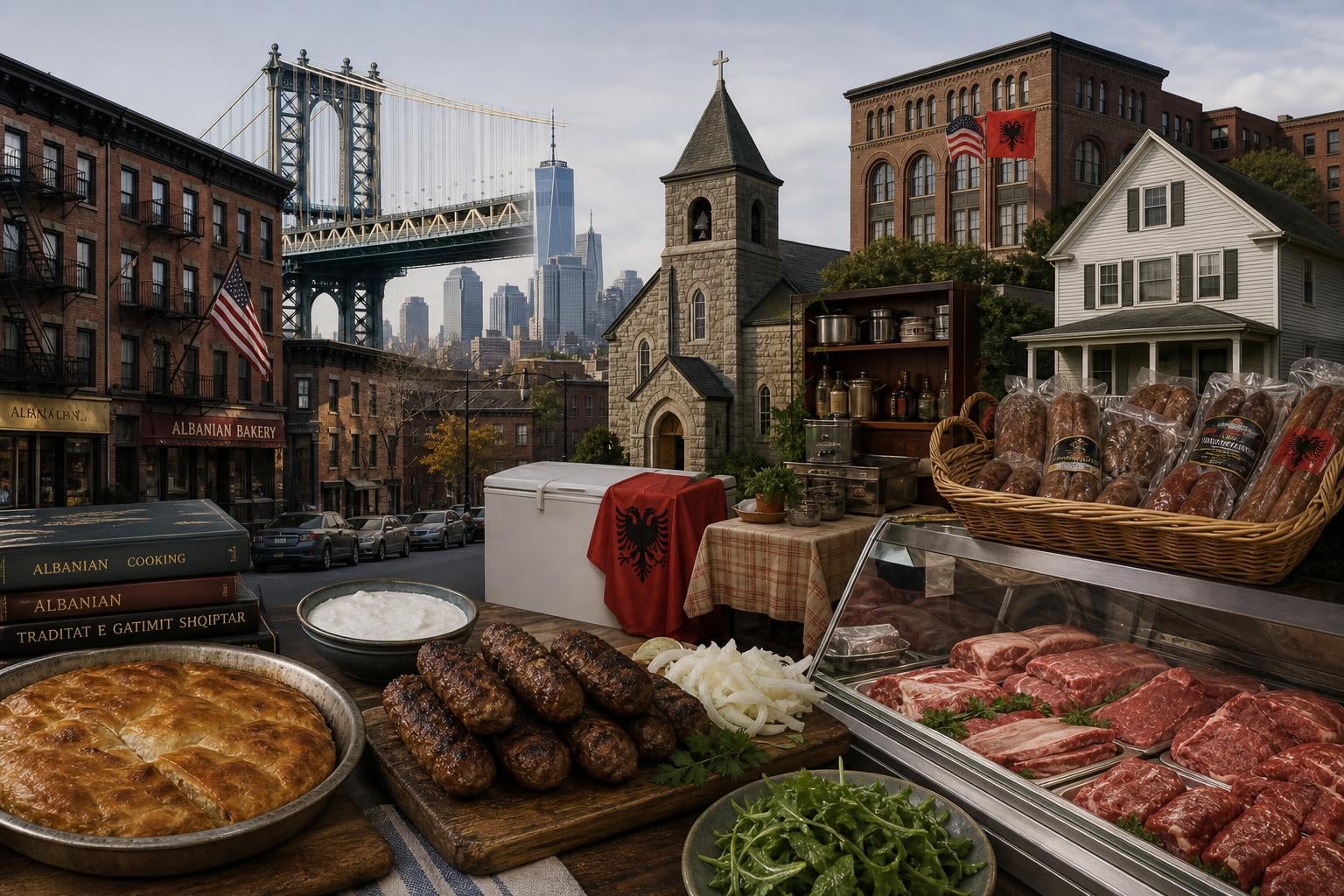
Albanian restaurants in the United States exist in concentrated form in only a handful of metros — New York, Detroit, Boston, Worcester, Waterbury, Paterson, and a short list of others. Outside those clusters, a search for “Albanian food near me” often returns nothing, and the reader concludes there is no Albanian food within reach. That conclusion is almost always wrong.
Albanian food is in many more US neighborhoods than the restaurant map suggests. It is on the back counter of Albanian-owned pizzerias in New Jersey, in the parish kitchen of an Orthodox church in Worcester, in the freezer case of a Balkan grocery in Sterling Heights, and at the holiday tables of families in Texas, Florida, and Colorado. The challenge is not the food’s absence. It is knowing where to look and what to ask for.
This is a working guide for the diaspora reader who is not in the Bronx. It maps the dense regions, names the kinds of places that carry Albanian food without putting “Albanian” on the sign, and walks through the staples a home cook can assemble in any metro with a Balkan, Mediterranean, or Middle Eastern grocer nearby. The other NYC-specific guide on this site covers the Bronx in depth; here, NYC is one region among many.
Where Albanian food is densest in the United States
The US Census Bureau’s American Community Survey counts about 230,000 Albanian Americans (2024 ACS); community estimates that account for ethnic Albanians with weaker self-identification put the number closer to 1,000,000. Either way, the population is not evenly distributed. Three states hold the majority: New York (about 56,000 by ACS count), Michigan (about 27,000), and Massachusetts (about 21,000). New Jersey, Connecticut, Illinois, Pennsylvania, Florida, and Texas round out the second tier.
The food map tracks that population map almost exactly. The most reliable places to find Albanian sit-down restaurants in 2026:
- New York City metro: the Bronx’s Belmont and Pelham Parkway neighborhoods, with smaller pockets in Yonkers, Westchester County, Astoria, and Staten Island.
- Detroit metro: Sterling Heights, Warren, and Macomb County, plus an older corridor on the east side of Detroit itself.
- Boston–Worcester corridor: the South End and Cambridge in Boston, plus the Worcester area, home to St. Mary’s Assumption, one of the 11 parishes of the Albanian Orthodox Archdiocese in America (the Archdiocese itself is headquartered in South Boston).
- Waterbury, Connecticut: a small but old community with a parish-anchored core and a handful of Albanian-owned grills.
- Paterson, New Jersey: the historic Albanian commercial street around Crooks Avenue and Getty Avenue, plus newer rooms in Bergen and Passaic counties.
- Chicago metro: Lincoln Square, Albany Park, and the northern suburbs.
- South Florida: Broward, Palm Beach, and parts of central Florida, with a growing diaspora business community.
Outside these metros, dedicated Albanian restaurants are rare. The food still travels — through pizzerias, parish kitchens, home catering networks, and online ordering. The rest of this guide is about how to find it.
How to spot Albanian food when it isn’t labeled “Albanian”
Most Albanian-owned food businesses in the United States do not market themselves as Albanian. They market as Italian, Mediterranean, Greek, pizzeria, or diner — because that is what the neighborhood orders, and because the owner learned the kitchen of the previous wave’s cuisine before opening their own room. Reading the signs takes practice.
A few reliable tells. The owner’s surname on the awning or business license: Lekaj, Gjoni, Berisha, Krasniqi, Marku, Prendi, Hoxha, Bajrami, Kola, Dervishi, Pllumaj, and similar northern Albanian and Kosovar family names point to an Albanian kitchen even when the menu says “trattoria.” A flag on the wall — red with a black double-headed eagle — almost always confirms the country of origin. An espresso machine that turns out a small, very strong coffee on request, in a glass rather than a paper cup, signals a kitchen used to Albanian customers.
The menu has tells too. A pizzeria that lists byrek (filo pastry layered with cheese, spinach, or meat) alongside calzone is Albanian-run almost by definition. A Mediterranean grill that offers qofte (Albanian meatballs, usually grilled and seasoned with onion and oregano) and sufllaqe (a grilled-meat wrap closer to a Greek gyro than a Turkish döner) under their Albanian names is showing its hand. Tave kosi (lamb or chicken baked under a yogurt-and-egg custard) on a sit-down menu is the strongest signal of all — almost no non-Albanian Balkan cuisine uses kos (yogurt) as a baking medium for meat.
Outside the named-Albanian restaurants, the rule is simple: ask. Albanian owners are usually happy to talk about food. A polite “are you Albanian?” — or shqiptar? in the language — opens a door that the printed menu rarely does. The byrek for staff lunch, the qofte the cook keeps on the back of the line, the pot of fasule (slow-cooked white bean stew with smoked meat) in the walk-in: these become available to customers who show they care, and almost never to customers who do not ask.
Markets and bakeries that stock Albanian staples
A home kitchen can produce a credible Albanian meal in any US metro with access to a Balkan, Mediterranean, Greek, Turkish, or Middle Eastern grocery store. The Ottoman-era pantry overlaps so completely with the Albanian one that the substitutions are almost invisible.
The staples worth sourcing first:
- Kashkaval — semi-hard yellow sheep- or cow-milk cheese, used for grating, slicing, and frying. Bulgarian and Macedonian brands are the easiest to find in the US; the Albanian version (sometimes labeled kaçkavall) appears in Balkan-specific stores.
- Feta — for byrek fillings and salads. Greek-style is universal and works fine; Albanian feta (djathë i bardhë) is preferred when available.
- Kos — strained yogurt, used as a side, a sauce base, and a baking medium. Greek yogurt is the closest US-supermarket equivalent; Balkan stores carry brands closer to the home consistency.
- Ajvar — roasted red pepper relish, sometimes with eggplant, served with bread and grilled meat. Bulgarian, Serbian, and Macedonian jars are the most common; mild and hot versions are both worth keeping on hand.
- Raki — clear fruit brandy, usually grape-based. Sold in liquor stores in metros with Balkan populations; the Albanian, Greek tsipouro, Turkish rakı, and Italian grappa families are close cousins.
- Filo dough — for byrek, lakror (the Tosk-region thin-pan pie), and baklava. The frozen Greek brands at most US supermarkets work; specialty stores carry hand-stretched dough that produces a more authentic texture.
- Suxhuk — spiced cured sausage, usually beef or veal. Common in Balkan and Turkish stores; useful for fasule, eggs, and grilling.
- Lamb and veal cuts — for qofte, tave kosi, and roasts. Halal butcher shops in metros with Muslim populations carry the cuts and grinds Albanian recipes call for, often labeled in transliterated Turkish or Arabic.
In NYC, Arthur Avenue’s Italian markets, the Greek and Balkan stores along Astoria’s 30th Avenue, and a handful of Albanian-owned bakeries in the Bronx cover almost the entire list. The Macomb County corridor in Detroit, the South End and Watertown in Boston, and the commercial streets in Paterson and Waterbury cover the same ground. Online, several US-based importers ship raki, suxhuk, kashkaval, and frozen byrek nationally — useful for readers in Atlanta, Dallas, Denver, Phoenix, and Seattle where the storefronts do not yet exist.
Parish, mosque, and community-center cookouts
The best Albanian food in many US cities is not for sale. It is cooked for community feasts, parish festivals, name-day celebrations, and weekend fundraisers — usually free or sold for a token donation, almost never advertised outside Albanian-language WhatsApp groups and Facebook pages.
The Albanian Orthodox Archdiocese in America, headquartered in South Boston, has 11 parishes spanning Massachusetts (South Boston, Natick, Worcester, Southbridge), New York (Jamaica Estates, Jamestown), Philadelphia, Trumbull in Connecticut, Farmington Hills near Detroit, and Cleveland. Most of them hold annual festivals — typically tied to a name day or a community anniversary — with grilled qofte, sufllaqe, byrek, baklava, and trilece sold by the plate. The dates and locations are usually posted on the parish website and in Dielli (gazetadielli.com), one of the country’s oldest Albanian-American newspapers, founded by Fan Noli in 1909 and adopted as Vatra’s official press organ after the Boston-based federation’s founding in 1912.
Albanian Catholic parishes — concentrated in the Bronx, Hartsdale (New York), Detroit, and Worcester — run benefit dinners around Christmas, Easter, and patron-saint days. Our Lady of Shkodra in Hartsdale, NY, the first Albanian Catholic parish established in the United States, is a reliable host. Most Sunni Muslim and Bektashi communities hold open iftar meals during Ramadan and bajram (holiday) gatherings after the fast — open to neighbors of any faith. The Bektashi World Headquarters in Taylor, Michigan — the First Albanian Bektashi Tekke in America, founded in 1954 by Baba Rexheb — is a large, active tekke and pilgrimage site.
Community organizations carry the rest. Vatra (the Pan-Albanian Federation of America), founded in Boston in 1912, holds annual events in the Northeast. The Albanian American National Organization (AANO) hosts regional gatherings in the New York metro. The Albanian American Civic League (AACL), AAEA, and AACI USA operate in the same cities; fundraisers usually include food made by member families. Local cultural associations in Sterling Heights, Worcester, Waterbury, Paterson, and Chicago do the same.
For a reader who has never been to one of these gatherings, the practical advice is to call ahead. The parish secretary or community-center coordinator is usually happy to tell a curious diaspora visitor when the next public meal is happening. The food at these events is often closer to home cooking than what restaurants serve.
Cooking it yourself: the diaspora workaround
In metros without an Albanian restaurant within driving distance — Phoenix, San Diego, Portland, Minneapolis, Atlanta, Nashville, much of the Mountain West and Pacific Northwest — the home kitchen is the default. The starter list is short and forgiving.
Byrek is the workhorse. Filo dough, crumbled feta and ricotta-style cheese, eggs, a little oil, salt: a cheese byrek bakes in 40 minutes and feeds six. Spinach byrek adds a quick saute of spinach and onion. Meat byrek uses ground beef or lamb cooked with onion. Pumpkin byrek is the autumn version. Any of them freeze well; many diaspora families bake a tray on the weekend and eat it through the week as breakfast, lunch, and a side.
Qofte is the second pillar. Ground beef or a mix of beef and lamb, grated onion, oregano, salt, a little baking soda, mixed by hand and shaped into small ovals or patties, grilled or pan-fried. Served with raw onion, ajvar, a yogurt-cucumber side, and bread. The recipe is forgiving and scales easily for a family meal.
Tave kosi is the dish that surprises new cooks. Lamb (sometimes chicken) is browned, layered into a baking dish with rice, and covered with a custard of yogurt, eggs, flour, and butter. Forty-five minutes in a 375-degree oven produces a tangy, set casserole that travels well to potlucks and reheats cleanly. It is one of the most distinctively Albanian dishes — almost no other cuisine bakes meat under a yogurt custard at this scale.
Fasule — the slow-cooked white bean stew — needs almost nothing: dried white beans, onion, garlic, paprika, a piece of smoked meat or suxhuk, and time. It simmers for two or three hours and improves the next day. With bread and a wedge of feta, it is a full meal.
Trilece, the three-milk sponge cake, has become the diaspora dessert of record. A simple sponge soaked in a mixture of whole milk, condensed milk, and evaporated milk, topped with caramel or whipped cream. It travels well to community events and is the dessert most non-Albanian guests remember by name.
Recipes for all of these are on this site — see the Albanian dishes overview and the popular foods in Albania reference — and in the Albanian-American cookbook community on YouTube and Facebook, where home cooks share family versions in English and Albanian.
Region-by-region overview
The summaries below are working notes, not restaurant reviews. Specific named businesses are listed only where they are well-established and community-known; readers should always confirm hours and ownership before driving across town.
New York City and Westchester
The dense core is the Belmont section of the Bronx, around Arthur Avenue and 187th Street. Six or seven Albanian-owned sit-down restaurants operate within a four-block walk, with a flagship that landed on the New York Times’ 2024 Top 100 list. Pelham Parkway and Morris Park add a second cluster. Manhattan has a sister room in Murray Hill that made the same NYT list two years running. Queens has a Balkan dinner-and-lounge in Astoria. Westchester County adds Albanian-owned pizzerias and grills around Yonkers, Mount Vernon, and New Rochelle, plus the first US Albanian Catholic parish (Our Lady of Shkodra) in Hartsdale. The NYC-specific guide covers the named restaurants in detail.
Detroit and Sterling Heights
Macomb County is the center of the Michigan diaspora. Sterling Heights, Warren, and Shelby Township have the largest concentration of Albanian families outside the East Coast. A handful of Albanian and Balkan sit-down restaurants operate along Hayes Road, Mound Road, and the M-59 corridor; several Balkan grocery stores within a short drive carry the full Albanian pantry. The Albanian American Cultural Center in Sterling Heights and the Bektashi World Headquarters in Taylor anchor community events with food. For a diaspora reader anywhere in the Midwest, metro Detroit is the most reliable single source of Albanian sit-down food, groceries, and community gatherings west of New York.
Boston, Worcester, and southern New England
The Boston area carries the third-largest Albanian-American population in the country. The food scene is quieter than New York’s — Boston has a few named Albanian-Mediterranean restaurants in Cambridge, the South End, and along Route 9 west of the city — but the community infrastructure is older. Vatra, founded in Boston in 1912, is the country’s oldest Albanian-American federation. The Albanian Orthodox Archdiocese in America is headquartered in South Boston, at St. George Cathedral; Worcester is home to one of its 11 parishes, St. Mary’s Assumption. Cambridge, Brookline, Watertown, and Worcester have Greek and Mediterranean groceries that cover the home-cook pantry. Smaller New England cities — Lowell, Lawrence, Lynn, Quincy — carry Albanian-owned pizzerias and Italian-American restaurants.
Connecticut and Waterbury
Waterbury has one of the older continuous Albanian communities in the country, with roots reaching back to the early twentieth century and the city’s brass industry. The community has stayed: an active Orthodox parish, an Albanian-American Civic League chapter, several Albanian-owned restaurants and pizzerias, and a small but well-established commercial corridor. Stamford, on the Connecticut side of the New York metro, has a sister to one of the Bronx flagships at 15 Clark Street. New Haven, Bridgeport, and Hartford have smaller communities with Albanian-owned pizzerias and one or two grills each.
New Jersey and Paterson
Paterson is one of the oldest Albanian-American food hubs outside Boston. The commercial street running south from Crooks Avenue, the Albanian Islamic Cultural Center of New Jersey nearby in Garfield, and a corridor of Albanian-owned bakeries, butchers, and groceries have anchored the community since the mid-twentieth century. Bergen County and Passaic County have a wider scatter of Albanian-owned pizzerias and diners — the Albanian-owned pizzeria is, by community count, the single most common Albanian-American small business in the New York–New Jersey metro. Wayne, Garfield, Wallington, Lodi, and Hackensack all have multiple examples.
Chicago and the Midwest
Chicago’s Albanian community is smaller than the Detroit one but well-established. Lincoln Square and Albany Park on the North Side, plus suburbs in Cook and Lake counties, hold the bulk of the population. A handful of Albanian and Balkan sit-down restaurants operate in the metro; a Macedonian and Bulgarian grocery network covers most of the home pantry. The Albanian American Islamic Center and an Albanian Orthodox parish anchor community events. Beyond Chicago, the Midwest has scattered Albanian-American pockets in Cincinnati, Indianapolis, Milwaukee, and Minneapolis, each with a few owned-and-run pizzerias and the occasional sit-down room.
Florida and the Southeast
Florida’s Albanian-American community is younger than the Northeast’s and growing fast, driven by second- and third-generation families relocating from New York, Michigan, and Massachusetts, plus newer arrivals from Albania and Kosovo. South Florida (Broward, Palm Beach) has the largest concentration; central Florida around Orlando and Tampa has a second cluster. A small number of Albanian-owned restaurants and Mediterranean grills operate in both areas; community catering networks fill the gap. Atlanta, Charlotte, Raleigh, and Nashville each have small Albanian populations with Albanian-owned pizzerias and the occasional sit-down restaurant.
Texas, the South, and the West
Texas, the Mountain West, and the West Coast carry the smallest Albanian-American populations. Dallas–Fort Worth, Houston, Austin, Los Angeles, San Francisco, San Diego, Seattle, Denver, Phoenix, and Las Vegas each have small communities with active Facebook groups but few named storefronts. Albanian-owned pizzerias and Mediterranean grills exist, usually not labeled as such. The home-cook plus online-shipping model is the standard. Several US-based importers ship raki, suxhuk, kashkaval, and frozen byrek to these metros routinely.
Dishes to ask for at any Albanian table
A short menu of the things to order, in any Albanian restaurant or community kitchen, glossed for a diaspora reader who may have grown up hearing the names but not eating them weekly:
- Byrek (also byrek, burek, pite) — filo pastry layered with filling. Cheese (feta and ricotta), spinach and cheese, meat (ground beef or lamb with onion), pumpkin in autumn, and leek in spring are the most common. Baked in a round or rectangular pan and cut into squares or wedges.
- Qofte — Albanian meatballs, usually grilled, seasoned with onion, oregano, salt, and a touch of paprika. Served with raw onion, ajvar, kos, and bread.
- Tave kosi — lamb (sometimes chicken) baked under a yogurt-and-egg custard with rice. Distinctive to Albanian cuisine; rare in neighboring Balkan kitchens. Often listed as the national dish.
- Fasule (or pasul) — slow-cooked white bean stew with onion, paprika, and a piece of smoked meat or suxhuk. A winter staple.
- Sufllaqe — a grilled-meat wrap, usually pork or chicken, with onion, tomato, and a yogurt-based sauce in a flatbread. Closer to a Greek gyro than a Turkish döner.
- Sarma — cabbage or grape leaves wrapped around ground meat, rice, and herbs, simmered slowly. A holiday dish in most Albanian households.
- Tave dheu — clay-pot stew of liver and organ meats with peppers and onions. A rustic dish, common in the Bronx restaurants and rare elsewhere.
- Lakror — the Tosk-region thin-pan pie, similar to byrek but baked in a shallower pan with a finer crumb.
- Flija — layered pancake-like crepe pie traditionally cooked under embers. Almost extinct as a restaurant dish because of the labor; appears at community events when a family is willing to make it.
- Suxhuk — spiced cured sausage, usually beef or veal. Grilled, fried with eggs, or sliced into fasule.
- Trilece — three-milk sponge cake. The most-ordered Albanian dessert in the United States.
- Baklava — phyllo-and-nut pastry, sweetened with syrup. Albanian baklava tends to be slightly less sweet than the Turkish or Lebanese versions.
- Kos — yogurt. Served as a side, a sauce base, a drink (sometimes thinned with water and salt as dhallë), and a baking medium.
- Raki — clear fruit brandy. Usually grape-based, sometimes plum or mulberry. The opener and closer to most meals.
- Kafe turke — small, strong, unfiltered coffee. The standard pour at the end of a meal and the start of a long conversation.
Most of these have dedicated pages on this site — see the Albanian dishes overview, the Albanian pastries reference, and the Albanian coffee tradition page for deeper recipes and regional notes.
A note on inclusivity
Albanian food in the United States is the food of Albanians from Albania, Kosovo, western North Macedonia, Montenegro, the Çamëria region, and the Italian Arbëresh villages whose ancestors crossed the Adriatic in the fifteenth century. The pantry, the techniques, and the holiday dishes overlap heavily across all these communities; the regional variations — Gheg in the north, Tosk in the south, heavier Italian and Greek influences in some kitchens, a stronger Ottoman base in others — are real but rarely visible from outside the family.
The same applies across faiths. Albanian Catholic, Orthodox, Sunni Muslim, Bektashi, and secular households share the same core dishes, with slight variations in meat choice and a calendar of fasting and feast days that shapes the table. A reader should not assume one community’s restaurant or parish does not welcome them. They almost always do.
Helping build the map
The National Albanian Registry is a 501(c)(3) nonprofit producing a community-led count of Albanian Americans. The count NAR is building — spanning the families behind the restaurants, markets, parishes, community centers, and regional ambassadors — depends on the people it counts to fill in the map. Adding yourself at /register takes a minute, costs nothing, and helps make the community’s full size visible in one place. It is free and the data stays yours.
If your metro is missing from this guide because there is no Albanian restaurant within driving distance — that is exactly the kind of gap the registry is built to surface. The count is the count, and the food map gets sharper as the count grows.