An Albanian-American cultural center is one of the few institutions that knows exactly who is in the room and who is missing. The parish secretary keeps the list of families. The Saturday-school teacher knows which kids stopped coming. The treasurer knows which businesses sponsored last year’s Flag Day banquet. None of this is on any government form.
That ground-level knowledge is the diaspora’s only complete record of itself. The 2024 American Community Survey counts roughly 230,000 Albanian Americans (ACS B04006). Community organizations — Vatra, AANO, the Albanian American Civic League, the regional chambers, the parish rolls — put the real number closer to one million when ethnic Albanians from Kosovo, North Macedonia, and Montenegro and second- and third-generation Americans are counted. The cultural centers are where that fuller count lives in practice.
This piece maps the network: what these centers are, where they cluster, what they do on a Tuesday and on a Saturday, how religious institutions function as cultural centers, and how the National Albanian Registry’s count fits alongside the institution-building work the centers have been doing for more than a century.
We have written it from the diaspora’s side. The reader is in the United States. The questions are: where is mine, what should I expect when I walk in, and what does any of this have to do with me, my family, or my community.
What an Albanian-American cultural center is
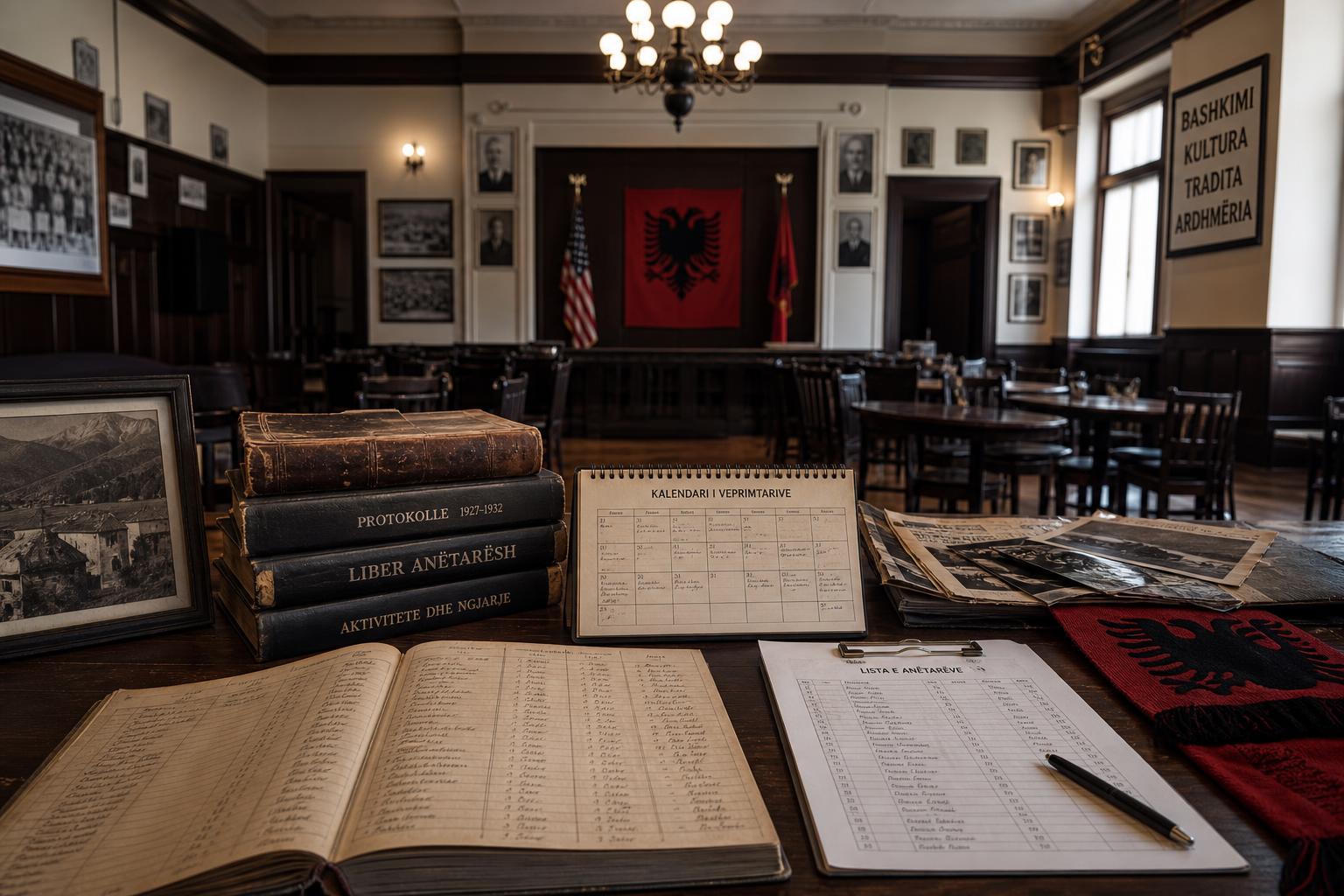
Strip the labels and a cultural center is three things: a hall, a calendar, and a roster.
The hall is the room where the community meets — sometimes purpose-built, more often a parish basement, a leased event space, or a converted storefront. The calendar is the recurring set of programs that fill the hall: Saturday Albanian-language school, valle (the circle dance) rehearsals, Flag Day on November 28, Independence Day banquets for Albania and Kosovo, Eid (Bajram) and Easter (Pashkë) gatherings, scholarship galas, weddings, baptisms, funerals and forty-day memorials. The roster is the families who pay annual dues, the volunteers who show up on Saturdays, and the businesses that sponsor the banquets.
Some centers are religion-agnostic civic federations — Vatra, AANO, the Albanian American Civic League. Others are religious institutions that do cultural work alongside worship — Albanian Catholic parishes, Orthodox cathedrals, Sunni xhamis (mosques), and Bektashi teqes (Sufi lodges). A few are chambers of commerce that grew programming around their member businesses. The legal forms differ. The function — keeping the diaspora gathered and connected — is the same.
For a family, the practical question is simple: where can my kids learn Albanian, where can I take my parents for valle and kafe (Albanian coffeehouse culture), where is my wedding hall, where will my forty-day memorial be held. Most metros with a meaningful Albanian population have an answer to all four of those at one address.
For the broader community, the centers are also infrastructure. Without them, Flag Day would be a date on Wikipedia. The language would not survive past the second generation. The Bronx Albanian Catholic parish would not have negotiated the Hartsdale property. The Harper Woods xhami would not have a Saturday school. Every visible piece of Albanian-American life rests on a board of unpaid volunteers in a building somebody put their name on a lease for.
The historical roots: from kafe to Vatra to today
The first Albanian-American cultural institution was the kafe. Boston, Worcester, Manchester, and the Massachusetts mill towns had Albanian-run coffeehouses by the early 1900s — small storefronts where mill workers met after shift, read the Albanian-language press, sent money home, and argued about the future of an Albania that did not yet exist as an independent state.
Two formal institutions emerged out of that informal world. Fan S. Noli founded the Albanian Orthodox Church in America in March 1908 in Boston, celebrating the first Divine Liturgy in the Albanian language on US soil. The church was the first stable address for Albanian-American religious life. Fan Noli and the Besa-Besën society founded the newspaper Dielli — the Sun — in Boston on February 15, 1909. Faik Konitza arrived in Boston later that year and took over as Dielli’s chief editor that autumn. It is the longest-running Albanian-language newspaper in the United States and is still published online at gazetadielli.com.
Then came the federation. In April 1912, Konitza, Noli, and a circle of Albanian-American leaders founded the Pan-Albanian Federation Vatra in Boston. Vatra means the hearth in Albanian — the central fire of a house, around which a family gathers. The name is the founders’ deliberate metaphor for what an Albanian-American institution should be. Within months, Dielli became Vatra’s official organ, and the federation became the umbrella civic body of organized Albanian-American life. Within a decade, Vatra had grown into a national federation with chapters concentrated in Massachusetts, New York, the Great Lakes industrial belt, and the Pennsylvania coal country.
The pattern of the next century followed Vatra’s template. New waves of immigration produced new federations. Post-war refugees and dissidents founded the Albanian American National Organization (AANO) in 1946. The 1980s Yugoslav-pressure migration of Kosovo Albanians produced the Albanian American Civic League (AACL), founded by former US Representative Joe DioGuardi in Ossining, New York, in 1989. The post-1990 wave from Albania and the 1999 Kosovo war refugees expanded existing federations and built new chambers of commerce in Detroit, the Bronx, and Chicago.
The through-line is institutional memory. Vatra is still here. So is Dielli. So is the Worcester parish that organized in 1911. The cultural centers are how the diaspora has compounded its own infrastructure for more than a hundred and twelve years.
Where the centers cluster: the state-by-state map
Cultural centers cluster where Albanian Americans cluster. The 2024 ACS gives the official rank order; community estimates run roughly 4× to 5× higher per state.
- New York (~56,000 ACS / >100,000 community). The largest concentration in the country. The Bronx — Belmont, Pelham Parkway, Morris Park — is the residential and commercial core, covered in detail in Little Albania in New York. Cultural centers in NY include Our Lady of Shkodra (Hartsdale, founded 1969), an Albanian Catholic parish serving the New York metro, the Albanian Islamic Center of New York (Bronx), the Albanian American Civic League (Ossining), and the Albanian American National Organization (NY chapter).
- Michigan (~27,000 ACS). The Detroit metro is the densest Sunni and Bektashi institutional cluster in the country. The Albanian Islamic Center in Harper Woods (founded by Imam Vehbi Ismail in 1963, see Albanian American Islamic Center) is the institutional flagship. The First Albanian Bektashi Tekke in America in Taylor, Michigan, founded by Baba Rexheb in 1954, is the first Bektashi teqe ever built in the US. The Albanian American Cultural Center and several Albanian Catholic parishes serve Macomb County’s post-1990s arrivals.
- Massachusetts (~21,000 ACS). Boston and Worcester anchor the country’s oldest Albanian-American institutional life. St. George Albanian Orthodox Cathedral (South Boston, 1908) is the seat of the Archdiocese; Vatra historically headquartered nearby. St. Mary’s Assumption Albanian Orthodox Church in Worcester (parish organized 1911, incorporated 1915) anchors the central-Massachusetts community.
- New Jersey (~15,500 ACS). Paterson and the Bergen-Passaic corridor host the Albanian Islamic Cultural Center of New Jersey (Garfield/Paterson area) and several Albanian Catholic parishes.
- Florida (~16,000 ACS). Tampa Bay’s Albanian-American community has grown sharply since the 2000s. The Albanian Islamic Cultural Center of Clearwater anchors the Gulf coast.
- Connecticut. Waterbury has the largest per-capita Albanian-American Muslim population in New England, served by the Albanian American Muslim Community of Connecticut. Hartford-area Orthodox and Catholic congregations cover the rest of the state.
- Illinois. Chicago’s metro community is concentrated in the western suburbs. The Albanian American Islamic Center (xhami.org) and several civic groups operate citywide.
- Pennsylvania. Philadelphia’s Albanian Cultural Center of Philadelphia is the long-established multipurpose hub for a community with early-twentieth-century roots.
- Texas. A newer, fast-growing community with a visible Dallas-Fort Worth and Houston footprint. Civic engagement is described in Albanian Americans in Texas.
The reason cultural centers concentrate where they do is the same reason diasporas anywhere build institutions where they build them: housing density, jobs, and the previous generation’s foothold. Centers do not arrive at the same moment as the first families. They arrive once the second wave of families decides the kids will not learn Albanian on their own.
Inside a typical center: programs, language, dance, holidays
Walk into a representative Albanian-American cultural center on a Saturday morning and three things are happening at once.
Language class. A volunteer teacher — usually a parent who finished high school in Albania or Kosovo — is leading 8 to 25 kids through reading drills in the Albanian alphabet. The program runs September through May, mirrors the school year, and almost always meets on Saturdays so it does not collide with public-school schedules or weekend liturgy. Parents who worry the language will not survive another generation send their kids here. The Saturday school is the most consequential program most centers run.
Valle rehearsal. Valle is the Albanian circle dance — different regional variants (the Tropoja step, the southern Tosk forms, the Kosovo and Macedonia patterns) carried by family memory. Teenagers practice for the Independence Day performance in the same hall the language class just left. Many centers maintain a youth dance group with custom fustanella and traditional dress for performances. The Bronx, Detroit, and Boston groups regularly travel to other Albanian-American events.
A board meeting in the back. The president, treasurer, and two volunteers are reconciling last month’s banquet receipts and signing the catering contract for the upcoming Flag Day program. None of them are paid. The board cycles every two or three years.
The annual calendar repeats with small variations across most centers:
- November 28 — Flag Day (Dita e Flamurit), commemorating the 1912 Albanian declaration of independence at Vlorë. The single largest cultural-center event of the year nearly everywhere.
- February 17 — Kosovo Independence Day since 2008, observed in centers with significant Kosovar membership.
- Pashkë (Easter) and Krishtlindja (Christmas) for Catholic and Orthodox communities, with red-egg cracking after the midnight Easter Liturgy at Orthodox parishes and kurorëzimi (the crowning ceremony) at weddings.
- Bajram — both Eid al-Fitr (end of Ramadan) and Eid al-Adha — at Sunni and Bektashi institutions, with community iftarë through Ramadan.
- Scholarship galas in spring or fall raising funds for graduating high-school seniors heading to college.
- Forty-day memorials (dyzetëditëshi) for community members who have died, hosted in the social hall.
The point of this density is recognizable to any Greek-American, Italian-American, or Armenian-American reader: the institutions exist so the children grow up assuming the calendar is normal. That assumption — that a Saturday in November includes a Flag Day banquet — is how a diaspora persists across generations.
Religious institutions as cultural centers
For many Albanian Americans the parish and the cultural center are the same address. Albanian-American religious life is plural — Catholic, Orthodox, Sunni, Bektashi, secular — and most of these institutions function as community spaces well beyond the hours of worship.
Catholic. Our Lady of Shkodra in Hartsdale, New York, founded in 1969, is one of the country’s established Albanian Catholic parishes, serving the New York metro. Smaller Albanian Catholic communities meet in Yonkers, Detroit, and Worcester. Most run an Albanian-language Saturday school and host weddings, funerals, and Flag Day events.
Orthodox. The Albanian Orthodox Archdiocese in America, part of the Orthodox Church in America since October 1971, operates roughly a dozen parishes across seven states (CA, CT, MA, MI, NY, OH, PA), organized into the Great Lakes, Massachusetts, and Mid-Atlantic deaneries. St. George Cathedral in South Boston is the seat. A smaller jurisdiction — the Albanian Orthodox Diocese of America under the Ecumenical Patriarchate — operates two parishes (Chicago and South Boston). Both function as cultural anchors as much as worship spaces.
Sunni Muslim. The Albanian American Islamic Center network includes centers across CT, PA, NY, NJ, FL, MI, IL, and Ontario. The flagship in Harper Woods, MI hosts thousands of families. Independent Albanian Sunni congregations operate in the Bronx, Boston, Chicago, and parts of CT and NJ.
Bektashi. The Bektashi order is a Sufi tradition with deep Albanian roots. The First Albanian Bektashi Tekke in America in Taylor, Michigan was founded by Baba Rexheb in 1954. Bektashi teqes operate separately from Sunni mosques with their own clerical hierarchy (baba, dervish, kryegjysh). New York and the Detroit metro have the largest Bektashi presence in the country.
The pattern that holds across all four traditions: a Bronx wedding, a Detroit Flag Day banquet, or a Boston scholarship gala routinely brings Catholic, Sunni, Orthodox, Bektashi, and secular Albanian-American family members to the same hall. The shared identity is shqiptar — Albanian — first; the religious institution is the venue, not the boundary. That pluralism is a defining feature of the cultural-center network and one of the reasons NAR’s count is religion-agnostic.
How cultural centers and the diaspora census fit together
The Albanian-American cultural center has been doing one half of the diaspora’s accounting for a hundred and twelve years: the local roster. NAR is building the other half: the national count.
The centers know who is in the room. They know which families paid dues this year. They know which kids are in Saturday school and which ones graduated to the dance group. They know which businesses sponsored the banquet. None of that information leaves the center.
The US Census knows who answered the ancestry question on the American Community Survey form. It does not know the families who skipped the question, who marked “Other”, who came from Kosovo and wrote Kosovar instead of Albanian, or who never returned the form at all. The 230,000 ACS figure is real but partial.
The gap between 230,000 (ACS) and ~1,000,000 (community estimate) is the diaspora the cultural centers can see and the Census cannot. Closing that gap is what NAR was built for. The registry is opt-in, free, takes about three minutes, and keeps the data private. It does not ask your religion, your party, or your immigration year. It asks if you exist and where.
Cultural centers gather. The registry counts. Both are infrastructure. Neither is a substitute for the other — a diaspora needs to gather and it needs to know how big it is, because the case for political weight, scholarship dollars, language-program funding, and federal recognition campaigns is stronger when the documented community count is credible. None of these follow automatically; they come from sustained organizing on top of a count. The cultural centers have done the hard institution-building work. The registry layers a national count on top.
For a center board this is practical: a center with a verified count of its city’s diaspora can argue more credibly with a city council, a school district, a foundation, or a state legislator than a center that can only say “many.” For a family, it is also practical: every family that registers makes the next center a little easier to fund.
Starting or supporting a cultural center in your state
Most cultural centers do not begin as cultural centers. They begin as a Saturday-school cooperative meeting in somebody’s basement, or as a Flag Day organizing committee that needed a bank account. The path from informal group to formal 501(c)(3) cultural center is well-trodden.
The honest version of the path:
- Find the existing community. Most metros with even 200 to 300 Albanian-American families already have something — a parish, a kafe, a chamber of commerce, a soccer club. Start by joining; the institution-building work the predecessors did is the foundation you will build on.
- Pick one program and run it for a year. Saturday Albanian school, a Flag Day banquet, a valle group, or a scholarship dinner. One program, done well, builds the volunteer base for the next program.
- Incorporate when the bank account outgrows somebody’s kitchen. State 501(c)(3) incorporation is paperwork. Vatra, AANO, the Albanian American Civic League, and several state chambers can share templates and walk new boards through the federal Form 1023 process.
- Find a permanent address. This is the hardest single step. Many centers rent for years before buying. Many never buy. Parish basements and leased event spaces are perfectly normal long-term homes.
- Get counted. Once the center exists, make sure the families behind it are counted in the National Albanian Registry so the next family that moves to your city can see the community is already there.
Supporting an existing center is faster: pay annual dues, send your kids to Saturday school, sponsor the Flag Day banquet, volunteer for the scholarship committee, and show up at funerals and forty-day memorials. Cultural centers survive on volunteer hours and recurring small contributions. There is no big donor coming.
Cultural centers help the diaspora gather; the registry helps the diaspora count itself
The Albanian-American cultural-center network is more than a century old. It has produced parishes, mosques, teqes, federations, newspapers, scholarship programs, banquet halls, and Saturday schools across at least nine states with serious institutional density. It has done this on volunteer boards and member dues, across waves of immigration that arrived under very different conditions.
NAR’s registry is meant to sit next to that work, not replace it. The centers gather. The registry counts. Both are infrastructure. Both compound. Get counted in about three minutes →.
Sources: 2024 American Community Survey (B04006 Albanian ancestry); Wikipedia — Vatra (federation); Wikipedia — Albanian Americans; Wikipedia — Albanian Orthodox Archdiocese in America; Wikipedia — Joseph DioGuardi / Albanian American Civic League; Building Islam in Detroit (University of Michigan, LSA); Orthodox Church in America (oca.org); gazetadielli.com. Where dates or congregation sizes are approximate, we have said so plainly.