

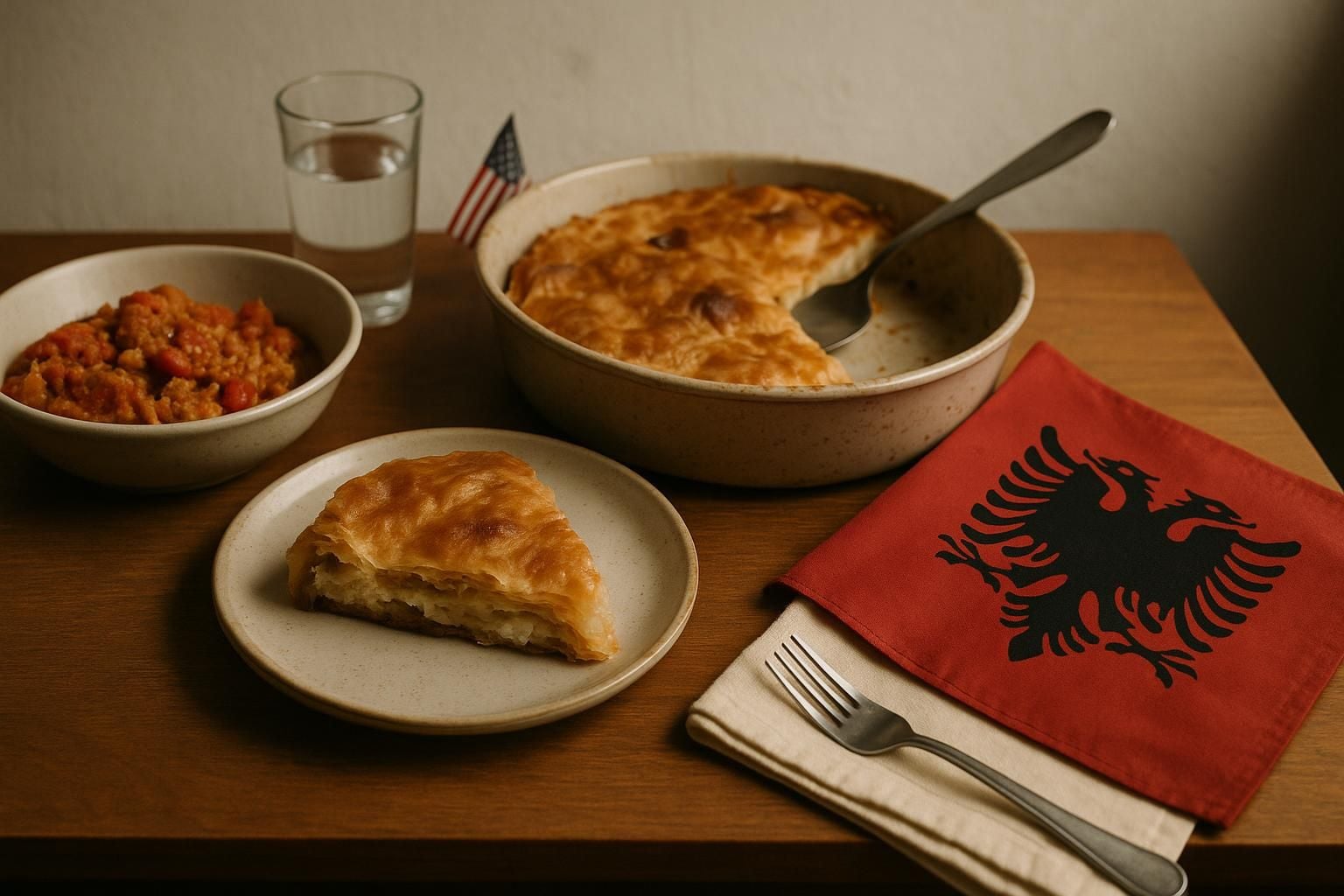
The short answer the world has converged on is tavë kosi — baked lamb and rice under a yogurt-and-egg topping, from Elbasan in central Albania. The everyday answer, the one that wins by sheer volume eaten, is byrek — the layered filo pie that every Albanian kitchen turns out by the trayful. The honest answer is that Albania has never officially designated a national dish, and the title is held informally by whichever dish you are looking at through.
This piece is for the reader who Googled the question and got a one-sentence answer that left the more interesting questions unasked. Who decides? Why tavë kosi and not byrek? Where does Elbasan fit in? What do Kosovar and Arbëresh kitchens add? And — for the US diaspora reader — what does the Albanian-American holiday table say about the answer?
We are not a recipe page; the full tavë kosi recipe lives at /blog/tave-kosi. We are not a 30-dish listicle; that is /blog/albanian-dishes. This is the answer to the meta question: which dish is the national dish, and why.
The Short Answer (and the Asterisk)
Tavë kosi is the dish most commonly named as Albania’s national dish (Wikipedia: Albanian cuisine). Cookbooks list it that way. International ranking platforms put it at or near the top. Albanian-American restaurants from the Bronx to Sterling Heights treat it as the centerpiece. If you ask a stranger in Tirana for the national dish, tavë kosi will be the first answer most of the time.
The asterisk: there is no government act, ministry decree, or UNESCO listing that makes the designation official. Albania has never legislated a national dish. The title sits where it sits because of three reinforcing things — a strong cookbook tradition coming out of Elbasan, the dish’s standing in international food media (it is consistently one of the better-rated Balkan entries in TasteAtlas’s crowdsourced dish rankings), and the consensus inside Albanian-American households that tavë kosi is the food you cook when the day is a real day.
The other contenders are not silly. Byrek is what Albanians eat most often. Fërgesë is the dish that defines Tirana. Fasule is the bean stew that fed the country through the lean 20th century. Qofte korçare is the grilled-meat answer from Korçë. Flija is the mountain-feast dish that Kosovar Albanian families call their own. Each has a case. None has the same international standing as tavë kosi, and none shows up on Easter and Eid tables across the diaspora the way tavë kosi does.
So: the short answer is tavë kosi. The honest answer adds the asterisk, names the contenders, and explains why the question has more than one defensible answer.
Tavë Kosi: Why the World Says It’s #1
Tavë kosi — “yogurt baking dish” in plain translation — is built in three layers (Wikipedia: Tavë kosi). Lamb shoulder is braised in garlic and oregano. Par-cooked rice goes over the lamb. A topping of full-fat yogurt whisked with eggs and a butter-flour roux is poured on top and baked until it puffs and browns like a soufflé. It comes to the table in its baking dish and gets cut into wedges. The dish is also called tavë Elbasani after the central Albanian city most associated with it.
Three things put tavë kosi at the top of the national-dish list. First, cookbook codification: the recipe was written down in 18th- and 19th-century Albanian kitchens during the Ottoman period and has been in print in Albanian cookbooks ever since (Wikipedia: Albanian cuisine). The version that survives is remarkably stable across regions — the lamb cut, the rice layer, the yogurt-egg-roux topping, the oregano finish.
Second, international ranking. TasteAtlas, the crowdsourced food-rating platform, consistently rates tavë kosi among the better-reviewed traditional dishes from the Balkans, even though it has not won the platform’s global “Best Traditional Dish” award — Japan’s karē (curry) took that title in 2022, and Brazil’s picanha won it in 2023 and 2024. The rankings are not academic — they aggregate user votes — but they reflect what food writers, travel media, and diaspora households have known for a long time. When the rest of the world started paying attention to Albanian food, tavë kosi is the dish that traveled.
Third, the holiday-table test. Tavë kosi is the dish Albanian-American families serve at Easter, Eid al-Fitr, Christmas, weddings, and Sunday lunches when the relatives are coming. It crosses religious lines — Catholic, Orthodox, Muslim, and Bektashi families all serve it — which makes it one of the few dishes that belongs to the entire Albanian community at once. A dish that everyone makes for the biggest day of the year has a strong claim to the title.
The food-science note is worth keeping in mind: the yogurt topping is what makes the dish technically distinct, and the technique is what lets it survive a 40-minute bake without curdling. Cousin dishes exist across the Ottoman-era Balkans, but the Albanian version — yogurt forward, lamb forward, oregano forward — is its own thing.
Byrek: Why the Everyday Answer Might Be Different
Byrek (also spelled byrek, byrek me djathë for the cheese version, byrek me spinaq for spinach, and so on) is the layered filo pie that runs through Albanian cooking from breakfast to midnight. Sheets of thin phyllo brushed with oil or butter, stacked over a filling of white cheese, spinach, leek, pumpkin, or seasoned meat, baked in a round or rectangular tin until the top shatters. Every neighborhood bakery (furrë byreku) in Tirana sells slices for roughly a dollar. Children carry it to school. Workers eat it standing at the counter. Families bake a full tray on weekends and reheat it through midweek.
The case for byrek as the national dish is volume. If a national dish is the one a country eats most often, byrek wins. Tavë kosi shows up four or five times a year in most households. Byrek shows up four or five times a week. Wikipedia notes that “pite is named by many as the national food” — pite and byrek are overlapping members of the same filo-pie family (Wikipedia: Albanian cuisine).
There is a reason byrek loses the international ranking even when it wins the everyday vote. The dish is shared across a wide regional family — börek in Turkish, burek in Bosnian and Serbian, pita in Bulgarian, spanakopita in Greek. International rankings tend to favor dishes that are unmistakably one country’s signature. The Albanian byrek tradition is distinct (the hand-rolled petë, the regional fillings, the furrë byreku model), but it shares too much DNA with its neighbors to win the “what is uniquely yours” question outright.
In the diaspora, byrek is the dish that traveled best. Albanian-owned bakeries along Belmont Avenue in the Bronx, on Van Dyke Avenue in Sterling Heights, and in Garfield, New Jersey, sell it by the slice and the tray. Home cooks adapt with supermarket phyllo when hand-rolled dough is not available. Frozen Greek phyllo from Costco works. The hand-rolled gjyshe (grandmother) version does not have a fair comparison.
For the everyday answer to “what do Albanians eat?” — it is byrek. For the formal answer to “what is the national dish?” — it is tavë kosi. Both can be true at once. The full deep-dive on byrek is at /blog/byrek.
The Regional Contenders
Several other dishes have a credible claim depending on which part of Albania (or the Albanian-speaking world) is doing the claiming. None of them displaces tavë kosi in the international answer, but each owns its region.
Fërgesë e Tiranës. The defining dish of Tirana and central Albania (Wikipedia: Albanian cuisine). Sweet peppers, tomatoes, and onions cooked down with gjizë (fresh cottage-style cheese), sometimes butter, sometimes liver or veal, finished in a clay pan. It is the dish that put central-Albanian vegetable-and-cheese cooking on the world map. Tirana residents will name it as the national dish without hesitation.
Tavë dheu. “Earth pan” — lamb or veal liver and offal cubed and slow-cooked in a clay pan with butter, oregano, peppers, and tomatoes, served sizzling. The name refers to the clay vessel (dheu means earth). It is meze food and the dish that proves Albania has a strong offal tradition that does not translate easily to English-language menus.
Fasule. The white-bean stew that fed Albania through the lean 20th century. Dried navy or great-northern beans simmered with onion, carrot, garlic, paprika, olive oil, and (in many versions) smoked sausage or lamb bones. It is the cheapest, most filling, most weekday-Albanian dish there is. In the diaspora, fasule is the dish that survived best — the ingredients are available everywhere. Some Albanian-Americans will name fasule as the national dish on the grounds that it is the dish that kept the country alive.
Qofte korçare. The long, finger-shaped grilled meatballs of Korçë, served four to six per plate with raw onion, ground sumac or paprika, yogurt, and bread. Korçë restaurants treat qofte as the city’s signature, and Korçë’s role as a culinary capital of southern Albania gives the dish a strong regional claim.
Flija. The stacked, crepe-like pastry built layer by layer under a saç (a metal lid covered with hot coals), brushed with cream and butter between layers. Flija is Kosovar Albanian in particular, served at big mountain gatherings and family camp days. Kosovo’s signature dish, more than Albania’s, but the same Albanian-speaking culinary world.
Each of these dishes wins a regional argument and would be a defensible answer at a Tirana, Korçë, Vlorë, or Pristina dinner table. None of them is the international answer, and that gap is what makes tavë kosi’s position stable.
Albania Never Officially Designated a National Dish — Here’s Why
This is the part of the answer that most articles skip. There is no Albanian government decree, no parliamentary act, no cultural-heritage ministry registration, no UNESCO listing that names a single dish as Albania’s national dish. The title is informal. It rests on cookbook consensus, international rankings, restaurant menus, and the way families talk about food.
Three reasons this hasn’t happened, and probably won’t.
First, Albania spent most of the 20th century under Communist rule (1944-1991), and the Hoxha-era state was more interested in standardizing food production than codifying culinary heritage. State cookbooks existed, but a formal “national dish” designation was not on the priority list. After 1991, the focus shifted to political and economic reconstruction. There has never been a moment when designating a national dish was the most important thing in front of the Ministry of Culture.
Second, the regional pull is strong. Naming tavë kosi as the official dish would advantage Elbasan. Naming fërgesë would advantage Tirana. Naming qofte would advantage Korçë. Naming fasule would advantage everyone and no one. The political cost of choosing is higher than the benefit of having an official answer. Italy has never officially designated pizza or pasta either, and for the same reason.
Third, the Albanian-speaking world extends beyond the borders of the Republic of Albania. Kosovo, parts of North Macedonia and Montenegro, the Arbëresh communities in southern Italy, and the diaspora in the United States, Germany, Switzerland, and the UK all share the same food culture with regional emphases. An official Albanian designation would not bind Kosovar, Macedonian-Albanian, or Arbëresh kitchens. A shared informal consensus around tavë kosi — and a shared everyday reality around byrek — does the job better than a decree would.
The absence of an official designation is not a gap. It is the answer working as designed.
What Kosovo, North Macedonia, and Arbëresh Kitchens Add
Albanian food is one cuisine with regional voices. Kosovar Albanian, Macedonian-Albanian, Montenegrin-Albanian, and Italian Arbëresh kitchens all share the central canon — tavë kosi, byrek, qofte, fasule, bakllava, raki — and each adds a regional emphasis.
Kosovo’s signature is flija, the layered crepe-stack cooked under a saç. Flija is to Kosovar Albanians what tavë kosi is to central Albanians: the dish that comes out for the biggest day. Kosovo also leans heavier on grilled meats, dairy-rich stews, and the bread-based meals that come from a colder, more mountainous food culture. Pite me presh (leek pie) is a Kosovar staple, and the qebapa and suxhuk tradition is stronger there than in southern Albania.
North Macedonian Albanian kitchens — concentrated in the western part of the country, in Tetovo, Gostivar, Kicevo, and the Polog Valley — overlap heavily with Kosovo. The same byrek and flija traditions, the same dairy backbone, the same emphasis on meat-and-onion stews. Regional dishes specific to North Macedonia include taratur me arra (yogurt-walnut soup variants) and a strong layered-pie tradition that bakes pite in particularly large rounds.
Montenegrin Albanian kitchens — concentrated in the Ulcinj region — sit between the Albanian and Adriatic-coastal traditions. More seafood, more olive oil, lighter cooking, but the same tavë kosi on Easter and bakllava at weddings.
The Arbëresh — descendants of Albanian soldiers and refugees who settled in southern Italy in waves through the 15th century, starting with Skanderbeg’s own mercenary contingents in the 1440s and 1450s and continuing with refugees who fled after his death in 1468 — kept a distinct version of Albanian food alive for 500 years inside the Italian peninsula. Arbëresh cooking has Italian influences (pasta, tomato-based sauces, more pork than mainland Albanian cooking) but retains Albanian core dishes: byrek (called petulla or bukë depending on the village), qofte, kos, and a strong tradition of layered pies. Arbëresh weddings still feature dishes that read as Albanian to a Tirana visitor, with an Italian inflection.
What all of this adds up to: tavë kosi’s position as the national dish is recognized across every Albanian-speaking community, even when the local hero dish is different. That cross-regional acceptance is part of why the informal designation holds.
The Diaspora Vote: What Albanian-American Families Serve
The most useful answer to “what is Albania’s national dish?” might be the one the US diaspora gives in practice. Albanian-American families do not vote in surveys; they vote by what comes out of the oven on the days that count.
The pattern is consistent across the major Albanian-American population centers — the Bronx (Belmont, Pelham Parkway), metro Detroit (Sterling Heights, Warren, Troy), Waterbury, northern New Jersey (Paterson, Garfield), Astoria Queens, and Boston-Worcester. Easter morning: tavë kosi. Eid al-Fitr lunch: tavë kosi, often alongside qofte and bakllava. Christmas dinner for Catholic Albanian families: tavë kosi on the main table. First dinner after a relative arrives from Albania or Kosovo: tavë kosi. Wedding banquet entrée option: tavë kosi.
Byrek is on those tables too, but in a different role — as part of the meze spread that opens the meal, or as a Sunday-morning breakfast, or as the food that gets sent home with guests. Bakllava (walnut baklava) is the dessert at every major holiday across every religious community. Raki (fruit brandy) is the pre-meal pour. But tavë kosi is the dish that gets the center of the table at the moments the family is signaling that the day is a real day.
This pattern matters because the diaspora is large enough to count as evidence. The US Census Bureau’s 2024 American Community Survey records roughly 230,000 Americans of Albanian ancestry, and community estimates including ethnic Albanians from Kosovo, North Macedonia, and Montenegro, plus 2nd- and 3rd-generation US-born descendants, run closer to one million. When that many families converge on the same dish for the same occasions, that consensus is the practical answer to the national-dish question.
If your family eats tavë kosi at Easter and byrek every Sunday, you are part of a tradition the National Albanian Registry is working to count. Get on the registry — it takes a minute and it helps us produce a modern community-led count of Albanian Americans, building on decades of community-organizing work that came before.
How to Taste the Contenders in the US
If the goal is to settle the national-dish question for yourself, the dishes are findable in the United States. Here is where each one shows up.
Tavë kosi. Albanian-American restaurants in the Bronx (Çka ka Qëllu on Arthur Avenue, Tradita in nearby blocks), metro Detroit (Troja Albanian Cuisine in Sterling Heights, several family-run places along Van Dyke), Waterbury, and northern New Jersey serve it as a centerpiece dish. Some restaurants list it daily; others run it as a weekend or holiday special. Call ahead. If a relative is making it, that version will be better than any restaurant version — tavë kosi is forgiving but rewards a careful hand.
Byrek. Easier. Albanian-owned bakeries along Belmont in the Bronx, in Sterling Heights, in Garfield, and in Astoria sell byrek by the slice and by the tray. Greek and Turkish bakeries in the same neighborhoods often carry close cousins (spanakopita, börek) that are good enough to satisfy a craving even when Albanian-specific byrek is not available.
Fërgesë. Harder, because the gjizë (cottage-style cheese) is the limiting ingredient. Where it shows up on Albanian-American menus — Çka ka Qëllu and Troja Albanian Cuisine both list it — it tends to disappear off the plate fast. Diaspora cooks often substitute ricotta or farmer’s cheese at home.
Fasule. Almost universal at Albanian-American family tables. Less common on restaurant menus because it reads as too plain to charge for. If you are at an Albanian-American restaurant and the soup of the day is bean, that is fasule.
Qofte. One of the easier Albanian dishes to find. Albanian-American steakhouses and grills across the Bronx, Westchester, and northern New Jersey put grilled qofte on their menus next to the New York strip. Pizzerias owned by Albanian families — there are thousands across metro New York — sometimes hide it on a back page.
Flija. Rare outside Kosovar-Albanian community gatherings. The dish requires a saç and four hours of attention. Albanian-American mountain retreats and family camp days in upstate New York, northern Michigan, and parts of New England are where it shows up. If you are invited to one, go.
For a fuller US ingredient map, see /blog/albanian-food-near-me.