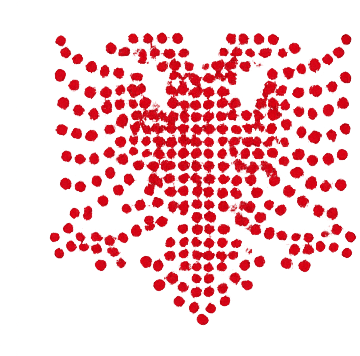

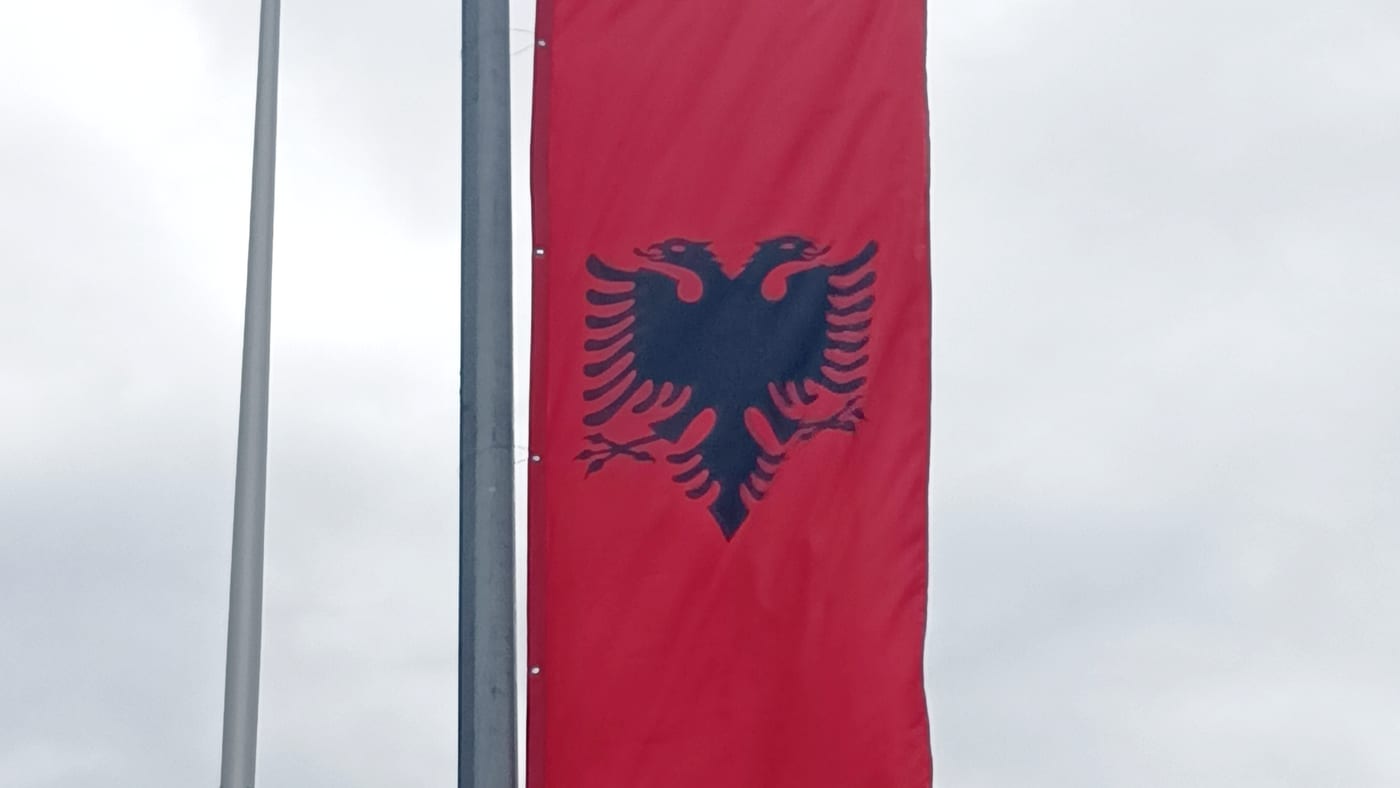
Most national flags need a paragraph to explain. The Albanian flag needs a sentence. A black double-headed eagle, centered, on a deep red field. No stars, no stripes, no lettering. The whole symbolic argument is in the bird and the color.
That economy is the point. The flag was built to carry meaning in the absence of a state, in regions where flying it openly was dangerous, and across a diaspora spread over six continents. It had to read at a distance and fit on a lapel. It does both.
This piece is a close read of what the flag means rather than where it came from. The history — the Kastrioti banner, the 1443 raising at Krujë, the 1912 declaration in Vlorë, the communist-era star — is covered in depth in the companion article. What follows is the symbolic content: what the two heads stand for, what the red field signifies, what the law actually specifies, what the flag has come to mean in moments of crisis, and how Albanian Americans display it in their homes and on their bodies.
For the diaspora, this is working knowledge — what a community uses every November 28, every wedding, every national-team match, every funeral of an elder. The flag is one of the few possessions that crosses every generation of Albanian-American life intact.
The double-headed eagle, decoded
The eagle is the part of the flag that carries the most symbolic weight, and the one most often misread.
The motif is older than Christianity. The earliest examples are Bronze Age, from the Hittite Empire of central Anatolia, where two-headed birds appear on royal architecture as signs of unified rule. The symbol re-emerges in the Eastern Roman Empire — Byzantium — by about the 10th century, and under the Palaiologos dynasty, in the 13th to 15th centuries, becomes the formal sign of Byzantine imperial sovereignty itself.
The two heads carry a specific meaning in that context. The Byzantine emperor was, in theory, sovereign over two domains at once — spiritual and temporal authority, or geographically the eastern and western halves of the old Roman world. The bird is sovereignty rendered as biology: one body, two horizons, no contradiction.
From Byzantium the symbol spread along every line of dynastic contact. Russia took it up in 1472 through the marriage of Ivan III to Sophia Palaiologina, niece of the last Byzantine emperor. Serbia used it from the 12th century under the Nemanjić dynasty. The Holy Roman Empire used the Reichsadler until 1806. Albania received the motif through the Kastrioti family, whose dynastic claims drew on Byzantine imperial heraldry.
The original meaning is therefore imperial. In strict heraldic terms, an Albanian double-headed eagle says sovereignty across two horizons, in the same vocabulary the Russian, Serbian, Habsburg, and Greek Orthodox eagles speak.
The folk readings overlay that core. The most common Albanian-American interpretations: one head for the past and one for the future; one head for the homeland and one for the diaspora; one head toward Albania and one toward Kosovo; one for the Christian Albanians and one for the Muslim Albanians. None is canonical. None is wrong. A symbol that has carried sovereignty for a thousand years can also carry the meanings each generation brings to it.
What the eagle does not mean: it is not a reference to Albania’s geographic position between East and West. It is not a Christian-specific emblem — Albania is multi-confessional, and the bird predates the flag’s modern demographics by centuries. It is, in its oldest layer, a statement that someone exists who can rule a place — and in its modern layer, that Albanians are that someone.
What the red field means
The red is the second half of the symbolic argument, and it is doing more work than it looks like.
In the Byzantine tradition the imperial banner was a deep red bordered or charged with gold. The Kastrioti family standard kept the red and dropped the gold trim — a common pattern in regional Balkan heraldry of the period. Skanderbeg’s banner, raised over Krujë on 28 November 1443, was therefore already red before the modern Albanian state existed.
The red field carries three layered meanings.
First: the historical inheritance. Red is the imperial color the Albanian banner descends from. Anyone who flies the flag is flying a 15th-century Kastrioti standard whose ultimate ancestor is the late-Byzantine imperial banner.
Second: the cost. The phrase kuq e zi — “red and black” — is the everyday shorthand for the flag and, by extension, for Albanian identity itself. The red is read as blood — the cost of holding the territory through five centuries of Ottoman rule, two world wars, foreign occupation, and a 46-year communist dictatorship. Albanian school recitations, Dita e Flamurit speeches, and parade narrations consistently frame the field this way.
Third: continuity. The red on the flag has never changed sides. Through every regime of the 20th century — republic, monarchy, Italian occupation, German occupation, the communist period — additions were placed on top of the eagle (a star, a crown, fasces, a Skanderbeg helmet), but the red field itself was never replaced. The continuity of the color is the visible argument that something underneath all of those regimes did not change.
The official shade is fixed by Albanian Law Nr. 8926 of 22 July 2002 at pure red (#FF0000) (Wikipedia: Flag of Albania). In practice, manufacturers and embroiderers tend to render the field in a slightly deeper crimson — closer to Pantone 186 — because the deeper shade reads better against the black silhouette in cloth and sun. Diaspora flags vary more than state flags on this point, and none of the variations are wrong.
The two heads — the actual symbolism vs. folk interpretation
The single most common question Albanian-American kids ask their parents about the flag is some version of: why does the eagle have two heads? Most of the answers are folk. Some are useful. None is the original.
The original (Byzantine) meaning. Two heads = unified sovereignty across two domains — spiritual and temporal authority, or geographically east and west. One body, one sovereign, looking in two directions at once because one ruler holds both.
The Albanian inherited meaning. When the Kastrioti family used the eagle as its dynastic symbol, the logic applied at smaller scale: a single princely authority over a dual inheritance. When Skanderbeg flew the banner over Krujë in 1443, it applied to him personally — he had returned from Ottoman service, restored Catholic Christianity, and reclaimed the principality. One body, two heads, two restorations at once.
The modern Albanian-American folk readings. Documented across community publications, parade speeches, and family conversations for decades:
- Past and future. One head toward Skanderbeg, the other toward whatever generation is currently flying it.
- Homeland and diaspora. One head toward Albania, one toward the lands Albanians have settled — Italy, the United States, Switzerland, Germany, Turkey, the Arbëreshë villages of southern Italy.
- North and south. One head for Gheg-speaking Albanians (north of the Shkumbin), one for Tosk-speaking Albanians (south).
- The two halves of the Albanian world after 1913. One head for the territory inside the Albanian state, one for the territory outside it — Kosovo, North Macedonia, Montenegro, the Preshevo Valley, Çamëria.
- Religious pluralism. One head for the Christian half of the Albanian community, one for the Muslim half — a reading that resonates in a country whose national poet, Pashko Vasa, wrote in 1880 that “the religion of the Albanians is Albanianism.”
These readings are not authoritative. They are also not arbitrary. The original meaning is one body, two horizons, one sovereign. Every generation that has carried the flag has filled in what the two horizons mean for them.
A note on the eagle’s posture: both heads face outward. The eagle is not staring at the person flying it; it is watching both directions at once. A symbol meant to project sovereignty looks outward, not inward, and the design preserves that posture in every certified Albanian flag manufactured today.
Specifications most people don’t know
The Albanian flag is one of the more technically specified flags in Europe. Most Albanian Americans have never read the law, but the law is unusually precise.
The governing legal instrument is Law Nr. 8926 of 22 July 2002, which fixed the modern Albanian flag’s specifications after the 1992 removal of the communist star. Its core provisions:
- Aspect ratio: 5:7. Slightly wider than tall — a different ratio than the US flag (10:19), the British Union Jack (1:2), or the EU flag (2:3). On a flagpole the proportions read shorter and squarer than American eyes expect.
- Colors: pure red (#FF0000) and black (#000000). The eagle has no shading, no outline, no gold trim. It is rendered as a single silhouette.
- Eagle silhouette. Centered on the red field, in profile. Both heads face outward. Wings spread. Talons forward. Tail short and pointed downward.
- Feather count: nine on each wing, seven on the tail. Part of the legal specification, not a folk feature (Wikipedia: Flag of Albania).
- Bilateral symmetry. Mirror-symmetric across a vertical axis through the body. The flag reads identically when reversed — a property that matters for parade carry, where the flag is sometimes seen from the back.
A handful of details most Albanian Americans have not encountered:
- The eagle is not crowned. Modern Albanian heraldry distinguishes between the flag (eagle alone) and the coat of arms (eagle on a red shield, topped with the goat-horned Skanderbeg helmet, adopted in 1998). The helmet appears on the coat of arms, not on the flag. Most diaspora households that own a “flag with a helmet” actually own a coat-of-arms hanging.
- The eagle’s beak is open. Both beaks are slightly open in the official silhouette. Folk variants sometimes close them.
- The talons hold nothing. The Russian double-headed eagle holds an orb and scepter; the Albanian eagle’s talons are extended forward but empty.
- There is no inscription. The flag carries no motto, date, or text.
The 5:7 ratio is the specification most often gotten wrong by diaspora manufacturers, who frequently produce 2:3 or 3:5 variants because those are standard cut sizes for nylon flag stock in the United States. None is illegitimate, but the 5:7 ratio is the one a state-issued Albanian flag will carry.
What the flag has always meant in moments of crisis
The clearest way to read what the flag means is to look at the moments Albanians have raised it. The pattern is consistent: the flag goes up when the question of Albanian sovereignty is open.
Krujë, 28 November 1443. Skanderbeg defected from the Ottoman lines, rode south with about 300 compatriots, took the fortress of Krujë, and raised the red banner with the black double-headed eagle over the walls. From that moment forward, it was the visible sign of organized Albanian resistance. The flag meant: we are not Ottoman territory.
Vlorë, 28 November 1912. Four hundred sixty-nine years after Krujë, to the month, Ismail Qemali raised the same flag from a balcony in Vlorë and declared Albanian independence from the Ottoman Empire. The Balkan Wars were underway, and Serbia, Greece, Montenegro, and Bulgaria had every intention of partitioning the Albanian-inhabited territory. The flag meant: we are not part of any of these neighboring states.
The 1990s. The public removal of the gold-bordered red star — formalized on 7 April 1992 — was the most-photographed civic moment of the transition out of communism. The same flag, minus the star, was the visible argument that the regime was over. In Kosovo through the 1990s, the Albanian flag served as the de facto banner of the Kosovo Albanian community throughout Slobodan Milošević’s revocation of the province’s autonomy and the war that followed. Flying the red-and-eagle was, in that period, a political act with consequences.
Tirana, 28 November 2012. The 100th anniversary drew large public celebrations to the capital — building-sized banners and parade columns filled the streets. The 110th anniversary in 2022 followed a similar pattern, with diaspora chapters across the United States holding enlarged Flag Day programs.
The pattern is constant: the flag is raised when the question of Albanian sovereignty needs an answer. In moments where the answer is uncontested, the flag is decoration. In moments where it is contested, the flag is the argument.
The flag in Albanian-American homes
The most common question Albanian Americans get from their non-Albanian neighbors and in-laws is some version of: why is there a flag in your living room? The honest answer is that the flag does specific work in Albanian-American households that most Americans do not associate with their own national flags.
Above the doorway. The most common indoor placement. The flag — usually framed, sometimes draped — sits over an interior doorway between the living room and dining area, or above the front door. In larger homes the placement is sometimes formal: framed beside a Skanderbeg portrait, a kuq e zi embroidered piece, or a photograph of the family’s town of origin.
On the family wall. Many households maintain a wall — in a hallway, dining area, or stairwell — that combines family photographs, religious imagery (Catholic, Orthodox, or Muslim depending on the family), and Albanian national imagery. The flag, the eagle silhouette, a Skanderbeg portrait, and a Dita e Flamurit commemorative commonly appear there.
At the business. Albanian-owned restaurants, cafes, bakeries, contracting offices, and law firms frequently display the flag — full flag in a window, lapel pin on the proprietor, or eagle silhouette painted on the door. Any Albanian-American walking past will read it instantly. Non-Albanian customers usually do not, which is part of the point.
At the parish and civic hall. Every Albanian Catholic, Orthodox, Sunni, and Bektashi parish in the United States flies the flag, typically beside the altar or near the entrance. Vatra in Boston, AANO in New York, the AACL, the GKS Fund in Michigan, and every other major Albanian-American organization keeps it prominent inside its meeting space, usually paired with the US flag.
Stored and replaced with care. Outdoor flags are folded triangularly (American-style) or rectangularly (Albanian-traditional) and stored in a closet, drawer, or display case — not balled up. Most households replace the flag before the red fades to pink, not because the law requires it but because flying a faded flag reads as carelessness in the community. A faded flag is retired ceremoniously, not thrown out.
Etiquette for displaying the flag
The conventions below are not enforced by Albanian law. They are community norms — the practical etiquette Albanian Americans pass down.
With the US flag, on US soil. The American flag takes precedence on its own ground. On crossed staffs, the US flag is on its own right (the viewer’s left) with its staff in front. On separate flagpoles of equal height, the US flag goes to the right of the observer. Indoors, the Albanian flag is displayed beside or below the US flag, never above it. The reverse is appropriate at Albanian-state-owned property (the consulate in New York, the embassy in Washington) but not at private US homes or businesses.
On Dita e Flamurit (28 November). The flag is flown at full mast through the day, often with a US flag of equal size beside it. Many homes that store the flag indoors most of the year bring it out for the porch or yard. Dita e Flamurit — covered in depth in the Albanian Flag Day article — is the one date when Albanian flag display in the United States is at its most visible.
At parades. Carried by hand on a staff, vertical, at chest or shoulder height. The flag does not touch the ground, the parade route, or any street furniture. At the end, the flag is folded and stored — never left in the parade vehicle overnight.
At weddings, baptisms, and funerals. A small flag or a kuq e zi sash is common at weddings and baptisms; the flag is not used as a tablecloth or an aisle runner. At funerals — particularly for first-generation immigrants and elders who lived through the communist period — draping the casket with the flag during part of the service is increasingly common. The flag is removed before the casket is committed and is kept by the family.
Retiring a worn flag. A faded, torn, or soiled flag is retired by burning it respectfully, often at the close of an Independence Day or Dita e Flamurit gathering. The flag is folded first, then placed on the fire as a single unit. Solemn, not celebratory.
What not to do. Never use the flag as a tablecloth, costume fabric, beach towel, or curtain material. Never let it touch the ground. Never fly it in poor condition. Never use it for commercial promotion without context — a restaurant logo with the eagle is fine; a sale advertisement that wraps the flag around a product is not.
The Kosovo flag question — why it’s different and what Albanians actually do with both
The Albanian flag and the Kosovo flag are often discussed as if they were in tension. They are not, and the way Albanian Americans use them in practice makes the distinction clear.
The Kosovo flag was adopted on 17 February 2008, the day Kosovo declared independence. It is blue, with a gold map of Kosovo and six white stars representing the country’s six main ethnic groups (Albanians, Serbs, Turks, Goranis, Roma, and Bosniaks). The choice was made under heavy international supervision. A state just emerging from a war in which ethnicity had been weaponized was being asked to present itself as a multi-ethnic civic state rather than an Albanian nation-state with an eagle banner. The Kosovo flag was designed to do that work.
In civic use the Kosovo state flag is the official emblem — at parliament, at consulates, on passports, at the airport. In private and family use, Albanian Kosovars overwhelmingly continue to display the red-and-eagle flag. Weddings, baptisms, Dita e Flamurit, national-team match days, lapel pins, and the wall in the living room — the Albanian flag does the cultural work it has always done. The Kosovo flag does the civic work the new state has assigned to it.
The two are often flown together. At a Kosovo Albanian wedding in the Bronx, a Pristina living room, or a Prizren parade, the Albanian flag and the Kosovo flag side by side is the standard arrangement. One flag for the state Kosovo Albanians live in, one for the inheritance they share with Albanians elsewhere. There is no tension in flying both. The Kosovo vs. Albania explainer covers the longer version.
The eagle on the body — tattoos, jewelry, lapel pins, jerseys
The flag has a parallel life as wearable identity. The eagle leaves the staff and travels with the person.
Tattoos. One of the most common Albanian-American tattoo designs. Common placements: upper back, chest over the heart, forearm, calf. Some carry a tight black silhouette, some a more stylized version, some pair the eagle with a Skanderbeg helmet or with the year of the family’s emigration. The tattoo reads as a statement of inheritance rather than fashion.
Jewelry. Silver and gold pendants, cufflinks, rings, bracelets, and embroidered patches. Albanian-American jewelers in Sterling Heights, the Bronx, Worcester, and Waterbury keep the eagle as a standard inventory item, often given as a gift at graduations, weddings, baptisms, or a return to the homeland.
Lapel pins. The most-worn version. At any Dita e Flamurit event, parade, banquet, or Sunday service, the eagle lapel pin is on a noticeable share of the men’s jackets and many of the women’s. Signals work without making a scene.
Jerseys. When the Albanian or Kosovo national football team plays, the kuq e zi jersey moves. Match days fill Albanian-American restaurants in Sterling Heights, the Bronx, and Worcester with red jerseys and the black eagle across the chest. The eagle salute — hands crossed at the wrists, fingers spread, thumbs locked, forming the silhouette of a double-headed eagle — is the gesture used most visibly by players after goals, replicated by the crowd. The salute is the flag rendered as a hand sign.
The line most Albanian Americans draw: imagery of the eagle as decoration is fine; using the actual flag itself as fabric is not. The body uses are how the diaspora keeps the flag close on days that are not Dita e Flamurit. The flag stays in the home; the eagle travels.
A short note for Albanian Americans reading this
The flag is a record. Skanderbeg raised it. The Arbëreshë preserved it for five centuries. Vlorë re-raised it. Every regime of the 20th century tried to add to it, and each addition came off again. The eagle is still there. If the flag means something to you, the count is the next step — NAR is a community-led census of Albanian Americans. Add your name.