The country he was visiting, six years earlier, was still constitutionally atheist — the only state in the world that had legally banned God. Catholic priests had been executed by firing squad. Cathedrals had been turned into basketball gyms and grain warehouses. Friars had baptized infants in secret, in kitchens, with tap water. The Catholic hierarchy of Albania had effectively been killed off — every bishop dead — and the surviving older clergy had spent decades in labor camps.
The Pope landed and consecrated four new bishops the same day. It was the first restoration of a Catholic episcopate in Albania since the regime had destroyed it. For Albanian Americans — particularly the Catholic communities of Shqipëri (Albania) who had built parishes in the Bronx, Detroit, Boston, and Worcester through the long decades of silence — the visit was a watershed. Twenty-five years of being cut off from the homeland church ended that morning.
This piece tells two intertwined stories. The first is the broader, well-documented one: how a Polish pope, elected in 1978, helped accelerate the collapse of communism across Eastern Europe between 1979 and 1991. The second is the Albania-specific story most general histories of John Paul II skip — what the regime did between 1967 and 1990, what the diaspora did from the United States while it happened, and why the 1993 Tirana visit mattered for Albanian-American religious life across denominations, not just Catholic.
We’ve written it factually. The Pope was a religious figure who acted in a particular historical moment; he wasn’t the only force, and Albanians of every faith — Catholic, Orthodox, Sunni, Bektashi, secular — share the country’s religious history. NAR counts all of it.
Albania, the world’s only atheist state (1967–1990)
In 1967, the Albanian government under Enver Hoxha declared the country officially atheist — the first and, to date, only state in modern history to do so as a constitutional matter. The 1976 Albanian constitution went further, formally banning religious practice and the propagation of any faith.
What that meant on the ground:
- Closure or destruction of religious sites. Roughly 2,169 churches, mosques, monasteries, tekkes (Bektashi lodges), and shrines were shut down, demolished, or repurposed as warehouses, sports halls, theaters, and storage facilities. Shkodër’s Catholic cathedral, katedralja e Shkodrës, was converted into a sports arena. Mosques were stripped of minarets. Orthodox churches were stripped of icons.
- Persecution of clergy. Catholic priests, Orthodox priests, Sunni imams, and Bektashi babas were imprisoned, sent to labor camps, or executed. The Catholic Church was hit hardest in the early waves: Archbishop Vinçenc Prennushi of Durrës died in prison in 1949 after torture; dozens of Franciscans and Jesuits were shot or worked to death through the 1940s and 1950s.
- Criminalization of private faith. Possession of a Bible, Qur’an, rosary, or icon could result in prison time. Parents who baptized children faced jail. The regime ran public renunciation campaigns in which villages were pressured to publicly burn religious books and objects.
- Replacement of religious holidays. Easter, Christmas, Bajram, and Bektashi feasts were replaced with secular holidays of the Communist Party. Krishtlindja (Christmas) and Pashkë (Easter) disappeared from the public calendar entirely.
For Albanian Americans watching from the United States, the period from 1967 to 1990 was a long blackout. Letters from family members were censored. Visits home were rare and surveilled. Albanian-American Catholic and Orthodox parishes in the US — which by then had been operating for decades, the Albanian Orthodox Archdiocese in America since 1908 under Fan Noli, the Catholic Albanian-American parishes through the early-twentieth-century immigration wave — kept the faith and the language alive on this side of the Atlantic while the homeland church, by official policy, did not exist.
A Polish pope who knew the Eastern Bloc from the inside
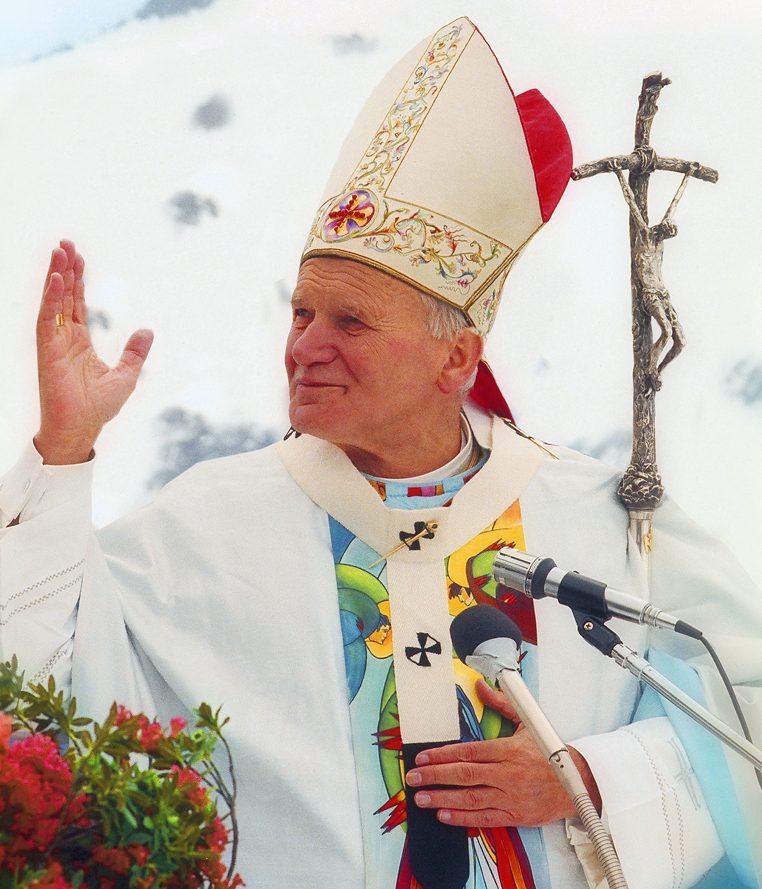
On October 16, 1978, the College of Cardinals elected Karol Józef Wojtyła, the Archbishop of Kraków, to the papacy. He took the name John Paul II. He was 58 years old, the first non-Italian pope in 455 years, and the first Slavic pope in history.
Wojtyła grew up under two totalitarianisms. His teenage years in Wadowice and Kraków coincided with the Nazi occupation of Poland (1939 to 1945); his priestly formation and episcopal career took place under Polish communism (1945 to 1989). He had spent his entire adult life navigating a state that was hostile to the institution he served. Unlike his predecessors, he didn’t need a briefing on what life under a one-party Marxist-Leninist regime looked like. He had lived it.
His inaugural homily on October 22, 1978, included the line that would become the unofficial motto of his papacy: “Be not afraid.” It was addressed to the universal Church, but in Warsaw, Kraków, Gdańsk, and Wrocław it was heard as something more direct. A Polish pope had told Poles, on global television, not to be afraid of the regime that ruled them.
In June 1979, John Paul II returned to Poland for a nine-day pilgrimage — the first papal visit ever to a Warsaw Pact country. The crowds were enormous: an estimated one-third of the Polish population saw him in person across the trip. The communist government had agreed to the visit assuming it would be a manageable religious event. It wasn’t. It was the largest peaceful gathering in the Eastern Bloc’s history to that point, and it demonstrated to ordinary Poles that they outnumbered the regime by orders of magnitude.
Solidarność, samizdat, and the long unraveling
Fourteen months after the 1979 pilgrimage, in August 1980, shipyard workers in Gdańsk under Lech Wałęsa launched the strikes that produced Solidarność (Solidarity) — the first independent trade union in the Eastern Bloc. The Polish hierarchy, supported quietly by the Vatican, kept lines of communication open between the union, the regime, and the Western press through the most dangerous years.
In December 1981, Polish General Wojciech Jaruzelski declared martial law and outlawed Solidarity. The Pope’s response was steady rather than dramatic: he kept publicly visible support for the underground union, maintained Vatican channels for clergy and dissidents, and continued returning to Poland for major pilgrimages in 1983 and 1987. Vatican Radio’s Polish-language broadcasts became one of the few uncensored news sources reaching the country.
On May 13, 1981, John Paul II was shot in St. Peter’s Square by Mehmet Ali Ağca, a Turkish gunman. He survived and credited the survival to the intercession of the Virgin of Fátima. The investigation eventually pointed toward Bulgarian and Soviet intelligence connections, though the full chain of command was never proven in court. The Pope met Ağca in his cell in 1983 and publicly forgave him.
The political alignment of the early 1980s — Ronald Reagan in the White House from 1981, Margaret Thatcher in Downing Street from 1979, John Paul II in the Vatican from 1978 — formed what historians later called the triple alliance against the Soviet system. The three coordinated less directly than the phrase implies, but they spoke about the Eastern Bloc in a shared moral register that broke with prior detente-era language. The slow unraveling that followed — the 1989 round-table negotiations in Poland, the fall of the Berlin Wall on November 9, 1989, the dissolution of the Soviet Union in December 1991 — had many causes. The Pope was one of them, not the only one.
By the time the Berlin Wall fell, every Eastern Bloc country was reopening its churches except one. Albania.
What Albania was missing (1967–1990)
Hoxha died on April 11, 1985, but the atheism policy and the regime’s hard line on religion outlasted him by five years. His successor Ramiz Alia maintained the official atheism through the late 1980s, even as the rest of the Eastern Bloc liberalized. It wasn’t until 1990, with the Albanian regime visibly collapsing alongside the rest of communist Europe, that religious practice was decriminalized.
The damage to institutional religious life was nearly total. The Catholic hierarchy of Albania — the four dioceses centered on Shkodër, Lezhë, Sapë, and Durrës — had been physically dismantled. Every bishop was dead. The surviving clergy were elderly men who had spent decades in prison. Seminaries were closed. Theological libraries had been burned or scattered. The infrastructure for ordaining new priests had been destroyed.
What kept the faith alive was domestic and informal: secret baptisms in kitchens, prayers memorized rather than written, parents teaching the Ati Ynë (Our Father) to children at night, the occasional surviving rosary buried in a garden and dug up for a wedding or funeral. Albanian-Americans who returned in the early 1990s described meeting older relatives who had not heard a public Mass since the late 1960s.
In the United States, the diaspora kept what could be kept on this side of the Atlantic. Albanian-American Catholic parishes in the Bronx, Westchester, Detroit, and Boston ran their own liturgies in Albanian and English. The Albanian Orthodox Archdiocese in America under the Orthodox Church in America (OCA) maintained its sixteen parishes and its Albanian-language liturgical tradition through the entire period. Albanian-American Sunni and Bektashi communities — concentrated in Detroit, the Bronx, and parts of Massachusetts — did the same for their traditions. Vatra (the Pan-Albanian Federation, co-founded by Fan Noli in 1912) kept civic ties alive across denominations. The community-organization layer documented in NAR’s history of the diaspora carried what the Albanian state had outlawed.
April 25, 1993 — the Pope arrives in Tirana
The first papal visit to Albania happened on a single day: Sunday, April 25, 1993. The country had decriminalized religion three years earlier; this was the first major international religious figure to visit. Albanians lined the route from Rinas airport into Tirana. Crowds gathered in the central square outside the Xhamia e Et’hem Beut (the Et’hem Bey Mosque, itself a recently reopened symbol of religious revival, this time across the Muslim community).
John Paul II’s airport remarks named the Albanian situation directly: a country that had been violently isolated from spiritual life across all faiths, now reopening. He spoke of religious freedom as the precondition for civic freedom. He greeted the country in Albanian — a language he had studied phrases of for the visit — invoking Hyji (God) and Shqipëri (Albania) in the same breath.
The substantive act of the day took place in Shkodër, the historic center of Albanian Catholicism in the north. There, the Pope consecrated four new bishops, replacing the entire Catholic hierarchy that the Hoxha regime had executed or worked to death. The four sees — Shkodër, Lezhë, Sapë, and the Apostolic Administration of southern Albania — had been institutionally vacant for more than 40 years. The consecration restored the Catholic episcopate of Albania in a single liturgy.
The four bishops consecrated that day were elderly men, several of them themselves survivors of the labor camps. The visual symbolism was deliberate: the priests who had refused to renounce their faith under Hoxha were the priests who now received the apostolic succession their predecessors had carried into the prisons.
The visit lasted less than 24 hours. The Pope flew back to Rome the same evening. But the scaffolding for a rebuilt Catholic Church in Albania — bishops, dioceses, the legal standing to ordain new clergy — was in place by Sunday night.
The diaspora response
Word of the visit traveled fast in the Albanian-American community. Parish bulletins in the Bronx and Detroit ran the photos within days. Albanian-language newspapers in the US — Dielli (The Sun, founded by Fan Noli in 1909) and others — covered the trip in full. The reaction crossed denominations: Albanian-American Orthodox, Sunni, Bektashi, and secular community members read the visit as a marker that the homeland was reopening, not narrowly as a Catholic event.
Practically, the visit catalyzed several things in the US diaspora through the rest of the 1990s:
- Travel home. Albanian Americans who had been blocked from visiting parents and grandparents for a generation began returning. The first organized parish trips from the Bronx and Detroit ran in 1993 and 1994. Some travelers were attending the funerals of relatives they hadn’t seen in 40 years.
- Clergy exchanges. Albanian-American Catholic priests visited the rebuilding dioceses in Shkodër, Lezhë, and Tirana. Orthodox clergy from the US Albanian Orthodox Archdiocese coordinated with Archbishop Anastasios in Albania, who had been sent in 1992 by the Ecumenical Patriarchate to rebuild the Orthodox Autocephalous Church. Sunni and Bektashi figures in the US maintained their own ties to the parallel rebuilding of those communities.
- Material support. Books, vestments, icons, altar furnishings, and money flowed from US Albanian-American parishes and xhami (mosques) to the rebuilding institutions. Translations of liturgical and devotional texts that had been preserved in the diaspora were sent back.
- Cross-denominational civic ties. Albanian-American organizations like Vatra and the Albanian American National Organization (AANO) coordinated humanitarian aid that wasn’t denominationally bounded. The shared identity, in the diaspora, was Albanian first; the religious institutions were the venues.
The 1993 visit also fed into the next major diaspora response: the 1997 Albanian crisis, when the collapse of pyramid investment schemes triggered civil disorder and an estimated 2,000 deaths. Networks of US Albanian Americans that had reopened around the 1993 papal visit were the same networks that organized aid in 1997.
Beatification of Albania’s martyrs (2016)
The historical accounting that John Paul II’s visit began was completed under his successor. On November 5, 2016, Pope Francis beatified 38 Albanian Catholic martyrs at the rebuilt cathedral of Shkodër — clergy and laypeople killed under the Hoxha regime between 1945 and the late 1970s. The cause for their beatification had been opened in 2002 under John Paul II.
The 38 are led by Archbishop Vinçenc Prennushi, the Franciscan Archbishop of Durrës, who died in prison in 1949 after torture. The list includes Jesuits, Franciscans, diocesan priests, seminarians, and lay Catholics — among them the writer and editor Atë (Father) Anton Harapi, the priest-poet Ndre Mjeda’s contemporaries, and several Stigmatine and Franciscan friars who had run schools and seminaries before they were arrested. Some were shot. Some died of torture. Some died of disease and starvation in the camps.
The beatification ceremony was held in the same northern Albanian city where John Paul II had consecrated the four bishops in 1993. The continuity was deliberate: the 1993 visit reopened the institutional Church, and the 2016 beatification gave a name and a date to the cost of its closure. Katolikë (Catholics) in Albania and across the diaspora attended; so did civic representatives from the country’s other religious communities.
For the Albanian-American Catholic diaspora, the 2016 beatification was the first formal Catholic-Church recognition that what had happened to Albania’s clergy was a religious persecution, not a political accident. Many of the family names on the list of 38 are family names still living in US parishes.
Why this history matters now
Modern Albania is multi-confessional by both tradition and constitutional design. The post-communist Albanian constitution guarantees freedom of religion and recognizes the country’s four traditional communities — Sunni Muslim, Bektashi, Orthodox Christian, and Catholic — alongside the right to practice no religion. Inter-religious tolerance is a public value in a way that, in much of the region, it isn’t. Albanian Americans pass that on through household practice, parish life, and civic events that cross denominational lines.
The history of the 1967 to 1990 period is not just a Catholic story. It’s an Albanian story that touches every faith community and every family. The diaspora’s role in it — keeping the language, the liturgies, the songs, the cookbooks, and the institutions alive in the US while the homeland ran a state-enforced silence — is part of why the post-1990 reopening worked as quickly as it did. The pieces were preserved here.
For families in the US whose grandparents kept the faith in private, or whose grandparents quietly stopped practicing under the pressure of the regime and never returned to it, both stories are equally Albanian. NAR’s count includes everyone — Catholic, Orthodox, Sunni, Bektashi, secular, mixed-heritage, fluent in Albanian or not. Documenting the community as it actually exists is the registry’s purpose; the history above is part of why some of those families ended up in the US in the first place.
If your family kept the faith — or didn’t — through the long years of Hoxha’s Albania, your story is part of the count. The National Albanian Registry is the first community-led count of Albanian Americans. Get counted →
Sources: Wikipedia — Pope John Paul II; Wikipedia — Albania–Holy See relations; Wikipedia — Religion in Albania; Wikipedia — Catholic Church in Albania; Wikipedia — Solidarity (Polish trade union); Wikipedia — Enver Hoxha. Where dates or counts are widely cited but not directly verifiable, they’re stated as approximate.