
This article was written by Edon Alibegu, MS, LAC, MHC, a member of the Council for Cooperation with the Diaspora (Emigrants of Montenegro), and originally published in Albanian in Gazeta Dielli, America’s oldest Albanian newspaper, on July 16, 2026. It is republished here with the author’s permission. English translation by the National Albanian Registry. The Albanian original is available here.
This week, New York City made it official.
The administration of Mayor Zohran Mamdani released a map of thirty immigrant enclaves across the five boroughs of New York, promoted as part of the city’s Neighborhood Passport campaign ahead of the 2026 FIFA World Cup, and Little Albania in the Bronx is on it. Side by side with Chinatown, Little Ukraine, Little Haiti, and Little Guyana, the Albanian community of the Bronx now has a neighborhood officially recognized by the City of New York on an official municipal map.
For anyone who has heard Gheg spoken in the cafés on Arthur Avenue, the recognition is long overdue. For the Albanians who built this neighborhood, many of them refugees from the wars that tore Yugoslavia apart in the 1990s, this is something deeper than official recognition. It is a reaffirmation of justice.
The map sparked immediate controversy, not because of the inclusion of Little Albania, but because of what was left off: Little Italy, one of the most famous immigrant neighborhoods in American history, was missing from the first version of the map, provoking a sharp reaction from the Italian-American Civil Rights League. Mayor Mamdani has announced that Little Italy will be added to the map following the criticism. But throughout the controversy, Little Albania’s place on the map was never in question. It belongs there. Here is why.
A Community Three Generations Deep
Albanians have been part of the fabric of New York City since the early 1900s, but the Bronx became the beating heart of Albanian America. The community’s beginnings there predate by decades the 1990s wars that many Americans associate with the Albanian wave. Among the first Albanians to find their way to the Bronx were the Albanians of Montenegro, families from Ulqin (Ulcinj), Tivar (Bar), Guci (Gusinje), and the northern highlands, who began arriving after World War II, driven by the pressure of the Yugoslav communist regime, economic discrimination, and the lack of opportunity under Tito’s rule. They came as young men looking for work, many of them with connections to Kosovar families who had come before them, and they settled in the northern and northeastern neighborhoods of the Bronx (Pelham Parkway, Belmont, and Morris Park), forming the community’s first institutional layer.
These pioneers from Montenegro built the first bridges: with Italian employers, with the landladies of the Jewish-built apartment houses, with the Albanian fabric of the Bronx that was still taking shape. Many worked in construction and food service, saved with strict discipline, and sponsored their brothers, cousins, and countrymen to come after them. They did not speak their story loudly. They built with it.
Alongside them came Albanians from Kosovo and from the other Albanian lands of the former Yugoslavia, settling largely in the same areas. They found a natural affinity with Italian-Americans through shared cultural traits, a shared history, and even shared ancestry: the Arbëreshë of southern Italy are descendants of Albanians who fled the Ottoman Empire centuries ago. Many Albanian newcomers found their first jobs in Italian-owned restaurants and shops, and many of them made those restaurants their own.
Our Lady of Shkodra Church grew out of an Albanian Catholic congregation that began gathering in the Bronx in 1969 and took its current name in 1987; it became the backbone of Albanian Catholic community life, a gathering place for families from Kosovo, Montenegro, and northern Albania alike, serving a population that crossed regional and religious lines. Also founded in Boston, in April 1912, by two pioneering Albanian immigrants (Fan S. Noli, an Orthodox clergyman, and Faik Konica, a writer and diplomat), the VATRA organization became the first major Albanian-American patriotic institution, before Albania itself declared its independence on November 28, 1912. Today VATRA remains among the most respected diaspora organizations.
The 1990s: Refuge After the Wars
No decade shaped Little Albania more deeply than the 1990s. The fall of communism in Albania between 1990 and 1992 opened mass emigration for the first time in generations. Thousands fled poverty, political instability, and the collapse of the pyramid schemes that left most of the Albanian population without savings in 1997. At the same time, the escalating conflict in Kosovo, which culminated in the 1998–99 Kosovo War, sent a second wave of refugees seeking safety in the United States, many of whom settled in New York.
A massive wave of immigration came in 1992 with the dissolution of Yugoslavia and continued throughout the decade, with Albanians from Albania, Montenegro, Serbia, and the Republic of North Macedonia emigrating to the United States as war refugees. They were mothers, fathers, grandparents, and children who lost their homes and their savings and crossed an ocean with almost nothing.
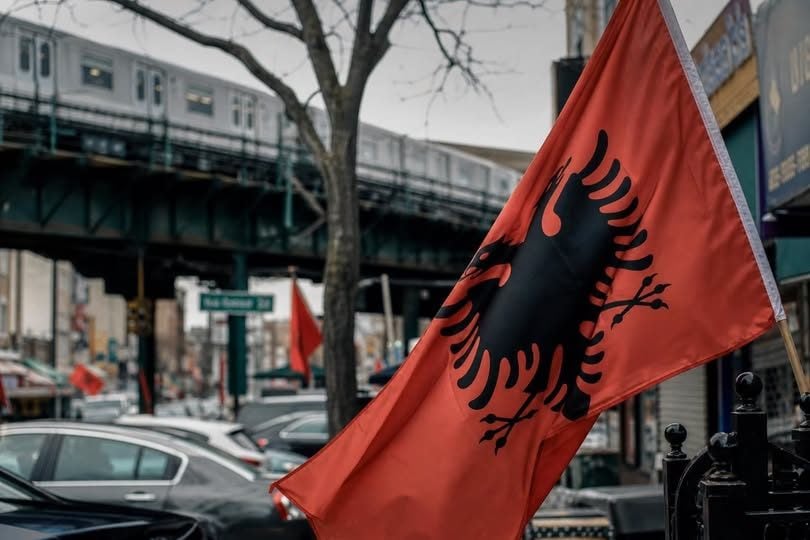
The Kosovar Albanians who arrived in 1999 came as war refugees under formal humanitarian parole, not as economic migrants, almost entirely from the cities and villages of Kosovo: Pristina, Peja, Gjakova, Prizren, Mitrovica. Most came to the Bronx, northern New Jersey, and Yonkers, where they found Albanian communities already consolidated by those who had come before them, the Albanians of Montenegro and Kosovo who had worked, saved, and built quietly for decades. The neighborhood they arrived in already had Albanian shop signs, Albanian food, and Albanian flags in the windows. The Bronx wasn’t new to the Albanian diaspora of the 1990s; earlier arrivals had already built the neighborhood they landed in.
Building a Neighborhood
The Albanian community’s contribution to the Bronx goes far beyond cultural presence. The greatest Albanian success story has been in real estate. Albanians now own a substantial share of the private buildings in the Bronx. Many started as building superintendents and, through years of saving and sacrifice, became owners. The Albanian building superintendent became a Bronx institution, known for reliability, resourcefulness, and the long game.
The expansion of Albanian businesses transformed Arthur Avenue, once known as “Little Italy,” into what is now called “Little Albania.” You can even hear the Italians themselves say it is no longer Little Italy, but Little Albania. Over time, crime fell, neighborhoods stabilized, and the Bronx became a comfortable hub for families. The transformation of the South Bronx from the devastation of the 1970s into a livable neighborhood has many authors, and Albanian families are among the most important.
The neighborhood today is also defined by three streets that bear the names of distinguished figures of the Albanian nation. The first street is named for Mother Teresa: the Albanian from Skopje who became a global symbol of love and human sacrifice. The second shares its name with Fan Noli (located at the corner of Morris Park Avenue and Tenbroeck Avenue), founder of the Albanian Orthodox Church, a Harvard University scholar, and founder of VATRA, the Albanian-American patriotic organization established in Boston in 1912. The third and most recent (inaugurated with a grand ceremony in May 2022 at the corner of Crescent Avenue and Adams Place) bears the name of Gjergj Kastrioti Skanderbeg, Albania’s national hero, the nobleman and military commander who for 25 years held off the Ottoman Empire in the 15th century. The plaque unveiling was held before a large crowd of Albanian-Americans, legislators, and New York officials, who celebrated with song and dance. The proposal was made by former City Council member and Albanian-American activist Mark Gjonaj.
Mayor Eric Adams took part in the street naming and praised the city’s Albanian community, which he described as the largest in America, calling its members hardworking, dedicated neighbors rather than a voting bloc.
Official Recognition: On the World Stage
The Little Albania in the Bronx map made its debut as part of the Immigrant Enclave Illustration Series of the Mayor’s Office for Immigrant Affairs, the first time the Albanian-American community appeared on the official maps of the City of New York, a historic moment for the community. Now, under Mayor Mamdani, that map is being promoted around the world during the 2026 FIFA World Cup, placing Little Albania in the Bronx on the same international stage as the tournament itself. Little Albania in the Bronx is home to dozens of Albanian-American businesses and a large Albanian population in New York City.
A Personal Note
As an Albanian-American with family roots in Ulqin, Montenegro (one of the first communities to send its sons and daughters to the Bronx, long before the wars), I feel the significance of this recognition in a way that goes beyond the civic. When the first of my community arrived in the Bronx, they did not come with fanfare. They built in silence, sacrificed with dignity, and left behind a legacy that today holds dozens of businesses, three streets with Albanian names, and a neighborhood recognized by the City of New York itself.
The people who built Little Albania arrived speaking a language that no one else in their new city understood, carrying a history most Americans had never heard.
Every new group of immigrants brings to New York its strengths and its weaknesses. The Albanians brought close-knit families, a strong sense of honor, and a fierce desire for independence. They found, in the Bronx, a neighborhood that knew something about struggle. And they made it their own.
The recognition is about the people who built the neighborhood, not the map lines around it. This week, New York City made it official, on a map now being shown to the whole world for the World Cup.
About the author: Edon Alibegu, MS, LAC, MHC, is an Albanian-American with family roots in Ulqin, Montenegro, and a member of the Council for Cooperation with the Diaspora (Emigrants of Montenegro). This piece originally appeared in Gazeta Dielli and is republished here with his permission.