The conversation every diaspora family is having
Language retention is the single most discussed worry inside the Albanian-American diaspora. It comes up at the parade, at the parish coffee hour, between cousins on WhatsApp. By the third generation in the United States, fluent Albanian speakers are rare, and the second-generation parents raising third-generation kids know it.
This guide is for those parents and grandparents. It is a practical document — no romantic platitudes about the music of the language, no nostalgia for the village, no inspirational closing about how love of country will do the work for you. Love of country does not teach a child to conjugate verbs. Structure does. Repetition does. The willingness to keep speaking Albanian to a child who keeps responding in English does.
The Albanian language (shqip) is the sole surviving member of the Albanoid branch of Indo-European. It has roughly 7.5 million native speakers worldwide, the majority in Albania (36%), Kosovo (23%), Germany (9%), North Macedonia (7%), and Italy (7%). Diaspora speakers in the United States, Switzerland, and elsewhere add several million more, depending on which heritage learners are counted. That last category — heritage learners — is the one this guide is about.
We’ve written this for parents whose Albanian is fluent and whose kids’ is fading. For grandparents who feel the slippage at the dinner table. For mixed-marriage households where one parent doesn’t speak Albanian and the other carries the entire weight of transmission. For the second-generation Albanian American who never quite learned to write shqip but doesn’t want their child to lose what little they have.
It works. None of it works automatically. All of it requires the parent to do the thing the parent is hoping the child will do — speak Albanian, every day, for years.
Why language transmission is hard in the diaspora
Three structural forces work against you, and you should name them honestly before you plan around them.
English dominance is total
US-born children spend roughly seven hours a day in English-only school environments by age five. Add another two to four hours of English-language television, YouTube, and games, and the total English exposure runs 10-12 hours a day. Albanian, in most diaspora households, gets a fraction of that — an hour at the dinner table, a phone call with grandma, a song in the car. The math is not in your favor.
This is not a failure of effort. It’s a structural feature of raising children in an English-dominant country. The strategies in this guide are designed to push back against that math, not pretend it doesn’t exist.
Mixed-marriage households
A meaningful share of second-generation Albanian Americans marry non-Albanian-speaking partners. In those households, the language of the household defaults to English unless the Albanian-speaking parent makes an explicit, sustained choice to speak Albanian to the child anyway. The default is the killer. Without a deliberate strategy, the Albanian parent slips into English at the dinner table to include the non-Albanian partner, and within a few years the child has no consistent Albanian input.
There is a workable solution for this — One-Parent-One-Language, covered below — but it requires the Albanian-speaking parent to break the social default and keep speaking Albanian to the child even when other adults present don’t understand. Many parents find this socially uncomfortable. The ones who push through that discomfort are the ones whose kids speak Albanian.
”They’ll pick it up from grandma”
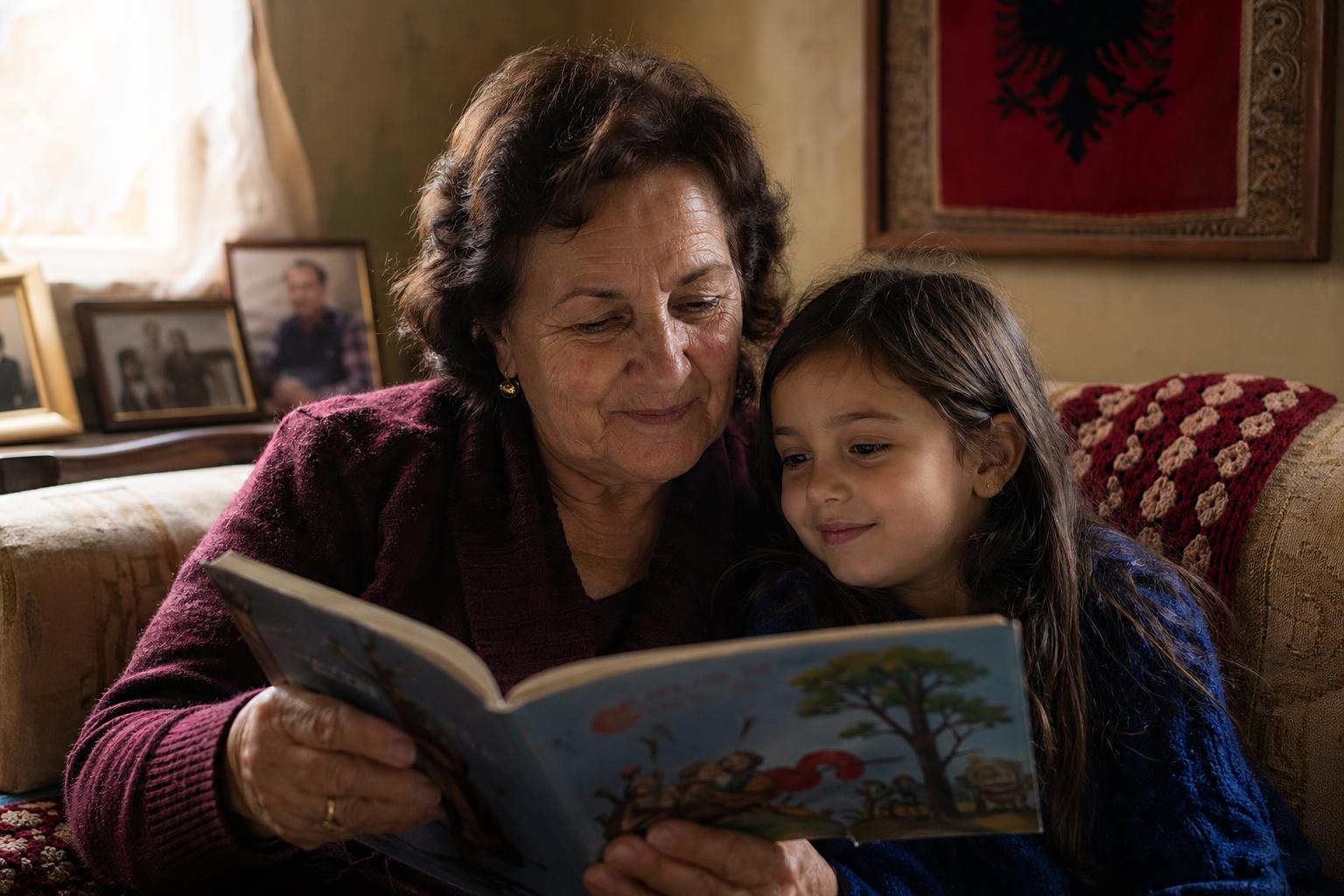
This is the most common assumption, and it is mostly false. Children pick up passive comprehension from a grandparent who speaks Albanian to them — they learn to understand when grandma calls them in for dinner or scolds them in Albanian. They rarely pick up active fluency this way, because there’s no need to produce Albanian when grandma understands their English perfectly well.
The distinction matters. A child with passive comprehension can follow a conversation but can’t sustain one. They can recognize byrek (Albanian filo pastry) and fasule (white bean stew) but can’t order them in Albanian at a Tirana restaurant. They can read an Albanian holiday card but can’t write one back. Passive comprehension is real and worth preserving — most diaspora kids don’t get even that — but it is not what most parents mean when they say they want their child to “speak Albanian.”
If your goal is active fluency, grandma alone is not enough. You need additional structure.
Eight strategies that work
These are the tactics that produce diaspora kids who can hold a real Albanian conversation. None of them works in isolation; the families that get fluent kids stack three or four of them.
1. One-Parent-One-Language (OPOL)
The Albanian-speaking parent speaks only Albanian to the child. From birth. In public. In front of non-Albanian-speaking adults. When the child responds in English, the parent answers in Albanian. When the child is 16 and rolling their eyes, the parent still answers in Albanian.
This is the single highest-impact strategy in this guide. It works because it gives the child a reliable, daily, multi-hour stream of Albanian input from someone they have to communicate with. Children adapt to the parent-language pairing within the first 18 months and rarely confuse it.
The hard part is the social pressure. You will feel rude speaking Albanian to your toddler in front of your non-Albanian in-laws. Speak Albanian anyway. Translate one sentence aloud if it matters. Don’t switch fully to English; the moment you do that consistently, you’ve broken the system.
2. Read aloud in Albanian, ten minutes a night
Children’s books in Albanian are harder to find than English ones, but they exist. Look for Lëkura by Ridvan Dibra, the Përralla shqiptare (Albanian folktales) collections, Albanian translations of Brothers Grimm and Hans Christian Andersen, and the many illustrated children’s books published by Botart, Onufri, and Dituria in Tirana. For Kosovo-published material, Buzuku and Koha Botime put out illustrated children’s series.
Ten minutes a night, every night, builds vocabulary and reading comprehension that no amount of conversational input will. Reading aloud also slows the parent down — you pronounce each word fully, the child hears unfamiliar words in context, and the printed page anchors the language in something more durable than spoken speech.
3. Saturday and Sunday Albanian schools
Most Albanian-American communities operate weekend schools out of parishes, mosques, and cultural centers. A typical curriculum covers the alphabet (36 letters including the digraphs dh, gj, ll, nj, rr, sh, th, xh, zh), basic reading and writing, holiday songs, dance, and Albanian history.
Some of the established US programs:
- Fol Shqip — Ridgewood, Queens. One of the longest-running NYC-area Saturday school programs.
- AAEA programs — Albanian American Educational Association, NYC-area.
- Detroit-area Saturday schools — operated through Albanian Orthodox and Catholic parishes in metro Detroit (Macomb, Oakland, Wayne counties).
- Worcester, Massachusetts — community schools tied to the strong central-Mass Albanian community.
- AACI Chicago — Albanian American Community Institute programs in the greater Chicago area.
These schools are uneven in quality — some are run by trained teachers, some by volunteer parents — but the consistent value is the peer group. A child who learns Albanian only from parents will never use it socially. A child who learns Albanian alongside other Albanian-American kids of the same age forms a peer-language association that lasts. They get used to speaking Albanian with other children, not just with adults.
If your city doesn’t have a school, ask the nearest parish or cultural organization. Many programs are quietly active and not online-discoverable.
4. Online tutoring and structured courses
For families without a local school — or with a local school that doesn’t fit — online tutoring fills the gap.
- Mëso!Shqip (msoshqip.com) — One-on-one video sessions with native-speaking instructors based in Albania, Kosovo, North Macedonia, and Montenegro. Curricula approved by the Albanian and Kosovo Ministries of Education. Targeted at children ages 6-15 living abroad. Sessions are recorded for review.
- Dinolingo Albanian — App-based, kid-focused, gamified. Useful for ages 4-9 as a supplement.
- University courses — Mercy College (NYC) and the University of Chicago have offered Albanian courses to outside students at the high school level.
- Live in-person tutoring — Many Albanian graduate students in US cities tutor the children of diaspora families on a flexible basis. The local parish often knows who’s available.
Online tutoring works best as a supplement to home use, not a replacement. A child who only sees Albanian once a week with a tutor will not become fluent. A child who hears Albanian daily at home and gets structured tutoring weekly will.
5. Albanian-language media for kids
Children absorb language from screens whether parents like it or not. The strategy is to redirect part of the screen budget to Albanian-language content.
- RTSH (Radio Televizioni Shqiptar) — public broadcaster of Albania. Children’s programming streams free online.
- YouTube cartoons in Albanian — Magjistari i Tokës and Biçikleta are kid-favorites. The catalog of Albanian-dubbed Disney and Pixar features (Mbreti Luan, Frozen, Toy Story) is large and mostly free on YouTube.
- Albanian dubbed Disney/Pixar — released theatrically in Albania and Kosovo, often available on streaming services with the Albanian audio track.
- Folk and children’s music — Era Rusi, traditional vajza me lahutë recordings, contemporary Albanian children’s musicians on Spotify.
Treat Albanian content as the default option, not the special-occasion option. If the kids watch a show, default it to Albanian audio. If they want music in the car, the playlist starts in Albanian.
6. Visit Albania or Kosovo with structure
Annual or semi-annual trips to Albania, Kosovo, North Macedonia, or Montenegro produce the steepest fluency gains a diaspora kid will ever see. Two weeks with cousins their own age — kids who don’t speak English to them — does what two years of weekend school can’t.
The structured version multiplies the effect. Several language-immersion summer camps for diaspora children operate in Tirana, Shkodër, Prishtina, and along the Albanian Riviera. Programs vary year to year; check with your local Albanian-American organization for current options. Even an unstructured summer with extended family produces results, but a structured camp gets the writing and reading work done that family visits often skip.
The reluctant teenager problem is real. A 14-year-old who refuses to speak Albanian at home will often loosen up by the second week with cousins in Tirana, particularly if they’re embarrassed by how much better the local kids are at English than they are at Albanian. The trip is the catalyst.
7. Make it earned, not enforced
The kid who refuses to speak Albanian at age 8 is a known pattern. Almost every diaspora child goes through it. The temptation is to enforce — you must speak Albanian at dinner, you can’t have screen time until you read this Albanian book, you have to answer grandma in Albanian or you’re being rude.
Enforcement at age 8 produces resentment by age 14, and the resentment outlasts the language. The families that get the best long-term outcomes treat Albanian as identity, not punishment. The kid is allowed to refuse, the parent keeps speaking Albanian anyway, and the door stays open.
Most kids who refuse at 8 come back at 18 — when they go to college and find they’re the only Albanian American on campus, when they visit Tirana and feel the weight of not being able to keep up with their cousins, when they fall in love and want to talk to their partner’s grandmother. The window doesn’t close at puberty; it just narrows. Keep the input going during the refusal years and the comeback gets to start from somewhere.
8. Grandparent contact, in Albanian, weekly
The single biggest predictor of third-generation language retention in the diaspora research that exists is regular grandparent contact in the heritage language. Not occasional. Weekly. By phone, by FaceTime, in person.
A grandparent who refuses to switch to English creates a permanent fixture in the child’s life that requires Albanian to access. That requirement does most of the work.
If the grandparents are already in the US, this is logistical. If they’re in Albania, Kosovo, or North Macedonia, it’s a scheduled video call. Either way, the value is in the regularity. A grandparent the child sees twice a year cannot do what a grandparent the child speaks to twice a week can.
Realistic expectations: what success looks like
Here is the part most diaspora parents avoid saying out loud.
Most American-raised Albanian kids will not speak Albanian the way an 18-year-old in Tirana does. They will not write Albanian fluently. They will mix English words in. They will have an accent. They will pause for vocabulary. They will struggle with the case system, the definite article suffix, the past-tense forms of irregular verbs.
That is fine. That is the realistic best case for most diaspora families.
The honest goal is bilingual-passive with active conversational ability — a child who understands parents and grandparents fully, can hold a basic-to-intermediate conversation in Albanian, recognizes the food, music, holidays, and basic cultural references, and can read at least at a child’s level. That child carries the language forward. That child can teach their own children some of it.
Measured against monolingual fluency, this looks like loss. Measured against the alternative — third-generation kids who don’t speak a word — it is a generational save. The right benchmark is not “could my child go to university in Tirana.” It is “will my child be able to talk to their grandmother, find Albania on a map, and recognize themselves in shqiptar identity.” If the answer is yes, you’ve succeeded.
A small percentage of diaspora families produce kids who are genuinely bilingual at near-native fluency. They tend to be families that did three or four of the strategies above for the full 18 years and visited Albania every summer. That is the high end. It is not a fair benchmark for the average family, and grading every diaspora child against it is how parents end up giving up.
Resources by age band
What’s worth doing changes as the child grows.
0-3 years
- Lullabies and nursery rhymes in Albanian. Nina nana, traditional Tosk and Gheg songs, recorded compilations on Spotify.
- Single-word labeling. Name body parts, foods, colors, animals, household objects in Albanian as you go through the day.
- Board books. Albanian-language board books are scarce; bilingual EN/SQ versions and Albanian translations of common Western titles are available through Albanian-American bookstores and online sellers shipping from Tirana.
- Talk constantly in Albanian. This age is when input volume matters most.
4-7 years
- Saturday school if available. The peer-group exposure starts paying off here.
- Basic reading. The Albanian alphabet, simple decoding. Many Saturday schools start formal reading at age 5 or 6.
- Children’s songs and animated content in Albanian. Magjistari i Tokës, Albanian-dubbed Pixar features.
- Holiday participation. Independence Day (November 28), Skanderbeg Day (January 17), Easter, Bajram, Christmas — every holiday is a vocabulary unit.
8-12 years
- Chapter books in Albanian. Translated children’s series, original Albanian children’s literature from Botart and Onufri.
- Structured tutoring — Mëso!Shqip or local tutoring weekly.
- First independent summer trip — two to four weeks with cousins or in a structured immersion camp. This is when the trip-to-fluency conversion is sharpest.
- Music and pop culture — Albanian music from current artists (Dua Lipa’s Albanian tracks, Era Istrefi, Rita Ora’s heritage interviews, plus traditional artists) keeps the language modern, not just ancestral.
13-18 years
- Heritage trips with structure — language immersion camps, volunteer programs, family-stay arrangements. The teenage trip is the high-impact one.
- Advanced reading — Albanian literature: Ismail Kadare, Migjeni, Naim Frashëri, Fan Noli (the Albanian-American writer), contemporary novelists. A kid who can read Kadare in the original retains the language for life.
- Conversation partners — peer-aged Albanians, online or in person. WhatsApp groups, language exchanges with kids in Tirana.
- Identity context — by this age, the child can engage with Albanian identity intellectually. Books like Robert Elsie’s history of the Albanian people, Edith Durham’s High Albania, Pashko Vasa’s O moj Shqypni in translation alongside the original.
The Tosk vs Gheg question
Diaspora parents from Kosovo, North Macedonia, and Montenegro often ask whether to teach their kids the dialect of home or the standard form taught in books and weekend schools. This matters more in the US than people admit. A large share of the Albanian-American population — including most of metro Detroit, much of the Bronx and Staten Island, and the Yugoslav-wave communities in Worcester and Chicago — comes from Gheg-speaking families. For them, “teaching kids Albanian” is not a neutral phrase; it carries an implicit choice about which Albanian.
The 1972 Tirana Orthography Conference standardized a literary Albanian based on Tosk forms, and that standard is what’s used in most US weekend schools, Albanian government documents, and formal writing across Albania and Kosovo. Gheg-speaking families sometimes feel cultural dissonance — the language their grandparents speak at home isn’t quite the language the child is being taught to read and write. A Kosovar grandmother in Detroit speaking Gheg to a grandchild who has only learned Standard Albanian at Saturday school will be understood imperfectly, and the child will sound to her like a Tirana radio announcer rather than family.
The practical answer: teach the home dialect first, learn the standard later if formal study happens. Children acquire the dialect they hear from their parents naturally; they don’t lose it by being taught Standard Albanian later in school. Adult Albanians from Kosovo and northern Albania routinely use Gheg at home and Standard Albanian for writing. That bilectalism is normal and lifelong, and it’s how most of the ethnic-Albanian world has lived for generations.
US weekend schools vary in which they teach. Many default to Standard; some Detroit-area and Bronx parish schools teach in the dialect of the community they serve; a few teach both side by side. Ask before you enroll. Both dialects are legitimate Albanian — neither is “more correct” — and the right starting point is the one that lets your child talk to the family they have. Standard Albanian comes along later through reading, schooling, and contact with Albanians from outside the home dialect, whenever and however it does.
Why the count matters here
Language survival in the diaspora is, at its core, a counting problem. We don’t have reliable numbers on how many Albanian Americans still speak the language, how many of their children are bilingual, or how many third-generation kids retain even passive comprehension. The American Community Survey records 224,000 Albanian Americans by ancestry but doesn’t break out language transmission generation-by-generation. Community estimates put the real number of ethnic Albanians in the US closer to 1 million, and the language data on that population is even thinner.
The National Albanian Registry is the first community-led count of Albanian Americans across all generations and dialects. We track who’s here, where, and — increasingly — what’s being transmitted. The registry is free, the data is yours, and adding your family makes the diaspora visible to itself, including the parts of it that are still teaching their kids shqip.
If your family is in this fight — if you’re raising bilingual kids, running a Saturday school, hosting a summer camp, or just speaking Albanian to a toddler in a city where almost no one else does — get counted. The work doesn’t show up in the official statistics. The community-led count is where it shows up.
Add your family at albanianregistry.org/register.