

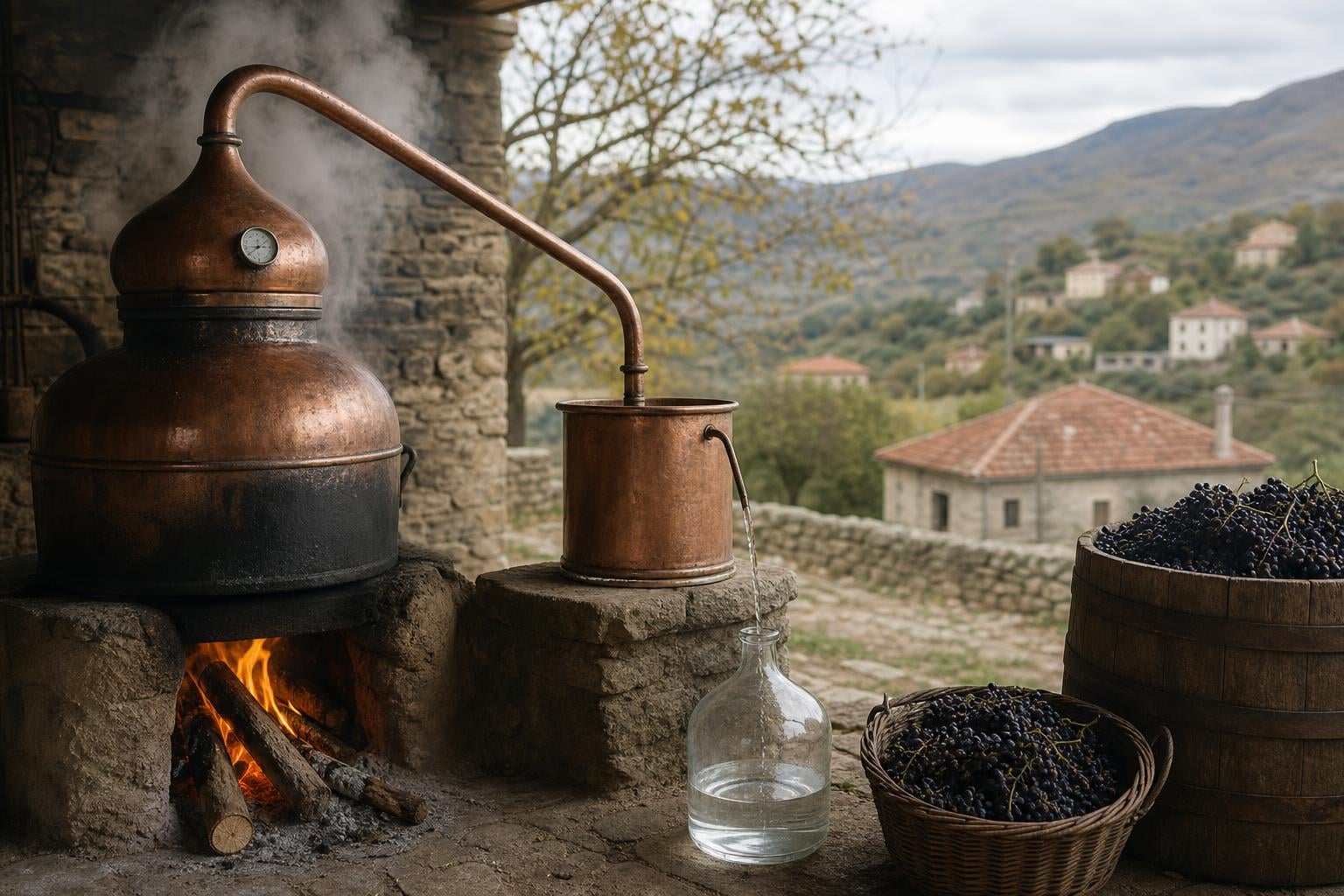
The copper, the fire, the autumn
In a village outside Berat, sometime in October, a fire is lit under a kazan (the copper still pot). The grape pomace from the September wine pressing has been fermenting in a sealed plastic drum for three weeks. The neighbors have already started checking on it. By midday the first drops of clear spirit are landing in a glass jar, and the year’s raki (Albanian fruit brandy) has begun.
This scene plays out in thousands of households across Albania, Kosovo, and Albanian-majority parts of North Macedonia every autumn. It has been the rhythm of the rural year for centuries — fruit harvest, fermentation, distillation, rest, pour. The process is not complicated, but it is exacting. A bad cut on the still produces raki that is harsh, headache-inducing, or in the worst case methanol-contaminated and unsafe.
This article walks through the traditional Albanian method, step by step, as a heritage explainer. It is not a recipe. There is a legal reality in the United States that anyone reading this should understand before going any further: home distillation of alcohol is a federal felony under 26 U.S. Code §§ 5601-5615, regardless of intent or batch size, and regardless of how legal and how routine the practice may be in your village in Albania. The Alcohol and Tobacco Tax and Trade Bureau (TTB) issues the federal permits required for any legitimate production. Home brewing of beer is separately legal under 26 U.S. Code §5053(e), and home winemaking is separately legal under 26 U.S. Code §5042. Distilling is not.
The point of describing the process here is cultural, not instructional. Understanding how raki is made deepens what it means to pour a glass, to recognize a good bottle, to talk about it with the cousin in Skrapar who actually runs the still. The diaspora carries the technique forward in memory even where the law restricts the practice.
What raki actually is
Raki is a clear distilled spirit made from fermented fruit. In Albania it is the national fruit brandy, sitting in the same broader Balkan family as Serbian šljivovica, Bulgarian rakia, Greek tsipouro, Romanian țuică, and Italian grappa. Across the wider region the umbrella term is rakia; the Albanian name is raki.
Commercial Albanian raki typically lands between 40 and 50 percent alcohol by volume (ABV), with 45 percent being the most common bottling strength. Homemade village raki frequently runs higher — 50 to 60 percent ABV is common, with some festive batches pushing above 60. The Wikipedia entry for rakia places the broader Balkan range in this same band.
A traditional raki contains exactly two ingredients: the fruit, and the alcohol the fruit’s sugars became. No malt, no oak, no spice, no anise, no added sugar, no coloring. Whatever you taste in the glass is the natural aromatic signature of the base fruit, concentrated through distillation. The clarity in the bottle reflects the clarity of the recipe.
A separate piece on this site covers what raki is made of in more detail. This article focuses on the process — what happens between the orchard and the glass.
Why “how to make raki” is the wrong question for the US diaspora
A US-based reader who searches “how to make raki” almost certainly imagines a path that ends with their own bottle on the table. The honest answer is that, for the overwhelming majority of US households, that path is not legally open.
Under federal law, producing distilled spirits in the United States without a Distilled Spirits Plant (DSP) permit from the TTB is a felony. The relevant statutes are 26 U.S. Code §§ 5601-5615, which criminalize unlicensed production, set criminal penalties (fines and imprisonment), and authorize seizure of the equipment and the spirit produced. This applies regardless of batch size — a one-liter test run is treated under the same statute as a thousand-liter operation. It applies regardless of intent — personal use carries the same prohibition as commercial sale. And it applies regardless of how legal the same practice is in your family’s village.
This is the point where Albanian diaspora households often expect a workaround. There isn’t one at the federal level. No US state allows hobby home distillation in the way roughly all states allow home brewing of beer under 26 U.S. Code §5053(e) and home winemaking under 26 U.S. Code §5042. Fermentation is legal at home; concentration through distillation is not.
The legal path forward exists and we cover it in a later section. The short version is licensure — federal permit, state license, bonded premises, federal excise tax, compliance reporting. A small number of Albanian Americans have completed this process and produce raki commercially under proper licensure. For most households, the practical path is to import or buy lawful bottles. The cultural knowledge of how raki is made still matters — it shapes how the diaspora chooses, evaluates, and serves the bottles it does pour.
The traditional Albanian process, step by step
What follows is the method as it is practiced across rural Albania. We describe it because the knowledge is part of the cultural inheritance, not because anyone reading this in the US should attempt it without a TTB permit.
The process has four phases. Harvest. Fermentation. Distillation. Rest.
Harvest runs from early summer through late autumn, depending on the fruit. Mulberries ripen in June. Apricots in July. Plums in August and September. Grapes in September. Quinces and figs late in the season. Most producers handle one fruit per year; some run multiple batches if their orchard is mixed.
Fermentation runs two to six weeks depending on fruit, temperature, and the producer’s preference. The fruit is crushed and placed in barrels or sealed plastic drums. No commercial yeast is added in the village method — wild yeasts on the fruit’s skin do the conversion from sugar to alcohol. The mash bubbles, the cap rises, the cap drops. The producer knows fermentation has finished when the bubbling stops and the mash tastes sour rather than sweet. The resulting liquid is roughly 6 to 10 percent ABV — comparable to a strong beer.
Distillation happens in a copper still — the kazan — heated with wood. The fermented mash goes into the pot. The pot is heated until ethanol vaporizes at 78.4°C. The vapor rises through a swan-neck pipe into a coiled condenser submerged in cold water, where it returns to liquid and drips out as clear spirit. The producer cuts the run into three portions — heads, hearts, tails — and only the hearts become raki.
Rest is the final phase. The finished raki rests in glass demijohns or stainless steel for weeks or months before bottling, allowing volatile compounds to mellow and the spirit to settle into balance. Some producers oak-rest a portion for a darker, rounder sipping raki, but most stays clear.
The seasonal rhythm matters. A grape raki distilled in late October is sitting in someone’s pantry by Christmas, and on the table for the New Year toast.
Equipment used by Albanian families
The traditional setup is simple and largely unchanged across generations. The core piece is the kazan.
The kazan is a copper pot still, typically 50 to 200 liters in capacity for a household setup. Copper matters chemically: copper ions bind sulfur compounds during distillation, scrubbing them out before they reach the condenser. A stainless-steel still produces a sulfurier, harsher spirit. Almost every traditional fruit-brandy region in Europe — Albania, Bavaria, Cognac, Armagnac — uses copper for this reason. Older kazans are hand-hammered; newer ones are factory-made but still copper.
The swan-neck is the curved pipe that connects the top of the still pot to the condenser. It is usually copper, sometimes lined or fitted with a small reflux chamber for partial redistillation as the vapor rises.
The condenser is a coiled copper tube (the worm, or serpentin) submerged in a vessel of cold water. As vapor passes through the coil, it cools and condenses to liquid. The water in the condenser vessel needs to stay cold throughout the run — a producer often pipes in spring water or refreshes it as it warms.
The fermenter is whatever holds the mash during fermentation. Older households use open wooden barrels with a cloth cover; modern setups use sealed plastic drums fitted with airlocks. The shift from open wood to sealed plastic over the last few decades has been the single biggest equipment change in village raki production — it is more sanitary, more predictable, and less prone to spoilage, though the older method is still defended by traditionalists who believe wild airborne yeasts add character.
The fire is wood, almost always. A wood fire gives the producer fine temperature control by adjusting the burn rate. Gas burners are sometimes used in modernized setups, but wood remains the standard.
The cuts equipment is minimal. A glass jar for the heads, a larger jar or demijohn for the hearts, another jar for the tails. A copper or steel mug for tasting. An alcoholmeter — a floating hydrometer that reads ABV — is the one piece of measurement gear most producers own.
These items are passed down within families. A kazan in regular use may be sixty years old. The skill of running it is older.
Grape raki: from pomace to finished spirit
Grape raki, raki rrushi, is the most common style in Albania and the easiest to follow through the process.
Day 0 — pressing. In late September, wine grapes are harvested and pressed for wine. What remains in the press is pomace — skins, stems, seeds, still wet with juice and natural yeasts. For higher-end raki, whole fresh grapes are used instead; for everyday raki, pomace is the standard input. Both approaches are traditional and produce different style profiles.
Days 1-21 — fermentation. The pomace or crushed whole grapes are placed in a sealed plastic drum (or open wooden barrel) and left to ferment. Wild yeasts on the skins — primarily Saccharomyces cerevisiae, the same species used in commercial wine fermentation — convert the remaining sugars to alcohol. Carbon dioxide bubbles out through an airlock or, in an open barrel, forms a protective blanket on top of the mash. The producer knows fermentation is finished when the bubbling slows to nothing and the mash tastes sour.
Day 21 (or whenever ready) — distillation. The fermented mash is transferred into the kazan. A wood fire is lit underneath. As the mash heats, the first vapors begin to rise around 78°C — alcohol vaporizes before water. The vapor travels through the swan-neck into the condenser and drips out as a clear, high-proof liquid.
The drip is not uniform. The producer makes three cuts:
- Foreshots and heads (the first 5 to 10 percent of the run): contains methanol, acetone, ethyl acetate, and other volatiles with boiling points lower than ethanol. The smell is sharp and solvent-like. Methanol is the major concern — it is acutely toxic and capable of causing blindness or death in small quantities. The heads MUST be discarded. This is the single most important safety judgment in raki production — methanol poisoning from a bad heads cut is a well-documented risk of unregulated home distillation anywhere it happens.
- Hearts (the middle 70 to 80 percent of the run): ethanol-dominant, clean, warm, carrying the fruit aromatics. This is the raki. The hearts typically run 60 to 75 percent ABV coming off the still, then drop as the run proceeds.
- Tails (the last 10 to 15 percent of the run): lower-proof, water-rich, containing fusel alcohols that produce harshness and bad hangovers. Tails are either discarded or saved to be redistilled in the next batch.
Cuts are made by smell, taste, and experience. A skilled distiller knows where to stop the heads collection and start the hearts; an unskilled one produces dangerous or unpleasant spirit. This is why village raki of unknown provenance is genuinely risky to drink — the cuts may have been wrong.
Some producers run the spirit through the still twice. The first run produces a low-proof spirit (25 to 35 percent ABV, sometimes called mesa); a second run concentrates and refines it to the final 45 to 55 percent. Both single and double distillation are traditional.
Days 22+ — rest. The collected hearts are placed in glass demijohns or stainless steel and left to rest for at least a few weeks, often two to three months. Volatile compounds mellow. Sharp edges round off. Then the raki is bottled — sometimes in commercial bottles for sale, sometimes in re-used wine bottles for household use, sometimes in unmarked glass jars for the cousin in the next village.
Fruit raki: mulberry, plum, quince
Beyond grapes, three other fruits dominate Albanian fruit raki, each with its own seasonal window and stylistic signature.
Mulberry (mani). Mulberries ripen in June and the season is short — sometimes a single week of full ripeness per tree. Producers are usually set up for immediate fermentation the same day as harvest, because mulberries oxidize and spoil quickly. The fruit is crushed lightly (heavy crushing extracts too much tannin from the seeds) and fermented at cool temperatures to preserve aromatic compounds. Distillation is slow, with precise cuts, because the aromatic compounds are fragile. Raki mani from Përmet is well regarded among Albanian rakis for its mulberry aromatics. White mulberries (mani i bardhë) yield a more delicate spirit; black mulberries (mani i zi) yield a more aromatic, lightly tannic one.
Plum (kumbull). Plums ripen in August and September, and the tradition is strongest in northern Albania — Tropojë, Mirditë, Dukagjin, and the area around Shkodër. The fruit is the European plum (Prunus domestica), often deliberately allowed to over-ripen on the tree to maximize sugar. The pit question divides traditions: some producers crush the plums whole and ferment with pits, which adds a faint almond-marzipan note from the small amount of amygdalin that breaks down during fermentation. Others pit the plums first for a cleaner spirit. The pit-included method requires especially careful heads cuts, because cyanide compounds concentrate in the early vapor. Northern plum raki, raki kumbull, is typically heavier-bodied than southern grape raki and often distilled to higher proof — 50 to 60 percent ABV is the village norm.
Quince (ftua). Quinces ripen in late October and November, after most other fruit. The fruit is hard, fragrant, and slow to ferment, which means quince raki is often the last batch of the season in regions that produce it. Raki ftua is a regional specialty rather than a national default, and bottles are less common than grape, mulberry, or plum. The character is floral, distinctly perfumed, with a long aromatic finish. Apricot (kajsie), fig (fiku), and walnut-infused styles also exist in smaller volumes as family traditions.
The constant across all fruit rakis is what is NOT added. No malt, no spice, no botanical, no sugar, no color. The fruit alone defines the finished spirit.
How long the whole process takes
Counting from fruit harvest to drinkable raki, the typical timeline runs eight to twelve weeks.
- Harvest day: fruit is picked or pomace is collected.
- Days 1-21 (or up to 42 for cooler weather): fermentation.
- One distillation day (or two days for double-distillation): the still run.
- Weeks 4-12 of rest: the finished spirit settles before bottling.
Skilled producers will often hold finished raki longer than that — six months is not unusual, and a year of rest in glass before bottling produces a noticeably smoother spirit. The exception is mulberry raki, which is sometimes drunk younger because its aromatic profile is most vivid in the first few months.
The seasonal rhythm shapes Albanian rural life. Autumn is the working season — fruit comes in, fermentation runs, the kazan is hot through October and November. Winter is the resting season — the spirit sits, the household drinks last year’s batch, and the planning for next year begins. Spring is the orchard year’s start. Summer is the mulberry window, then a pause before the grape harvest.
A US diaspora reader looking at this timeline may notice it does not work well as a hobby project even if it were legal. Raki production requires a meaningful piece of land, dedicated equipment, careful seasonal attention, and a relationship with local fruit. It is a rural agricultural tradition, not a kitchen project. The version that exists in modern Albania exists because the orchards, the equipment, and the knowledge all sit in the same village.
What the US diaspora actually does
Albanian Americans across the diaspora generally do not produce raki. They pour it. The bottles get into the household through three main channels.
Imports through licensed distributors. Albanian-labeled raki — often carrying a regional name like Skrapar, Berat, or Përmet — turns up at Albanian groceries and specialty liquor stores in metro New York, northern New Jersey, southeast Michigan (especially around Detroit and Hamtramck), and greater Boston. Selection and pricing vary by store and import channel. State alcohol laws shape availability: control states like Pennsylvania, Utah, and North Carolina may require special-order through the state board.
Checked luggage from Albania or Kosovo. A visit to the home country produces a duty-free bottle in the suitcase on the way back. US Customs allows generally 1 liter per adult duty-free, with additional liters subject to declaration and duty. Many Albanian American households travel with empty bottle space deliberately and return with the year’s raki supply from a specific village producer or family connection.
Family producers in Albania or Kosovo. Households with cousins, uncles, or in-laws still producing raki in the home country receive bottles through the network — handed off at family events, included in shipping containers, or carried by visiting relatives. This is the most common channel for the village-style high-proof raki that does not exist in commercial distribution.
Attending family producers on visits. Some Albanian Americans travel back specifically during distillation season — late October for grapes, August for plums — to participate in the family’s annual run. The kazan in the courtyard, the wood fire, the cousins, the first taste off the still. This is the closest most diaspora households get to the production side of the tradition. It is also where the cultural knowledge gets transmitted to the next generation.
Among these channels, the most reliable for safety is the licensed imported bottle. Unlabeled raki of unknown provenance carries a real methanol risk — poorly-distilled batches with bad heads cuts are a well-documented cause of poisoning wherever home distillation goes unregulated. A bottle from a producer you trust, in a region you know, with a label you can read, is the safest pour.
How to legally pursue distillation in the US
For Albanian Americans who want to actually produce raki in the United States, the lawful path is real and accessible, though not casual.
Federal step. Apply for a Distilled Spirits Plant (DSP) permit from the TTB. The application packet includes business documents, premises information, a bond, and a registration of the still equipment. Processing time runs several months. The TTB website at ttb.gov/spirits hosts the current application forms and guidance. The permit is required before any distillation can begin.
State step. Each state has its own alcohol regulatory body and licensing process. Requirements vary widely — some states have streamlined craft distillery licenses, others are more restrictive. Control states like Pennsylvania and Utah add an additional layer because the state itself controls wholesale distribution. The state license operates in parallel to the federal permit; both are required.
Premises step. The DSP permit requires a bonded physical premises that meets federal requirements — fire safety, separation from residential space, security, recordkeeping infrastructure. A home kitchen does not qualify. A small commercial space, a shared distillery, or a partnership with an existing craft distillery does.
Tax step. Federal excise tax applies to every proof gallon of distilled spirits produced — a reduced rate of $2.70 per proof gallon on the first 100,000 proof gallons, $13.34 on the next 22.13 million, and the full $13.50 only above 22.23 million proof gallons (the Craft Beverage Modernization Act tiers). State excise taxes also apply. Compliance reporting is ongoing — monthly federal reports, periodic state reports, recordkeeping requirements.
Operating step. Once licensed, a producer can legally distill, label, and sell raki under their own brand. A small number of Albanian Americans have done this. Some operate full craft distilleries; others partner with an existing craft distillery to produce a labeled raki under a contract arrangement that uses the partner’s permits and premises.
This is the lawful path. The system is open to anyone who completes the process. It is not a hobby route — the time, capital, and compliance overhead are real — but it is the only legitimate way for a US-based household to actually make raki on US soil.
Tasting and serving raki the Albanian way
Whether the bottle on the table was distilled in Skrapar by a licensed producer or in a family kazan two generations ago, the way it is served and drunk is the same.
Glassware. Small glasses, 25 to 50 mL capacity. Raki is sipped, not shot. Treating it like a tequila shot will offend the host and ruin the evening. A standard pour fills the glass perhaps two-thirds, leaving room to inhale the aromatics before the first sip.
Temperature. Room temperature, neat. Raki is not chilled in the Turkish rakı style with ice, and not mixed with water. The clear spirit stays clear; if you add water and it turns cloudy, you have Turkish anise-based rakı or Greek ouzo, not Albanian raki.
The toast. Gëzuar (cheers, literally “may you be made joyful”), said with eye contact before the first sip. Raise the glass, meet the eyes of every person at the table, sip. Some households add specific toasts: për familjen (to family), për shëndetin (to health), për ata që mungojnë (to those who are missing).
Pace. One small glass over the course of a meze course or thirty minutes of conversation. Village raki at 55 or 60 percent ABV is not table wine — a glass and a half on an empty stomach can take you out of the evening. Eat first, sip alongside, stop when you have had enough.
The pour. In a traditional setting, the host or the eldest at the table pours. Reaching for the bottle yourself is not catastrophic, but it skips a small ritual. The pour is small on purpose — a half-full glass invites a refill, which invites another toast, which keeps the table conversation going.
The accompaniments. Raki is rarely served alone. Olives, white cheese (djathë i bardhë), figs, walnuts, llokum (Turkish-style soft candy), or fresh bread. The first round before a meal is often the most formal — a single small glass with a small bite, a toast, a settling-in moment.
Evaluating the raki. Albanians compliment each other’s raki the way other cultures compliment each other’s cooking. If the bottle is homemade, ask who made it and where they are from. People are proud of their raki for a specific reason — the village, the fruit, the cousin who runs the still. Asking is the right move.