
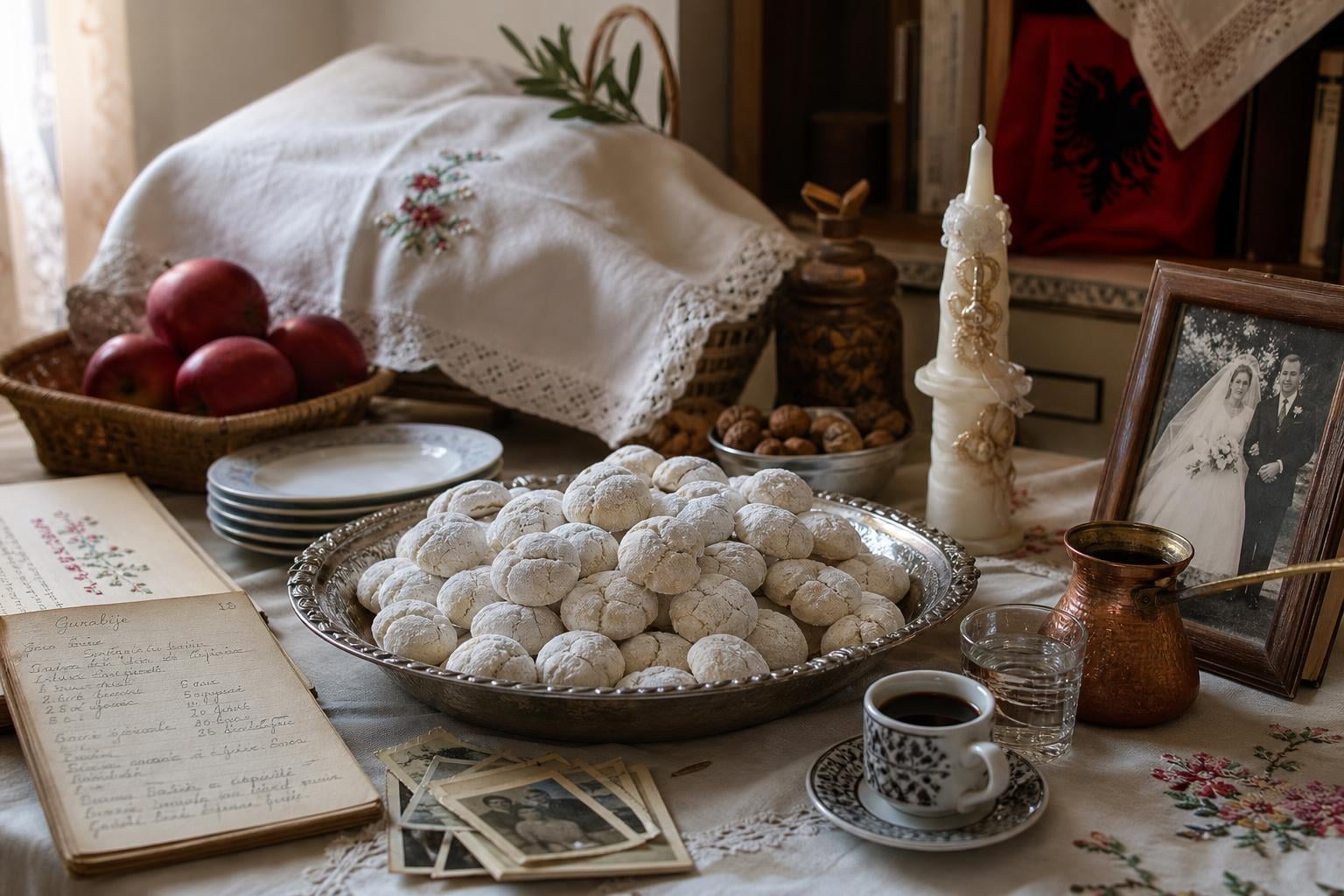
At every Albanian wedding in New York, Detroit, Worcester, and the Bronx, the same white cookie shows up on the same kind of silver tray. It sits next to the kafe turke (Turkish coffee), the candied almonds, and the small glasses of cordial. The cookie is gurabija — a dry, dense, slightly sandy shortbread that the older women in the family made by feel, by handful, and rarely from a written recipe.
That is the problem this piece tries to fix. Second- and third-generation Albanian Americans tell us the same story: the gurabija tin at gjyshja’s (grandma’s) house was always full, and when she stopped baking, the recipe stopped existing. There is no box mix and no supermarket aisle. Whoever holds the recipe in your family holds something specific, and if it does not get written down, it does not survive a generation.
This guide is for the cook who grew up eating gurabija and wants the method on paper, and for the cook who has only heard the word. The recipe is honest: cup and gram measurements, US oven temperatures, real timing, and notes for the variables that matter — flour, fat, resting time. We will also walk through where the cookie comes from and how the diaspora version differs from what you find in Tirana, Pristina, or a Sicilian Arbëresh kitchen.
NAR is the National Albanian Registry, a 501(c)(3) building a community-led count of Albanian Americans. Recipes like this one are part of the cultural record we are preserving alongside the count. If your family carries this recipe, we want to know.
The Cookie at the Center of Every Albanian Celebration
Walk into any Albanian-American wedding hall — Yonkers, Sterling Heights, the rented banquet rooms in Worcester and Waterbury — and the dessert table tells the same story. Trilece in the center. Baklava on one side. A platter of gurabije on the other. The smaller cookies disappear first, taken three at a time by aunts who slip them into napkins.
The cookie shows up at every life event. At baptisms, the tray sits next to the candle. At funerals, kafe turke is poured into small porcelain cups and the gurabije pass around the room without speech. At holiday tins — Bajram, Easter, Christmas, Nevruz — the cookie is the constant. Trays of baklava come and go; the white shortbread stays.
It is also a daily cookie. Many Albanian households keep a tin on the counter year-round. It travels well, does not go stale quickly, and pairs cleanly with Turkish coffee in a way almond-rich or syrup-soaked sweets do not. A guest arriving in the afternoon without warning is offered coffee, and the tin opens.
That dual role — celebration and weekday, special and ordinary — is what makes gurabija the most Albanian of Albanian cookies. Baklava is event food. Trilece is event food. Gurabija is event food and the thing in the tin behind your grandmother’s coffee tray. In a US diaspora figuring out how to keep its food traditions intact across the third generation, the cookie that does both is the one worth learning.
Where Gurabija Comes From
The cookie is part of a family of shortbread cookies that spread across the Ottoman Empire and stayed behind in every kitchen the empire touched. The Albanian gurabija, Turkish kurabiye, Greek kourabiedes, Bosnian and Serbian gurabija, Bulgarian kurabii — all share a single root.
The word’s deeper root is disputed. Some food historians trace it to the Arabic ghurayba (غريبة), a soft butter cookie known in the medieval Arab world; others argue for a Persian rosewater cookie, gulābiya; and some linguists hold that Turkish itself is the origin point, with the Arabic and Persian forms borrowed from it rather than the reverse. What is settled is that kurabiye spread through Ottoman Turkish into every language of the empire and its successor states (Wikipedia: Kurabiye). Each culture took the same base — flour, fat, sugar, sometimes egg — and shaped it to local taste.
The Albanian version is among the plainest in the family. Where Greek kourabiedes are pillowy with butter, dusted in clouds of powdered sugar, and often loaded with toasted almonds or rosewater, Albanian gurabije are dry, sandy, and unornamented. An egg yolk for color, a hint of vanilla or a few drops of cognac, and that is the seasoning list. The cookie is the quiet companion to coffee, not the star of the table.
That plainness is partly the long shadow of communist-era Albania, when decades of state food rationing under Enver Hoxha’s regime meant imported and specialty ingredients rarely reached ordinary kitchens (Wikipedia: Albanian cuisine). Cooks made do with neutral oil, regular granulated sugar, and whatever flour they could get. The version that emigrated with families in the 1990s and 2000s carries that leaner base forward — the diaspora version we bake in the US today, with butter creeping back in as households can afford it.
The result is a cookie that is recognizably Balkan, recognizably Ottoman in lineage, and at the same time recognizably Albanian — drier and plainer than its cousins.
What Gurabija Actually Is
Gurabija is a small, off-white shortbread cookie. Diameter is about 1.5 inches (4 cm) for a standard size, sometimes shaped into a small crescent, sometimes a flattened round with a thumbprint, sometimes a half-moon scored with a fork.
The texture is the load-bearing thing. A correctly made gurabija is dry on the outside, sandy at the first bite, and breaks down into something almost powder-like in the mouth. No chew, no give. The crumb structure is closer to Scottish shortbread than to an American sugar cookie — short, fragile, falling apart against the tongue.
Color is pale. The cookie is not browned aggressively. A correctly baked tray comes out with just the faintest gold at the edges and a center essentially the color of the dough that went in. If the cookies are tan or brown all the way through, the oven was too hot or they stayed in too long.
Flavor is subtle. No chocolate, no nut, no fruit, no spice. The dominant note is butter or oil, the sugar is moderate, and a single drop of vanilla rides underneath. Some families add a small pour of cognac or raki for aromatics. The cookie should taste like itself: flour, fat, sheqer (sugar), and patience.
What gurabija is not is also worth naming. It is not soaked in syrup (that is sheqerpare). It is not layered with phyllo and nuts (that is baklava). It is not crescent-shaped with powdered sugar (that is kourabiedes, the Greek cousin). It is the plainest cookie on the tray, and that plainness is the point.
Ingredients You Need
This recipe makes about 36 cookies, enough for one celebration tray with leftovers for the tin.
- All-purpose flour — 4 cups (500 g), spooned and leveled
- Granulated sugar — 1 cup (200 g)
- Neutral oil (sunflower, vegetable, or light olive) — 1 cup (240 ml). Or unsalted butter, melted and cooled — 1 cup (225 g)
- Eggs — 2 large, at room temperature
- Baking powder — 1 teaspoon
- Vanilla extract — 1 teaspoon
- Cognac, raki, or brandy (optional) — 1/2 teaspoon
- Fine sea salt — a generous pinch (about 1/4 teaspoon)
- Powdered sugar for dusting (optional) — 2 tablespoons
A note on the flour: spoon it into the measuring cup and level the top with a knife. Do not scoop directly — that packs the flour and adds 15–20% by weight. If you have a kitchen scale, use the grams.
A note on the fat: oil is the older village-style choice and gives the drier, sandier classic texture. Butter is the diaspora upgrade and gives a richer, slightly softer cookie. Both are correct.
A note on the egg: room-temperature eggs combine with oil or melted butter without seizing. Set eggs out an hour before you start, or warm them in tap water for ten minutes.
A note on the alcohol: a half teaspoon of cognac, raki, or brandy is traditional in older households. The alcohol bakes off completely and contributes a faint warm aromatic. Skip it if you prefer.
Step-by-Step Method
Total time is about two hours, mostly hands-off. Active time is roughly 30 minutes.
-
Preheat the oven to 325°F (165°C). Line two large baking sheets with parchment paper. The temperature is deliberately moderate — gurabija should bake long and slow, not hot and fast.
-
Whisk the dry ingredients. In a large bowl, combine 4 cups (500 g) flour, 1 cup (200 g) sugar, 1 teaspoon baking powder, and a generous pinch of salt. Whisk until evenly mixed, breaking up any sugar clumps with the back of a spoon.
-
Combine the wet ingredients. In a separate medium bowl, whisk 2 room-temperature eggs until the yolks and whites are fully combined. Add 1 cup (240 ml) oil (or 1 cup melted-and-cooled butter), 1 teaspoon vanilla, and the optional 1/2 teaspoon cognac. Whisk again until uniform.
-
Bring it together. Pour the wet mixture into the dry. Use a wooden spoon or your hand to fold, scraping the bowl as you go. The dough should come together as a soft, slightly crumbly mass. If it feels wet or sticky, add flour 1 tablespoon at a time. If it feels too dry to hold a shape when squeezed, add 1 teaspoon of oil at a time.
-
Rest the dough for 20 minutes. This is non-negotiable. The flour needs time to fully absorb the fat, and the dough firms as it sits. Cover the bowl with a kitchen towel and walk away.
-
Shape the cookies. Pinch off pieces about the size of a walnut — roughly 1 tablespoon, or 20 g if you have a small scale. Roll each piece between your palms into a small ball, then flatten gently to about 1.5 inches (4 cm) across and 1/2 inch (1 cm) thick. Place on the parchment-lined sheet about 1 inch (2.5 cm) apart. They do not spread much.
-
Mark the tops. Use the tines of a fork to press a small cross or parallel lines into the top of each cookie. This is decorative and traditional, not structural. Some families use the bottom of a glass; others leave them plain.
-
Bake 22 to 28 minutes. The cookies should look barely golden at the edges and pale across the top. If you wait until they look browned in the American cookie sense, they are overdone. Rotate the trays halfway through (front to back, top to bottom) for even color.
-
Cool on the tray for 10 minutes, then transfer. Gurabije are extremely fragile when hot. Let them firm up on the tray before moving to a wire rack. Cooling completely takes about 30 minutes.
-
Dust with powdered sugar (optional). Diaspora households often skip this step; village-Albania households often add it. A light dusting through a fine sieve once the cookies are fully cool is the traditional touch. If you serve them with coffee, dust at the table.
Yield: approximately 36 cookies. Store in an airtight tin at room temperature.
Variations Across the Diaspora
The cookie shifts as it crosses borders. In Albanian-American kitchens, the version in northeast cities (New York, Worcester, Boston) leans toward butter and a slightly richer dough — second-generation cooks have adopted American baking expectations. In Midwestern Albanian households (Detroit, Chicago), oil-based recipes persist more strongly, in part because immigration waves from southern Albania and Kosovo brought rural recipes that did not switch to butter.
In Kosovo, the cookie is most often made with oil and is sometimes called gurabije me vaj (gurabija with vaj, oil) to distinguish it from butter versions. Shapes tend toward small crescents or stamped rounds.
In North Macedonia, Albanian families in Tetovo, Skopje, and Struga bake essentially the same cookie under the same name. A version with crushed walnuts in the dough exists in some households as a distinct local variant.
In the Italian Arbëresh communities — the Albanian-language villages of southern Italy and Sicily, settled from the 15th century after the fall of the Albanian principalities — the best-documented named specialty isn’t a cookie at all. Kulaçi, recorded in villages such as San Costantino Albanese, is a wedding cake, not a shortbread (Wikipedia: Arbëreshë people). It sits on the celebration table for a different reason than gurabija does, and the two should not be confused as cousins in the same cookie family.
Across these variations, the core idea holds: flour, fat, sugar, eggs, baked low and slow, served with coffee. The cookie is plain enough to absorb regional preference without losing its identity.
How to Serve It
The default pairing is kafe turke — Turkish coffee — served in small porcelain cups with thick foam on top and grounds settled at the bottom. The coffee is bitter, unfiltered, and dense. The cookie is dry and plain. The two balance each other: the cookie absorbs a touch of coffee on the tongue, the coffee cuts the sweetness, and the combination is the standard daily ritual in many Albanian households.
At weddings and baptisms, gurabije appear on a tiered platter alongside trilece (three-milk cake), baklava, candied almonds, and small glasses of liqueur. The cookies are typically the first thing eaten and the last thing left over — they keep well during a long reception and travel home with guests in wrapped napkins.
At Bajram, the Muslim Eid celebrations, gurabije join baklava, halva, and other syrup-rich sweets on the holiday tray. Bajram tables welcome guests for several days, and the cookie’s long shelf life is part of why it stays in rotation. At Easter in Catholic and Orthodox households, gurabije sit next to the dyed red eggs and the special breads.
At funerals, the role is more specific. Albanian funeral coffees — the gatherings held after the burial and again at the seven-day and forty-day marks — center on kafe turke served to mourners in succession. Gurabije and other plain cookies pass quietly. There is no sweetness in the visit; the cookie is meant to acknowledge the host’s hospitality, not to celebrate.
For a weekday afternoon, the cookie goes well with coffee, with strong black tea, or with a small glass of milk. In a US diaspora kitchen, gurabije are also at home next to a mug of American drip coffee, which is lighter than Turkish coffee and lets the cookie’s plainness come through more directly.
Storage and Shelf Life
Gurabije are unusually long-lived. The combination of low moisture, fat, and sugar leaves very little for spoilage organisms to work with. Stored in a tin or airtight container at room temperature, the cookies hold their texture for two to three weeks.
The container matters. A tin with a tight lid is the traditional choice and works because metal does not absorb odors and the lid seals against humidity. A glass jar with a screw lid is the next best option. Plastic works but can trap residual moisture if the cookies were not fully cooled before storage.
Do not refrigerate. The refrigerator pulls moisture out of the cookie unevenly and leaves it with a stale chalkiness that no recovery time can fix.
For longer storage, gurabije freeze well. Place fully cooled cookies in a freezer bag with as much air pressed out as possible. They keep for three months without noticeable texture loss. Thaw at room temperature for 30 minutes before serving; do not microwave.
Raw dough can also be made ahead. Wrap tightly and refrigerate up to three days, or freeze in a log shape for up to two months. Let it return to cool-room temperature before shaping — straight-from-the-fridge dough cracks when pressed.
Common Mistakes to Avoid
Overworking the dough. Gurabija dough wants the minimum handling that gets it together. Knead it like bread and you develop the gluten, which gives a chewy cookie instead of a sandy one. Fold until it comes together, then stop.
Oven too hot. The most common diaspora mistake is reading “shortbread” and reaching for the 350°F setting that American cookie recipes use. Gurabija bakes at 325°F (165°C). At 350°F the cookies brown before they bake through, and the inside stays slightly raw while the outside hardens. Lower and slower is correct.
Skipping the rest. Twenty minutes of resting after the dough comes together is what lets the flour fully absorb the fat. Without it the cookies spread in the oven and the texture is greasy. Set a timer and walk away.
Wrong flour weight. Measuring by volume without spooning and leveling adds enough flour to change the cookie’s structure. If you have a kitchen scale, use the grams. If you do not, fluff the flour in its bag with a fork before measuring, then spoon it into the cup and level with a knife.
Cold eggs. Cold eggs hitting room-temperature oil or warm melted butter will cause the fat to seize into small lumps that never fully reincorporate. Set eggs out an hour ahead or warm them in a bowl of warm tap water.
Pulling them out too early or too late. The visual cue is wrong here — by the time gurabije look “done” in the American cookie sense, they are overdone. Pull them when the edges are just barely tinged gold and the centers are still pale. They firm up significantly as they cool.
Underseasoning the salt. A common oversight is forgetting salt entirely. A generous pinch — about 1/4 teaspoon for the full batch — is enough. Without it the sweetness reads flat.
Storing while still warm. A cookie sealed in a tin while heat is still escaping the crumb will trap moisture and soften. Let the batch cool fully on a rack — 30 minutes minimum — before tin storage.