

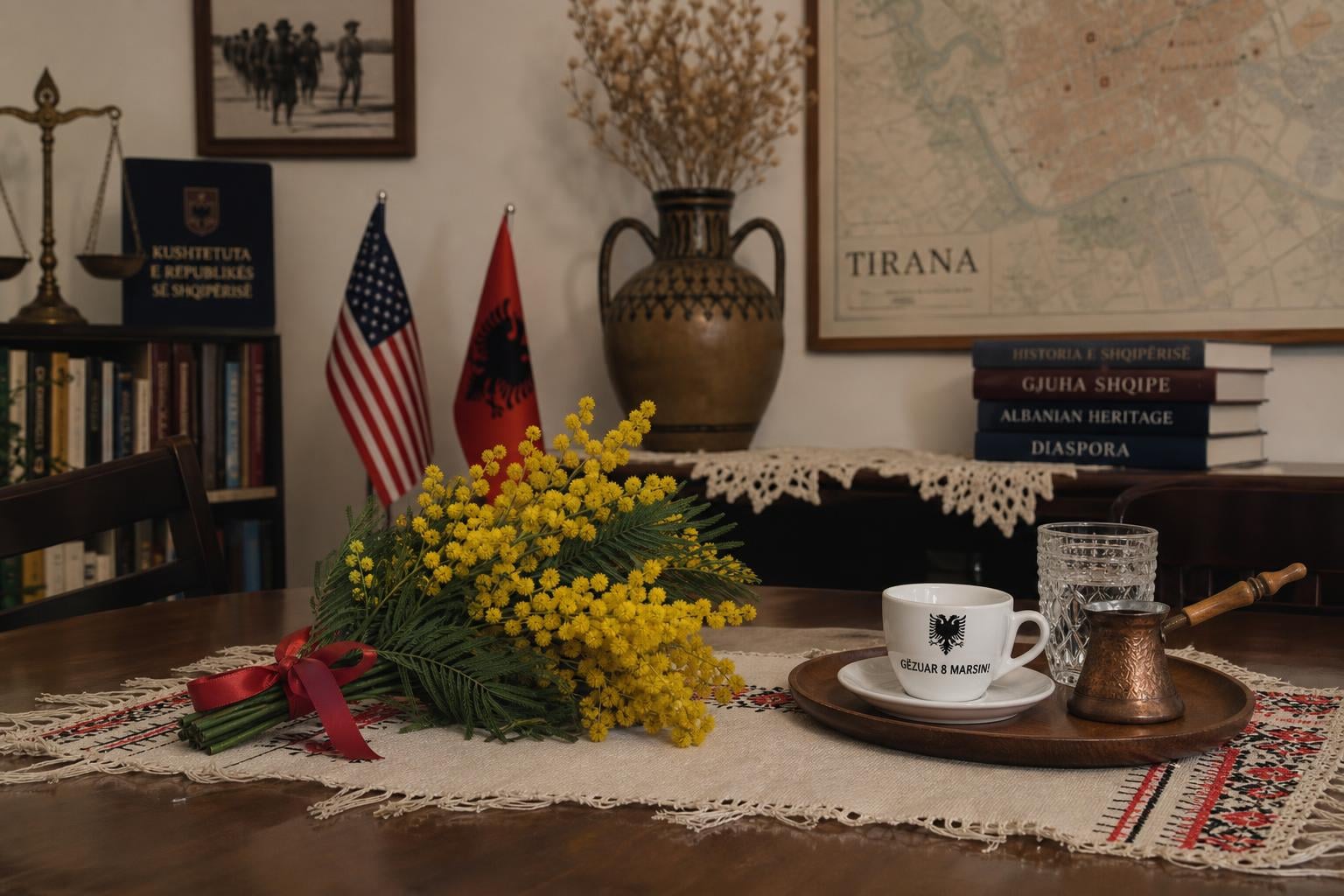
Saturday morning, March 8, in a Bronx apartment. Two kids — ages nine and twelve — are at the kitchen table with a card they made the night before, half in English, half in Albanian. The Albanian half says Gëzuar 8 Marsin, mami. A small sprig of yellow mimosa, bought from the Italian florist on Arthur Avenue, sits in a juice glass. The phone is already dialing Tirana for the morning call to gjyshe (grandmother).
This scene plays out across Albanian-American homes every March 8. It is the day Albanian families mark women — mothers, grandmothers, sisters, wives, daughters, teachers, friends — with flowers, phone calls, small gifts, and a single greeting that travels by text, voice memo, and front-door hug. The phrase is Gëzuar 8 Marsin (happy March 8th), often paired with urime (congratulations, best wishes). The day itself is known as Dita Ndërkombëtare e Gruas (International Women’s Day) or, more commonly in everyday speech, Dita e Gruas (Day of the Woman).
This piece is a guide for the US diaspora. What the greeting means and how to use it. Why Albanian families treat March 8 as Mother’s Day. The history of the day in Albania, the role of the mimosa flower, and how second- and third-generation kids in New York, Michigan, Massachusetts, and Texas can mark the day for the women in their family — even when the Albanian is shaky. No tourism, no event listings, no politics. Just the practical, neighborly version a relative might walk you through over coffee.
What Gëzuar 8 Marsin means
Gëzuar 8 Marsin is built from three parts.
Gëzuar — pronounced roughly guh-ZOO-ar — is the Albanian word for “happy” or “joyful,” used as a holiday wish across the calendar. The same word opens Gëzuar Vitin e Ri (Happy New Year), Gëzuar Krishtlindjet (Merry Christmas), and Gëzuar Bajramin (Happy Bajram). The grammar is participial — literally something like “[may you be] gladdened” — but the function is identical to English “happy” in a holiday greeting.
8 Mars is “March 8” — tetë Mars if spelled out, almost always written numerically. In the greeting, the date is the object of the wish, so it takes the Albanian accusative ending: 8 Marsin. The shift from Mars to Marsin is the same grammar move as Bajram to Bajramin in Gëzuar Bajramin. Albanian marks the object of a wish with a definite ending; English does not, which is why a literal translation reads slightly differently.
Put together, Gëzuar 8 Marsin is “[Have a] joyful March 8th.” It is the most common short form. The longer, more formal version is Gëzuar Ditën Ndërkombëtare të Gruas (Happy International Women’s Day) or Gëzuar Ditën e Gruas (Happy Day of the Woman). A common pairing is Urime për 8 Marsin (best wishes for March 8) or Urime për Ditën e Gruas (best wishes on Day of the Woman), where urime (congratulations, well-wishes) softens the greeting into a more affectionate register.
The phrase works for any woman in your life — your mother, your grandmother, your sister, your daughter, your wife, your coworker, your barista. In Albanian usage, the greeting is universal across the day; there is no equivalent of the English distinction between “Happy Mother’s Day” (mothers only) and “Happy Women’s Day” (women generally). On March 8, every woman gets the wish.
A short history of March 8 in Albania
International Women’s Day did not begin in Albania. It began in Copenhagen in 1910, when the German socialist Clara Zetkin proposed an annual international day to honor women workers at the Second International Socialist Women’s Conference. The first observances were held in 1911 in Germany, Austria, Denmark, and Switzerland. The date settled on March 8 after the 1917 strike by women workers in Petrograd — held on what was March 8 in the Western Gregorian calendar — helped trigger the Russian Revolution. The date was formally fixed as March 8 in 1921, at the Second International Conference of Communist Women; the Soviet Union did not make it an official non-working holiday until 1965, and the wider Soviet bloc followed suit across the 20th century.
Albania, after liberation in 1944, made March 8 an official state holiday almost immediately. The People’s Republic of Albania under Enver Hoxha used the day to celebrate women’s contribution to socialist construction — factory workers, kooperativiste (collective-farm workers), teachers, doctors. Schools held assemblies. Workplaces organized speeches and small gifts. Newspapers ran tributes. For 47 years, March 8 was one of the most reliable holidays on the Albanian calendar.
After the regime fell in 1991, the political framing dropped away. The day kept its place. What changed was the meaning: instead of celebrating women’s role in building socialism, the day became a family-and-flowers holiday, much like Mother’s Day in the West. The greeting on the street stayed Gëzuar 8 Marsin. The flowers stayed mimosa. The phone calls home stayed.
A related shift happened with Dita e Mësueses (Teacher’s Day), which Albania observes on March 7 — the day before. The two days now run as a back-to-back pairing: teachers get flowers on the 7th, women generally get flowers on the 8th. Many Albanian-American kids who attend Albanian-language Saturday schools in New York, Michigan, or Connecticut mark both, handing flowers to their Albanian teacher on Friday and to their mother on Saturday.
Today, March 8 in Albania, Kosovo, and North Macedonia is observed as a public-spirit day rather than a state holiday in the Hoxha-era sense. Government offices stay open. Shops stay open. But florists sell out of mimosa branches by mid-morning, every restaurant takes lunch reservations, and the phone networks run heavy with calls between continents.
Why Albanian families treat it as Mother’s Day
Most Albanian-American families do not observe the US Mother’s Day — the second Sunday of May — as their primary maternal holiday. They observe March 8. This is one of the most common points of confusion when an Albanian household integrates with American school calendars, Hallmark store displays, and well-meaning teachers who assume Mother’s Day in May.
The reason is straightforward: Albania historically had one day for the women of the family, and that day was March 8. The Communist state did not import the US Mother’s Day. Neither did the post-1991 Albanian republic. The cultural slot in the calendar was already filled. When Albanian families emigrated to the US — in the 1990s wave, the early 2000s wave, and continuously since — they brought the March 8 practice with them.
The result is a quiet calendar split inside many Albanian-American homes. The kids learn at school that Mother’s Day is in May and make a card in art class. The parents — especially first-generation parents — wait for March 8 and call gjyshe in Tirana, Prishtina, or Skopje. Some families observe both, treating May as the American version and March 8 as the real one. Others mark only March 8 and let May pass. A small number, particularly in households with one non-Albanian parent, fully switch to May.
Functionally, when an Albanian person says Mother’s Day, they almost always mean March 8. When they say Dita e Nënës (Day of the Mother), they may mean either March 8 or — in some Catholic communities and in a small handful of post-1991 contexts — a separate observance. The safest assumption is that March 8 is the day mom expects a call.
This also means that for many second- and third-generation Albanian-Americans, March 8 is a more emotionally weighted day than May’s Mother’s Day. It is the day the family-network call chain lights up. It is the day a kid in Yonkers hears their gjyshe in Korçë say Faleminderit, zemra ime (thank you, my heart) on a video call.
How Albanian-Americans mark the day
The American observance follows a small, predictable shape across most households.
The morning starts with the kids. Younger kids hand their mother a card, a flower, or breakfast in bed. Older kids and adults send a text — Mami im, gëzuar 8 Marsin, të dua (my mom, happy March 8, I love you). Husbands give wives a flower, sometimes a small gift. The exchange is not extravagant; it is consistent.
The phone calls come next. Almost every Albanian-American household with a parent or grandparent still in Albania, Kosovo, or North Macedonia places a call home on March 8. WhatsApp and Viber carry most of these calls. The greeting is the same in every direction: Gëzuar 8 Marsin.
Flowers are the most visible part of the day in the US. Florists in Albanian-dense neighborhoods — Belmont in the Bronx, Astoria in Queens, Sterling Heights in Michigan, Worcester in Massachusetts — stock mimosa branches and small bouquets the week before. Tulips and roses are common alternatives. A single mimosa branch in a glass on the kitchen table is enough.
The day’s main meal is usually lunch or dinner with family. A common spread includes byrek (Albanian filo pie), fërgesë (peppers and tomato cooked with cheese), salads, and grilled meats. Cake is on the table. Wine and coffee carry the meal more than raki on this particular day.
Albanian-American Saturday schools — the shkolla shqipe that run on weekends in many US cities — mark the day with student recitations. Kids read short poems for their mothers, sing songs, hand out flowers. For many families, the Saturday closest to March 8 is when their kid performs Mami ime (my mother) in front of an auditorium of parents holding phone cameras.
Common Albanian wishes for Women’s Day
The full set of greetings, with English glosses, in roughly the order they appear in everyday Albanian-American use:
- Gëzuar 8 Marsin! — “Happy March 8th.” The most common short form. Works for anyone, any setting.
- Urime për 8 Marsin! — “Best wishes for March 8.” Slightly warmer; pairs urime (congratulations, well-wishes) with the date.
- Gëzuar Ditën e Gruas! — “Happy Day of the Woman.” More descriptive; common in cards and posters.
- Gëzuar Ditën Ndërkombëtare të Gruas! — “Happy International Women’s Day.” The formal full name; used in workplace messages, official statements, headlines.
- Urime për Ditën e Gruas! — “Best wishes on Day of the Woman.” A softer version of the formal greeting.
- Mami im, gëzuar 8 Marsin, të dua. — “My mom, happy March 8, I love you.” The text most kids send. Mami is the affectionate “mom”; të dua is “I love you.”
- Gjyshes sime të dashur, gëzuar 8 Marsin. — “To my dear grandmother, happy March 8.” For gjyshe (grandmother). The full grammar marks affection: të dashur (dear), sime (my).
- Motra ime, gëzuar 8 Marsin. — “My sister, happy March 8.” For a sister (motër).
- Bashkëshortes sime, gëzuar 8 Marsin. — “To my wife, happy March 8.” Formal; used in written cards. In speech, husbands more often say zemër (heart, sweetheart) or use the wife’s name.
- Mësueses sime, gëzuar 8 Marsin. — “To my teacher, happy March 8.” For a female teacher (mësuese); often paired with March 7 Dita e Mësueses in Saturday-school settings.
A note on register. Gëzuar alone — Gëzuar! — works in informal contexts the same way an English speaker might just say “Happy March 8!” without naming the holiday. Among close family it is enough. In writing, in formal cards, or across generations, the longer form lands better.
A note on spelling. Gëzuar is the official spelling, with the diacritical ë. Some older or informal greetings drop it and write Gezuar. Both are read the same; the version with ë is correct.
Greetings for different recipients
The tone shifts slightly depending on who you are wishing.
To your mother. Mami im, gëzuar 8 Marsin is the standard. Many Albanian-Americans use Mama (more common in Catholic households) or Nëna (more formal, more common in writing) instead of mami.
To your grandmother. Gjyshe, gëzuar 8 Marsin in speech. Many grandmothers in Albania, Kosovo, and North Macedonia receive a video call on March 8 from grandchildren in the US who barely speak Albanian. A simple Gëzuar 8 Marsin, gjyshe, të dua shumë (happy March 8, grandma, I love you very much) is a complete moment.
To your sister. Motër is “sister.” Sisters often skip the formal greeting and use a name plus gëzuar: Eda, gëzuar 8 Marsin! The tone is peer-to-peer.
To your wife. Husbands use the wife’s name plus zemër (sweetheart) or another term of endearment. Zemër, gëzuar 8 Marsin is common. Written cards may use bashkëshortes (to my wife), but in speech this reads as overly formal.
To your daughter. Bija ime, gëzuar 8 Marsin — “my daughter, happy March 8.” A father wishing his daughter on March 8 signals that she is included in the day as a woman in her own right, not only as a future mother.
To a teacher. Gëzuar 8 Marsin, mësuese — “happy March 8, teacher.” Albanian-American Saturday schools often coordinate small group gifts for female teachers, paired with March 7 Dita e Mësueses.
To a coworker. Gëzuar 8 Marsin with first name. In Albanian-American workplaces with a mostly-Albanian staff, March 8 is acknowledged the way Christmas or New Year is — flowers from the boss, a short toast.
Across generations. Younger speakers should use Ju (the formal “you”) rather than ti (the informal) for older women outside the immediate family. Gëzuar 8 Marsin, ju uroj shëndet dhe lumturi — “happy March 8, I wish you health and happiness” — is a respectful full greeting.
The mimosa tradition
The mimosa branch is the iconic flower of March 8 in Albania, Kosovo, and the diaspora. The species is Acacia dealbata — silver wattle — a small flowering tree native to Australia, naturalized across the Mediterranean, with clusters of bright yellow pom-pom blossoms that open in late February and early March.
The tradition did not begin in Albania. It began in Italy in 1946, the first peacetime March 8 after the war, when activists Teresa Mattei, Rita Montagnana, and Teresa Noce chose the mimosa as the symbol of Festa della Donna (Festival of the Woman). The reasoning was practical: the mimosa blooms in early March, it grows wild across the Italian countryside, and it cost almost nothing — a flower the post-war working class could actually afford. Pinned to a lapel, carried in a small bouquet, or tied with a ribbon at a market stall, the mimosa became the visual code for March 8 in Italy.
Albania, which sits across the Adriatic from Italy and which absorbed enormous cultural influence from Italian television and radio in the late 1980s and 1990s — particularly RAI broadcasts that reached the Albanian coast — adopted the mimosa as the same symbol on the same date. By the 2000s, trumzë mimoze (a sprig of mimosa) was the standard March 8 gift across Albania, regardless of region. Kosovo and North Macedonia followed. The diaspora kept the practice.
In the US, mimosa branches are sold at Italian florists (Arthur Avenue in the Bronx, Federal Hill in Providence, the North End in Boston, Italian-Albanian shops in Astoria) and at Albanian markets that stock them for the week. Some florists import directly from California growers; others source from Italy. A single branch — five to ten yellow clusters on a stem — is the standard small gift. A small bouquet of mimosa is more formal. The flower’s symbolism is read by every Albanian and Italian woman receiving it; explanation is rarely needed.
Common alternatives: red tulips, white tulips, small bouquets of pink or yellow roses, freesias. Albanian florists sometimes pair mimosa with tulips in a single bouquet. The shorthand “give her flowers on March 8” is more important than the specific species; the mimosa is the cultural default but not a requirement.
March 8 in Communist Albania vs today
The Hoxha-era observance, from 1944 to 1991, was state-organized. Factories held assemblies. The Albanian Women’s Union (Bashkimi i Grave të Shqipërisë), founded in 1943, ran public events. Newspapers ran portraits of model women workers — the textile worker, the agronomist, the doctor, the teacher. Schools released children early; some workplaces gave a half-day off. The state distributed small gifts through workplace committees.
The framing was political. Women were celebrated as builders of socialism, as evidence of the regime’s claim to have liberated Albanian women from what the state described as feudal and religious oppression. The propaganda mixed real changes — universal female literacy by the 1980s, mass female employment, women in technical professions — with the broader claims of the regime.
After 1991, the state framing fell away. The Albanian Women’s Union dissolved. Public assemblies stopped. What remained was the family practice. The flowers, the calls, the lunches, the small gifts at home — all of it survived because none of it had been imposed by the state in the first place. The state had observed the day; the family was always the unit that meant it.
Today’s March 8 in Albania, Kosovo, and North Macedonia carries no political weight. It is treated the way Mother’s Day is treated in the US — a family holiday, marked privately, with public visibility limited to florist shops and restaurants. Younger Albanians sometimes mark the day with feminist organizing and public statements about ongoing issues (domestic violence rates, workplace pay gaps, political representation), but this is a layer added on top of the family practice rather than a replacement for it.
The diaspora inherited the post-1991 version. For a child born in Yonkers in 2008 to parents who emigrated from Vlorë in 1998, March 8 is the day they call grandma. The Hoxha era is a story, not a memory. The mimosa branch on the kitchen table is the connection that survived.
How kids in the diaspora can mark the day
Second- and third-generation Albanian-Americans often want to mark March 8 for their mothers and grandmothers but feel the language is a barrier. It is not. The gesture is the language. A handwritten card, a flower, and a short phrase carry the day even when the speaker’s Albanian is unsteady.
The handwritten card. A folded card with one Albanian line — Gëzuar 8 Marsin, mami — and the rest in English. The Albanian line is what makes it a March 8 card rather than a generic Mother’s Day card. Most mothers keep these for decades.
The video call to gjyshe. The conversation does not have to be in Albanian. An opening — Gëzuar 8 Marsin, gjyshe, të dua — and a closing — Faleminderit, gjyshe, mirupafshim (thank you, grandma, goodbye) — frame an English middle and the call lands as fully Albanian for her.
Three Albanian phrases worth teaching kids by age five:
- Gëzuar 8 Marsin — happy March 8 (greeting)
- Të dua — I love you (closing)
- Faleminderit — thank you (reply when she thanks you back)
These three travel further than any longer phrase. Kids carry them for life.
The flower. A single mimosa branch, a tulip, a small rose. The act of handing it over with the greeting is the entire ceremony.
The lunch. Older kids and adult children take their mother to lunch or cook for her. Albanian-American restaurants in the New York, Detroit, Boston, and Worcester metros run March 8 specials and book up the week before.
For grandmothers no longer here. March 8 is a day many adults visit a grave or light a candle. Albanian Catholic, Orthodox, and Muslim traditions all have variants of this practice.
The day is built to be small. A flower, a call, a card, a meal. None of it requires fluent Albanian. The phrase Gëzuar 8 Marsin is the door; what walks through it is whatever the speaker has, in whatever mix of languages the household speaks.
Get counted on the registry
If your mother, grandmother, or wife is Albanian-American and not yet on the National Albanian Registry, March 8 is a good day to add the women of the family. The registry is free, takes about a minute, and is a community-led count of Albanian-Americans in the country. Register here.