
Most second-generation Albanian Americans grow up with one foot in each language. You hear gjyshe (grandmother) on the phone, byrek (savory pie) at the kitchen table, and a long stream of Albanian at weddings that you mostly catch but can’t quite produce yourself. The vocabulary is in there. What’s missing is the connective tissue — the small phrases, the polite formulas, the right thing to say when an aunt hands you a plate or a great-uncle starts a toast.
This is a working phrase book for that situation. Not a textbook, not a tourist guide. The phrases here are the ones a heritage speaker actually needs: how to greet an elder, how to behave at the table, what to say at a wedding or a funeral, the terms of endearment used for kids and grandkids, and the handful of idioms that turn a polite stranger into family. We’ve also included a short pronunciation primer because the 36-letter Albanian alphabet contains a few letters English readers consistently mispronounce, and getting those right is the difference between sounding like a heritage speaker and sounding like a tourist with good intentions.
A note before we start: most readers in the US diaspora come from Gheg-speaking families (Kosovo, northern Albania, North Macedonia, Montenegro), but the official literary standard taught in schools and used in writing is Tosk-based. We’ll flag the differences where they matter and stay neutral on which one is “real” Albanian. Both are. Use what your grandparents use.
A short note on pronunciation
Albanian uses a 36-letter Latin alphabet standardized at the 1908 Congress of Manastir (in present-day North Macedonia). The script looks familiar to English readers, but several letters carry sounds English speakers don’t expect. The good news: the alphabet is almost perfectly phonetic. Each letter has one sound, every time. Once you learn the table, you can read aloud accurately even when you don’t know the meaning.
| Letter | Sound | English example |
|---|---|---|
| ë | schwa (the “uh” in sofa); often silent at word endings | gjyshë (gypsh-uh) — grandmother |
| ç | “ch” as in chair | çelës (CHEH-lus) — key |
| c | “ts” as in cats | cica (TSEE-tsah) — breast/teat (also used for baby’s bottle) |
| q | a soft “ch” (between “ky” and “ch”) | qen (chen) — dog |
| gj | a soft “j” — like the “gu” in argue | gjyshe (JEW-sheh) — grandmother |
| xh | “j” as in jam | xhami (JAH-mee) — glass / mosque |
| x | “dz” — voiced version of c | xixë (DZEE-dzuh) — spark |
| dh | “th” as in this | dhomë (THOH-muh) — room |
| th | “th” as in thin | thua (THOO-ah) — fingernail |
| rr | rolled, trilled “r” | rruga (RRR-OO-gah) — road |
| ll | a deep, dark “l” | llokum (lloh-KOOM) — Turkish delight |
| nj | “ny” as in canyon | një (nyuh) — one |
| sh | “sh” as in ship | shqip (shchip) — Albanian |
| zh | “zh” as in measure | zhurmë (ZHOOR-muh) — noise |
The trickiest letter for English speakers is ë. It’s the schwa — the unstressed “uh” sound that English already uses constantly but doesn’t write. At the end of a word it’s often barely pronounced (mirë sounds close to “MEE-ruh,” sometimes just “meer”). In the middle of a word it’s a real syllable. Gheg speakers tend to drop it more aggressively than Tosk speakers, which is one reason Kosovar Albanian sounds clipped to ears trained on standard Albanian.
The other thing to know: stress almost always falls on the penultimate (second-to-last) syllable. Faleminderit is fa-le-min-DEH-rit. Mirëmbrëma is mee-rum-BRUH-mah. Once you trust the rule, you can pronounce new words confidently the first time you see them.
Essential greetings
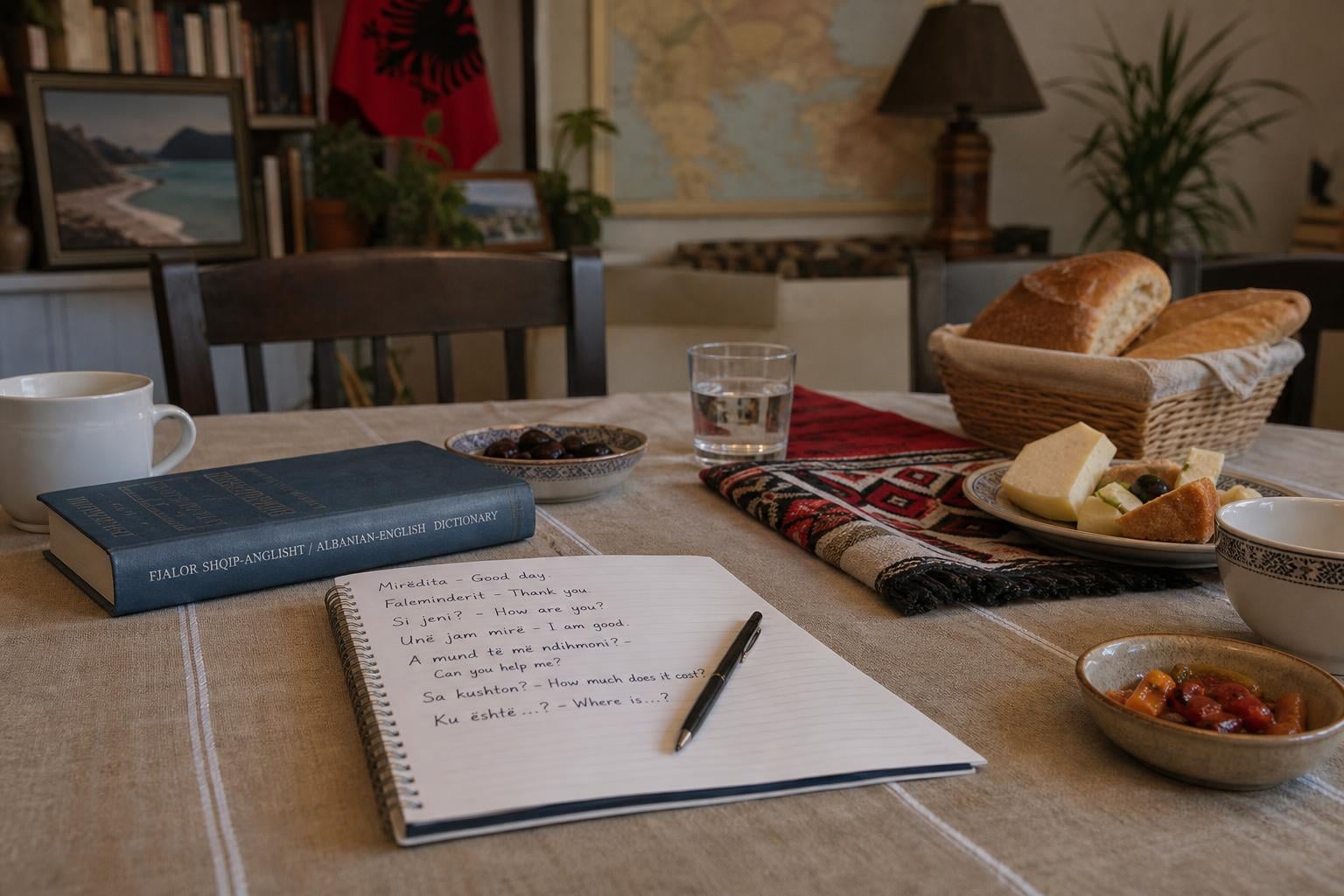
Greetings are where you make or lose the first impression. Albanian has a tiered system: there’s a casual register for family and peers, a formal register for elders and strangers, and a few set phrases that work everywhere. Memorize this short list and you’ll handle 90% of opening moments.
| Albanian | Pronunciation | Meaning | When to use |
|---|---|---|---|
| Mirëdita | mee-ruh-DEE-tah | Good day | Late morning through afternoon; formal and safe everywhere |
| Mirëmëngjes | mee-ruh-MUN-jess | Good morning | Until about 10–11 am |
| Mirëmbrëma | mee-rum-BRUH-mah | Good evening | After dark, until late |
| Natën e mirë | NAH-tun eh MEE-ruh | Good night | When leaving or before bed |
| Tungjatjeta | toon-jah-TYEH-tah | “Long life to you” — hello/goodbye | Respectful, slightly formal; works any time of day |
| Tung | toong | Hi / bye (shortened tungjatjeta) | Casual, with peers or younger family |
| Përshëndetje | pur-shun-DET-yeh | Greetings | Formal; phone calls, emails, strangers |
| Si je? | see yeh | How are you? (informal, singular) | To one peer, child, or family member |
| Si jeni? | see YEH-nee | How are you? (formal/plural) | To an elder, a group, or someone you’ve just met |
| Jam mirë, faleminderit | yam MEE-ruh, fah-leh-min-DEH-rit | I’m well, thank you | Universal polite response |
| Faleminderit | fah-leh-min-DEH-rit | Thank you | Standard; use it freely |
| Të lutem / Ju lutem | tuh LOO-tem / yoo LOO-tem | Please (informal / formal) | Use the formal ju lutem with elders |
| Po / Jo | poh / yoh | Yes / No | Universal |
A cultural note on Tungjatjeta. The word literally means “may your life be long” — a wish for the other person’s longevity, compressed into one word. Older speakers, especially in the south, use it as both hello and goodbye. Younger Albanians shortened it to tung. Both are fine. Saying the full tungjatjeta to a grandparent lands warmly every time.
Faleminderit is one of the few Albanian words English speakers struggle to chunk. Break it as fa-le-min-DE-rit. Stress lands on the DE. Heritage speakers shorten it to flmnt in texts and falmnerit in fast speech, but the full form is the standard.
Family vocabulary
Albanian family vocabulary distinguishes maternal and paternal lines in a way English doesn’t. There is no single word for “uncle” — you have to specify which side. This matters for diaspora kids talking to or about extended family, and it matters when an elder hears you use the wrong term and quietly notes it.
| Albanian | English | Notes |
|---|---|---|
| mama / nëna | mom / mother | mama is the everyday term; nëna is more formal |
| baba / babi | dad / father | baba is universal across the Albanian-speaking world |
| gjyshe / gjyshja | grandmother | gjyshja ime = my grandmother |
| gjysh / gjyshi | grandfather | gjyshi im = my grandfather |
| vëlla / vëllai | brother | plural: vëllezër |
| motër / motra | sister | plural: motra (same form) |
| dajë / daja | maternal uncle (mother’s brother) | most commonly addressed as daja + name |
| emtë / tezja / teze | maternal aunt (mother’s sister) | tezja is the most common form in diaspora speech |
| xhaxha / axha | paternal uncle (father’s brother) | xha for short; addressed as xhaxhi + name |
| hallë / halla | paternal aunt (father’s sister) | halla + name in direct address |
| kushëri / kushërira | cousin (m / f) | |
| nip / mbesa | grandson / granddaughter (also: nephew / niece) | context disambiguates |
| bir / bija | son / daughter | formal; djali / vajza are more everyday |
| gruaja / burri | wife / husband | literally “the woman” / “the man” |
| vjehrri / vjehrra | father-in-law / mother-in-law |
The maternal-paternal split is real and worth respecting. Your mother’s brother is daja; your father’s brother is xhaxhi. Confusing them in front of family is a small thing, but getting it right signals that you grew up paying attention. Many heritage speakers default to xhaxhi for every uncle because it’s easier — older relatives will gently correct, and that’s fine. Take the correction.
A note on form: in direct address you usually add the definite article. Gjyshi (the grandfather) is how you call him, not gjysh. Tezja (the aunt) is how you call her. Halla Nora means “Aunt Nora” (paternal). Daja Besnik means “Uncle Besnik” (maternal). The pattern is consistent once you see it.
At the table — hospitality (mikpritja)
Albanian hospitality, mikpritja, is a cultural cornerstone tied to the broader concept of besa — the code of honor that obligates a host to protect and feed any guest who crosses the threshold. The practical effect at a family dinner is that food keeps appearing on your plate, and refusing is harder than accepting. Here are the phrases that move the meal along.
| Albanian | Pronunciation | Meaning |
|---|---|---|
| Urdhëro! (sg) / Urdhëroni! (pl/formal) | oor-DUH-roh / oor-duh-ROH-nee | “Please, help yourself / come in / sit down” — multi-purpose courtesy verb |
| Hajde ha! | HIGH-deh HAH | “Come on, eat!” — affectionate push |
| Të bëftë mirë! | tuh BUFF-tuh MEE-ruh | “May it do you good” — said to anyone eating |
| Faleminderit, jam ngopur | … yam ngoh-POOR | “Thank you, I’m full” — the polite refusal |
| Më jep pak bukë, të lutem | muh yep pahk BOO-kuh tuh LOO-tem | “Pass me some bread, please” |
| Shumë e shijshme! | SHOO-muh eh SHEESH-meh | “Very tasty!” — compliment to the cook |
| Gëzuar! | guh-ZOO-ar | “Cheers!” — for raising a glass |
| Për shëndet! | pur shun-DET | “To your health” — used at a toast or after a sneeze |
| Mos u shqetëso | mos oo shchet-uh-SO | “Don’t trouble yourself” — when a host insists on serving |
| A ke uri? / A keni uri? | ah keh OO-ree / ah KEH-nee OO-ree | “Are you hungry?” (informal / formal) |
A practical truth: jam ngopur (I’m full) gets ignored at least once. The expected exchange is host insists, guest declines, host insists again, guest accepts a small portion. This isn’t manipulation — it’s the script. If you cannot eat another bite, pat your stomach and say Shumë faleminderit, gjithçka ishte shumë e shijshme (Thank you, everything was delicious). That phrase carries weight.
Gëzuar deserves its own line. You’ll hear it at every meal where wine, raki (the Albanian fruit brandy), or beer is poured. Glasses clink, eyes meet — eye contact during the toast matters — and the word lands. Some families add Për shëndet (to your health) before the first sip. At a wedding or a big holiday, expect multiple toasts, each with its own theme: to the elders, to the children, to those who are no longer with us.
Weddings, funerals, and holidays
These are the moments when knowing the right phrase matters most, and when guessing wrong feels worst. Here are the standard well-wishes and condolences across the main occasions in an Albanian-American family’s year.
Weddings (dasma). To the bride and groom: Të trashëgoheni (toh trash-eh-GOH-heh-nee) — “may you grow and continue together as a family,” the all-purpose wedding wish. To the parents of the couple: Të rrosh dhe ta gëzosh (may you live to enjoy them). To toast: Gëzuar dasmën! (joy to the wedding). After the wedding, when you next see the couple: Gëzuar të rinjtë! (joy to the newlyweds). For a deeper look at the rituals, see our guide to the Albanian wedding.
New babies. Të jetë me jetë të gjatë — “may they have a long life.” Shorter: Të rrosh (may they live). To the parents: Urime për fëmijën! (congratulations on the child). When meeting the baby for the first time, older relatives often say Mashallah — a Turkish-Arabic loanword used across Albanian-speaking Muslims, Christians, and secular families alike, meaning “what God has willed” but used culturally as “may no evil eye touch this beautiful child.”
Funerals (varrime) and condolences. This is the hardest register. The standard phrase is Ngushëllimet e mia (my condolences) or simply Të ngushëlloj (I offer you comfort). To the bereaved family: Të rrosh or Të jetosh — both mean “may you live,” said as a wish for the survivor’s continued life and health. Older speakers may say I lumtë jeta (blessed be the life [of the departed]). Don’t say Faleminderit in response to condolences; the expected reply is Të rrosh in return, or simply a nod and a hand on the heart.
Holidays. Albanians celebrate across faiths and the phrasing scales:
- Christmas: Gëzuar Krishtlindjet! (joyful Christmas)
- Easter: Gëzuar Pashkët! (joyful Easter) — response: Krishti u ngjall! / Vërtet u ngjall! (Christ is risen / Truly risen)
- Eid al-Fitr / Eid al-Adha: Gëzuar Bajramin! (joyful Bajram)
- New Year: Gëzuar Vitin e Ri! (joyful New Year)
- Independence Day (Nov 28): Gëzuar 28 Nëntorin! — Albania’s flag day
- Birthday: Gëzuar ditëlindjen! — and add Të lumtë jeta (blessed be your life)
The pattern is consistent: Gëzuar (joyful) + the thing you’re celebrating, in the accusative case. Once you hear it a few times, you can build your own.
Talking to grandparents — ti vs ju
Albanian, like French or Spanish, distinguishes informal ti (you, singular) from formal ju (you, plural or polite singular). Most diaspora kids default to ti for everyone because it’s how they speak to siblings and parents. With grandparents, that’s usually fine — they raised you, they don’t expect distance. But there are situations where ju is the right call: your grandparents’ friends, elderly relatives you don’t know well, the priest or imam, your grandmother’s hairdresser. When in doubt, use ju. No one is offended by being addressed too respectfully.
In practice, the form shows up in verbs and pronouns:
- Si je? → Si jeni? (How are you, sg → pl/formal)
- Të lutem → Ju lutem (Please, informal → formal)
- Të dua → Ju dua (I love you — but note that the romantic të dua almost never takes the formal form; ju dua is rare and usually appears in stylized writing)
- A do? → A doni? (Do you want?, sg → pl/formal)
- Ti thua → Ju thoni (You say, sg → pl/formal)
A small, kind move with grandparents: ask them in Albanian. Gjyshe, si je sot? (Grandma, how are you today?) Even a halting attempt is heard as love. They’ll answer slowly, sometimes in Gheg, sometimes mixing in older Turkish or Slavic loanwords you don’t recognize. That’s the conversation worth having. Write the new words down after.
Gheg vs Tosk: a few differences
Albanian has two main dialect groups, divided roughly by the Shkumbin river in central Albania. Gheg is spoken north of the river — northern Albania, Kosovo, parts of North Macedonia and Montenegro, and most of the US diaspora. Tosk is spoken south of the river — southern Albania, the Arbëresh of southern Italy, and the Arvanites of Greece. The 1972 Orthography Congress in Tirana made a Tosk-based variety the official literary standard, so school textbooks, news, and government writing follow Tosk conventions. (Editorial note: live Wikipedia sources were not reachable at write-time; facts here reflect standard linguistic consensus — see our Albanian language explainer for deeper sourcing.)
A handful of differences you’ll notice quickly:
| Concept | Gheg (northern) | Tosk (southern / standard) |
|---|---|---|
| I am | jam / kam qenë | jam |
| Bread | bukë | bukë (same) |
| House | shpi | shtëpi |
| Want (1st sg) | due | dua |
| Said (he/she) | tha / kish thanë | tha / kishte thënë |
| Infinitive (“to do”) | me ba / me bo | (no infinitive — uses subjunctive të bëj) |
| Final -n vs -r (rhotacism) | zâ (voice) | zë / zëri |
| Schwa ë | often dropped | preserved |
The most useful Gheg feature for diaspora speakers is the infinitive with me. Where standard Tosk says dua të shkoj (I want to go — literally “I want that I go”), Gheg speakers say due me shku (I want to go — literally “I want to go”). The Gheg form maps cleanly onto English and is one reason Kosovar Albanian feels easier for English-speaking heritage learners than school Albanian does. Neither form is wrong. Both are spoken by millions of people every day. If your grandmother says due me shku, that’s your dialect. Keep it.
Idioms worth knowing
Albanian is rich in compressed wishes and blessings — short phrases that carry more than their literal meaning. These are the ones you’ll hear most around an Albanian-American family.
-
Të lumtë! (tuh LOOM-tuh) — “Well done to you / bless you.” Said when someone has done something kind, hard, or impressive. Said to a child who finished their plate, a niece who graduated, a grandfather who told a good joke. Universal.
-
Të hëngsha! (tuh HUNG-shah) — Literally “may I eat you.” Said to babies and small children as a term of overwhelming affection — the same impulse English speakers express with “I could just eat you up.” Used by grandparents and aunts constantly. Not weird in context.
-
Të rrosh! (tuh RROHSH) — “May you live!” Said in response to many things: a wedding announcement, a graduation, a birth, condolences. Versatile blessing.
-
I biri i babës / E bija e babës — “His father’s son / Her father’s daughter.” Said when a child resembles their father physically or in temperament. I biri i nënës / E bija e nënës for the mother. Compliment when said warmly; a gentle tease when said with a raised eyebrow.
-
Gjak shqiptari (jak shchip-TAH-ree) — “Albanian blood.” Used when describing someone whose ethnic identity runs deep — often a diaspora kid who grew up in the US but still cooks byrek and dances valle. See Shqiptar for more on the self-name.
-
Besa-besë — “Word given is word kept.” The shortened reference to besa, the Albanian code of honor. When someone says “kam besë” (I have given my word) the matter is closed.
-
Punë e mbarë! (POO-nuh eh MBAR-uh) — “Good work to you.” Said when passing someone working, or when starting a project together.
-
Rrush! / Rrushi i gjyshes! — Literally “grape” / “grandma’s grape.” A grandmother’s pet name for a beloved grandchild. The image is sweet, round, precious.
Phrases for Albanian-American kids
For families teaching kids Albanian at home, the most important phrases are the ones that bond the child to the language emotionally, not academically. Terms of endearment, small bedtime phrases, the silly back-and-forth at mealtime. These are the ones that stick.
| Albanian | English | When to use |
|---|---|---|
| Shpirti im | My soul | Universal term of endearment, child or adult |
| Zemra ime | My heart | Affectionate, slightly more romantic but used for kids too |
| Ylli im | My star | For a child you’re proud of |
| Bukuria ime | My beautiful one | Said to daughters, granddaughters, sometimes sons |
| Engjëlli im | My angel | Universal for small children |
| Çuni i gjyshes | Grandma’s boy | When grandma is talking about her grandson |
| Vajza e gjyshes | Grandma’s girl | Same for granddaughters |
| Të dua shumë | I love you so much | Use freely |
| Eja te mami / babi | Come to mommy / daddy | |
| Mirë je, zemër | You’re fine, sweetheart | When a child falls and isn’t really hurt |
| Mos qaj, je trim/trime | Don’t cry, you’re brave (m/f) | Comfort phrase |
| Ke fjetur mirë? | Did you sleep well? | Morning to a kid |
| Të puth! | A kiss! / Kisses! | Closing a phone call with grandma |
| Natën e mirë, ëndrra të ëmbla | Goodnight, sweet dreams | Bedtime |
Kids who grow up hearing shpirt and zemër from grandparents tend to keep those words in their adult vocabulary long after they’ve forgotten the verb conjugations. The emotional words are the durable ones. If you teach your child only ten Albanian phrases this year, make most of them terms of love.
For more on building an Albanian-language environment at home, see our practical guide on how to teach kids Albanian.
Asking for help and getting around
A short utility set, for when the phrasebook needs to do real work — at a relative’s apartment, a Albanian-American festival, or a trip back to the homeland.
| Albanian | English |
|---|---|
| Më falni | Excuse me / I’m sorry (formal) |
| A flisni anglisht? | Do you speak English? |
| Nuk e di | I don’t know |
| Nuk e kuptoj | I don’t understand |
| A mund të më ndihmoni? | Can you help me? (formal) |
| Si quhesh? / Si quheni? | What’s your name? (informal / formal) |
| Quhem ___ | My name is ___ |
| Jam nga Amerika | I’m from America |
| Familja ime është nga ___ | My family is from ___ |
| A ka tualet? | Is there a bathroom? |
| Sa kushton? | How much does it cost? |
| Më duhet ujë | I need water |
| Më duhet ndihmë | I need help |
| Ku është ___? | Where is ___? |
| Mirupafshim | Goodbye (more formal than tung) |
A real-world note: if you tell an Albanian relative familja ime është nga Korçë (my family is from Korçë), expect the conversation to expand. Place of origin is one of the first questions older Albanians ask — knowing your family’s village or city tells them something about your dialect, your faith tradition, and the people you might know in common.
Keeping the language alive
Language is the thinnest thread in any diaspora story. Food survives. Music survives. Dances and weddings and funerals survive. Language is the one that breaks first — usually in the third generation, when grandparents pass and the daily reason to speak Albanian goes with them. If you’re trying to keep that thread intact for your kids, the phrases above are the place to start. Not grammar drills. Not flashcards. The actual phrases that carry love, food, hospitality, grief, and welcome.
The National Albanian Registry exists in part to make this work easier — to count the diaspora honestly and connect families doing the same work. If you haven’t yet, register your family and add your name to the count.