
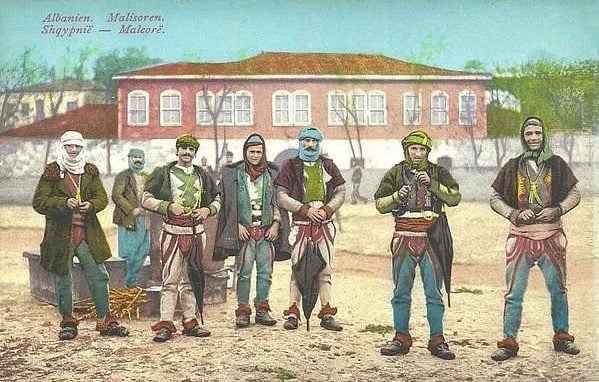
In the mountains of northern Albania, for roughly five hundred years, there were no judges, no police, and no written statute books — and yet there was law. It governed how you married, where your land ended, who you owed, how you treated a stranger at your door, and what happened when blood was spilled. This was the Kanun, and people lived and died by it long before any state reached the highlands.
The most famous version of that law is the Kanun of Lekë Dukagjini (Kanuni i Lekë Dukagjinit) — the “Code of the Mountains.” It was never invented by a single mind. It was custom, transmitted by word of mouth across generations, named for a 15th-century prince but far older than him. When a Catholic priest finally wrote it down in full in the early 20th century, it filled 1,262 articles across 12 books.
For most outsiders, the Kanun means one thing: the blood feud. That reputation is not wrong, but it is badly out of proportion. The blood feud was a single provision in a sprawling code that spent far more words on hospitality, family duty, property lines, and the careful, formal business of making peace. The same code that allowed vengeance also fenced it in.
This article covers what the Kanun actually is, who Lekë Dukagjini was, how the code came to be written down, and the ideas at its center — honor, the sacred guest, the binding word. It then looks at the blood feud and the stone towers built to survive it, the code’s suppression under communism and its partial revival in the 1990s, and what crossed the Atlantic into Albanian-American life. For a diaspora reader, the Kanun is not a museum piece. Pieces of it still shape how families behave.
What the Kanun is
The word kanun comes from the Greek kanon, meaning a rule or measuring rod — the same root behind “canon.” In Albanian usage it came to mean the whole body of traditional customary law that governed the highlands. There was more than one regional version. The Kanun of Lekë Dukagjini is the best-documented, applied mainly across the northern mountains; other variants, like the Kanun of Skanderbeg, governed elsewhere.
What makes the Kanun a legal system rather than a loose set of customs is its structure. Gjeçovi’s codified version is organized into 12 books covering, in turn: the Church, the family, marriage, the house and property, work and livestock, the transfer of property, the spoken word, honor, damages, the law on crimes, the law of the elders, and exemptions and exceptions. Inside those books sit the 1,262 articles.
This was civil and criminal law combined. It set the bride-price and the rules of inheritance. It defined where one clan’s grazing land ended and another’s began. It fixed how debts were paid, how oaths were sworn, and how disputes went before a council of elders. The blood feud was real, but it lived inside a much larger machine designed mostly to keep order in places the central state never reached.
One detail surprises people. The Kanun was a secular code, not a religious one. It applied to Catholic, Orthodox, and Muslim Albanians alike. In a region where religion was often imposed from outside — by Rome, by Constantinople, by Istanbul — the Kanun belonged to the people themselves, and that shared ownership is part of why it endured.
Who Lekë Dukagjini was
Lekë Dukagjini lived from roughly 1410 to 1481. He was a prince of the Dukagjini family, which ruled territory in the northern Albanian highlands, and he was a contemporary of Gjergj Kastrioti — Skanderbeg, the national hero who held off the Ottoman Empire for a quarter century.
Their relationship was not a simple alliance. Historians describe the period as closer to an Albanian civil war than a united front: Dukagjini and Skanderbeg were at times rivals and even adversaries, with Dukagjini allied against Skanderbeg — including, by some accounts, with Ottoman backing — before the two men reconciled. Only after that reconciliation did Dukagjini fight alongside Skanderbeg, and he continued the resistance after Skanderbeg’s death in 1468 with diminishing success until around 1479. In the chronicles he is the quieter figure — Skanderbeg the warrior “dragon,” Dukagjini the wise “angel prince” credited with holding the highland order together. You can read more about that era in our piece on Skanderbeg.
Here is the honest part. The code that bears his name is much older than he is. Highland customary law had governed those mountains for centuries before 1410, and it kept evolving for centuries after 1481. Attributing the whole body of law to one prince is a folk tradition, not a historical fact — a way of giving a vast, authorless inheritance a human face.
So Lekë Dukagjini is best understood as the code’s namesake and patron, not its legislator. He may have reaffirmed or standardized existing custom in his territory. What he did not do was sit down and write 1,262 articles. That work fell to someone else, four and a half centuries later.
How Gjeçovi wrote it down
For most of its life, the Kanun was never written. It lived in memory — in the rulings of elders, in proverbs, in the practiced sense of what was owed and what was forbidden. Anyone wanting to study it had to go to the highlands and listen.
That is exactly what Shtjefën Gjeçovi did. Gjeçovi was a Catholic Franciscan priest, born in 1874, who spent years among the highland tribes — serving as priest and teacher while collecting their oral law, folklore, and archaeology. He moved village to village, much of his fieldwork done in Mirdita and the surrounding northern districts, writing down what the elders told him about how the Kanun actually worked.
He began publishing pieces of his collected code in the journal Hylli i Dritës (“The Star of Light”) as early as 1913. But he did not live to see the complete work in print. On 14 October 1929, Gjeçovi was shot and killed near Gjakova, then under Yugoslav control.
The first complete codification was published posthumously in 1933 in Shkodër, under the title Kanuni i Lekë Dukagjinit — Gjeçovi’s life’s work, the 1,262 articles, finally fixed on paper. That 1933 edition is the version scholars cite, the version later translated into English and other languages, and the reason a body of law that was never meant to be written survived the century that nearly erased it.
It is worth marking what that achievement was. Gjeçovi did not impose a code. He recorded one that already existed, in danger of disappearing as the modern state advanced. Without his fieldwork, much of what we know about highland Albanian law would have died with the last elders who carried it.
Besa and nderi: the honor at the center
Strip the Kanun to its core and you reach two ideas: besa and nderi. Everything else hangs on them.
Besa is the given word — a pledge of honor that binds not just the person who gives it but that person’s family, sometimes across generations. It is often compared to the Latin fides, the root of “fidelity.” A besa could guarantee a truce, protect a traveler, or seal an agreement, and to break one was not a misstep but a permanent stain on the whole house. We cover this concept in depth in our article on besa.
Nderi is honor itself — family honor, the standing of your name in the eyes of your neighbors. In a society without courts or police, reputation was the enforcement mechanism. A man with honor could borrow without a contract and travel without a guard. A man who lost it became, in the code’s harsh phrasing, socially dead.
These were not abstractions. The Kanun made honor measurable and procedural. An insult, a broken promise, a violated guest — each had a defined weight and a defined remedy. Honor could be lost in an instant and took deliberate, witnessed action to restore.
This is the part of the Kanun that traveled well. The blood feud needed mountains, clans, and the absence of a state. But besa and nderi needed only a family that cared what its word was worth. That is why, generations later and an ocean away, an Albanian grandfather’s handshake could still close a deal that no paper ever recorded.
Mikpritja: the guest is sacred
Few cultures take hospitality as seriously as the Kanun did. The Albanian word is mikpritja — literally “the receiving of the guest” — and the code devoted a substantial block of articles to it.
The principle was absolute. A guest who crossed your threshold came under your protection completely, and defending that guest’s life and dignity became an extension of your own honor. The Kanun put it in a line still quoted today: “the house of the Albanian belongs to God and the guest.” The master of the house ranked below the visitor he sheltered.
The obligation was startlingly strong. A host was bound to feed and protect any guest who entered — even a stranger, even at risk to his own family, even, in principle, a man he might otherwise have reason to fight. Once besa was given to a guest, harming him was among the gravest violations the code knew.
This was not mere courtesy. It was the mechanism that let people move at all through a landscape of feuds and clan boundaries. A traveler under a host’s besa could pass safely; the host’s honor was the passport. Hospitality and the given word were two faces of the same thing.
The diaspora kept this almost entirely. Anyone who has visited an Albanian-American household and tried to leave without eating has met mikpritja directly. The table is not optional. The coffee is not optional. The pressure to stay, to take more, to be sent off full, is the old highland law of the guest, softened into a kitchen ritual but unmistakably the same code.
Gjakmarrja and the kulla: the blood feud
Now the hard part — the reason the Kanun is famous, and infamous. Gjakmarrja, literally “blood-taking,” was the obligation to avenge a killing or a grave dishonor of the family. When blood was shed, the dead man’s family carried a duty to take blood in return.
It is essential to understand what the Kanun actually did here. It did not invent vengeance or order people to kill — it regulated a practice that already existed and otherwise had no limits. The code defined who was a legitimate target (adult men of the offending family, never women or children), granted formal truces, protected anyone under besa, and laid out detailed paths to end a feud through mediation and a council of elders. Making peace was treated as an honor.
Even so, a feud could last for years and pass down generations — your grandfather’s enemy becoming your enemy. That is where the kulla comes in. A kulla is a fortified stone tower house, with thick walls, small high windows, and one guarded door. When a feud was active, the men of a targeted family could shut themselves inside a kulla, sometimes for months or years, until the danger passed or a truce was reached. The Kanun protected the kulla as inviolable ground.
The literary monument to all this is Ismail Kadare’s 1978 novel Broken April (Prilli i thyer), which follows a young highlander, Gjorg, who kills to avenge his brother and then waits under the code for his own death. It is the work that introduced the Kanun’s tragic logic to readers worldwide, and it remains the gentlest way for a diaspora reader to understand what the feud felt like from inside.
The feud is the Kanun’s darkest face. It is also, by the code’s own design, the face it most wanted to constrain.
The Kanun under communism and its 1990s revival
When the communist regime of Enver Hoxha took power after World War II, it set out to erase the Kanun. The party would not tolerate a rival source of authority, especially one rooted in clan and faith. Blood feud and Kanun-based justice were made illegal and crushed through hard repression and a pervasive police state. For roughly four and a half decades, the practice went largely dormant.
Then the regime fell. After 1991, and especially through the chaos of Albania’s transition — including the 1997 collapse — central authority weakened in the remote north. Where people had little faith in courts or police, some returned to the old code, and a partial revival of gjakmarrja appeared in pockets of the northern highlands and parts of Kosovo.
This revival is real but should be kept in proportion. It was confined to remote areas, it was always against modern Albanian law, and it has been condemned by Albanian civil-society groups and human-rights organizations working to reconcile feuding families. Most Albanians never lived under a feud and never will. The phenomenon draws outsized media attention precisely because it is dramatic and rare.
One modern consequence reaches all the way to the United States. Some Albanians have sought asylum abroad on the grounds that a standing blood feud puts their lives at risk at home. This is a documented immigration-law matter, assessed case by case under ordinary refugee standards. Adjudicators weigh such claims carefully — fabricated feud attestations have been reported, which makes scrutiny necessary — but genuine cases do exist and reflect the practice’s narrow, stubborn survival.
What crossed the Atlantic
So which parts of the Kanun made it to America, and which did not? The pattern is clean. The honor side crossed. The vengeance side, with rare exceptions, did not.
The blood feud needed conditions that the United States simply does not provide — isolated clans, contested grazing land, the absence of a working state. Transplanted into American cities and suburbs, with functioning courts and police, gjakmarrja had nothing to live on. It mostly stayed behind in the mountains.
Besa, nderi, and mikpritja were different. They needed only a family. So they came along, and they shaped how generations of Albanian Americans did business and raised children: the word that holds without a contract, the obligation to a guest, the sense that the family name is a shared possession everyone must protect. Many second- and third-generation Albanian Americans first met the Kanun not in a book but at a grandparent’s table, in a rule that was never explained because it was simply how things were done.
The diaspora’s relationship with the code is genuinely complicated — proud but uneasy. There is real pride in a 500-year legal tradition that bound Christian and Muslim alike and built one of the world’s strongest codes of honor and hospitality. There is also discomfort that the same word, abroad, conjures only vendetta.
That discomfort is fed by pop culture. The action film Taken and its imitators reduced Albanian identity to a menacing “particular set of skills,” collapsing an entire heritage into a crime stereotype. It is a caricature worth refusing gently. The Kanun’s actual center of gravity is the opposite of that image — a guest you are sworn to protect, a word you would rather die than break, a peace the elders worked patiently to make.
The Kanun is one thread in a much larger inheritance — language, faith, food, music, and memory — that Albanian Americans carry whether or not they can name it. The National Albanian Registry exists to record that inheritance and the people who hold it; if your family’s story is part of this heritage, you can be counted in it at our registration page.