
Football is one of the few cultural arenas where the Albanian diaspora is impossible to ignore. Walk into a Bronx café and someone is watching Bayer Leverkusen because Granit Xhaka used to wear their armband. Walk into a Sterling Heights restaurant and someone is pulling up Fenerbahçe to see if Vedat Muriqi scored. The Albanian heritage roster runs through three national teams and most top European leagues — a daily reminder that the community is bigger than any one country’s border.
This guide profiles fifteen of the most consequential Albanian and Kosovo-Albanian soccer players active or recently retired, with their birth years, current clubs, positions, and what they’re known for. Some chose to play for Kombëtarja (the Albania national team). Some chose Switzerland. Some chose Belgium. A few chose the Kosovo national side that joined FIFA only in 2016. All of them carry Albanian family origin somewhere in the line — and all of them show up in diaspora WhatsApp threads when match weekends roll around.
If you want the team itself, our companion piece on the Albania national football team covers history, coaching, and how to watch from the US. This article is the people behind the team sheet — and the players from Kosovo, Switzerland, and Belgium who share the same heritage line but pull on a different shirt on international duty.
The Albanian football diaspora across three national teams
A fact most casual fans don’t realize: at any given international window, players of Albanian heritage are pulling on at least four different national-team shirts. Kombëtarja — the Albania senior side — fields a squad that’s heavily diaspora-born. Kosovo, the youngest UEFA member, draws from a similar pool but with a different center of gravity. Switzerland runs one of the most successful national-team programs in Europe partly because it integrated Kosovar-Albanian refugees’ children into its youth pyramid in the 1990s and 2000s. And Belgium’s long Golden Generation included Adnan Januzaj, a Kosovo-origin winger who chose the country of his birth.
FIFA’s eligibility rule (Article 7) is the structural reason this happens. A player can represent the country he was born in, the country of one parent or grandparent, or — under certain conditions — a country where he has lived for five consecutive years after age 18. For diaspora-born players, that usually means a clean two-option choice: the country of birth or the country of family origin. Some take Switzerland; some take Albania; some take Kosovo. None of those choices is more “Albanian” than another. The community has mostly settled into accepting all three.
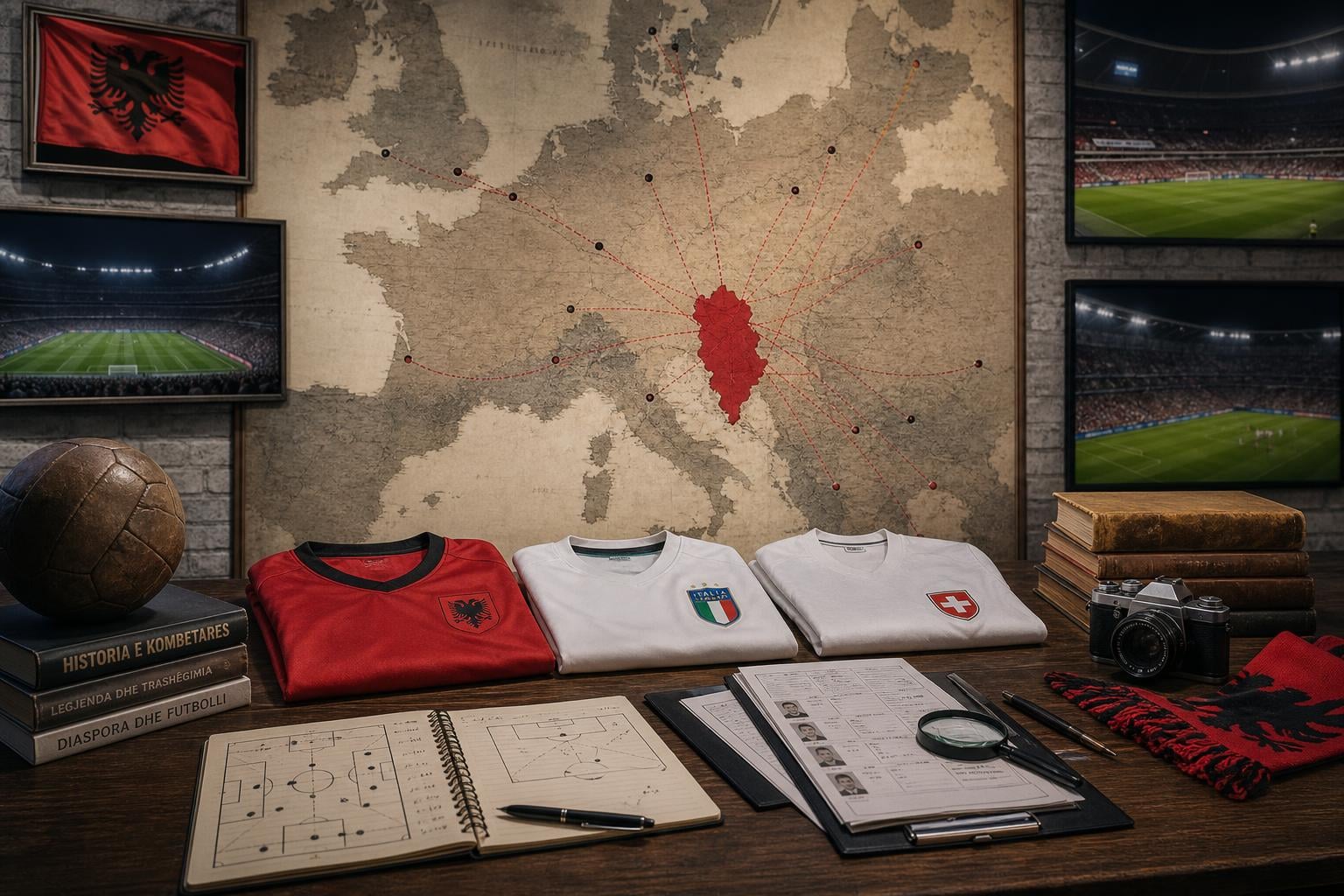
The numbers map the migration. Switzerland’s 200,000-strong Albanian community produced both Xhaka brothers, Shaqiri, Behrami, Bajrami, Daku, and dozens of younger players in Super League academies. Italy’s diaspora — older, often from Albania proper — produced Djimsiti at Atalanta and Asllani at Inter. England produced Broja, born in Slough. Belgium produced Januzaj. The map of European Albanian migration is, almost exactly, the map of where Albanian heritage shows up in professional football.
Switzerland’s Kosovo-Albanian generation
Switzerland’s national team, in the 2010s and 2020s, has been the most visible carrier of Albanian heritage talent at the senior international level. Three names define the generation.
Granit Xhaka (b. 1992, Basel)
Granit Xhaka is the current captain of Switzerland and the country’s record appearance-holder, with more than 150 caps. Born in Basel in September 1992 to Kosovar-Albanian parents from Podujevë, he came through FC Basel’s academy, moved to Borussia Mönchengladbach in 2012, and then signed for Arsenal in 2016. After seven Premier League seasons in London — including three as captain — he transferred to Bayer Leverkusen in 2023 and immediately helped the club to its first-ever Bundesliga title in the famous “invincible” double season under Xabi Alonso.
On 30 July 2025, Xhaka returned to England with Sunderland after the club’s promotion to the Premier League, signing a three-year contract and being named captain by head coach Régis Le Bris. He is set to captain Switzerland at the 2026 FIFA World Cup in North America.
Xhaka’s older brother Taulant Xhaka plays for Albania — the same family, two different national teams. The two faced each other in the Euro 2016 group stage in Lens, the first time brothers had played for opposing sides in a major tournament. The Xhaka family has been clear that both choices are legitimate. We don’t relitigate it here.
Xherdan Shaqiri (b. 1991, Gjilan)
Xherdan Shaqiri was born in Gjilan, Kosovo in October 1991 and emigrated to Switzerland with his family as a child. A short, explosive attacking midfielder with one of the most decorated trophy cabinets of any Swiss-Albanian player, Shaqiri came through FC Basel, signed for Bayern Munich in 2012, won three Bundesliga titles, and later spent time at Inter Milan and Stoke City. His most famous chapter is at Liverpool, where he won the 2018-19 UEFA Champions League under Jürgen Klopp — making him one of only a handful of Albanian heritage players to lift Europe’s top club trophy.
After spells at Lyon and a two-year MLS stint at Chicago Fire (2022-2024), Shaqiri returned to FC Basel in August 2024 — the club where his career began. He has continued to perform at a high level in the Swiss Super League and remains active in Switzerland senior squad conversations heading into 2026.
Shaqiri was part of the trio — along with Xhaka and former captain Stephan Lichtsteiner — fined by FIFA at the 2018 World Cup for the double-eagle gesture made after both Swiss goals in a 2-1 win over Serbia. The fines were 10,000 Swiss francs each for Xhaka and Shaqiri; no suspensions were issued.
Valon Behrami (b. 1985, Mitrovica)
Valon Behrami closed the door on the previous generation of Swiss-Albanian midfielders. Born in Mitrovica, Kosovo in April 1985, he played 83 senior matches for Switzerland between 2005 and 2018 — appearing at four World Cups and Euro 2008 and Euro 2016. His club career took him through Lazio, West Ham (signed in 2008 for £5 million), Fiorentina, Napoli, Hamburg, Watford, and Udinese. He retired from professional football in 2022 and now works in football administration; he was appointed assistant to the sporting director at Watford in July 2025.
Behrami’s longevity at the top of the European game made him the bridge generation between the players who arrived in Switzerland as Kosovar-Albanian refugee children in the 1990s and the Xhaka-Shaqiri cohort that became the national team’s core.
The Albania national team core
The Albania senior squad’s spine is in Italy’s Serie A. Five names define the post-Euro 2024 cycle.
Berat Djimsiti (b. 1993, Zürich)
Berat Djimsiti captains both club and country. Born in Zürich, Switzerland in February 1993 to an ethnic Albanian family from the Preševo Valley in southern Serbia, he came through the FC Zürich academy and moved to Atalanta in 2016. He is a center-back, has more than 200 Serie A appearances for the Bergamo club, and was confirmed as Atalanta’s captain for the 2024 Europa League final against Bayer Leverkusen — which Atalanta won, lifting the club’s first major European trophy.
Djimsiti captained Albania during the 2026 FIFA World Cup qualifying campaign, leading the team to the play-off round for the first time in their history before a 2-1 defeat to Poland on 26 March 2026 ended the run. He was named Albania National Team Player of the Year at the December 2025 Ballon d’Or Albania ceremony and has more than 68 senior caps for Kombëtarja.
Kristjan Asllani (b. 2002, Elbasan)
Kristjan Asllani is the youngest player on this list — a 23-year-old deep-lying playmaker who emerged at Empoli and signed for Inter Milan in 2022 as the heir-apparent to Marcelo Brozović. Born in Elbasan, Albania in March 2002, he made his Albania senior debut at age 19 and has been a regular in midfield since. After three seasons backing up at Inter, Asllani joined Torino on loan for 2025-26 (with a purchase option) and then moved to Beşiktaş in the Turkish Süper Lig on a second loan that runs through the end of the 2025-26 season.
He’s the team’s central creative midfielder under head coach Sylvinho — the player most likely to dictate tempo in the bigger matches.
Nedim Bajrami (b. 1999, Zürich)
Nedim Bajrami is the squad’s Swiss-born attacking midfielder. Born in Zürich in February 1999 to Albanian parents originally from North Macedonia, he came through the Grasshopper Club Zürich academy and built his senior career in Italy at Empoli and Sassuolo. Bajrami initially represented Switzerland at youth level, then switched his international allegiance to Albania in 2022 — a switch FIFA’s eligibility rules allow.
He moved to Scottish Premiership side Rangers from Sassuolo in 2024 and is under contract there through 2028. A left-footed creator who scored Albania’s fastest goal in Euro tournament history — 23 seconds against Italy at Euro 2024 — Bajrami is one of the team’s most direct attacking outlets.
Elseid Hysaj (b. 1994, Shkodër)
Elseid Hysaj is now the most-capped Albania player in history. Born in Shkodër in February 1994, he came through Empoli’s youth system, joined Napoli under Maurizio Sarri in 2015, and moved to Lazio in 2021. A versatile fullback who can play either flank, Hysaj passed Lorik Cana’s national-team appearance record in 2025 and continues to be a regular for Lazio in Serie A.
He has captained Albania in Djimsiti’s absence and is the senior outfield voice in the dressing room.
Etrit Berisha (b. 1989, Pristina)
Etrit Berisha is the squad’s veteran goalkeeper. Born in Pristina, Kosovo in March 1989, he played his Serie A career at Lazio, Atalanta, and Empoli before leaving Italy in 2024. He joined Swedish side BK Häcken in 2025 and won the 2025 Svenska Cupen with the club, qualifying for European competition. With more than a decade of senior international service stretching back to 2012, Berisha is the wall behind Djimsiti’s defense.
Diaspora-born talent — the British connection
Two of the most-followed Albanian heritage players grew up in Britain rather than the Balkans.
Armando Broja (b. 2001, Slough)
Armando Broja is the Albania men’s team’s most marketable forward. Born in Slough, England in September 2001 to Albanian parents from Koplik, in the far north of the country, he came through the Chelsea academy and made his Premier League debut for the club in 2020. Loan spells at Vitesse, Southampton, Fulham, and Everton followed. In August 2025, Broja completed a permanent £20 million transfer from Chelsea to Burnley, signing a five-year contract with the newly promoted Premier League side.
He made his Burnley league debut against Liverpool on 14 September 2025 and scored his first Premier League goal for the club against Bournemouth on 20 December 2025. Eligible for both England (through birth) and Albania (through heritage), Broja chose Albania at senior level and has been one of the team’s main number-nine options through the Euro 2024 and 2026 World Cup qualifying cycles.
Adnan Januzaj (b. 1995, Brussels)
Adnan Januzaj is the most prominent Albanian heritage player who chose neither Albania nor Kosovo. Born in Brussels, Belgium in February 1995 to Kosovar-Albanian parents — his father is from Kosovo — Januzaj was famously eligible to represent Belgium, Albania, Kosovo, Serbia, and Turkey. In April 2014, he committed to Belgium, and went on to play at the 2018 and 2022 World Cups with the country’s Golden Generation.
His club career broke out at Manchester United in 2013-14, where he scored a memorable winning goal at Sunderland (against Lorik Cana’s old club) as a teenager. He spent five seasons at Real Sociedad in La Liga and moved to Sevilla FC in 2022, where his contract ran through June 2026 before the two sides parted ways. He holds dual Belgian and Kosovo citizenship.
The Januzaj choice is a useful reminder that the diaspora’s football identity isn’t a single line. Some players in the same generation took Albania, some took Kosovo, some took the country of their birth. All three are part of the same broader story.
Mirlind Daku — Albania’s target man
Mirlind Daku is the squad’s physical center forward. Born in Gjilan, Kosovo in January 1998, he plays for Rubin Kazan in the Russian Premier League and is the team’s leading striker — scoring 9 goals in his first 18 league appearances of the 2025-26 season. His contract with Rubin Kazan was extended through June 2029.
Daku is the target man Sylvinho often pairs with Broja or uses as the central reference point against deep-sitting defenses. He has been the focus of some controversy abroad — most notably an incident after Albania’s draw with Croatia at Euro 2024 — but on the pitch his importance to the team’s structure is clear.
Veterans who built the modern Albania team
Two veteran names still cast a long shadow on the current squad.
Lorik Cana (b. 1983, Pristina)
Lorik Cana is the captain everyone in the diaspora over 30 talks about. Born in Pristina in July 1983, he grew up in Switzerland after his family fled the Yugoslav wars, and made his professional debut at Paris Saint-Germain in 2002, winning the Coupe de France in 2003-04. He then moved to Marseille, where he became one of the club’s most admired captains.
In 2009, Cana joined Sunderland, becoming the first player of Albanian origin to play in the Premier League, and was appointed captain immediately. He later played for Galatasaray, Lazio (winning the Coppa Italia in 2012-13), and Nantes. At international level he was Albania’s captain from 2011 and retired after Euro 2016 with 93 caps — a record that stood until Elseid Hysaj surpassed it in 2025.
Cana is, by acclamation, the captain of the generation that took Albania to its first major tournament. The current core of the squad — Djimsiti, Hysaj, Broja — grew up watching him.
Erjon Bogdani and the older generation
The squad that played at Euro 2016 included other names worth noting in the diaspora record. Erjon Bogdani scored 18 international goals between 1996 and 2013 — long Albania’s all-time top scorer. Klodian Duro and Altin Lala were the midfield spine of the 2000s squads. Together they kept Kombëtarja competitive through a long period without a major tournament.
Kosovo national team — a separate path
The Kosovo men’s national team has been a FIFA member only since 2016, but in less than a decade it has built a senior squad that competes seriously in UEFA qualifying. Some of the most-watched names:
Milot Rashica (b. 1996, Vushtrri)
Milot Rashica was born in Vushtrri, Kosovo in June 1996 and broke through at Vitesse and Werder Bremen before signing for Norwich City and then Galatasaray, where he won the 2022-23 Turkish Süper Lig title. He moved to Beşiktaş in 2023 and remains a senior squad regular for Kosovo. A direct, left-footed winger who is often the team’s most dangerous attacking outlet.
Vedat Muriqi (b. 1994, Prizren)
Vedat Muriqi is the Kosovo squad’s record goalscorer and the most prolific Albanian heritage striker in Europe. Born in Prizren, Kosovo in April 1994, the 6’4” target man broke out at Çaykur Rizespor and Fenerbahçe in Turkey before signing for Mallorca permanently in July 2022. He scored his 50th La Liga goal in February 2026 and closed out the 2025-26 season — his last at the club — with 23 league goals, two short of the Pichichi Trophy. He returned to Fenerbahçe in June 2026 on a three-year contract.
Bersant Celina (b. 1996, Prizren)
Bersant Celina is the squad’s senior attacking midfielder. Born in Prizren in September 1996, he came through the Manchester City academy and played in the Championship at Swansea and Ipswich. He moved to Swedish side AIK in January 2024, then transferred to Saudi club Al-Ettifaq in 2026, and remains a regular for Kosovo. A left-footed playmaker who often partners with Rashica.
Several other Kosovo internationals — Amir Rrahmani at Napoli, Florent Muslija at various German clubs, Edon Zhegrova at Lille — round out a senior pool deep enough to make Kosovo a tournament-qualification candidate for the first time in the 2026 cycle.
What this tells us about Albanian football migration
The pattern is clear when you map it. Two waves of migration produced the modern Albanian football diaspora at the European top flight.
The first wave — Kosovar-Albanian refugees fleeing the Yugoslav wars of the late 1980s and 1990s — landed primarily in Switzerland and Germany. Their children, born between roughly 1985 and 1998, are the spine of the current Swiss national team and a significant chunk of the Kosovo squad: Xhaka, Shaqiri, Behrami, Rashica, Muriqi, Celina, the Xhaka brothers.
The second wave — economic migration from Albania proper after the country opened in 1991 — landed in Italy, Greece, and the United Kingdom. Their children, born mostly after 1995, are now the spine of the current Albania squad: Asllani, Broja, Djimsiti, Bajrami, Daku. Most of them came through Italian youth academies, which explains the heavy Serie A representation.
A third wave, still developing, is producing players in the diaspora’s most recent host countries. American-born Albanian players are starting to appear at the college and lower-division level. German Albanian-heritage players are filtering through Bundesliga academies. The pool will keep deepening for at least another decade.
That migration map matters for Albanian-American fans. The reason the US Census’s count of Albanian Americans sits around 230,000 while community estimates put the real number closer to one million is the same reason the football diaspora is hard to track: people are scattered, multi-generational, and often classified by host country rather than heritage. The football roster is a useful proxy. When Granit Xhaka lines up for Switzerland next to Armando Broja on Albania duty, that’s the diaspora made literal on a team sheet.
Where to watch from the United States
Following Albanian heritage players from the US takes a layered subscription stack — there isn’t one channel that covers everyone.
Premier League and Bundesliga (Broja, Xhaka)
NBC’s Peacock carries every Premier League match — Broja at Burnley, and Xhaka’s Sunderland fixtures. For Bundesliga coverage, ESPN+ is the standard US option.
Serie A (Djimsiti, Hysaj)
Paramount+ holds the US Serie A rights. Atalanta, Lazio, and most Italian top-flight matches stream there.
La Liga
ESPN+ carries La Liga in the US.
Turkish Süper Lig and Swedish Allsvenskan
Both leagues stream through Fanatiz or fuboTV packages, depending on the cycle. Beşiktaş (Rashica), Fenerbahçe (Muriqi), and BK Häcken (Berisha) matches all run through those services.
International windows
For national-team matches — Albania, Kosovo, Switzerland, Belgium — TVALB is the diaspora-standard Albanian-language streaming service ($15/month, carries RTSH). Fubo sometimes carries UEFA qualifying through its soccer package. FotMob carries free Albanian-language audio commentary for most Albania matches.
A more complete watch guide — including streaming, cable, and Albanian-American sports bars by city — lives in our Albania national football team article.
A note before the FAQ
The National Albanian Registry is a community-led count of Albanian Americans. Football fans driving from Worcester to Bronx watch parties, refreshing the FotMob app at 14:45 ET on a Thursday, wearing the eagle on a baseball cap — that’s the diaspora NAR is counting. If you’re Albanian or of Albanian descent and living in the United States, take 2 minutes and get counted at /register. The certificate is free; the count is the point.
Shqipëria. Kosova. Të gjithë bashkë në fushë.