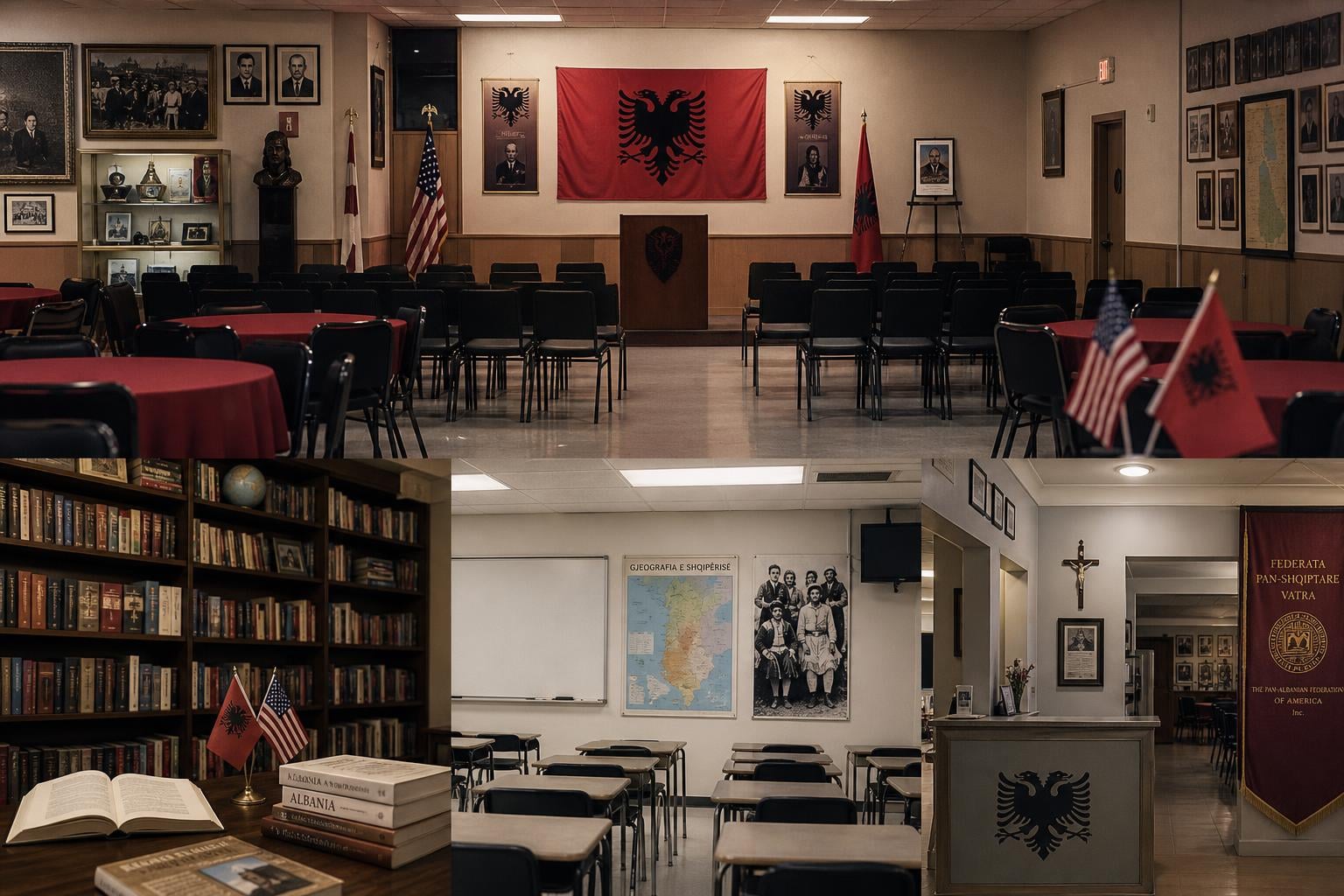
An Albanian community center is one of the quietest pieces of infrastructure in the United States and one of the most consequential to the people who use it. It is the room where the diaspora keeps itself across generations — the Saturday-morning Albanian-language class, the wedding hall, the parish basement, the federation office. The 2024 American Community Survey counts roughly 230,000 Albanian Americans (ACS table B04006). Community organizations put the real number closer to one million once ethnic Albanians from Kosovo, North Macedonia, and Montenegro, and second- and third-generation Americans, are counted in.
For a population that is still mostly first- and second-generation, those numbers translate into a specific problem: how do you keep a language, a faith life, and a sense of belonging intact when the country is far away and the kids were born in Yonkers or Sterling Heights or Worcester? The answer, for more than a century, has been the community center.
This piece is written for the Albanian American reader who is trying to find theirs. We cover what an Albanian community center actually is, the four jobs a working center does, the named organizations that anchor the network, how religion fits in without taking sides, where the centers cluster on the US map, and what to do when the closest one is two hours away. We also cover honestly what a community center cannot do, so nobody walks in with the wrong expectations.
What an Albanian community center actually is
Strip the labels and a community center is three things at once: a hall, a calendar, and a roster.
The hall is the room. Sometimes it is purpose-built, more often it is a parish basement, a leased banquet space, or a converted storefront with a kitchen in the back. The calendar is the recurring set of events that fill the hall through the year — Saturday school, valle (circle dance) rehearsals, weddings, baptisms, Bajram (Eid) and Pashkë (Easter) gatherings, Flag Day on November 28, scholarship galas, forty-day memorials. The roster is the families who pay dues, the volunteers who show up on Saturdays, and the businesses that sponsor the banquets.
A center can be a religion-agnostic federation. It can be a parish. It can be a chamber of commerce that grew programming around its member businesses. The legal forms differ. The function is the same: keep the diaspora gathered and reachable across generations.
For a family in the US, the practical questions a center answers are simple. Where can the kids learn Albanian on Saturdays. Where will the wedding be held. Where do we go for Pashkë or Bajram. Where is the Flag Day banquet. Most metros with a meaningful Albanian population have an answer to all four at one or two addresses.
The four roles a community center plays
Every working Albanian community center does some version of four jobs. A small parish in a smaller state might handle two of them. A large federation in a major metro handles all four with separate committees for each. The four roles are language, religion, culture, and civic life.
Language transmission. Saturday-morning Albanian-language classes for second- and third-generation kids are the single most consistent program a center runs. The Albanian American Educators Association (AAEA) supports many of these schools with curriculum, teacher training, and shared materials. Without these classes, the language stops at the parents. With them, it has a chance with the grandchildren.
Religious community. Catholic, Orthodox, Sunni Muslim, and Bektashi traditions all have institutional homes in the US diaspora. The parish, the kishë (church), the xhamia (mosque), and the teqe (Bektashi lodge) double as community centers because they hold the weddings, the funerals, the holiday banquets, and very often the language classes too. NAR treats all four traditions as equal partners; we do not rank them.
Cultural events. Flag Day on November 28 (Dita e Flamurit), Independence Day for Kosovo on February 17, Pashkë, Bajram, Krishtlindja (Christmas), Mother Teresa’s feast in early September, and the run of weddings and baptisms across the year. The center is where the calendar gets enacted in person, with food, valle, and a hall full of cousins.
Civic and advocacy work. Voter outreach, get-out-the-count campaigns, scholarship programs, relief drives after earthquakes or floods back home, statements to the press, meetings with elected officials. The federations carry most of this, but parishes and xhamia participate when the issue touches the whole community.
A reader trying to evaluate a local center can ask which of the four it covers. Most cover at least two; the strongest cover all four under one roof or in close coordination with sister organizations down the street.
Vatra — the oldest, founded in 1912
The Pan-Albanian Federation of America, known by every Albanian American simply as Vatra (the hearth), was founded in Boston in April 1912 — months before Albania itself declared independence. The two best-known founders are Faik Konitza and Fan Noli, the latter a future prime minister of Albania and a long-serving Orthodox archbishop in the US.
Vatra is the oldest continuously active Albanian-American organization. It has been a federation of local chapters since its founding, a publisher (its newspaper Dielli — the Sun — has been printed in some form since 1909, predating Vatra itself and absorbed into it as its official organ in 1912, and is still in print today), and a civic anchor across the Boston–New York corridor.
For its first half-century, Vatra served as the de facto diaspora government for Albanian Americans — funding relief, lobbying for Albanian statehood at Versailles, supporting newcomers through Ellis Island, and convening communities that had no other meeting place. Its 1912–1944 archive is one of the better-documented institutional histories in any US ethnic diaspora.
Today Vatra operates more modestly than it did in its mid-century peak, but it still publishes, still convenes, and still anchors the institutional memory of the Albanian-American community. For a reader new to the diaspora’s organizational map, Vatra is the first name to know.
Religious community centers — kishë, xhamia, teqe, parish
Religion in the Albanian-American diaspora is unusually plural. Albania itself is roughly half Sunni Muslim, with significant Bektashi, Orthodox, and Catholic minorities, and the diaspora reflects that mix without the political weight it sometimes carries back home. The center where you celebrate Pashkë is the center where your cousin gets married next month; the xhamia on the next block holds Eid dinner; nobody finds this strange.
Catholic parishes anchor several US metros. Mother Teresa Albanian Catholic Church operates in multiple locations, including parishes in the New York metro and the Detroit area, and is the most recognizable Catholic name in the diaspora. Most Albanian Catholic communities trace their roots to the highlands of northern Albania and to Kosovo.
Albanian Orthodox parishes in the US fall mainly under the Albanian Orthodox Archdiocese in America (within the Orthodox Church in America) and trace directly back to Fan Noli’s pioneering work in Boston and Worcester in the early 1900s. St. George Albanian Orthodox Cathedral in Boston is among the historic anchors. Worcester, Massachusetts and Southington, Connecticut also host major Orthodox parishes.
Sunni Muslim communities are organized largely through xhamia affiliated with bodies such as the Albanian American Islamic Center (AAIC), which has locations in several US states. These mosques hold the same dual role as Catholic and Orthodox parishes — religious services on the weekly schedule, Saturday Albanian-language classes for the kids, weddings, bajram banquets, and Flag Day programs.
Bektashi communities — a Sufi order with deep historic roots in Albanian Islam — maintain teqe in the US, with the First Albanian Bektashi Tekke in the Detroit area among the better known. The Bektashi tradition emphasizes interfaith dialogue and a distinctive liturgical and poetic heritage; Bektashi communities in the US often host non-Bektashi neighbors at major holidays as a matter of practice.
NAR’s editorial posture across this section is the same one it takes everywhere: we name what exists, give every tradition equal treatment, and let readers find the institution that fits their family. The strongest community centers in the US do exactly the same thing.
Cultural centers and Saturday schools
The single most replicated program across the diaspora is the Saturday Albanian-language school. It is also the program that determines whether the third generation can speak with their grandparents in Albanian or only nod and smile.
The Albanian American Educators Association (AAEA) is the umbrella body for many of these schools, supporting teachers, sharing curriculum, and convening conferences. Individual schools operate inside parish halls, xhamia basements, and standalone cultural centers. Most run from October through May, mirror the US school calendar, and graduate students through a sequence of beginner-to-advanced classes.
Beyond language, the cultural calendar covers the obvious anchors and a long tail of smaller traditions:
- Flag Day (Dita e Flamurit) on November 28, marking Albania’s 1912 declaration of independence.
- Kosovo Independence Day on February 17.
- Pashkë (Orthodox and Catholic Easter, on different dates most years).
- Bajram (both Eid al-Fitr and Eid al-Adha for Sunni and Bektashi communities).
- Krishtlindja (Christmas) for the Catholic and Orthodox traditions.
- Mother Teresa’s feast day on September 5, observed widely across all four religious traditions given her status as the diaspora’s most universally claimed figure.
- Albanian-American Heritage Month in November, recognized by several states and localities (there is no federal Albanian-American Heritage Month).
The Albanian American Cultural Center (AACC) in New Jersey and the network of community halls in Michigan, the Bronx, Worcester, and Waterbury anchor the larger version of this programming. Smaller halls in Pennsylvania, Illinois, Florida, and Texas run the same calendar at a smaller scale.
Civic and advocacy organizations
A handful of named bodies do most of the diaspora’s civic work in the US. They are not interchangeable and they do not always agree on tactics, but together they form the advocacy layer that sits above the parishes and cultural halls.
Vatra — Pan-Albanian Federation of America (1912, Boston/NYC). Federation and publisher, covered above.
Albanian American National Organization (AANO), founded after World War II and headquartered for many years in Worcester, Massachusetts, with chapters across the Northeast. AANO is best known as the long-running organizer of the Albanian American Parade in New York City, the largest annual Albanian gathering in the US.
Albanian American Civic League (AACL), founded in 1989 by former US Congressman Joseph DioGuardi and based in Ossining, New York. AACL focuses on policy advocacy — Kosovo, religious freedom, congressional outreach — and has been the most visible Washington-facing Albanian-American organization for three decades.
AACI USA — Albanian American Community Institute. A more recent civic and policy body based in the Washington, DC area, working on professional networks, public-affairs research, and community-data projects.
Illyria newspaper, New York-based, the leading Albanian-language community newspaper in the US for decades. ACTV Michigan carries community media in the Detroit metro and is one of the most active Albanian-American broadcast operations in the country.
AAEA — Albanian American Educators Association. Covered above for its Saturday-school role; it also functions as a civic and professional network for Albanian-American educators across the country.
National Albanian Registry (NAR). The newest entry on the list, and the one we run. NAR is a 501(c)(3) producing a community-led count of Albanian Americans. The Certificate of Recognition we issue is not government ID and not citizenship — it is a community recognition tied to a federally legible count. We sit alongside the federations, not above them.
Where the centers cluster — New York, Michigan, Massachusetts
The map of Albanian community centers tracks the map of Albanian-American population, with one caveat: density of institutions tends to lag density of people by a generation, because a new metro needs a critical mass of families before the first center opens its doors.
Using ACS 2024 B04006 data and community estimates, the top US clusters are:
- New York — roughly 56,000 Albanian Americans. The Bronx is the densest single concentration in the country, with multiple parishes, the Albanian American Parade route, and the broadest selection of restaurants and businesses. Westchester (Yonkers, Ossining), Brooklyn, Queens, Staten Island, and parts of Long Island add to the network.
- Michigan — roughly 27,000. The Detroit metro — Sterling Heights, Warren, Troy, and surrounding suburbs — has been the historic Midwest center since the early twentieth century, with Catholic, Orthodox, Sunni, and Bektashi institutions all represented.
- Massachusetts — roughly 21,000. The Boston–Worcester corridor is the historic intellectual and religious anchor of the diaspora, with Vatra, the AANO Worcester headquarters, and the Orthodox archdiocese’s roots all in this corridor.
- New Jersey. Garfield, Paterson, and surrounding North Jersey towns; the Albanian American Cultural Center in NJ is one of the larger purpose-built halls.
- Pennsylvania. Philadelphia and Pittsburgh metros, plus pockets across the state, with a growing presence in the Lehigh Valley.
- Connecticut. Waterbury, Hartford, and Southington — the last with a notable Orthodox community.
- Illinois. Greater Chicago, with multiple community organizations and a Saturday-school presence.
- Florida. Tampa, Orlando, and the South Florida metros are growing fast, mainly first-generation arrivals from the past two decades.
- Texas. The smallest of the named clusters historically but among the fastest growing. Houston and the Dallas–Fort Worth metroplex now sustain regional meetups and an emerging community center footprint. NAR’s Texas regional work is part of this build-out.
States outside this list almost always have Albanian families — they may just lack a brick-and-mortar center. In those cases, the closest hall is typically one to four hours away, and families either drive in for major holidays or join the nearest cluster’s online programming.
How to find your nearest one
There is no single national directory of Albanian community centers in the US. In the meantime, three paths reliably work.
Search by state plus the right keywords. Try your state name plus kishë (church), xhamia (mosque), teqe, kulturor (cultural), valle, Vatra, or AANO. Add the metro name if the state is large. Most centers have at least a basic web presence or a Facebook page.
Ask a long-settled Albanian family in your metro. The roster — who’s where, who runs what, when the Saturday-school registration opens — lives in their phone, not on a website. One coffee with a family that has been in your city for twenty years will save you a month of searching. Albanian hospitality makes this an easier ask than it sounds.
Use state-level Facebook groups and get counted in the NAR count as it grows. Many states have private or semi-private Facebook groups (Albanians in Texas, Albanians of New England, Detroit Albanians, and so on) where people post community-center events, Saturday-school registrations, and Flag Day announcements. The community-led count at albanianregistry.org is being built specifically to make the diaspora’s full size and reach visible for the next generation.
We deliberately do not promote any single center over others. The right center for a family depends on language priority, religious tradition, distance, and the personalities of the volunteers who run it. Visit two or three, see which one fits, and stay.
What a community center can’t do
Every honest piece on community institutions has to include this section, because the most common reason people leave a center disappointed is that they walked in expecting something it was never built to provide.
A community center is not a government agency. It cannot issue ID, citizenship, passports, or legal status. It cannot process Albanian-citizenship-by-descent applications under Law 113/2020 — that work is done by Albanian consulates and the General Directorate of Civil Status in Tirana. A center can refer you and often will, but the document path runs through the state, not the parish.
A center is not a legal-aid clinic. Volunteers may know an immigration lawyer or a probate attorney who is part of the community, but the center itself does not provide legal services. Confusing the two creates real harm — both to the family that needed an actual lawyer and to the volunteer who got asked to do work they are not licensed to do.
A center is not a social-services agency. It can run a relief drive after a disaster, organize a meal train, or pass the hat for a family that has lost a member. It cannot replace Medicaid, WIC, SNAP, or a county social worker, and it should not be asked to.
A center runs on volunteer capacity, and capacity varies. The same hall that hosts a 400-person Flag Day banquet in November may have three people answering email in February. Treat that with patience. The volunteers are doing this on top of full-time jobs, kids, and the rest of life.
Finally, a community center is not the same as a federal count. A parish secretary’s family list is precious and irreplaceable; it is also invisible to the US Census, to congressional apportionment, to state-level redistricting, and to almost every form of public-policy data. NAR exists to add the second kind of count alongside the first kind, not to replace it.
Where NAR fits
Community centers count members the old way — face to face, family by family, dues paid in cash at the back of the hall after a wedding. That count is real and irreplaceable. It is also private to each center and invisible at the national level.
NAR runs a different count alongside it: a community-built census of Albanian Americans that sits alongside the Census ACS, with a free recognition certificate for every person counted. Both counts matter. If you are part of an Albanian community center, the parish secretary already has you. If you want to be counted at the national level too — to make the broader Albanian-American community visible to the institutions that decide language access and recognition, and for the public number — that is what /register is for.