

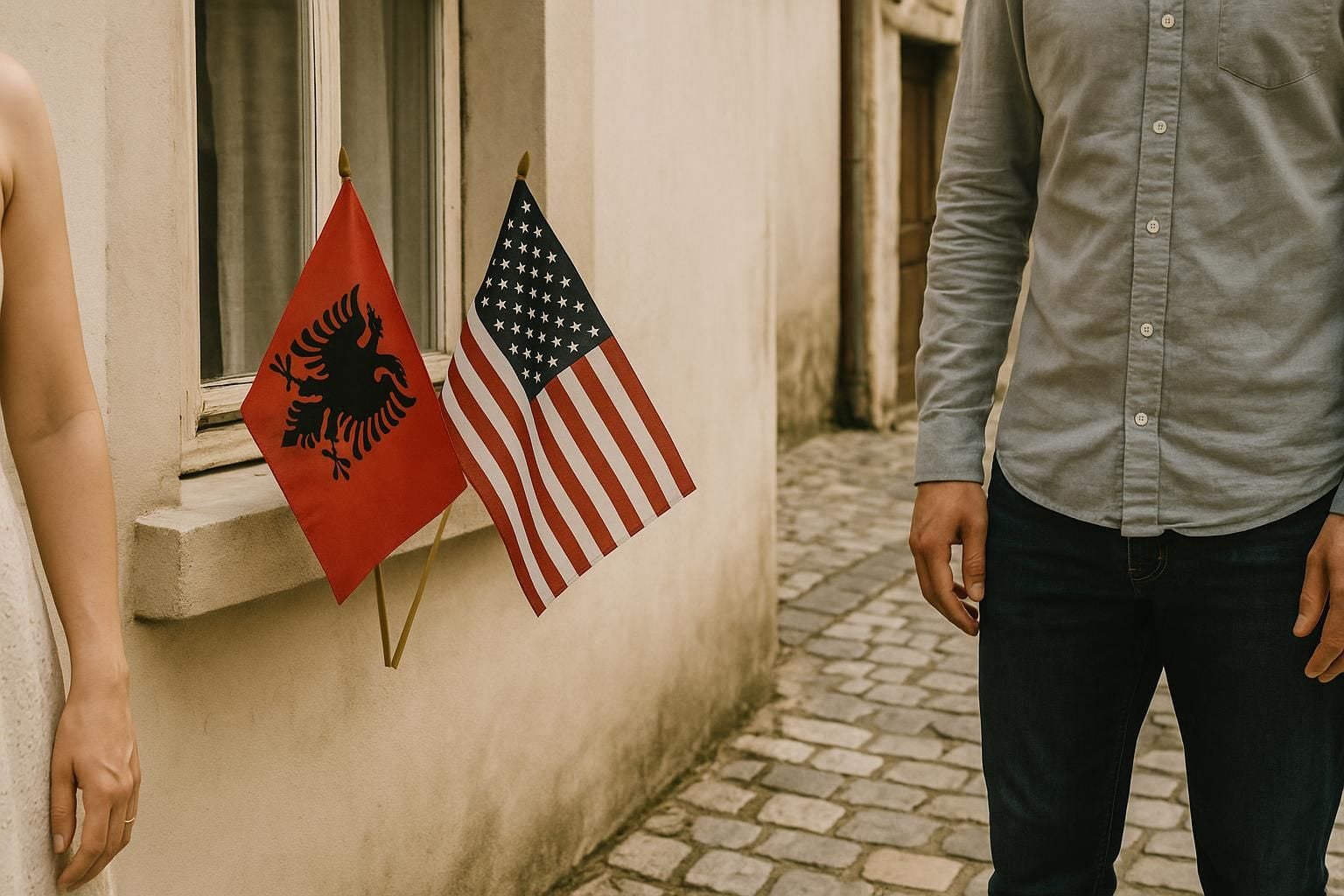
The marriage path is real, but it works differently than descent
Albanian Americans who claim citizenship by descent, through a parent, grandparent, or great-grandparent, can do the entire process from the United States. No residency required. No language test. The 2020 Citizenship Law (Law No. 113/2020) made that path straightforward for anyone who can document the family chain.
The marriage path is different. If you are a US citizen married to an Albanian citizen, Law No. 113/2020 lets you naturalize on a shortened timeline, but it still requires living in Albania for a year.
This guide covers the marriage pathway from a US perspective: what the law requires, what documents you need, what it costs, and what the realistic timeline looks like.
What Law 113/2020 requires for spouses
Under Law No. 113/2020 on Citizenship, a foreign national married to an Albanian citizen can naturalize after one continuous year of legal residence in Albania, once the marriage has lasted at least three years and is registered with Albania’s civil registry. That is a substantial reduction from the seven years of continuous residence ordinary naturalization requires, but it is a reduction, not a waiver. There is no marriage route that skips residence in Albania entirely.
You must also have no serious criminal convictions and not pose a threat to Albania’s public order or national security, and you must be able to support yourself.
One key difference from ordinary naturalization:
- Reduced residence. Ordinary naturalization requires seven years of continuous legal residence in Albania; the marriage pathway cuts that to one year once you have been married at least three years.
- No language or history test. The same provision that shortens the residence requirement also exempts spouses from the Albanian language and history exam that ordinary naturalization requires.
The marriage must be legally recognized in Albania. If you married in the United States, your marriage certificate must be apostilled and translated into Albanian before the Albanian civil registry will accept it.
How the marriage path compares to descent
If your spouse has Albanian ancestry and you are also of Albanian descent, the descent pathway (Article 6) is almost always the faster route. Here is the comparison:
| Marriage (Law 113/2020) | Descent (Article 6) | |
|---|---|---|
| Residency required | 1 year in Albania | None |
| Marriage required | At least 3 years | No |
| Language test | No | No |
| Can apply from the US | Sometimes, see above | Yes, via embassy/consulate |
| Processing time | 6–12 months after submission | 6–12 months after submission |
| Government fee | ~€30 | ~€30 |
| Dual citizenship | Yes | Yes |
The tradeoff is clear: descent is simpler and cheaper if you qualify. The marriage path exists for non-Albanian spouses, people who have no Albanian ancestry but are married to an Albanian citizen and want to share their spouse’s citizenship.
The document checklist
Every document issued outside Albania must be apostilled (or authenticated if the issuing country is not a Hague Convention member) and translated into Albanian by an authorized translator. Here is what you need:
Personal identification:
- Valid US passport (original + certified copy of photo page)
- US birth certificate with apostille from your state’s Secretary of State office
Marriage documentation:
- Marriage certificate with apostille, if married in the US, apostille from the state where the marriage was registered
- Spouse’s Albanian ID card (letërnjoftim) or Albanian passport
Criminal background:
- FBI Identity History Summary (commonly called the FBI background check), request through the FBI’s Identity History Summary website; electronic requests are processed faster than mailed ones, though the FBI does not publish a fixed turnaround
- State-level criminal background check from every US state where you have lived, if required by the Albanian civil registry
- Both must be apostilled by the US Department of State (not the state Secretary of State, FBI documents are federal)
Residency proof (if using the 3-year-marriage route):
- Albanian residence permit (leje qëndrimi) showing at least 1 year of continuous legal residence
- Lease agreement or property deed for your Albanian address
Financial documentation:
- Bank statements (Albanian bank account preferred) showing ability to support yourself
- Employment contract or proof of income in Albania, or proof of remote income if self-employed
Your spouse’s citizenship proof:
- Your Albanian spouse’s birth certificate from the Albanian civil registry
- Your spouse’s Albanian citizenship certificate, if available
Application form:
- The citizenship application, typically filed online through the e-albania platform
Step by step: from residence permit to citizenship decree
The steps below follow the marriage pathway: at least three years of marriage plus one year of legal residence in Albania.
Step 1, Get your Albanian residence permit. Before the 1-year residency clock starts, you need a valid residence permit. Apply at the Albanian border and migration office (Drejtoria e Kufirit dhe Migracionit) in the district where you will live. Bring your passport, marriage certificate (apostilled and translated), spouse’s Albanian ID, proof of address, and proof of financial means. The initial permit is usually issued for 1 year and is renewable.
Step 2, Live in Albania for at least 1 continuous year. The law does not set a strict limit on days of absence, but the Ministry of Interior reviews whether you have maintained genuine residence. Extended absences, spending most of the year outside Albania, can lead to rejection. Plan to be physically present for the majority of the year.
Step 3, Gather and apostille your US documents. While living in Albania, order your FBI background check and any state-level criminal records. Have them apostilled: state-issued documents by your state’s Secretary of State, federal documents (FBI) by the US Department of State’s Office of Authentications. Each apostille costs $20 at the federal level; state fees vary ($2–$40 depending on the state).
Step 4, Translate everything into Albanian. All apostilled foreign documents must be translated by a sworn translator (përkthyes i betuar) authorized by the Albanian Ministry of Justice. In-country translation typically costs 1,500–3,000 lekë ($15–$30) per page.
Step 5, File your application online through e-albania. Applications are typically filed electronically through Albania’s e-albania platform, though some district offices still accept in-person submission, confirm the current procedure before you file. Local police structures in your district verify your file before forwarding it to the Ministry of Interior’s citizenship sector, within 1 month of filing.
Step 6, Ministry of Interior review. The Ministry’s review typically takes around six months, though it can run longer. During this period, officials may verify the authenticity of your marriage (interviews, home visits), confirm your residency record, and run background checks through Interpol and national security databases.
Step 7, Presidential decree. If the Ministry approves, it sends a recommendation to the President of the Republic of Albania, who then signs the citizenship decree (dekret i nënshtetësisë). The decree is the legal instrument that grants your citizenship.
Step 8, Register and get your documents. After the decree is signed, you register at the civil registry office. You can then apply for an Albanian ID card and an Albanian passport.
Dual citizenship: what both countries allow
Albania permits dual citizenship without restriction. Under Law 113/2020, Albanian citizens may hold any other nationality without losing their Albanian citizenship. Spouses of Albanian citizens are explicitly exempt from any requirement to renounce a previous nationality.
The United States also generally permits dual citizenship. The US State Department’s position is that a US citizen who acquires foreign citizenship voluntarily and by free choice does not lose US citizenship unless they intend to relinquish it. Obtaining Albanian citizenship through marriage does not trigger automatic loss of US citizenship.
In practice, this means a US citizen who gains Albanian citizenship through marriage holds both passports simultaneously. You enter the US on your US passport and enter Albania on your Albanian passport.
Realistic timeline and costs
These figures assume the marriage pathway with its one year of residence in Albania, which is the main time and cost commitment.
Timeline from start to finish:
| Phase | Duration |
|---|---|
| Residence permit application | 2–4 weeks |
| Residency period | 12 months minimum |
| Document gathering and apostilles | 1–3 months (can overlap with residency) |
| Ministry of Interior review | Typically ~6 months |
| Presidential decree | Timing varies |
| Total | ~20–24 months from arrival in Albania |
Costs (estimated for a US applicant, 2026):
| Item | Cost |
|---|---|
| Albanian residence permit | ~€50 |
| Albanian citizenship application fee | ~€30 |
| FBI background check | $18 |
| US state apostilles (varies by state) | $2–$40 per document |
| US Department of State apostille (FBI docs) | $20 per document |
| Sworn Albanian translations | $15–$30 per page (10–15 pages typical) |
| Total government + document costs | $500–$1,500 |
These figures do not include living expenses in Albania during the 1-year residency period. Rent in Tirana ranges from €300–€600/month for a one-bedroom apartment; smaller cities run significantly less. The total cost of the year in Albania depends on your lifestyle.
What can go wrong
Genuine marriage scrutiny. The Ministry of Interior actively investigates whether marriages are real. A marriage entered into solely for the purpose of obtaining citizenship, a marriage of convenience, is grounds for denial. Expect questions about your shared life, possibly interviews with neighbors, and cross-referencing of your residence permit and travel records.
Residency gaps. If you left Albania for extended periods during your residency year, the Ministry may find that you did not maintain genuine continuous residence. There is no published bright-line rule for how many days of absence disqualify you, but spending more than 2–3 months outside Albania in a 12-month period raises risk.
Document issues. US documents that are not properly apostilled, or that carry expired apostilles, are rejected at the civil registry. The most common error: getting a state-level apostille on an FBI document (it needs a federal apostille from the Department of State) or vice versa.
Name mismatches. If your name appears differently on your birth certificate, marriage certificate, and passport, maiden name vs. married name, transliteration differences, you will need additional documentation (court order, affidavit, or marriage certificate showing the name change) to connect the chain.
Processing delays. The 6-month statutory review period is a maximum, not a guarantee. Complex cases or incomplete files can extend the process. Budget for 8–10 months of review time in practice.
When the marriage path is the right choice
The marriage pathway makes sense for one specific group: US citizens (or residents) who are married to Albanian citizens, who have no Albanian ancestry of their own, and who want Albanian citizenship. If you are of Albanian descent, apply by descent, it is faster, cheaper, and does not require moving to Albania.
For non-Albanian spouses, the marriage path is a viable route to dual citizenship: three years of marriage plus one year of legal residence in Albania, versus the seven years of residence ordinary naturalization requires. That year in Albania is the main commitment.
The Albanian Embassy in Washington DC (2100 S Street NW, Washington, DC 20008; embassy.washington@mfa.gov.al) and the Consulate General in New York (320 East 79th Street, New York, NY 10075; consulate.newyork@mfa.gov.al) can provide current application forms and answer questions about specific cases. For anything beyond basic guidance, retain an Albanian immigration attorney, the marriage pathway has more discretionary elements than descent, and professional help reduces the risk of a rejected application.
That gap between the million and the 230,000 is the reason the National Albanian Registry exists. The Census misses most of us for structural reasons we’ve written about at length, and the 2030 count is being designed now. If you are handling Albanian paperwork, you are already doing the harder version of this. Add yourself to the count → It is free and takes about two minutes.