

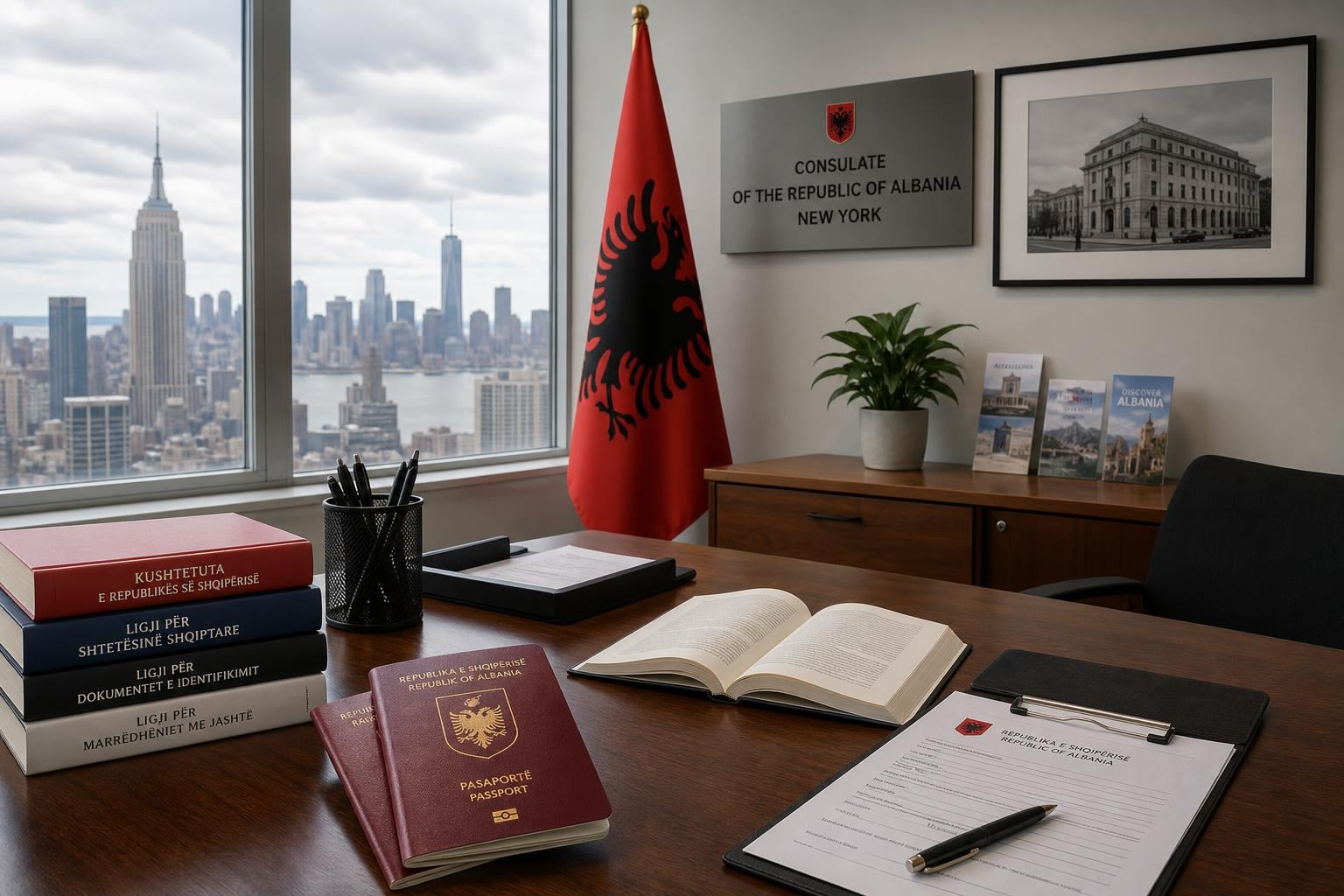
For most Albanian Americans on the East Coast, the Consulate General of Albania in New York is the single most consequential government office in their lives. It is where the pasaportë (passport) gets renewed, where the çertifikatë lindjeje (birth certificate) gets requested, where a prokurë (power of attorney) is signed so a cousin in Tirana can sell an apartment on your behalf, where citizenship-by-descent files start moving, and where the next generation gets registered into Albania’s civil books.
It is also, for many readers, the office whose appointment portal has been the source of more frustration than any other piece of bureaucracy in their adult life.
This guide is meant to cut through that frustration. It explains what the consulate does, which states it covers, how appointments work in practice, what to bring, and where the lines are drawn between the consulate in New York and the Embassy in Washington, DC. None of this replaces the consulate’s own official channels, addresses and fees change, and the only sources that can confirm a specific appointment slot or document fee are e-Albania and the consulate itself. But by the time you finish reading, you should know exactly which questions to ask and which surprises to plan around.
We’ll also be honest about what the National Albanian Registry can and cannot do. NAR is a community-led count, useful for the diaspora’s collective infrastructure, useless for renewing a passport. Both layers matter; they don’t substitute for each other.
What the Consulate General of Albania does
A consulate is the day-to-day, citizen-facing arm of a foreign government. While the Embassy of Albania in Washington, DC focuses on state-to-state diplomacy, relations with the US Department of State, agreements, accreditation, defense and trade cooperation, the consulate in New York handles consular services for Albanian citizens and their families who live in the United States (Albanian MFA, Embassy of Albania in the USA).
In practice, the New York consulate’s daily workload includes:
- Issuing and renewing biometric Albanian passports (pasaportë biometrike).
- Issuing and renewing the national ID card, the letërnjoftim.
- Registering births, marriages, and deaths that happen abroad into Albania’s civil registry.
- Issuing and apostilling civil status certificates (birth, marriage, death, family certificates, citizenship status).
- Notarizing signatures and documents.
- Preparing and authenticating powers of attorney for use in Albania.
- Authenticating and apostilling Albanian-origin documents for use in the United States, and vice versa.
- Processing visa applications for non-Albanians traveling to Albania who require one.
- Supporting citizenship and trashëgimi (inheritance) cases, including citizenship-by-descent files under Law 113/2020.
- Helping Albanian nationals in distress, lost passports, hospitalizations, detentions, repatriation of remains.
- Maintaining the consular protection function for Albanian citizens in its jurisdiction.
What the consulate does not do is replace US government services. Your green card, your US passport, your immigration interview, those belong to USCIS and the State Department. The consulate’s universe is Albanian-side paperwork.
Address, hours, and which states it covers
As of the most recent published guidance, the Consulate General of Albania in New York is at:
320 East 79th Street, New York, NY 10075 Phone: (+1) 212-255-7381 Email: consulate.newyork@mfa.gov.al
The office sits on Manhattan’s Upper East Side, between First and Second Avenues. The closest subway is the Q at 72nd Street; the 6 at 77th Street works as well, with a longer crosstown walk. Parking in the neighborhood is street-only and competitive. If you’re coming in from New Jersey, Connecticut, or further out, the PATH plus subway, NJ Transit to Penn Station, or Metro-North to Grand Central all connect cleanly. Plan extra time for security at the building entrance and for any line that has formed before the office opens.
Hours typically fall within standard business windows on weekdays, with reduced or closed days for Albanian and US public holidays. Holiday calendars vary year to year, and the consulate sometimes adjusts hours around peak passport season or staff changes. Confirm the day’s hours before traveling. A wasted trip from Boston or Pittsburgh because you didn’t check is one of the most common avoidable mistakes diaspora Albanians make. The official Albanian Ministry of Foreign Affairs portal at punetejashtme.gov.al and the Embassy’s site at ambasadat.gov.al/usa are the upstream authorities for any current update.
Jurisdiction
Albania maintains a small consular network in the United States. The Embassy in Washington, DC and the Consulate General in New York are the principal posts; honorary consuls and limited representation exist in other cities depending on the year, but the New York consulate is the workhorse for the East Coast diaspora. Most appointments funnel here, and many people travel several hours to reach it.
Neither the Albanian MFA nor the Embassy publishes an official state-by-state jurisdiction map, so the exact boundary isn’t written down anywhere public. In practice, community reports and e-Albania’s routing put these East Coast states through New York most often:
- New York
- New Jersey
- Connecticut
- Pennsylvania
- Massachusetts
- Rhode Island
- Maine
- New Hampshire
- Vermont
Depending on the service and current consular assignments, residents of nearby states, Maryland, Delaware, sometimes Virginia and West Virginia, may also be routed through New York, especially for biometric capture. Residents of Michigan, Illinois, Ohio, and other states with large Albanian populations may have closer options, but for many practical purposes the New York consulate ends up being the appointment people can secure soonest.
If you live outside the standard East Coast cluster, do not assume your case must go to New York. Ask the consulate, there’s no substitute for confirming directly, since this isn’t formally published anywhere.
How to book an appointment (and what to bring)
The single most useful URL for any of this is e-albania.al, the Albanian government’s e-services portal. Almost every consular service starts there.
To use it you’ll need:
- An e-Albania account, which requires your Albanian ID number (NID) and a verified phone or email.
- The specific service you’re requesting (renew passport, request birth certificate, etc.), which the portal lists by category.
- A method to pay the state fee, usually a card payment in the portal itself.
- Scanned copies of supporting documents in PDF or image form.
Once you submit, the system routes biometric and in-person services to the consulate jurisdiction your address falls under. For the East Coast, that is usually New York. The portal then assigns or asks you to pick an appointment slot.
What to bring on the day of your appointment depends on the service, but a baseline list includes:
- Your current Albanian passport and/or letërnjoftim, even if expired.
- A US government ID, driver’s license, state ID, or US passport.
- Proof of your US address (utility bill, lease, official mail).
- Printed confirmation of the e-Albania application, including the unique application number.
- Receipts for any state fees already paid.
- For minors: both parents’ IDs, the child’s US birth certificate (apostilled if not already filed in Albania), and authorization documents if only one parent is present.
- For citizenship-by-descent files: the originals and apostilled copies of your parent’s, grandparent’s, or great-grandparent’s Albanian civil documents, plus your own chain-of-descent paperwork.
Bring more than you think you need. The cost of an extra photocopy is nothing; the cost of being turned away and having to rebook two months out is real.
Passport renewal and the biometric process
Albania issues a biometric passport that complies with International Civil Aviation Organization standards (Albanian Ministry of Foreign Affairs). The New York consulate is one of the Albanian missions abroad equipped to take biometric fingerprints, which is critical: many smaller posts cannot, which is why people fly from across the US to New York for capture.
The basic flow is:
- Start the application on e-Albania. Pay the state fee.
- Receive an appointment for biometric capture at the consulate.
- Show up with documents, get fingerprinted and photographed, sign the application.
- The data goes to the General Directorate of Civil Status in Tirana.
- The passport is printed in Albania and shipped back to the New York consulate (or another method depending on current policy).
- You’re notified when it arrives; you collect it in person or have it sent based on the option you selected.
Processing times vary. Several weeks is typical; longer is common during peak seasons. For a current fee schedule and processing-time guidance, check the official e-Albania service page and the consulate’s confirmation messages. We don’t list numbers here because they change.
If your existing passport is lost or stolen, the process is different, you may need to file a police report and request emergency travel documents through the consulate. For travel emergencies, call rather than email.
Civil status documents: birth, marriage, death certificates
Albania’s civil registry runs through the General Directorate of Civil Status, and most extracts can be requested online through e-Albania. The consulate’s role is to:
- Help you obtain Albanian civil certificates if you can’t get them yourself online.
- Apostille or authenticate Albanian-origin certificates for use in US legal, immigration, or estate matters.
- Apostille or authenticate US-issued certificates (already apostilled by the US state of issue) for filing into Albania’s civil registry.
- Register events that happened in the US, your child’s birth, your marriage, the death of a relative, into Albania’s books, which matters for inheritance, citizenship transmission, and pension claims.
This is one of the most common reasons people first interact with the consulate. A US-born child of Albanian parents often gets registered in Albania’s civil registry years after birth, usually because the family is preparing for a passport, a school enrollment in Albania, or a property matter. The earlier you do it, the easier it tends to be. Documents from twenty years ago routinely surface gaps that take weeks to resolve.
Bring originals. Bring apostilles. Bring certified translations into Albanian where required.
Power of attorney, notarizations, and ID cards
A prokurë, power of attorney, is the document that lets a relative in Albania act on your behalf. Sell an apartment, manage a piece of land, represent you in court, file your taxes, deal with the cadastre. For many diaspora Albanians, this is the single most-used consular service over a lifetime.
The consulate prepares and authenticates these. You’ll need:
- The names, ID numbers, and contact details of the person you’re giving power to.
- A precise description of what powers you’re granting. Vague language gets rejected by Albanian notaries.
- Your own Albanian ID document.
- A consultation in Albanian or, if needed, an interpreter for the legal language.
Notarizations more generally, signature verification, document copies certified true to the original, are also handled at the consulate. Costs vary by document type.
ID card renewal, the letërnjoftim, follows the same biometric capture flow as passport renewal: start on e-Albania, book the in-person appointment, get fingerprinted, wait for production in Albania, collect or receive the card. Many diaspora Albanians let their ID card lapse because they “only use the passport” in the US, which works until you need to vote, prove residency, or deal with property, at which point the ID card matters again.
Citizenship by descent and the 2020 law, how the consulate fits in
Albania’s 2020 Citizenship Law (No. 113/2020) opened a path to citizenship for people who can document an Albanian parent, grandparent, or great-grandparent. Descent through a parent carries no residence requirement, and dual citizenship is permitted (Wikipedia, Albanian nationality law); the terms for grandparent- and great-grandparent-level claims are more specific, so check exactly how your generation qualifies before assuming the same rules apply. We’ve written about the law in detail in the citizenship law explainer and the practical US-side checklist in the citizenship by descent guide.
For applicants on the East Coast, the consulate’s role is mainly to:
- Help you get the Albanian-side civil documents you’ll need, your grandfather’s birth certificate from a village in northern Albania, your grandparents’ marriage record, the family registry extract that ties you to them.
- Apostille and authenticate US-side documents (birth, marriage, death certificates, name-change orders) for the Albanian file.
- Notarize your application paperwork.
- Receive and transmit the file to the relevant authorities in Albania.
The decision itself is made in Albania, not at the consulate. The President of the Republic signs citizenship decrees. The processing window depends on file completeness, backlog, and which authorities have to weigh in.
Citizenship-by-descent files are document-heavy. The single biggest reason files stall is missing or mis-translated documents from a generation ago. The consulate can guide; it cannot fabricate documents you don’t have. Plan for a multi-month effort and budget for translations, apostilles, and travel.
Common pitfalls and how to avoid them
A few patterns show up repeatedly in diaspora consular stories:
Showing up without an e-Albania confirmation. Biometric capture is not a walk-in service. Without an appointment, you’ll be turned away.
Wrong jurisdiction. If your driver’s license says Detroit but you’re trying to book in New York, the system may catch it. Confirm your residence-based jurisdiction first.
Documents not apostilled. US documents intended for use in Albania need an apostille from the issuing state’s Secretary of State first. Albanian documents intended for use in the US need an apostille from Albania’s Ministry of Justice. The consulate’s role is downstream of those apostilles, not a substitute.
Translations missing. Many Albanian filings require a certified Albanian translation. Some US filings require certified English translations. Sworn translators are not free and not instantaneous.
Letting passport or ID lapse during a busy life. Renewal is much easier than first-time issuance, and easier still when your civil registry is current. Don’t let your file go cold.
Assuming the consulate emails back fast. Like most consular offices worldwide, the New York consulate is under heavy volume. Plan ahead by months, not days, for non-urgent matters.
Confusing the consulate with the Embassy. The Embassy in DC does not run a walk-up passport counter. Don’t fly to Washington thinking you’ll skip the New York queue, you won’t.
Trusting third-party “consulate services” sites. Several private websites advertise consulate appointments, document expediting, or visa services. Some are scams; some are legitimate paid intermediaries; none are the consulate. The only authoritative channels are e-albania.al and the consulate’s official contacts via the Albanian MFA. If a site asks you to pay them to “secure” an appointment slot, walk away.
Where the National Albanian Registry fits in
The consulate handles the legal, formal side of being Albanian in the US, citizenship, identity, civil records, the paperwork that connects you to the state. That work is essential and entirely the consulate’s domain.
There is a second layer most diaspora Albanians never see, and it is the one the National Albanian Registry exists for. The US Census Bureau records roughly 230,000 Albanian Americans in the 2024 American Community Survey, with community estimates including ethnic Albanians from Kosovo, North Macedonia, Montenegro, and the Arbëresh of Italy pushing the real number close to one million. Knowing where the community lives, by state, by metro, by generation, strengthens the case for advocacy, scholarships, language preservation, business networks, and the recognition campaigns other diaspora communities have walked.
NAR’s count is community-run, free, and independent. It is not a government program. The certificate it issues is a community recognition document, not citizenship, not government ID, not legally binding. We do not share data with the consulate, the Embassy, or any other government body.
Once you’ve handled the consular side, the community count is the other half of being properly counted as Albanian American. Get counted →
That gap between the million and the 230,000 is the reason the National Albanian Registry exists. The Census misses most of us for structural reasons we’ve written about at length, and the 2030 count is being designed now. If you are handling Albanian paperwork, you are already doing the harder version of this. Add yourself to the count → It is free and takes about two minutes.