

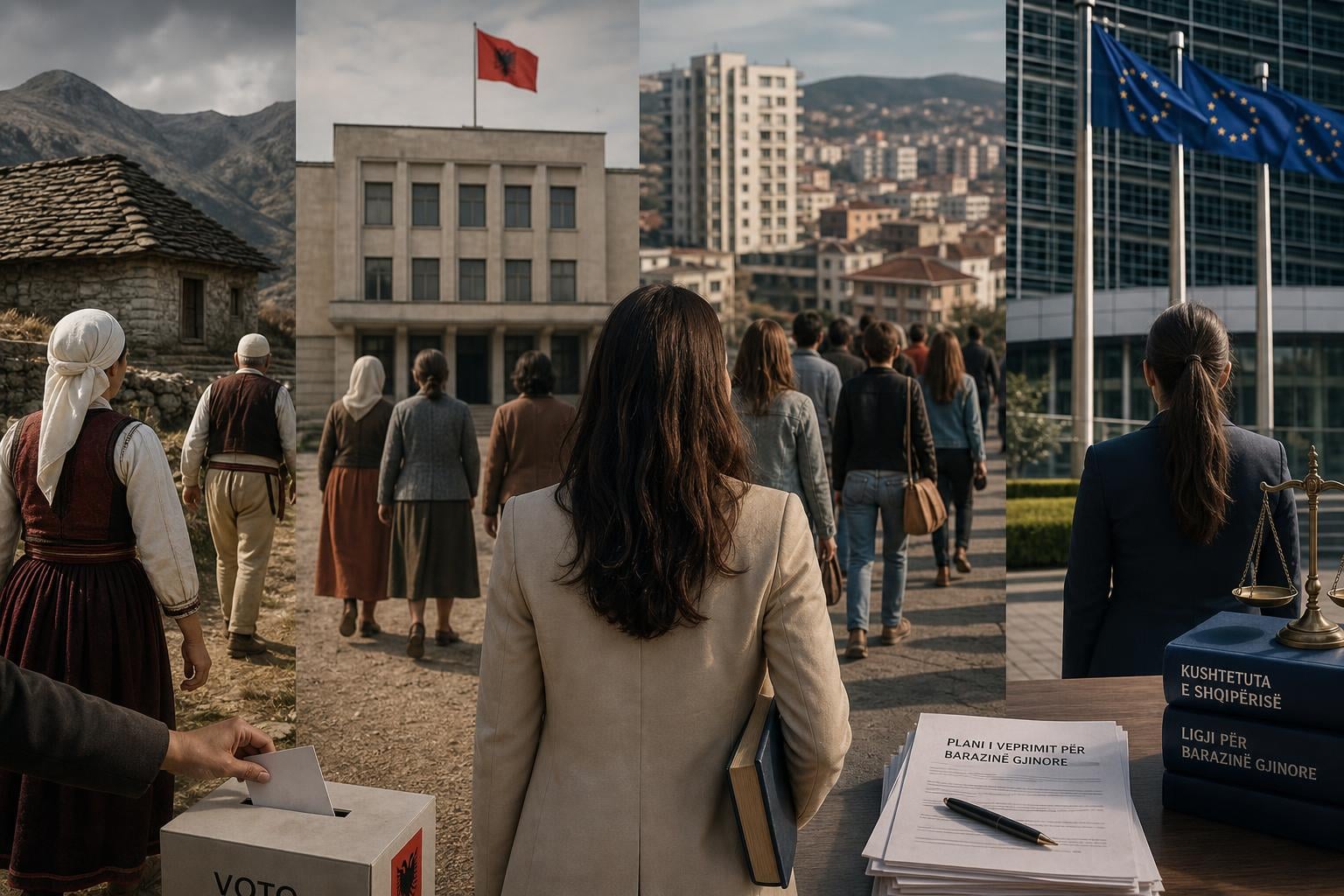
The four eras of Albanian women’s rights
Albanian women’s legal status has moved through four reasonably clean periods. The Ottoman-era highlands, governed by the customary Kanun, gave women almost no autonomous legal standing — property, inheritance, and household authority were patrilineal by default. The communist period (1944–1991) imposed a top-down equality program that produced real gains in literacy and labor-force participation alongside continuing private-sphere patriarchy. The transition decade after 1991 saw legal protections weaken in practice as state capacity collapsed and emigration peaked. The current era, shaped by EU accession dialogue from 2003 forward, has produced a dense statute stack — CEDAW ratification in 1994, the 2006 domestic violence law, the 2008 gender equality law, and the candidate-list quotas — with enforcement still uneven.
This article walks through each period with named statutes, ratification dates, and current numbers where they are publicly available. The second half covers Kosovo, where the legal framework is parallel but distinct, and the US diaspora picture, where the home-country baseline is less load-bearing than people often assume.
NAR’s stance throughout is institutional and factual. The intent is not advocacy but a clean reference for the diaspora — Albanian-American women, parents of daughters in the community, academic readers, and journalists. For background on related cultural institutions, see NAR’s pieces on albanian-besa (the honor pledge that bound male oath-taking under the Kanun) and on albanian-traditions more broadly.
The Albanian Constitution of 1998 (Article 18) prohibits discrimination on the basis of sex, among other categories. That clause has been the constitutional anchor for every statutory reform since.
Kanun-era and Ottoman context
The Kanun (the medieval customary code, most famously the Kanun i Lekë Dukagjinit compiled in the 15th century and still operative in the northern highlands into the 20th) treated women as members of their natal family until marriage and members of their husband’s household after. Property was inherited patrilineally. A woman could not own land in her own name in most northern fis (clan) structures. Marriage was arranged, often in childhood. Bride price (pajë on the bride’s side; prikë in some districts) and dowry exchanges formalized the transfer of household labor between families.
The Kanun did include protections for women that should be named accurately. Women were not legitimate targets in gjakmarrja (blood vengeance) — a man could not kill a woman or a child in feud. Honor offenses against women were enforceable through the same mechanisms that governed male-on-male disputes. But these protections were predicated on women’s status as non-actors in the legal sense, not as autonomous rights-holders.
The Ottoman administrative system (formal Ottoman rule lasted in Albania from 1479 to 1912) operated in parallel with the Kanun in much of the territory. In urban centers and Muslim communities, Ottoman family law (a version of sharia administered by qadi courts) governed marriage, divorce, and inheritance. Christian women in the south fell under Orthodox or Catholic ecclesiastical jurisdiction for the same matters. In the highlands, the Kanun continued to function more or less untouched by either system.
One narrow institution stood out: the burrneshë (sworn virgin), a woman who took an irreversible oath of celibacy to live as a man under the Kanun and thereby acquired male legal status — including the right to inherit, head a household, and bear arms. NAR’s full treatment is at Burrnesha: Albania’s Sworn Virgins. The institution illustrates the rigidity of the underlying gender rules: the only Kanun-recognized way for a woman to access male rights was to socially cease being a woman.
The communist record: 1944 to 1991
The communist government installed under Enver Hoxha in 1944 made women’s legal equality a stated programmatic priority from the start. The 1946 constitution declared full legal equality between the sexes. Women received the vote in the 1945 elections — the first national elections in Albanian history in which they could participate. The 1965 Family Code and subsequent revisions standardized marriage, divorce, and child-custody rules on a formally gender-equal basis.
Labor-force participation rose sharply under the Hoxha government. By the late 1980s, women made up roughly 47% of the Albanian labor force, a rate higher than most Western European countries at the time. The state directed women into agriculture, light industry, education, and healthcare. Maternity leave, state childcare, and equal-pay rules were codified, though wage data for the period is fragmentary.
The literacy gain was the most concrete success. In 1945, female illiteracy in Albania was estimated at roughly 90%, concentrated heavily in rural and highland districts. The 1949 mass literacy campaign and subsequent compulsory schooling drove that figure to near-parity with men by the late 1970s. Women entered the universities in significant numbers from the 1960s on, and by the 1980s made up roughly half of the university student population.
The record was not what the propaganda claimed. The communist state targeted Kanun-era practices — bride price, arranged marriage, the burrnesha institution — as “feudal survivals” to be eradicated, and persecuted families that practiced them. But the private sphere remained heavily patriarchal. Domestic violence was not criminalized as such, and women were almost entirely absent from senior political positions. Nexhmije Hoxha, Enver Hoxha’s wife, held real institutional power; almost no other woman did.
Land collectivization (1946–1990) abolished private landholding altogether, which had the practical effect of erasing the Kanun-era patrilineal property rules — there was no longer property to inherit. When private land returned after 1991, the older patrilineal patterns reasserted themselves in many rural districts, and women re-emerged as a small minority of registered landowners.
The transition decade: 1991 to the early 2000s
The fall of the communist government in 1991 was followed by economic collapse, the 1997 pyramid scheme crisis, large-scale emigration, and a substantial weakening of state capacity. Women’s legal equality remained on the books — the 1998 Constitution, Article 18, expressly prohibits sex discrimination — but enforcement was thin.
Three patterns from this period are worth naming. First, female labor-force participation fell sharply, from the communist-era ~47% to under 40% by 2001, as state-sector employment contracted and private-sector hiring favored men in many sectors. Second, the Family Code was substantially rewritten — the current code, Law No. 9062/2003, replaced the 1965 version and modernized marriage, divorce, and parental-authority rules along EU-aligned lines. Third, domestic violence emerged as a publicly named issue for the first time, driven by NGO reporting and by international monitoring under CEDAW.
CEDAW ratification came in 1994. The treaty obligates Albania to report periodically to the UN Committee on the Elimination of Discrimination Against Women on legislative and policy measures, and to align domestic law with the treaty’s substantive provisions. Albania’s first periodic report was filed in 2002, with subsequent reports in 2010, 2016, and 2020 — each a useful primary source for state-of-play snapshots.
The 1995 Albanian Penal Code was the operative criminal statute through this period. It contained rape provisions and limited assault provisions but did not separately criminalize domestic violence or marital rape until the amendments tied to the 2006 and 2007 reform packages. Trafficking of women — a significant problem in the late 1990s with Albania emerging as a transit and origin country for Western European destinations — was addressed through later statutory work and through the 2005 Council of Europe trafficking convention, which Albania ratified in 2007.
The modern statute stack
The current Albanian framework for women’s rights is built on four named statutes and the constitutional anti-discrimination clause. Read together they form a reasonably comprehensive structure on paper; enforcement varies.
CEDAW (ratified 1994; Optional Protocol 2002). Treaty-level baseline. Direct effect in Albanian courts under Constitution Article 122.
Law No. 9669/2006, “On Measures Against Violence in Family Relations” (the 2006 DV law). This was Albania’s first dedicated domestic violence statute. It defines family violence broadly, creates civil protection orders issued by district courts, requires police response, and establishes shelter-referral obligations for municipal authorities. It was amended in 2010 and again in 2018 to widen the scope and stiffen the enforcement chain.
Law No. 9970/2008, “On Gender Equality in Society” (the 2008 gender equality law). The substantive equality statute. It defines direct and indirect discrimination, mandates equal pay for equal work, creates the National Council on Gender Equality, designates a Commissioner for Protection from Discrimination as the primary enforcement officer, and — most visibly — sets the 30% gender quota for candidate lists in elections.
Law No. 9062/2003, the Family Code. Marriage age set at 18 for both sexes (16 with court authorization), gender-neutral divorce grounds, joint parental authority, equal property rights in marriage.
Law No. 144/2013, amendments to the Penal Code. Criminalized domestic violence as a standalone offense (Article 130/a). Criminalized stalking. Increased penalties for sexual violence offenses. Aligned Albania’s criminal law with the Istanbul Convention.
Council of Europe Convention on Preventing and Combating Violence Against Women and Domestic Violence (Istanbul Convention). Albania signed in 2011 and ratified in 2013, becoming one of the earlier Council of Europe states to do so.
Law No. 113/2020, the current Albanian Citizenship Law. Citizenship by descent runs through either parent without gender distinction, up to and including great-grandparents, with no residence requirement and no renunciation obligation. NAR’s full breakdown is at The 2020 Albanian Citizenship Law Explained.
The 2008 gender equality law was amended in 2020 to tighten the candidate-list placement rules — preventing parties from concentrating female candidates in unwinnable list positions — and to expand the National Council’s monitoring mandate.
Domestic violence and enforcement today
The named statutes are stronger than enforcement. Reported domestic violence cases have risen substantially over the past decade, which observers read as a combination of reporting-rate gains and continuing high underlying prevalence. Civil protection orders are issued by district courts in most reported cases, but compliance enforcement remains a problem.
Three structural issues recur in CEDAW reporting and in Council of Europe GREVIO (Group of Experts on Action against Violence Against Women) monitoring. First, shelter capacity is below need — Albania operates a small number of state-funded and NGO-run shelters, concentrated in Tirana, Shkodër, and a few other urban centers. Rural women face significant access barriers. Second, prosecution rates for domestic violence cases remain low; cases often resolve through civil protection orders without criminal sanction. Third, femicide as a separately tracked category was introduced into Albanian crime statistics only recently, and historical comparison is difficult.
The 2018 amendments to the 2006 DV law expanded the definition of “family relations” to include former partners and dating relationships, broadened the categories of conduct covered, and tightened the timeline for police response. The 2020 amendments to the Penal Code added aggravating circumstances for crimes committed in front of children.
NGOs that produce regular monitoring reports include the Albanian Women’s Empowerment Network, Counseling Line for Women and Girls (which operates a national hotline), and the Center for Legal Civic Initiatives. Their reports are useful primary sources for diaspora readers tracking conditions on the ground.
In Kosovo, the parallel framework is the Law No. 03/L-182 on Protection from Domestic Violence (2010), replaced and strengthened by Law No. 08/L-185 (2024), which raised penalties and tightened the protection-order chain. Kosovo also ratified the Istanbul Convention in 2020.
Women in politics and the economy
Albania’s 30% candidate-list quota has produced measurable results. After the 2013 parliamentary elections, women held 20% of seats. After 2017, that rose to 28%. After the 2021 elections, women held roughly 36% of the 140 seats in the Kuvendi i Shqipërisë (the Albanian Parliament) — above the legal floor and above the EU average. Niko Peleshi has served as Speaker of the Parliament since September 2025, succeeding Elisa Spiropali (2024–2025) and Lindita Nikolla (2021–2024). The current cabinet includes multiple female ministers, and women have held the foreign ministry, the defense ministry, and other senior portfolios in successive governments.
In Kosovo, women hold approximately 33% of the 120 seats in the Kosovo Assembly under the constitutional reserved-seat rule. Vjosa Osmani has served as President of Kosovo since 2021. Atifete Jahjaga was Kosovo’s first female president (2011–2016). Both Kosovo and Albania have higher female political representation than several older EU member states.
Economic participation is a different picture. Female labor-force participation in Albania was approximately 55% in 2023, below the male rate (~73%) and below the EU average for women. The gender pay gap is officially reported at around 6–10%, lower than the EU average — though that figure partly reflects sectoral segregation rather than equal-work parity. Female business ownership has risen substantially since the early 2000s, with women now leading roughly 30% of small and medium enterprises registered in Albania.
Education is now ahead of the gender curve. Women make up more than 55% of university students in Albania and a similar share in Kosovo, with even larger majorities in medicine, law, and education faculties. This is a significant inversion of the communist-era picture, and it carries through into the diaspora.
Mother Teresa (born Anjezë Gonxhe Bojaxhiu in Skopje to ethnic Albanian parents, canonized in 2016) remains the most internationally recognized Albanian woman, a Nobel Peace Prize laureate (1979), and a symbolic anchor in both Albania’s and Kosovo’s public iconography. Her significance is more symbolic than legal, but her image appears across Albanian and Kosovar institutional life — currency, airports, public statues.
The US diaspora picture
The Albanian-American population is approximately 230,000 by 2024 American Community Survey self-identified ancestry, with community-level estimates including second- and third-generation Albanians and ethnic Albanians from Kosovo, North Macedonia, and Montenegro running closer to 1 million. The three highest-density states are New York (~56,000), Michigan (~27,000), and Massachusetts (~21,000). See NAR’s full demographic write-up at albanian-americans.
Within that population, the picture for women is distinct from the home-country baseline in several measurable ways. First-generation immigrant women — particularly those who arrived in the 1990s emigration wave — show a labor-force participation rate above the Albanian baseline and often above the general US-immigrant baseline. Second-generation Albanian-American women complete bachelor’s degrees at rates roughly comparable to or exceeding the US-born female average, with ACS B15002 data consistently showing strong educational outcomes for the ancestry group.
Professional concentration shows up in healthcare, education, financial services, real estate, and small-business ownership. Albanian-American women run a substantial share of the family businesses in the New York metropolitan area’s bakery, restaurant, and construction-services sectors. The professional networks that have emerged over the past decade — the Albanian American Women’s Organization, the Motrat Qiriazi heritage circles (named for the sisters Sevasti and Parashqevi Qiriazi, pioneers of Albanian-language girls’ education in the late 19th and early 20th centuries), and various regional professional associations — operate primarily in New York, Detroit, and Boston.
The generational shift is the most consistent pattern in diaspora reporting. First-generation Albanian-American women, particularly those from rural or traditional backgrounds, often retained home-country social expectations around marriage age, family structure, and women’s role in the household. Second-generation women, raised inside the US educational and labor system, have moved decisively toward US-norm patterns on age at first marriage, fertility, and career trajectory — while often maintaining significant ties to Albanian language, religious community, and family networks. The third generation is largely indistinguishable from the broader US-born population on demographic markers, with cultural identity preserved through periodic family travel, food, music, and the residual community organizations.
The academic literature is small but growing. Notable contributors include Antonia Young’s anthropological work on the burrnesha institution and the periodic ACS-derived demographic profiles produced by the Migration Policy Institute. NAR’s own regional civic-engagement profiles include the Texas write-up at Albanian Americans in Texas.
Many of the Albanian-American women now in their thirties and forties are daughters of mothers who grew up under the communist program and then emigrated through the 1990s transition. Their relationship to Albanian women’s rights is layered: a grandmother who lived under the Kanun’s residual rules, a mother who entered the workforce under a state that proclaimed equality while practicing it incompletely, and themselves operating inside US legal and professional norms. The full arc fits inside three generations.