

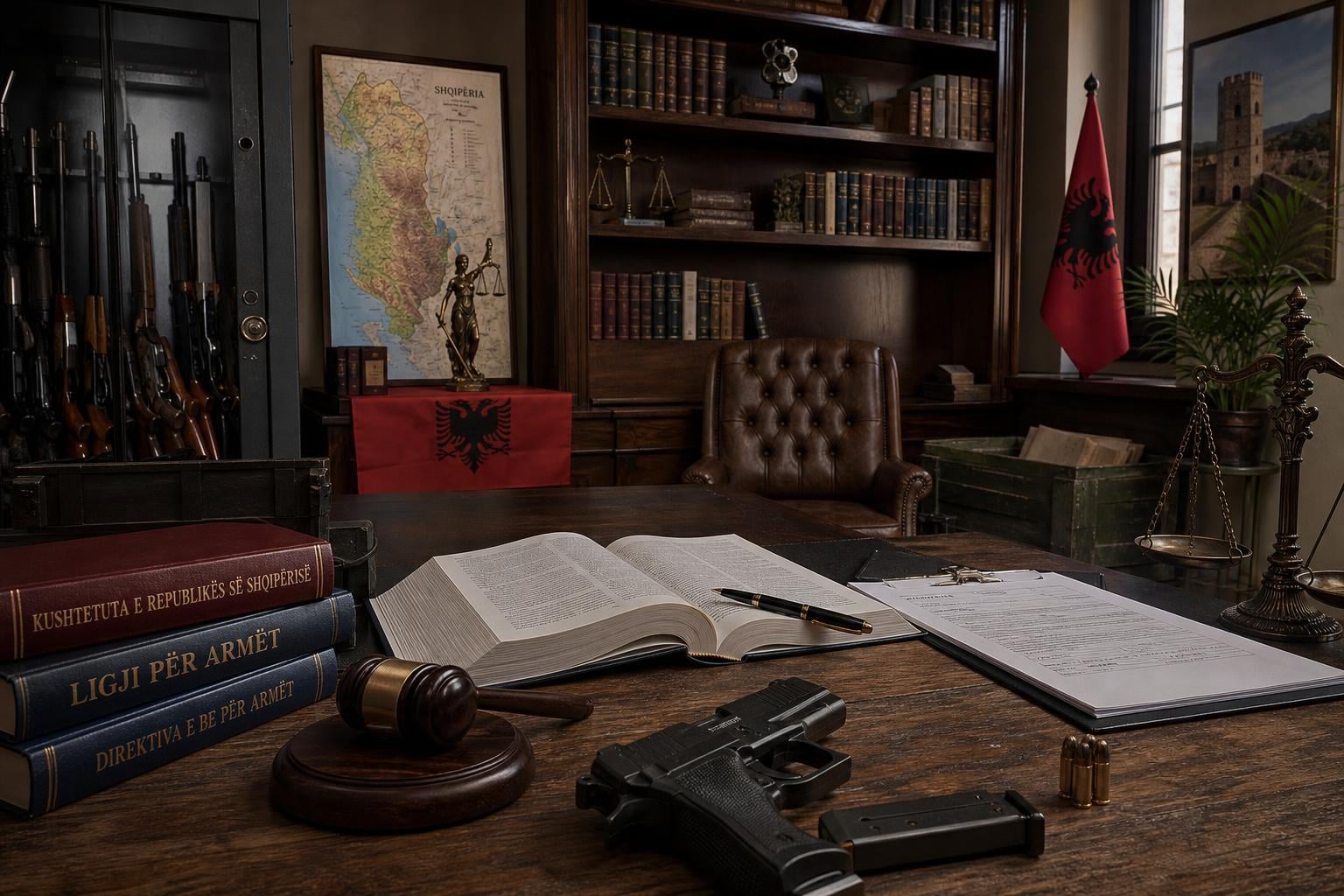
A reader in metro Detroit writes that his uncle in Korçë just renewed a hunting license and was casually proud of it over a long phone call. The reader’s other side of the family, in Texas, watches the US gun debate the way most Americans do — with strong opinions and a lot of crosstalk. Somewhere between the two conversations a question lands: how do firearms actually work in Albania? Not the cliché of a Balkan country awash in old AKs. Not the assumption that everything goes. The real legal picture.
That is what this article tries to lay out, on facts. It is written for Albanian Americans first — the daughter checking what her father in Vlorë can keep at the cabin, the law student writing a comparative paper, the journalist filing a feature on the Albanian-American community, the returnee weighing what to do with a grandfather’s rifle. It is deliberately neutral. The US gun-policy argument stays out of it. What stays in is the Ligji për Armët (Law on Weapons), how the Albanian State Police runs licensing, what the 1997 unrest did to the country’s small-arms stockpile, and where the European Union accession process is pushing Albanian rules next.
Three things are worth knowing before the details. First, civilian gun ownership is legal in Albania, but it is licensed on a per-firearm, per-purpose basis with a real review at the front end and at every renewal. Second, the post-1997 stockpile of unaccounted-for military weapons shaped a generation of disarmament policy, much of it run with OSCE and UNDP support. Third, the legal text Albania uses today — Law No. 74/2014 and its amendments — is closer to the European Union’s firearms framework than it is to any US state’s framework. The rest of the piece is the reasoning behind those three sentences.
The 1997 inflection point
Nothing about Albania’s modern firearms picture makes sense without 1997. Across January and February of that year, a cluster of unregulated investment companies collapsed and took two-thirds of Albanian household savings with them. Protests turned into uprising. By March, the southern third of the country was outside government control and state armories had been emptied by crowds and by organized groups. The standard published estimates put the number of military small arms taken from state stockpiles in the hundreds of thousands, with widely cited figures clustering around the 550,000 to 650,000 range. Ammunition stockpiles running to roughly 1.5 billion rounds moved into private hands at the same time. We covered the collapse and its civilian costs in The 1997 Albanian Pyramid Scheme Collapse.
What followed for firearms policy was a long, uneven recovery. The Organization for Security and Co-operation in Europe (OSCE), the United Nations Development Programme (UNDP), and a series of bilateral donors backed weapons-collection programs across the late 1990s and 2000s. Amnesty windows let households surrender weapons without prosecution. Buy-back pilots in specific districts paid modest sums per turned-in firearm. Public-information campaigns ran in Albanian and were targeted at the regions believed to hold the largest residual stockpiles of unregistered weapons. Estimates of total recoveries vary by source; published OSCE and UNDP figures over the lifetime of the programs are in the low-to-mid hundreds of thousands, leaving a significant residual number of weapons unaccounted for through the early 2010s.
The political point is that 1997 reset the question. Before the collapse, Albania’s firearms regime was a transition-era patchwork, inherited from the communist period and adjusted piecemeal. After the collapse, every serious policy document on Albanian firearms — domestic and international — started from the premise that the country had a small-arms problem the law had to address head-on. The 2014 statute is the most concrete legislative answer to that premise.
The current legal framework: Law No. 74/2014
The operative law is Ligji nr. 74/2014 “Për Armët” (Law No. 74/2014, “On Weapons”), passed by the Albanian Parliament — the Kuvendi — and amended several times since. It replaced earlier legislation and brought Albania’s civilian firearms regime closer to the European Union’s framework as a step in the accession process.
The law sorts firearms into categories that map onto the European Union’s Firearms Directive — Category A, B, C, and D, in descending order of restriction. Category A is the prohibited tier — fully automatic firearms, military-grade weapons, certain large-caliber and explosive devices, and prohibited high-capacity magazines. Civilians cannot hold Category A weapons except in narrow specialized cases (such as registered museum collections operating under separate authorization). Category B covers most civilian handguns and certain semi-automatic long guns; these require a license issued for a stated purpose and are tracked individually in the national registry. Category C covers most non-semi-automatic long guns — typical hunting rifles and shotguns — and is the most common civilian category. Category D, before the 2017 EU amendment that reclassified it, covered some lower-restriction items such as certain antique-style or low-power devices; the practical Albanian application of the lowest tier has narrowed in line with EU updates.
The law sets out the obligations that follow from each category — registration, license type, transport rules, storage rules, ammunition limits per license, renewal cadence, and the offenses that apply when any of those obligations are broken. It also gives the Albanian State Police — Policia e Shtetit — the lead role in licensing, registry maintenance, inspections, and enforcement, in coordination with the Ministry of Interior. Implementing regulations fill in the procedural detail; the law itself is the public framework.
Who can hold a license
The starting requirements for a civilian leje arme (firearms license) under Law No. 74/2014 are straightforward on paper and meaningfully gated in practice. An applicant must be at least 25 years of age. Albanian citizenship or legal permanent residency in Albania is required. A clean criminal record on disqualifying offenses — violent crime, weapons offenses, organized-crime convictions, certain domestic-violence offenses — is required. A current medical certificate covering physical fitness to handle a firearm is required. A psychological evaluation, focused on the applicant’s mental fitness to safely possess a weapon, is required. Completion of an approved firearms safety and handling course is required for first-time applicants. A documented lawful purpose — hunting, sport, or self-defense — has to be stated and supported.
The application is filed through the Albanian State Police, which runs background checks against domestic criminal-records databases and, depending on the category, additional checks. The decision is administrative. Denials can be appealed under standard administrative-law procedure, including, in the last instance, judicial review.
Licenses are not permanent. They renew on a fixed cadence — typical renewals are every several years for hunting and sport categories, with self-defense licenses generally renewing on a shorter cycle. Each renewal requires a fresh medical certificate, refreshed background checks, and confirmation that the licensee continues to meet the original criteria. A license can be revoked between renewals for a disqualifying event — a criminal conviction, a medical finding, a serious safety incident, or a violation of storage or transport rules.
One detail worth flagging for a US reader: there is no Albanian equivalent of a US-style “shall-issue” carry permit. The license is purpose-bound; carrying outside the purpose the license was issued for is not authorized.
Categories: hunting, sport, self-defense
The three civilian license categories under Albanian law are not parallel — each comes with a different evidence bar and a different operating envelope.
A hunting license is the most common civilian category. The applicant must be a member of a recognized hunting association, hold a separate hunting permit issued under wildlife and conservation rules, and limit firearm use to lawful hunting on lawful grounds during open season. The firearm itself is typically a Category C rifle or shotgun appropriate to the game. Transport to and from the hunt is regulated — the firearm must be unloaded, in a case, separated from ammunition, and accompanied by the license and hunting permit. Hunting tourism is a real, if regulated, part of Albania’s outdoor economy, and licensed Albanian guides handle the firearms side for visiting hunters under separate authorization.
A sport license covers competitive target shooting at registered ranges. The applicant must be affiliated with a recognized sport-shooting club. The license is tied to specific firearms appropriate to the sporting discipline — pistols for ISSF-style events, rifles for precision events, shotguns for clay disciplines. Firearms are stored under the club’s regime where applicable and at the licensee’s home under the storage rules described below. As with hunting, transport between home and range is regulated and the firearm must be unloaded and cased.
A self-defense license is the steepest hurdle. The applicant must demonstrate a documented, heightened risk to personal safety — a credible threat, an occupational exposure (such as certain private-security or cash-handling roles), or an established pattern of harassment that domestic authorities have on record. The State Police evaluates the evidence and decides. Approvals are not routine and the licensee’s record is reviewed closely at renewal. The firearm is typically a Category B handgun. Even with a self-defense license, carry in public places is constrained by specific rules on where, when, and how the firearm can be on the person.
Carry, transport, storage
The day-to-day rules around an Albanian license are tighter than what many US readers expect.
Concealed carry of a firearm in public is not a default right that comes with any standard license. A hunting license does not authorize concealed carry off the hunting ground. A sport license does not authorize concealed carry off the range. Self-defense licenses can authorize on-the-person carry, but with conditions — certain locations are off-limits (schools, government buildings, courts, public demonstrations, mass-transit hubs, licensed premises serving alcohol in many cases), and the firearm must be carried in a holster, secured, and unloaded or chambered according to the conditions on the license.
Transport rules apply to every category. The firearm has to be unloaded, in a locked or hard-sided case, separated from ammunition (which is typically transported in its own container), and accompanied by the license document. Transport across borders is separate and tightly controlled — see the diaspora section below.
Home storage is mandated. Firearms must be kept in a locked safe or equivalent secure container. Ammunition must be stored separately from the firearm. Households with minors face additional storage requirements designed to prevent unauthorized access. The State Police conducts inspections, which can be routine on a renewal or triggered by a complaint or incident.
Violations of carry, transport, and storage rules are administrative or criminal depending on severity. A loose-storage finding can support a license suspension or revocation. Carrying a firearm into a prohibited location can support criminal charges under the relevant section of the Weapons Law and the Criminal Code.
Disarmament programs and ongoing collection
The civilian-weapon collection effort that started after 1997 did not end with the 2000s. It continued, in different forms and at different intensities, into the 2010s and the present, run by the Albanian State Police with international support.
The early phase, broadly across 1998 to 2005, was the most visible. UNDP’s Small Arms and Light Weapons Control program in Albania, OSCE-backed amnesty windows, and bilateral donor projects from European partners ran in parallel. Public-information campaigns made the legal status of unregistered weapons clear and the surrender process simple. Pilot buy-back programs offered modest cash incentives in selected districts. Published OSCE and UNDP retrospectives put cumulative recoveries through this phase well into the low-to-mid hundreds of thousands of small arms, with much larger quantities of ammunition collected at the same time. Exact totals vary across reports, and the figures are best read as orders of magnitude rather than precise counts.
The later phase, from the late 2000s onward, shifted toward routine police-led collection — voluntary surrender at any State Police station, with no penalty for the act of surrender itself — combined with targeted operations against organized illegal possession. Albania’s accession-related work has also tightened the connection between the domestic registry and EU-level information exchange on lost, stolen, and trafficked firearms, supporting cross-border investigation when an Albanian-origin weapon shows up elsewhere in Europe.
The honest read is that the country has reduced the residual stockpile substantially over a quarter century without claiming victory. Estimates of how many unregistered weapons remain in private hands vary widely across sources and have generally trended down over time. Albanian and international officials describe it as a long-running effort rather than a closed file.
EU accession alignment
Albania has been a European Union candidate country since June 2014 and formally opened accession negotiations in July 2022. Firearms policy is part of that conversation. The European Union’s framework — the Firearms Directive, codified as Directive 91/477/EEC and substantively amended in 2008 and again in 2017 — sets minimum standards for member states on civilian firearm classification, licensing, marking, registry, deactivation, and cross-border transfer. Candidate countries are expected to align their domestic law with the directive as part of accession.
The 2014 Albanian Weapons Law was the major legislative step in that direction. The categorical structure (A through D), the licensing-on-purpose architecture, the prohibition on civilian access to military-grade weapons, the registry and tracing obligations, the deactivation standards, and the cross-border-transfer rules all map onto the directive’s requirements. Subsequent amendments have continued to close gaps — on magazine-capacity limits for civilian firearms, on the treatment of converted alarm and signal weapons, on the rules around acoustic-only “blank-firing” replicas, and on registry interoperability. Albania’s 2017-era amendments specifically tracked the European Union’s 2017 directive update in several places.
For an Albanian-American reader, the practical implication is that an Albanian license today operates inside a regulatory environment broadly recognizable to anyone familiar with how the European Union handles firearms. The categories, the language, and the registry obligations are not Albanian inventions; they are the European framework, adapted into Albanian law.
What an Albanian-American should know
The diaspora-side questions cluster around three real-life situations.
Bringing a firearm from the United States into Albania. Do not do this casually. Importing a firearm into Albania requires advance authorization from the Albanian State Police, supporting documentation on the lawful purpose, US-side export compliance, and a customs declaration on entry. Most US-based visitors who want to hunt or shoot during a trip leave their own firearms at home and arrange access through an Albanian license-holder — a licensed guide, a relative with a hunting license, or a registered range for sport use. An undeclared firearm in checked baggage or in a vehicle at the border is treated as a serious offense.
Inheriting a relative’s firearm in Albania. The legal status of an inherited firearm follows from the heir’s status, not from the deceased’s prior license. An heir who is not a licensed firearms owner cannot simply keep the gun. The practical options are to apply for a license in the appropriate category (which is realistic only if the heir lives in Albania and qualifies), to transfer the firearm to a licensed relative or dealer, or to surrender it to the Albanian State Police. Cross-border transfer to the United States is its own process — it involves the State Police on the Albanian side, the importing requirements of the US Bureau of Alcohol, Tobacco, Firearms and Explosives, and, in most cases, a licensed customs broker. For most diaspora heirs, the path of least friction is in-country transfer or surrender rather than US import.
Joining a family hunt or range visit during a trip home. The most common diaspora interaction with Albanian firearms is the family hunt, where a licensed Albanian relative handles the licensing and equipment and the visiting family member participates as a guest. This works inside the law as long as the firearm stays in the licensee’s control, transport and storage rules are followed, and the hunting permit covers the species and ground. Sport-range visits work similarly — the licensed club handles the firearms; visitors shoot under supervision.
A separate point that the NAR certificate sometimes raises: a certificate from the National Albanian Registry is recognition of heritage. It is not Albanian government identification, not citizenship, not a firearms license, and not a legal authorization of any kind for activity in Albania. The relevant Albanian documents for any firearms activity are the State Police license, the hunting permit (where applicable), and, for cross-border movement, the customs and export-control paperwork. Heritage and law are separate questions.
How Albania compares to the United States
Side-by-side, the most useful contrasts are structural rather than rhetorical.
Licensing. Albania requires a license for every civilian firearm, tied to a stated purpose and recorded in a national registry. The United States runs a patchwork. Long guns are unlicensed in most states. Handguns require a permit to purchase or own in a minority of states. Federal-level licensing applies to dealers, not buyers. A national firearms registry, in the Albanian sense, does not exist at the federal level in the United States.
Carry. Albania does not have a routine concealed-carry pathway for civilians. Self-defense licenses with carry conditions are issued narrowly. Most US states issue concealed-carry permits on either shall-issue or constitutional-carry terms, and many recognize permits from other states under reciprocity arrangements.
Storage. Albanian law mandates locked storage, separated ammunition, and inspectability. US storage laws are state-by-state. Some states have mandatory-storage requirements similar to Albania’s; others have none.
Categories and magazine limits. Albania mirrors the EU Firearms Directive on prohibited categories and magazine capacity. Civilian access to fully automatic firearms is prohibited, and magazine-capacity limits apply to certain semi-automatic configurations. The US federal framework prohibits civilian possession of post-1986 fully automatic firearms but otherwise leaves magazine-capacity limits to the states.
Enforcement. Albania centralizes firearms enforcement in the State Police, working with the customs administration on cross-border issues. US firearms enforcement is divided across federal (ATF), state, and local agencies, with overlapping jurisdiction.
None of this is offered to argue that one framework is better. It is offered so that an Albanian-American reading about either country’s gun policy in the news has a fair picture of what the other country actually does on paper.
It would also be incomplete to describe Albanian firearms law as if compliance were uniform. Independent monitors — the OSCE, the UNDP, the European Commission’s annual progress reports on Albania’s accession — continue to flag implementation gaps. Illegal possession in rural areas, residual unrecovered weapons from 1997, organized-crime trafficking, and inconsistent inspection coverage across districts all surface in the reporting. The Albanian government’s response, broadly, has been to keep tightening the legal framework, keep running the State Police’s collection and inspection operations, and keep aligning with European Union standards as the accession process advances.
The reading from outside Albania, in 2026, is roughly the same as the reading on the country’s democracy more broadly (which we covered in Is Albania a Democracy?) — a real legal framework with real institutions doing the work, in a country where the implementation gap is the active subject of reform rather than a settled state of affairs. The 1997 stockpile is no longer the dominant fact about Albanian firearms; it is one input among several. The dominant fact is the European framework, adapted into Albanian law and run by the Albanian State Police.
Civilian firearm ownership in Albania is legal, licensed, and meaningfully gated. The license is purpose-bound, the registry is real, and the renewal review is not perfunctory. The 1997 unrest reset the policy conversation but does not define it today. A quarter century of weapons collection, legislative reform, and European Union accession alignment has moved the framework substantially.
The practical questions a US-based family asks — about a relative’s hunting license, an inherited rifle, a planned trip home — have administrative answers, not improvised ones. The Albanian State Police is the agency to ask; the leje arme is the document to look for; the Ligji për Armët is the statute that decides what is and is not permitted.
Counting the diaspora helps the conversation about Albanian-American civic life — including how Americans of Albanian descent think and write about issues like firearms policy on both sides of the Atlantic — stay accurate. If you are an Albanian American who has not yet been counted, the registration page is the place to start.