
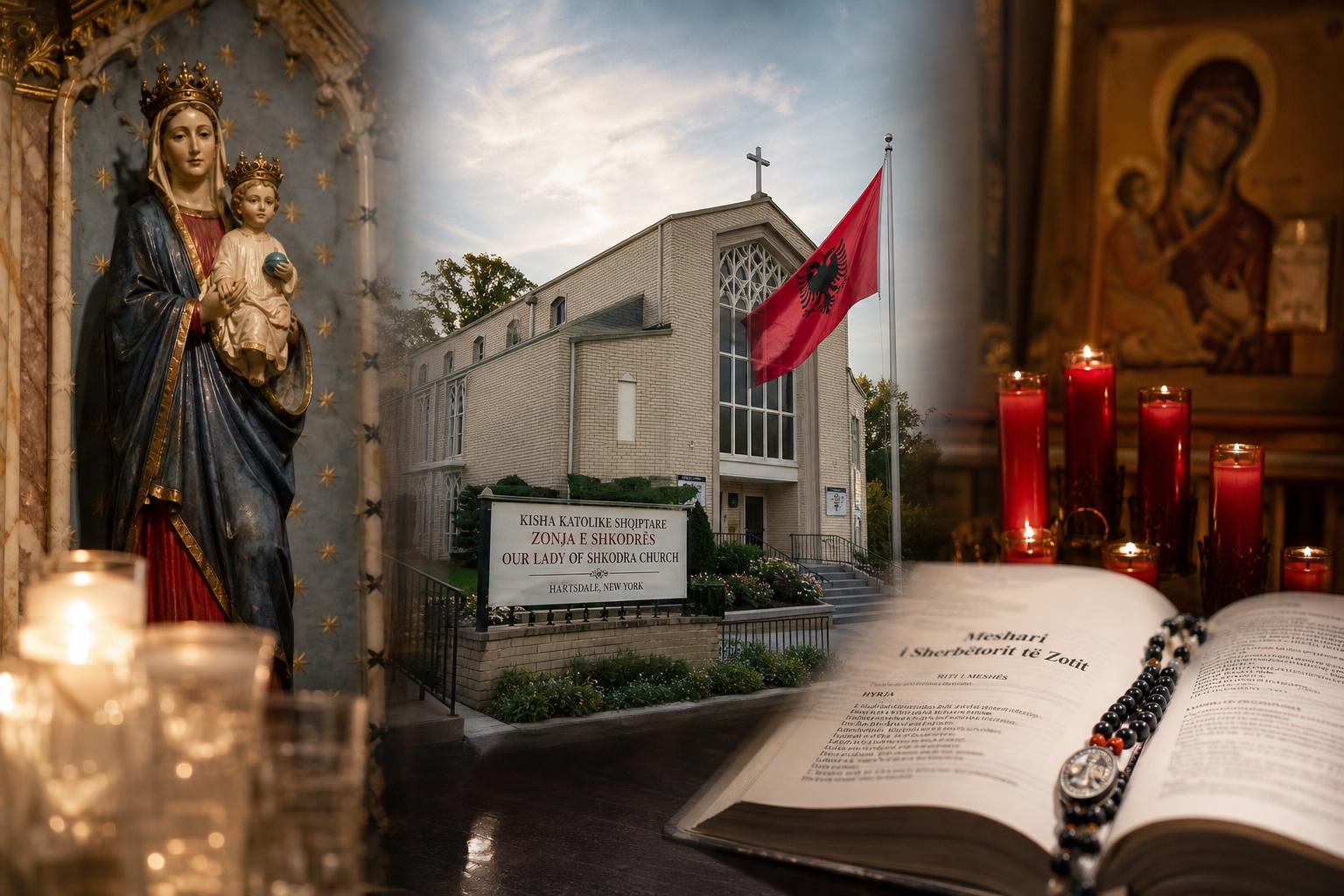
Drive twenty-five minutes north of midtown Manhattan, turn off the Saw Mill River Parkway into a quiet stretch of Westchester County, and you arrive at a modest church on West Hartsdale Avenue. The sign in front says Our Lady of Shkodra — Albanian Roman Catholic Church. For Albanian Catholics across the New York metro area, this is the parish that anchors their religious life in America.
It is the first Albanian Catholic parish established in the United States. Cardinal John O’Connor, then Archbishop of New York, created it in 1989, naming Father Rrok Mirdita as its first pastor. A decade later, the same Cardinal O’Connor returned to consecrate the current church building on the feast of Our Lady of Shkodra in April 1999. The parish is part of the Roman Catholic Archdiocese of New York, but its language, music, and calendar of saints are unmistakably Albanian.
Most American Catholic parishes serve a neighborhood. This one serves a people. Families drive in from the Bronx, Yonkers, Mount Vernon, New Rochelle, Stamford, even Long Island, to hear a meshë (mass) in their own language and to keep their children connected to a tradition that survived five centuries of Ottoman rule and twenty-three years of state-enforced atheism. To understand the parish, you have to understand the Madonna it is named for.
Who Our Lady of Shkodra is — the Albanian Madonna
Zoja e Shkodrës (Our Lady of Shkodra) is the patroness of Albania. The title belongs to an ancient Marian image once venerated at a small church near the foot of Rozafa Castle in Shkodër, in northern Albania.
The most enduring legend says that in 1467, as Ottoman armies besieged Shkodër, the painted icon detached itself from the church wall and traveled west across the Adriatic to Italy, finally coming to rest in the town of Genazzano outside Rome. There it became known as Our Lady of Good Counsel, Madonna del Buon Consiglio. The Albanian feast in Shkodër has long been observed on April 26, the feast of Our Lady of Good Counsel, while local tradition in northern Albania also marked the Madonna on October 8.
Whether one reads the story as miracle or as memory of refugees carrying a beloved icon to safety, the meaning is the same. For Albanian Catholics, the Madonna of Shkodra is the Mother who left with the people when invasion came and who has never stopped being theirs. She is the image that returned, again and again, through five centuries of conquest, dispersion, and eventually communist persecution.
The original shrine in Shkodër was closed after 1946, converted to a dance hall, and razed in 1967 when the communist government declared Albania the world’s first officially atheist state. Even in April 1946, half a year after the communist takeover, more than two thousand people had walked in pilgrimage to the shrine. The regime read that pilgrimage as a threat and acted accordingly.
After the regime fell, the shrine was rebuilt, and Pope John Paul II blessed its cornerstone on his 1993 visit to Albania. In April 2024, Pope Francis raised it to the status of minor basilica, formally the Basilica of Our Lady of Good Counsel (Bazilika e Zojës së Këshillit të Mirë). That is the lineage the Hartsdale parish belongs to. When the parish was named in 1989, the Albanian shrine had not yet been rebuilt. Naming the first US Albanian Catholic parish Zoja e Shkodrës was an act of memory under conditions where the original was still rubble. The icon, in a sense, had traveled west again — this time to Westchester County.
How the Hartsdale parish came to be
Albanian Catholic migration to the United States began in waves. A first generation came in the late nineteenth and early twentieth century from what was then Ottoman territory. Larger numbers arrived after the Second World War as refugees from communism, and again after 1990 when Albania opened. By the late 1980s, the Albanian Catholic community in the New York metro area was sizable enough that the Archdiocese of New York recognized the need for a dedicated kishë (church).
On September 28, 1989, Cardinal John O’Connor formally established the parish, the first Albanian Catholic parish in the country. Father Rrok Mirdita, an Albanian-born priest ordained in 1965 who had become a US citizen, was named the first pastor. He served the parish from 1989 to 1993 and began planning a permanent church building before his recall to Albania, where he was later named Archbishop of Tiranë-Durrës. The Archdiocese of New York obituary for Archbishop Mirdita credits him as the founding figure of Albanian Catholic parish life in the United States.
Construction of the current church began on December 3, 1995. The first mass in the new building was celebrated at Christmas 1998. On April 25, 1999, on the feast of Our Lady of Shkodra, Cardinal O’Connor returned to consecrate the church under its patroness. The full timeline is summarized on the Wikipedia entry for the Church of Our Lady of Shkodra, which traces the deeper origins to the founding of the Albanian-American Catholic League in 1962.
That earlier league matters. By the early 1960s, Albanian Catholics in the New York area had organized themselves as lay Catholics without a dedicated parish, attending mass at non-Albanian parishes while pushing the Archdiocese to recognize their pastoral need. It took more than a quarter century for that effort to become a parish. The patience involved is worth naming. So is the timing — 1989, the year communism began to collapse across Eastern Europe, was when the Archdiocese moved. The community was ready, and the historical moment had finally arrived.
Where it is and how to find it
The parish is located at 361 West Hartsdale Avenue, Hartsdale, NY 10530. Hartsdale is an unincorporated hamlet within the town of Greenburgh in central Westchester County. The setting is residential and wooded, not a downtown.
By car, the parish is most easily reached from the Saw Mill River Parkway. There is on-site parking on the parish grounds, which is meaningful because street parking on West Hartsdale Avenue is limited. By Metro-North, the Hartsdale station on the Harlem Line is the closest stop, with a connecting drive to the church.
Because the parish draws from a much wider radius than a typical Catholic territorial parish, expect that on Sundays the lot fills with cars from across the metro area. Families schedule their day around the drive. For first-time visitors, arriving fifteen to twenty minutes early is the realistic move.
Liturgy: bilingual Albanian-English mass
The Sunday liturgy at Our Lady of Shkodra is celebrated in Albanian, the language of the parish’s founding mission. The Ungjilli (Gospel) is proclaimed in Albanian, the homily is delivered in Albanian, and the hymns are Albanian. For Catholics raised in the tradition, the experience is what mass at home would feel like if home were still Shkodër or Pukë or Mirditë.
That said, the parish is conscious that its second- and third-generation members are bilingual or English-dominant. Some masses include English readings or English-language portions of the homily so that younger parishioners and non-Albanian spouses and in-laws are not lost in the service. The exact mix varies by celebrant and by Sunday. The parish website at albchurch.org publishes the current schedule and posts bulletins.
What you will not find is a tourist’s mass. This is a working parish for a working community. Visitors are welcomed warmly, but the liturgy is not staged for visitors. It is the same Roman Catholic mass celebrated anywhere in the Archdiocese of New York, in the language of the people who built this parish.
Parish life: sacraments, choir, religious education
The sacramental life of the parish runs on the same calendar as any other Catholic parish, with an Albanian inflection.
Pagëzim (baptism) is one of the most common reasons younger Albanian American families reconnect with the parish. Parents who were baptized in Albania or in another diaspora parish often want their own children baptized here, especially when grandparents fly in for the occasion. Baptisms are scheduled through the parish office.
Kurorëzim (wedding, the word means “crowning”) at Our Lady of Shkodra is a particular event. Albanian Catholic wedding traditions blend the Latin rite with cultural touches that have traveled with the community, including specific hymns and the presence of godparents (kumbarë) who carry lifelong responsibility. The Archdiocese of New York requires advance preparation, typically six months, before any Catholic wedding.
Funerals are arranged through a funeral home that coordinates with the parish. Albanian Catholic funeral customs emphasize the presence of the extended family and the community, with the church often packed for elders who were known across the diaspora.
Beyond the sacraments, the parish supports religious education for children, a choir, and the cycle of feast-day liturgies that mark the Albanian Catholic year. None of these programs make the parish unusual in Catholic terms. What makes them distinct is that they happen in Albanian, for Albanians, in a place that has done this work for more than three decades.
Albanian Catholic culture preserved abroad
Albanian Catholic identity in America is not only a matter of theology. It is a matter of fjala (the word, the spoken language), of family memory, of certain hymns sung at certain times of year, of kurban and shared meals after services, of grandparents being able to hear in church the language their own grandparents prayed in.
The parish is one of the few institutions in the New York metro area where this transmission happens by default. A child who grows up attending Sunday mass at Our Lady of Shkodra hears Albanian in a sacred register every week. That is different from hearing it at home from one parent. It places the language inside a frame older than the family itself.
Major feasts are celebrated with particular care. Christmas (Krishtlindja) and Easter (Pashkët) follow the Western calendar, since this is a Roman Catholic parish under the Archdiocese of New York. The feast of Our Lady of Shkodra in April carries special weight, given that the church itself was consecrated on this feast in 1999. Throughout the year, the liturgical calendar follows the universal Catholic Church while keeping a distinctly Albanian texture in music, language, and devotional practice.
It would be wrong, though, to read the parish as a folk-culture project. The first purpose of the parish is the sacramental life of the church. The cultural preservation is a consequence of doing that work in Albanian, week after week, for a generation.
There is a quiet contrast here with the homeland. In Albania today, the Catholic Church is rebuilding after the longest and most thorough religious suppression in modern European history. Seminaries, monasteries, parishes that did not exist in 1990 are being staffed and resourced again. The diaspora parish in Hartsdale, by contrast, has been continuously operating since 1989. In some narrow institutional senses, the diaspora carried the tradition forward without interruption while the homeland was forced to suspend it. That is part of what the parish quietly represents.
Community beyond the church: weddings, funerals, and the social anchor role
For many Albanian Americans in the New York metro area, Our Lady of Shkodra is the location of the most important days in their family history. First communions, weddings, milestone anniversaries, requiem masses for parents and grandparents. These rites unfold here in a way they could not in a non-Albanian parish.
That gives the church a social function that goes beyond the spiritual. People who do not attend mass weekly still know the parish. They show up for a cousin’s wedding or a neighbor’s funeral. They remember which priest celebrated their child’s baptism. The parking lot conversations after Sunday mass connect families spread across three or four counties.
This is not unique to Albanian Catholics. Italian, Polish, Korean, and Haitian parishes in the Archdiocese of New York play the same anchor role for their communities. What is unique is the smaller scale, the more recent founding, and the fact that for Albanian Catholics in the US, there are only a handful of such parishes nationally. The weight that Hartsdale carries is therefore proportionally greater.
How it fits into the broader Albanian Catholic landscape in America
Albanian Americans are religiously plural. The community in the United States is Catholic, Orthodox, Sunni Muslim, Bektashi, and secular, and the proportions vary by region and by generation. Catholic Albanians are concentrated in three metropolitan areas: New York, Detroit/Michigan, and Boston. Each has its own institutional history.
In New York, the center is Our Lady of Shkodra in Hartsdale. In Michigan, Albanian Catholic life is supported by parishes and missions around the Detroit area, where Albanian Catholic migration has its own long arc going back to the early twentieth century. In the Boston region, smaller communities have formed around specific parishes that offer Albanian-language pastoral care.
The Hartsdale parish, as the first, plays a coordinating role that goes beyond its own membership. Priests trained here have served Albanian Catholic communities elsewhere. Lay leaders shaped here have shaped the broader Albanian-American Catholic League and similar institutions. When Albanian bishops or visiting priests come to the United States, Hartsdale is on the itinerary.
It is worth saying plainly: the parish is one institution, not the whole of Albanian Catholic life in America. But it is the institution that started the chain, and three decades on, it remains the anchor.
It is also worth being honest about the demographic future. The first generation that built the parish is aging. The second generation is largely English-dominant, married into other communities, and dispersed across the metro area. Whether the parish remains as densely Albanian-speaking in twenty years as it is today depends on choices the next generation makes — about where to live, where to baptize their children, and whether to drive twenty-five miles for a Sunday mass in their grandparents’ language. The same question hangs over every immigrant-founded parish in the United States. There are Italian and Polish and Irish parishes in the Archdiocese of New York that walked this road a century earlier and emerged in different shapes. The Albanian Catholic version of that story is still being written.
Why this kind of institution matters for the diaspora
Faith institutions like this parish are part of how Albanian American identity has stayed coherent across generations. They sit alongside the Albanian Orthodox Church in America, the Albanian American Islamic Center network, Bektashi tekkes, and a wider set of secular cultural organizations. Together, these form the connective tissue of the community in the US.
The National Albanian Registry is the parallel civic infrastructure: a community count for all Albanian Americans, Catholic, Orthodox, Muslim, Bektashi, and secular alike, independent of religion. If you are part of the Albanian American community, you can add yourself to the count →.