

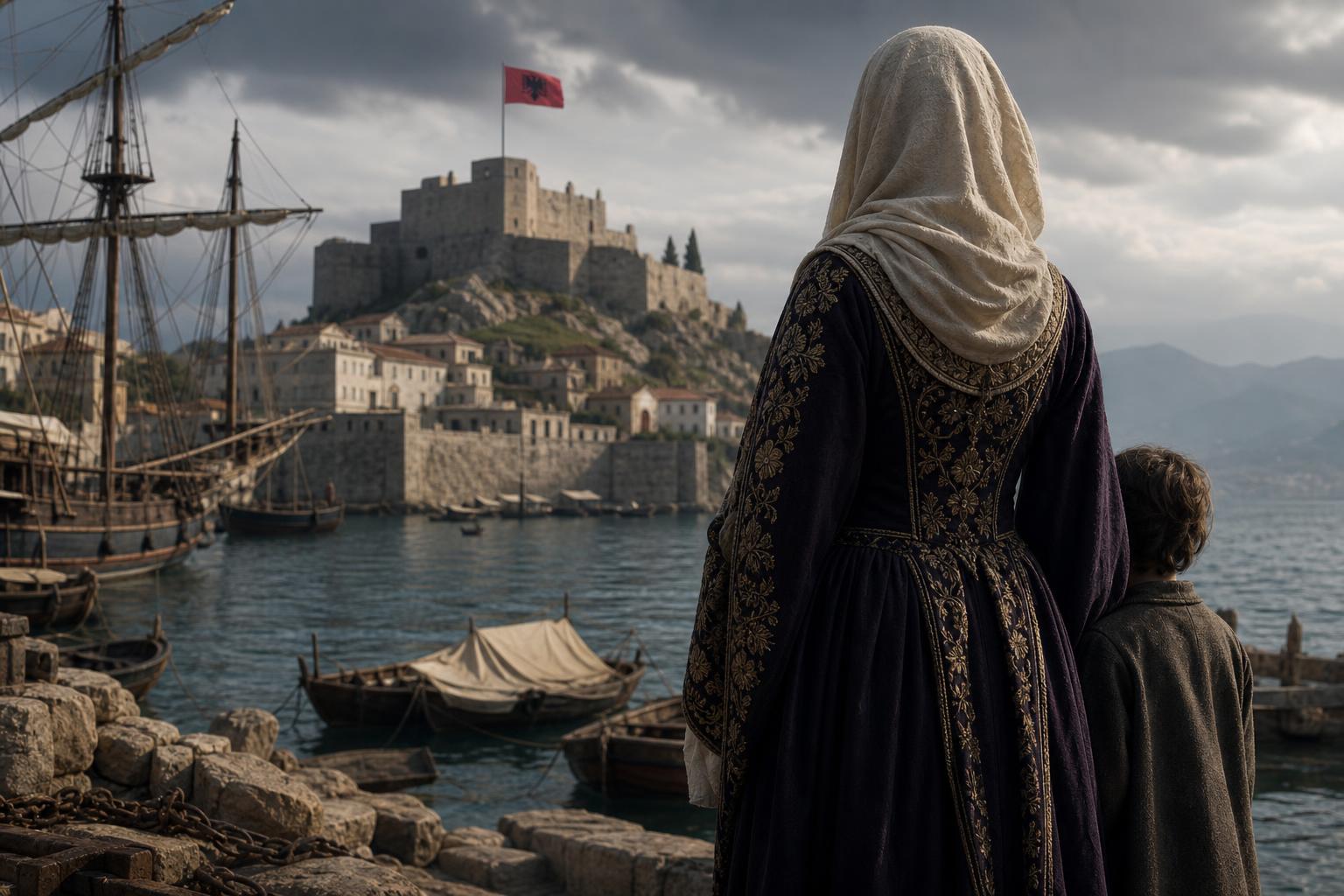
A widow lit a candle in a Valencia monastery in 1505, almost forty years after she had buried her husband at Lezhë. The fortress where she had raised her son had fallen to the Ottomans decades earlier. Her father’s lands, her mother’s lands, the alliance her marriage had sealed — all of it had been overrun. She lived on as a refugee in a foreign court, and the people who would one day remember her by name were not yet born.
That woman was Donika Kastrioti, born Andronika Arianiti around 1428. She was the wife of Gjergj Kastrioti Skanderbeg, the mother of his only surviving heir, and one of the most documented Albanian women of the late medieval period. For US-based Albanian Americans, she is more than a footnote in a husband’s biography. She is a thread that connects the 15th-century Albanian resistance to the Arbëreshë (the Italo-Albanian) communities that have lived in southern Italy ever since — communities whose descendants, centuries later, joined the wider Albanian migration to the United States.
This article walks through what we know about Donika’s life, her family, the marriage that sealed an alliance, the long exile that followed, and why her story still matters to a diaspora trying to count itself today.
Who was Donika Kastrioti
Donika Kastrioti is the Albanian short form of Andronika Arianiti, the name she was given at birth and used in most of her surviving correspondence. She is also referred to in older Italian and Spanish sources as Donna Andronica or Andronika Castriota. The single Albanian name Donika — closer to the affectionate form — is how she is best known today in Tirana, Pristina, and the diaspora.
She was born around 1428, most likely at Kaninë (a hill fortress overlooking the Bay of Vlorë in southern Albania), into the Arianiti house. Her father was the prince Gjergj Arianiti, and her mother was Maria Muzaka of the neighboring Muzaka family. Both lines were among the leading Albanian noble houses of the period — the families that would, in 1444, sign on to the League of Lezhë, the alliance Skanderbeg organized to fight the Ottoman advance (Wikipedia: Donika Kastrioti).
Her early life is poorly documented, which is normal for noble daughters of the era. We know enough to place her: educated within a princely household, raised in the Orthodox Christian tradition that dominated southern Albania at the time, and old enough by 1451 to enter a politically arranged marriage. The records get richer once she becomes a Kastrioti.
The Arianiti family and Albanian noble alliances
To understand Donika’s role, you have to understand the family she came from. The Arianitis controlled a corridor of land that ran roughly along the Shkumbin valley in central Albania, sitting on the route of the old Roman Via Egnatia. That corridor connected the Adriatic coast to Macedonia and, through it, to Constantinople. Whoever held the Shkumbin valley held the road.
Donika’s father, Gjergj Arianiti, had been fighting the Ottomans since the 1430s — earlier, in fact, than Skanderbeg’s own open rebellion. He led campaigns in the Drin and Mat valleys, won several battles against Ottoman commanders, and built a reputation as one of the most reliable Albanian princes of the resistance. By the time the League of Lezhë was formalized in 1444, Gjergj Arianiti was a senior partner, not a junior one.
The Albanian nobility of the period was a tight, intermarried network: Kastrioti, Arianiti, Muzaka, Dukagjini, Topia, Thopia, Spani, Balsha. These families fought each other when interests diverged and married each other when interests aligned. The 1451 marriage of Donika to Skanderbeg sat squarely in that pattern. It was a political document executed in flesh — the equivalent of a treaty clause that two houses could not easily walk away from.
This is why later chroniclers paid attention to her. She was not an ornamental wife. She was the living embodiment of an alliance that mattered to the survival of the Albanian campaign.
The 1451 marriage to Skanderbeg
By 1451, Skanderbeg was forty-five years old, a widower or unmarried (the sources differ), and badly in need of two things: a male heir and a deeper alliance with the Arianiti front. The Treaty of Gaeta, signed in March of that year between Skanderbeg and King Alfonso V of Aragon, brought the Albanian resistance under the formal protection of the Kingdom of Naples and opened a steady channel of Aragonese support — money, grain, soldiers — at a moment when the Ottomans were preparing renewed pressure on the Albanian highlands.
About a month after Gaeta, on 21 April 1451, the marriage took place. Most sources locate the ceremony at the Eastern Orthodox Ardenica Monastery (a 13th-century monastic complex near Lushnje in present-day southwestern Albania) (Wikipedia: Donika Kastrioti). A more recent regional account places the wedding alliance at Kaninë, Donika’s birthplace, with the religious ceremony at Ardenica (OCNAL on the Skanderbeg-Arianiti wedding). The two are not contradictory; medieval noble weddings often involved a betrothal and feast at one site and the church rite at another.
What matters is the political effect. The Kastrioti north and the Arianiti center were now bound by blood as well as treaty. For the next seventeen years — from 1451 until Skanderbeg’s death in 1468 — Donika was at Krujë more often than she was anywhere else.
Life at Krujë during the resistance
Krujë (the mountain fortress that served as Skanderbeg’s seat) sat above a steep valley northeast of present-day Tirana. From its walls you can see the Adriatic on a clear day. It is a defensive position by nature: hard to climb, hard to starve out, and impossible to take without sustained siege. The Ottomans tried three times during Skanderbeg’s lifetime — in 1450, 1466, and 1467 — and failed each time.
Donika lived at Krujë through the second and third of those sieges. The 1466–1467 siege under Sultan Mehmed II is the better-documented of the two, and it was brutal. The Ottomans built a fortified counter-camp called Elbasan to choke the Albanian highlands, raided villages across the Mat and Drin valleys, and forced the local population to ration grain and salt for months at a stretch (Wikipedia: Siege of Krujë (1466–1467)).
A noblewoman in that environment was not a passive figure. She managed household provisions, supervised the women and children of the garrison families, and corresponded on behalf of her husband with Italian and Aragonese courts when Skanderbeg was in the field. Surviving condolence and protection letters from later years show that European courts treated her as a recognized political figure, not as a silent partner.
Their son, Gjon Kastrioti II, was born around 1456. He was the only child of the marriage who survived infancy, which made him the entire future of the Kastrioti line.
The fall of Krujë and exile to Naples
Skanderbeg died on 17 January 1468 at Lezhë (the coastal town where the League of Lezhë had been founded twenty-four years earlier). He had traveled there for a council of Albanian and Venetian commanders. He fell ill — most accounts say malaria — and died within days, at age sixty-two (Wikipedia: Skanderbeg).
His death was the signal his enemies had been waiting for. Within weeks, Sultan Mehmed II began to plan the campaign that would erase the Albanian resistance as a coherent force. The Albanian league fragmented. Krujë held out for ten more years — falling finally in 1478 — but the strategic situation after 1468 was grim.
Skanderbeg’s last orders included evacuating his wife and twelve-year-old son. They were sent to Italy — initially to Monte Sant’Angelo in Puglia, a castle on the Adriatic that the Aragonese had granted to Skanderbeg in recognition of his earlier campaigns on Naples’s behalf. Ferdinand I of Naples confirmed his protection of the family in writing within five weeks of Skanderbeg’s death.
The household was given a feudal grant in southeastern Italy: the Duchy of San Pietro in Galatina and the County of Soleto, both in the province of Lecce, deep in the Salento peninsula (Wikipedia: Donika Kastrioti). This was not a generous retirement. It was a working fief that the Kastriotis were expected to manage and defend, and it placed them at the eastern edge of the Aragonese world, a short sail from the Albania they had just left.
Mother of the Arbëreshë diaspora
The Kastrioti exile in 1468 was not the first Albanian arrival in southern Italy, and it was not the last. As early as 1448, Skanderbeg himself had sent a contingent of Albanian soldiers under Demetrio Reres to help King Alfonso V suppress a revolt in Naples; some of those troops settled in twelve villages in the Catanzaro highlands of Calabria, and a related group settled in four villages in Sicily a year later (Wikipedia: Arbëreshë people).
After 1468, and especially after Krujë’s fall in 1478, the trickle became a wave. Albanian families — soldiers, clergy, peasants, minor nobility — fled to Calabria, Sicily, Puglia, Basilicata, Molise, Abruzzo, and Campania. They preserved their language, their Eastern-rite Christianity, and their family names. Their descendants are the Arbëreshë, who today number roughly 100,000 across more than fifty towns in southern Italy and remain one of Europe’s oldest continuously identifying diaspora communities.
Donika Kastrioti’s household was the most prominent of these refugee families, and her son Gjon Kastrioti II became a focal point. In 1481 — three years after Krujë fell — Gjon organized an expedition back across the Adriatic with Neapolitan ships. He landed at Himara, where the revolt began, and the uprising briefly captured the castles of Himara and Sopot before it collapsed; his cousin Kostandin Muzaka was among the commanders. Gjon returned to Italy and lived out the rest of his life on the Salento estates, dying on 2 August 1514 at around fifty-seven or fifty-eight (Wikipedia: Gjon Kastrioti II).
Donika did not live to see her son’s later years in Italy. When the Italian Wars of the 1490s pulled the Kingdom of Naples into open conflict between France and Spain, the Salento estates became unsafe. In 1501 or early 1502, she traveled to Valencia, on the eastern coast of Spain, under the protection of Frederick of Aragon — the deposed last Aragonese king of Naples, who had himself fled there. She made the journey with a retinue of household courtiers.
She lived her last years in Valencia and died there between March 1505 and September 1506, roughly eight years before her son. She was buried at the Royal Monastery of the Holy Trinity in Valencia.
Donika in Albanian memory
For most of the modern period, Donika Kastrioti was a secondary figure in Albanian historiography. The 19th-century national revival, the Rilindja, focused on Skanderbeg as the male hero figure of resistance, and his wife appeared mostly as a name in his biography. That has shifted.
Streets and schools across Albania and Kosovo carry her name. Her tomb in Valencia has become a pilgrimage site for Albanian-American and Albanian-European visitors, and the Royal Monastery of the Holy Trinity is a regular stop for diaspora cultural tours of southern Spain. Albanian historians have begun to publish detailed studies of her correspondence, her household management, and her role in negotiating the family’s protection at three foreign courts — Naples, Aragon, and Valencia.
She matters because her life crossed every fault line of Albanian medieval history: the noble alliances, the Ottoman conquest, the loss of land, the establishment of the Italian diaspora, the long memory of refugee survival. She is also one of the few women of her century whose voice survives in the documentary record at all. Letters to and from European monarchs, monastery donation records, and inscriptions name her, address her, and credit her decisions.
For a US-based Albanian American, the relevant question is: where does her story land for me? The answer, for most readers, is two-fold. First, the Arbëreshë communities Donika joined in exile produced waves of emigration to the Americas in the 19th and early 20th centuries; if your family came through Calabria or Sicily, the chain reaches back to her time. Second, she is a useful counter to the assumption that Albanian history is a story of men and battles. It is also a story of households that survived, women who kept records, and lineages that reconstituted themselves abroad after the homeland was lost.
Why this history shows up in a registry
The Albanian American community in 2026 is in the same position, on a much smaller scale, that the Kastriotis were in after 1468: dispersed, partially counted, and dependent on its own records to know itself. The US Census Bureau’s American Community Survey reports about 230,000 Albanian Americans as of 2024. Community estimates that include ethnic Albanians from Kosovo, North Macedonia, Montenegro, and the Arbëreshë diaspora, plus second- and third-generation descendants who don’t always self-identify on government forms, run closer to one million.
That gap is the practical reason the National Albanian Registry exists. We’re building a community-led count of Albanian Americans, with registry infrastructure designed to outlast any single administration’s data preferences. Donika Kastrioti’s lineage survived because someone wrote down her name and someone else preserved it across three countries and five centuries. The diaspora’s memory of itself works the same way. If your family carries any thread of this history — Kastrioti, Arianiti, Arbëreshë, or just Albanian American — add your name to the registry so the next century has a record to work from.