

Few moments test a sense of belonging like a death in an Albanian family. The phone rings late, a relative is gone, and a younger Albanian American who grew up far from the village suddenly has to walk into a room full of grieving elders and know what to do. The instinct is often to stay away rather than risk doing it wrong.
That instinct is the thing to resist. In Albanian culture, showing up is the whole point. Mourning is communal, not private, and the people who come to sit with a family — even briefly, even awkwardly — are doing exactly what the custom asks. The family will remember who came long after they forget what anyone said.
The customs themselves are learnable in an afternoon. There is a word you say, a way you say it, and a rhythm to the days and weeks that follow. Some of it varies by religion and region, and this guide is honest about where it does. Most of it is simpler and warmer than newcomers expect.
This is a practical resource for the Albanian American who needs to attend a wake, send word from another state, or simply understand what the elders are doing and why. It covers what ngushëllime (condolences) means and when they’re offered, what to say and what to avoid, the structure of the mourning cycle, the communal meal, the old lament traditions, how religion shapes the rites, and how families in the United States adapt all of it.
What ngushëllime means and when condolences are offered
Ngushëllime (condolences) is the word at the center of all of this. Spellings vary — you will see ngushëllime and ngushllime both — and it comes from the verb ngushëlloj, to console or to comfort. Said by itself to a grieving person, it carries the full weight of “my condolences.”
Condolences in Albanian life are not a single gesture made once. They are offered when news of a death first spreads, at the wake or viewing, at the funeral itself, and again at the gatherings that mark the mourning cycle in the weeks after. A relative who lives far away may call to offer ngushëllime and then call again around the fortieth day.
The expectation is participation, not perfection. Albanian mourning is built around the family receiving a steady stream of visitors — neighbors, coworkers, distant cousins, members of the same church or mosque or hometown association. Each visitor’s arrival is itself a form of condolence. The custom assumes that grief is carried by a community, and that a family left alone in its loss has been failed by everyone around it.
This is the cultural logic a second- or third-generation Albanian American should hold onto. You do not need fluent Albanian or deep knowledge of the rites. You need to be present, to say the word, and to treat the family’s loss as partly your own. That posture is recognized instantly and valued more than any phrasing.
What to say — and what to avoid
The single phrase to know is Ngushëllime (condolences). Offered directly to a family member, with a handshake or a quiet embrace, it is always correct. In slightly more formal settings, people say ngushëllimet e mia (“my condolences”).
A common companion expression wishes long life on the survivors: Ju pastë lënë jetë — roughly, “may [the deceased] have left life to the rest of you.” It is a way of saying that the person who died leaves their remaining years as a kind of blessing to the living family. You will also hear ju pastë lënë uratën, “may they have left you their blessing.”
You may hear close relatives and intimates use softer, affectionate expressions of shared pain, such as të keqen — literally “your harm,” used as a tender “oh, you poor thing.” This is the language of family and very close friends, not something a more distant acquaintance should reach for. When in doubt, Ngushëllime covers you.
A few practical notes on delivery:
- Keep it short. At a wake there is usually a receiving line. Shake hands, say Ngushëllime, move on. A long monologue holds up the people behind you.
- Lower your voice and slow down. Tone does most of the work.
- Name the person if you knew them. A single warm, specific memory is welcome later in the gathering, once the line has cleared.
- Avoid “at least” framing. “At least they lived a long life,” “at least they’re not suffering” — these land badly in any culture and especially here, where the loss is meant to be felt fully, not softened.
- Don’t rush the family toward recovery. Albanian mourning expects grief to take its time. Telling someone to “stay strong” or “move on” cuts against the custom.
If you can manage only one Albanian word the entire day, make it Ngushëllime.
The mourning cycle: third day, seventh, fortieth, one year
Albanian mourning unfolds on a calendar, not just in a single funeral. The exact milestones vary by family and faith, but the broad shape is widely shared, and the cycle is one of the most important things to understand.
In most accounts the cycle marks the third day, the seventh day (or the ninth, depending on religious tradition), the fortieth day, and the one-year anniversary, with some families also observing six months or even a third year. The body is typically buried quickly — within a day or two — so these later marks are about remembrance and the community returning to sit with the family.
The fortieth day — dyzet ditët, “the forty days” — is the most widely recognized milestone across regions and religions. Many families hold a gathering then, with food and a renewed round of visits. There is a broad cultural sense that the forty-day mark closes the most intense phase of mourning, even as grief continues.
Through the first year, close family commonly observe visible mourning: wearing black, declining invitations to weddings and celebrations, and keeping the home open to visitors. The one-year anniversary (motmoti, or simply the përvjetori, the anniversary) is marked with a memorial gathering and, in religious families, a service or prayers.
For a diaspora reader, the takeaway is that condolences are not a one-time event. If you missed the funeral, you have not missed your chance. Reaching out around the fortieth day or the one-year mark is not only acceptable — it is exactly what the cycle is built to invite. The family expects the community to keep showing up.
The communal mourning meal
Food is woven through Albanian mourning from the first day onward. The gathering at the home — and later at the fortieth-day and anniversary marks — almost always includes a shared meal, sometimes called dreka e të vdekurit, “the meal of the dead,” or simply the meal held in the deceased’s memory.
The meaning is practical and symbolic at once. A grieving household cannot cook and host while in shock, so neighbors and relatives bring food, take over the kitchen, and make sure every visitor is fed. Feeding the mourners and the community that comes to sit with them is itself an act of respect for the person who died.
Coffee and raki (the traditional Albanian fruit brandy) often appear, served quietly to those who keep the family company. In many families a portion of the gathering is given over to remembering the person aloud — their character, their life, the good they did.
For someone attending in the United States, the meal is where you can be genuinely useful. Bringing a dish to the home in the days after a death, or contributing to the cost of feeding a large crowd, is squarely within the custom and almost always welcome. If you are invited to stay and eat, staying is a way of honoring the family. Leaving immediately after the receiving line, while not wrong, misses part of what the gathering is for.
Across Catholic, Orthodox, Muslim, Bektashi, and secular Albanian families alike, the shared meal is one of the most consistent threads. The specifics of what is served and which prayers, if any, accompany it differ — but the act of gathering to eat together in grief is nearly universal.
Gjama and vajtim: the lament traditions
Two old traditions of ritual lament deserve to be understood with care, because they are often the most striking thing a newcomer reads about — and also among the least likely to be encountered at a modern American funeral.
Vajtim (keening, or lament) is the women’s tradition of grieving aloud. As described in the Vajtim entry, it is a dirge — women lamenting the dead, in parts of northern Albania “singing in verse the praises of the deceased, with a heart-breaking and moving voice.” Vajtim is found across Albanian regions; in southern Albania the lament is primarily a women’s practice. It is an expression of grief that the tradition does not measure in days, and for some women it returns for years.
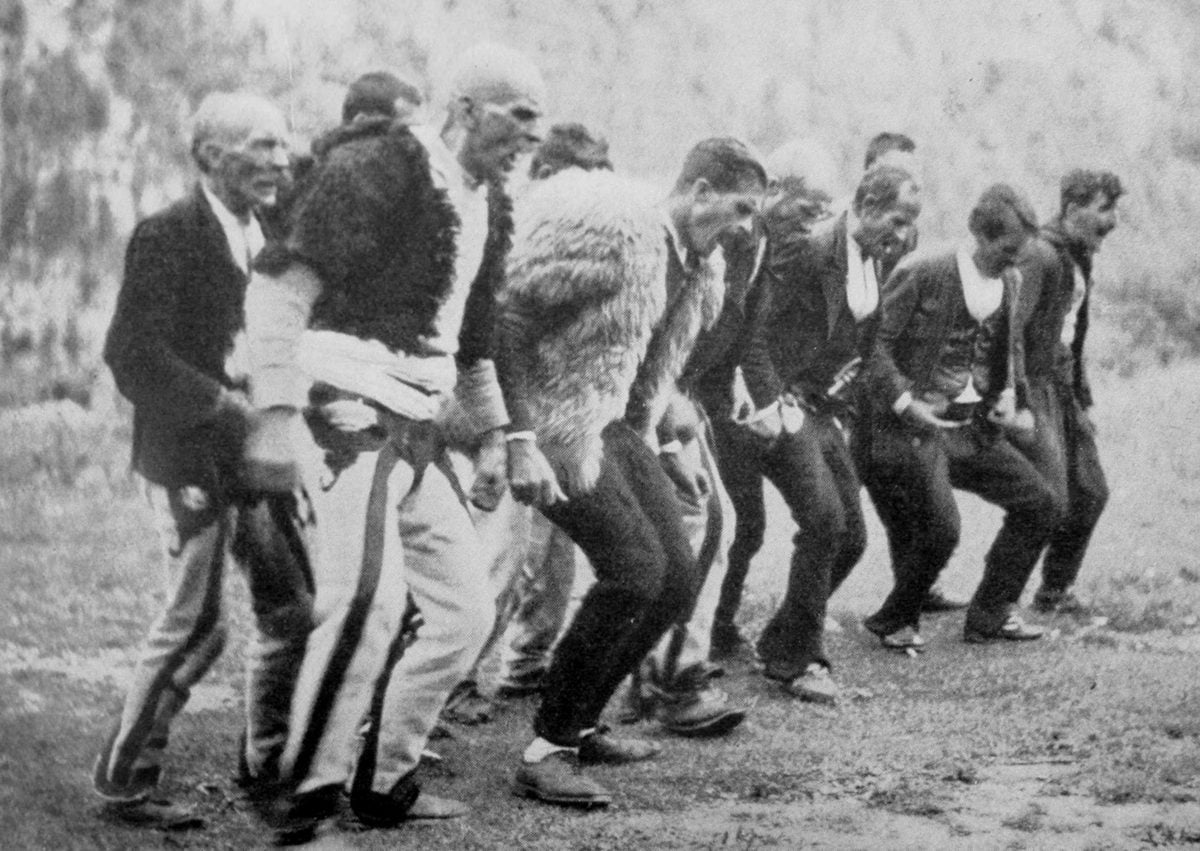
Gjama (Gheg: gjâma) is the men’s ritual lament, and it is far more localized. The men’s lament — gjâma e burrave — was performed only by men, and for men, in the northern highlands: Dukagjin, the area around Gjakovë and Iballë in Pukë, and the broader Malësia and Mirdita regions. The ritual called for a group of men, traditionally ten or more, who lamented in a forceful, rhythmic cry, striking their chests, calling out their grief for the dead man as son, nephew, or friend. Where the men began the gjâma, the women’s lament would pause. This is an old highland custom, shaped by the same northern culture as the Kanun, the customary law of the region; researchers trace lament imagery in Albanian-inhabited lands back to funerary stelae of classical antiquity.
Both are worth knowing about as heritage. Neither should be expected or imitated at a typical diaspora funeral. Most Albanian-American mourning today is quieter — closer to a Catholic, Orthodox, or Muslim service plus the gathering and the meal. Treat gjama and vajtim as part of the cultural record to respect, not a script to follow.
How religion shapes the rites
Albanians are Catholic, Orthodox, Sunni Muslim, Bektashi, and secular, and mourning customs follow those lines while sharing a common cultural floor. None of these is “the” Albanian way; all of them are.
Catholic families — concentrated historically in the north and among many Italian Arbëresh — typically hold a wake or viewing, a funeral Mass, and burial, followed by the home gatherings and the fortieth-day and anniversary memorials. Prayers for the dead and a Mass on the anniversary are common.
Orthodox families — historically southern, and well represented in the Albanian Orthodox Church in America — observe the Orthodox funeral service and memorial prayers, often with particular weight on the fortieth-day memorial (the Orthodox mnemosyno tradition) and the koliva, a dish of boiled wheat, in many parishes.
Sunni Muslim families follow Islamic practice: a swift burial, usually within a day, ritual washing and shrouding of the body, the funeral prayer (janazah), and Quranic readings. The wider Albanian gathering, condolences, and the meal layer on top of these religious requirements.
Bektashi families — Bektashism is a Sufi order with a notable presence among Albanians, and Albania is home to its world headquarters — blend Islamic practice with the order’s own customs and a strong emphasis on community and remembrance.
Secular families, common after decades of state atheism in communist Albania, often keep the cultural frame — the gathering, the black clothing, the meal, the fortieth day — without a religious service.
If you don’t know a family’s tradition, the safe move is to arrive, offer Ngushëllime, dress modestly, and follow the lead of close relatives. A quiet question to a cousin beforehand — “what are the customs here?” — is always better than guessing.
Mourning dress and conduct
Conduct at an Albanian mourning is governed less by strict rules than by a shared sense of restraint and respect. A few norms hold across most families.
Dress in dark, modest clothing — black is standard for close family, and dark, sober colors are right for everyone else. Close relatives, especially women, often continue to wear black for an extended period, sometimes through the first year. Loud colors, casual dress, and anything festive are out of place.
Conduct is subdued. Phones are silenced. Conversation is low. Laughter and light talk are held back, particularly in the first days and in the presence of the immediate family. This is not stiffness; it is the community matching the family’s grief rather than asking the family to perform composure.
The receiving line is the main point of contact. You wait your turn, approach the closest mourners, offer your handshake or embrace and your Ngushëllime, and step aside. Men and women may be seated separately in some traditional or religious settings, especially Muslim ones; take your cue from how the room is arranged.
There is also an old current, tied to the Kanun and the broader culture of besa (the Albanian code of honor), that treats obligations to a grieving household as binding. You come because the relationship requires it, not because it is convenient. That sense — that attendance is a duty owed — still shapes how seriously Albanian families take who shows up.
How the diaspora adapts these customs in America
In the United States, Albanian mourning runs through American institutions while keeping its cultural core. Understanding the blend helps a diaspora reader know what to expect.
The funeral home replaces the family home as the site of the wake and viewing. Many Albanian-American communities concentrate around particular funeral homes and churches or mosques in their areas — in the New York metro region, in Michigan, in Massachusetts and elsewhere — and these become gathering points for the whole community when someone dies. The religious service happens at the church, mosque, or teqe (Bektashi lodge), and burial follows at a local cemetery.
The home gathering, the shared meal, and the fortieth-day and anniversary remembrances carry over largely intact. Families still open their homes, still feed everyone who comes, still mark the forty days. Hometown and regional associations often help organize and spread the word, which is part of why staying connected to the community matters in moments like these.
Distance is the hardest part of diaspora mourning. Many families now coordinate over WhatsApp and group chats, share funeral details and obituaries widely, and increasingly livestream services so relatives in Albania, Kosovo, and across the United States can take part. A relative who cannot travel can still send Ngushëllime, join the livestream, and call around the fortieth day.
For a younger Albanian American, the practical lesson is that the community is reachable. If you are unsure what is happening or what is expected, a call to an older relative or to the local Albanian church, mosque, or association will get you a clear answer — and that act of asking is itself a small step back into the community the custom is built to hold together.
Practical etiquette for a distant relative or non-Albanian attending
If you are a more distant relative, a friend, a coworker, or a non-Albanian invited to an Albanian funeral or wake, the customs are easy to honor. A short checklist:
- Go if you can. Attendance is the most meaningful thing you can offer. A brief appearance counts.
- Dress in dark, modest clothing. Cover shoulders; avoid bright colors and casual wear. For a mosque service, expect to remove shoes and, for women, to cover the head.
- Say Ngushëllime. Offer it directly to the immediate family with a handshake or quiet embrace, then step aside.
- Bring something if it fits. Flowers, food brought to the home in the days after, or a contribution toward expenses or a charity are all appropriate. Ask a relative if you’re unsure.
- Stay for the gathering if invited. Sharing the meal honors the family. Eating, sitting, and remembering the person aloud are part of the point.
- Follow the close family’s lead on prayers, seating, and timing. You don’t need to know every ritual — you need to be respectful and willing to be guided.
- Reach out again. A call or note around the fortieth day or the anniversary is welcome and within the custom.
Above all, don’t let fear of doing it wrong keep you away. Albanian families are forgiving of small mistakes and unforgiving of absence. Showing up, with a quiet Ngushëllime and a willingness to follow the room, is nearly always enough.
Mourning is one of the clearest ways an Albanian community remembers its own — by gathering, by feeding each other, by counting who is present. Being part of that count, in grief and in everyday life, is how the Albanian-American community stays connected across generations; if you want to be part of it, you can be counted at /register.