

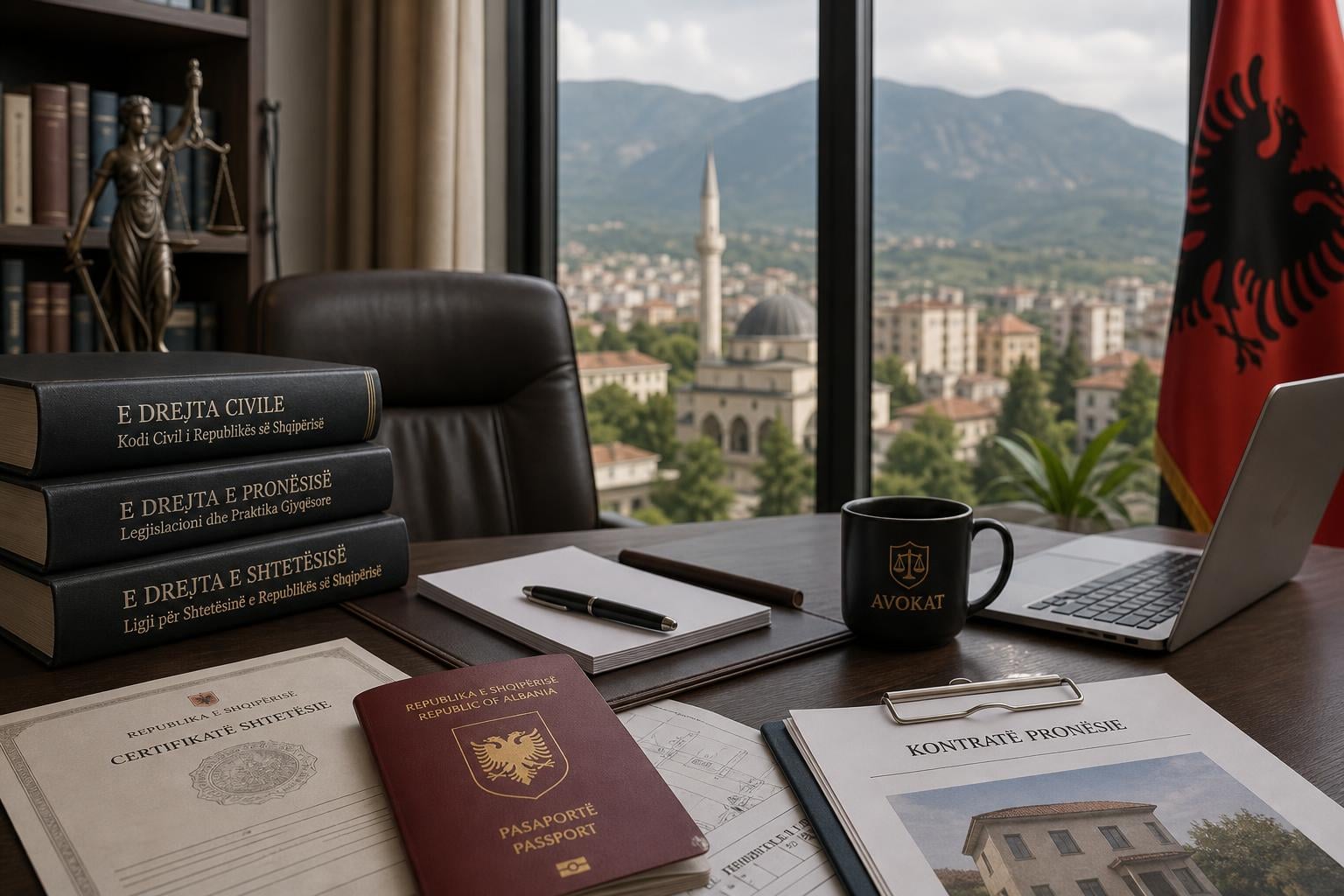
Why this article exists
Most US Albanian Americans go years without thinking about the Albanian legal system. Then a parent passes away in Tirana with a small apartment in their name. Or a grandmother’s old house in Korçë comes back into a family conversation about who owns what. Or a citizenship application stalls because a 1937 birth record cannot be located. Or a cousin asks for help selling a parcel of land that was nationalized in 1946 and partially returned in 2008.
That is when the question arrives: do we need a lawyer in Albania, and if so, how on earth do we find one from New York or Detroit?
This guide answers that question for US-based readers. We cover when an Albanian avokat (lawyer) is genuinely necessary versus when paperwork can be handled directly, how the Albanian legal profession is organized, how to verify a license, what fees look like, what documents to prepare, and how to authorize a lawyer to act for you without ever boarding a plane.
One sentence we will repeat: this article is general information for the diaspora. It is not legal advice. For any specific case, consult a lawyer licensed by the Dhoma Kombëtare e Avokatisë (National Chamber of Advocacy) in Albania.
National Albanian Registry is a 501(c)(3) nonprofit. We do not provide legal services and we do not refer to specific firms. What we do is help diaspora families document descent and family history — work that often becomes useful evidence for the legal matters described below.
Common reasons US Albanian Americans need an Albanian lawyer
The diaspora’s legal needs cluster into a small number of recurring scenarios.
Property restitution and titling. Land and homes nationalized between 1945 and 1991 have been the single longest-running legal headache for Albanian families. The post-communist restitution framework, administered through what is now the Property Treatment Agency (Agjencia e Trajtimit të Pronës, ATP), continues to process claims and pay compensation. Diaspora heirs often inherit the right to a claim from a parent or grandparent, but the case file requires Albanian-side documentation that almost no US family has on hand.
Inheritance and succession. Under the Albanian Civil Code, succession opens automatically at the moment of death and shares are determined by statutory rules unless a valid will (testament) exists. When the deceased held assets in Albania, an Albanian notary and often a lawyer are required to issue a certificate of heirs (dëshmi trashëgimie) and to register the transfer of property.
Real estate purchase or sale. Buying or selling real property in Albania involves title searches at the State Cadastre Agency (Agjencia Shtetërore e Kadastrës), notarial deeds, transfer tax filings, and updates to the immovable property registry. A lawyer is not legally required, but the diaspora buyer who skips one tends to discover boundary disputes, missing predecessors in title, or unregistered family co-owners only after wiring the money.
Citizenship by descent under Law 113/2020. Albania’s citizenship law grants automatic citizenship to a person born abroad with one Albanian-citizen parent, regardless of birthplace, with no residency requirement. Diaspora members whose Albanian ancestry runs through a grandparent (or great-grandparent) also qualify for citizenship by descent, with no residency requirement. Most US-side applications in the first-generation case can be assembled without a lawyer. A lawyer becomes useful when civil records were destroyed, when an Albanian civil-status office (zyra e gjendjes civile) refuses to issue a certified extract, or when the applicant’s ancestor was born in present-day Kosovo, North Macedonia, Montenegro, or the Çamëria region of Greece and the documentary chain crosses borders.
Cross-border divorce and family law. A US citizen married to an Albanian citizen, or a couple holding property in both countries, may need parallel proceedings. Recognition of US judgments in Albania, child custody arrangements, and division of Albanian-situated assets all benefit from local counsel.
Starting a business. Registering a Sh.p.k. (limited liability company) at the National Business Center (Qendra Kombëtare e Biznesit, QKB), drafting articles of incorporation, complying with tax and labor law, and protecting trademarks generally require an Albanian-licensed professional.
Civil litigation and criminal defense. Suing or being sued in an Albanian court, or facing criminal charges as a US passport holder traveling in Albania, requires a licensed avokat with right of audience.
In short: any matter that touches Albanian property, Albanian civil status, an Albanian court, or an Albanian government agency is a case where local counsel is worth at least a consultation.
How the Albanian legal profession is organized
Albania is a civil-law jurisdiction in the continental European tradition, with codes derived from the Italian and French families. The legal profession is regulated by the Dhoma Kombëtare e Avokatisë (DHKA, National Chamber of Advocacy), the self-governing bar body now governed by the Law on the Profession of Lawyer (Law No. 55 of 2018), which replaced the earlier Law No. 9109 of 2003.
Membership in the DHKA is mandatory for anyone who wants to represent clients before Albanian courts as an avokat. The DHKA operates through regional chambers in each judicial district — Tirana, Durrës, Vlorë, Shkodër, Korçë, Gjirokastër, and others. A lawyer is licensed nationally but registered in one regional chamber.
To become a licensed avokat, a candidate must hold an Albanian law degree (or a foreign law degree formally recognized by the Albanian Ministry of Education), complete a roughly one-year supervised practical training period (stazh), pass the bar exam administered by the DHKA’s Examination Committee, and take the professional oath. Lawyers must complete annual continuing legal education and pay annual dues to remain in good standing.
The profession is unified, meaning Albania does not split solicitors and barristers in the British sense; the same license permits both advisory work and courtroom representation. Specialized practice areas — restitution, commercial, family, criminal, administrative — are not separately accredited, so identifying the right lawyer for a specific matter is a function of asking and verifying experience, not of looking up a separate certification.
A separate licensed profession is the noter (notary), regulated by the National Chamber of Notaries (Dhoma Kombëtare e Noterisë). Notaries authenticate signatures, draft and certify deeds, issue certificates of inheritance, and perform other functions that in the US are split among notaries, title companies, and attorneys. Many diaspora transactions involve both a lawyer and a notary in sequence.
How to verify that a lawyer is actually licensed
This is the single most important practical skill for a diaspora client. The DHKA maintains a public roster of licensed advocates. Before retaining anyone, request:
- The lawyer’s full legal name as registered with the DHKA.
- Their DHKA license number (numri i licencës).
- The regional chamber (dhoma e avokatisë) where they are registered.
- A copy of their professional ID card (kartë profesionale) or a current certificate of good standing.
Cross-check the name and number against the DHKA registry. If the lawyer claims a specialization in property restitution or international inheritance, ask for the names of recent reported cases (these are public) or for references from past diaspora clients.
A lawyer in good standing will not be offended by these questions. A lawyer who is offended is telling you something. Likewise, anyone presenting themselves as a lawyer who cannot or will not produce a DHKA license number is not a lawyer for purposes of representing you in an Albanian court — they may be a paralegal, a fixer, or someone else entirely.
The US Embassy in Tirana publishes a “List of Attorneys” as a courtesy to American citizens. The list is exactly that: a list, alphabetical, with contact details. It is not an endorsement, a recommendation, or a vetting process. The embassy’s standard disclaimer makes this explicit and the list should be treated as a starting point for due diligence, not a substitute for it.
Languages and document translation
The working language of Albanian courts, ministries, and notaries is Albanian (shqip). Every document submitted to an Albanian authority must be in Albanian or accompanied by a certified Albanian translation prepared by a licensed translator (përkthyes i licencuar).
In practice, most Albanian lawyers under the age of fifty speak functional or fluent English. Many older lawyers are more comfortable in Italian or French. A productive opening question is: in what language do you prefer to handle written correspondence? A lawyer who can read English fluently but prefers to draft in Albanian and have the firm’s in-house translator render it for the client is providing better service than one who insists on English-only.
For documents originating in the United States — birth certificates, marriage certificates, death certificates, court orders, US notary acknowledgments, FBI background checks — the standard sequence is:
- Obtain the document from the US issuing authority.
- Have it apostilled by the Secretary of State of the issuing state (or by the US Department of State for federal documents like FBI checks).
- Send the apostilled original to Albania.
- Have it translated into Albanian by a licensed Albanian translator.
- Submit the translation, with the apostilled original attached, to the relevant Albanian authority.
A diaspora-experienced lawyer will tell you exactly which documents need apostilles, which need translations, and what order to do them in. Skipping the apostille step is the single most common avoidable error.
The power of attorney and the apostille
The diaspora’s superpower is the prokurë (power of attorney). With a properly executed prokurë, a US-based client can authorize an Albanian lawyer to receive documents, sign filings, appear in court, accept service of process, transfer funds, and conclude transactions — all without the client traveling to Albania.
The standard procedure for executing a prokurë from the United States:
- The Albanian lawyer drafts the prokurë in Albanian, scoped narrowly to the specific matter (general powers of attorney are disfavored and many institutions will reject them).
- The lawyer sends the draft, plus an English courtesy translation, to the US client.
- The client signs the document before a US notary public. Some Albanian institutions prefer or require execution before an Albanian consular officer instead — the Albanian Embassy in Washington, DC and the Consulate-General in New York provide notarization for citizens and persons of Albanian origin. A consularly-notarized prokurë does not require an apostille.
- If executed before a US notary, the client takes or mails the notarized prokurë to the Secretary of State of the state where the notary is commissioned, and obtains an apostille.
- The apostilled prokurë travels to Albania, is translated by a licensed Albanian translator, and is filed where needed.
Albania acceded to the 1961 Hague Apostille Convention in 2004. The United States has been a party since 1981. The apostille replaces the older, slower legalization chain that used to require multiple consular stamps. For diaspora families, this single treaty saves weeks of paperwork on every cross-border document.
For service of process — being formally notified of a lawsuit — Albania is also a party to the 1965 Hague Service Convention, which it joined in 2006. This matters most when a US citizen is being sued in Albania or vice versa; a lawyer will explain whether and how the convention applies.
Fees: what to expect, what to ask, what is a red flag
Albanian lawyers’ fees are not regulated by a published schedule and vary significantly by city, specialization, and the complexity of the matter. Tirana commands the highest rates; provincial cities are meaningfully cheaper.
Three structures are common:
Hourly billing. Used most often for litigation, complex commercial work, and matters where the scope is hard to predict. Senior lawyers in Tirana commonly bill hourly rates that, while well below New York or DC rates, are no longer trivial. Always ask for the hourly rate of every timekeeper who will work on the matter, not just the lead lawyer.
Flat fees. Used for discrete, predictable services: a consultation, drafting a single contract, handling a citizenship application, registering a company. Flat fees should be quoted in writing before work begins and should specify exactly what is and is not included.
Success or contingency fees. Restitution, certain inheritance disputes, and some collection matters may be quoted as a percentage of the recovery. The ethical rules permit contingency arrangements with limits; ask the lawyer to explain how the percentage applies and at what valuation, and insist on the formula in writing.
Reasonable questions to ask any lawyer, in any jurisdiction, before retaining:
- What is your fee structure for this matter?
- What costs and disbursements (court fees, translator fees, notary fees, travel) are separate from the fee?
- How often will I receive itemized invoices?
- What is your estimate of total cost from start to finish, and what could change that estimate?
- What is the realistic timeline?
- Who else in the firm will work on the matter and at what rate?
- How and to what bank account do I pay you?
Red flags to walk away from:
- Refusal to provide a written engagement letter.
- Refusal to share a DHKA license number.
- Demands for payment in cash only, especially in foreign currency.
- Demands that funds be wired to a personal account rather than a firm trust account.
- Vague or shifting fee structures.
- Pressure to act immediately without time to verify credentials.
- Promises of guaranteed outcomes — no honest lawyer guarantees a result.
- Statements that “I know the judge” or that bribes are required to move the case forward. Albania has serious anti-corruption institutions, including the Special Structure Against Corruption and Organized Crime (SPAK), and clients who participate in corruption expose themselves to prosecution.
A lawyer who insists on a written, itemized engagement letter; who provides a DHKA license number without being pressed; who quotes fees in writing; and who explains the realistic uncertainty of the case is the kind of lawyer the diaspora should retain.
Property restitution: the diaspora’s longest-running legal headache
The communist regime that governed Albania from 1944 to 1991 nationalized urban housing, agricultural land, and commercial property on a sweeping scale. After 1991, successive Albanian governments enacted legislation to restore property to former owners or their heirs, or to compensate them when physical restitution was impossible.
The current framework is administered by the Property Treatment Agency (ATP), created under reform legislation that consolidated earlier restitution and compensation bodies. Under the current law, recognized claims are typically resolved through financial compensation rather than physical return of the land, with valuations based on a published map of unit values by zone.
For diaspora heirs, the practical reality looks like this:
- A claim must be backed by pre-1945 documentation showing the family’s ownership. These records are held in Albanian state archives and in the cadastre.
- The chain of inheritance from the original owner down to the current claimants must be documented through Albanian civil-status records, sometimes supplemented by US-side records and family-history work.
- The case file is submitted to the ATP. Decisions can be appealed to the administrative courts.
- Even with a favorable decision, payment of compensation can take years and is subject to the state budget.
- The European Court of Human Rights has issued multiple judgments against Albania for delays in implementing restitution, and reform legislation was enacted in part to address those judgments.
This is not a do-it-yourself area. A lawyer with specific restitution experience, working from the actual documents in the family file, is the only realistic path. Diaspora families should expect a multi-year process, should not pay large up-front “guarantee” fees to anyone, and should be patient with a system that is genuinely slow rather than blame the lawyer for the system’s pace.
Inheritance and succession from the United States
When a relative dies leaving assets in Albania — most commonly a residence, agricultural land, or a bank account — Albanian law governs the disposition of those Albanian-situated assets, regardless of where the heirs live or what citizenship they hold.
The basic mechanics:
- Heirs request a certificate of heirs (dëshmi trashëgimie) from an Albanian notary, providing the death certificate, identification of all heirs, and proof of family relationship.
- The notary issues the certificate identifying the legal heirs and their statutory shares under the Civil Code.
- The certificate is then used to register the transfer of real property at the cadastre, to access bank accounts, and to handle any sale or division.
For diaspora heirs, the practical steps are:
- Obtain the Albanian death certificate (the family in Albania can usually request this from the local civil-status office).
- Gather US-side documents proving each heir’s relationship — birth certificates, marriage certificates — apostilled and translated.
- Identify all heirs. Albanian succession law has rigid rules about forced shares for spouses and children; an heir who is left out by mistake or design can later challenge the distribution.
- Decide whether all heirs will appear in person or whether absent heirs will sign powers of attorney to a single representative or lawyer.
- Engage a notary, and where the matter is contested or the property is complex, also a lawyer.
Disputes among heirs — over which assets are part of the estate, over the valuation of property, over the validity of a will — are litigated in the Albanian civil courts and can take years. A lawyer’s first job in a contested succession is often to slow the family down and find a settlement before the case is filed.
Citizenship by descent: when a lawyer helps and when one does not
The 2020 Citizenship Law (Law No. 113/2020) is the framework under which a person born abroad with one Albanian-citizen parent can claim Albanian citizenship automatically, regardless of birthplace, with no residency requirement, and Albania fully accepts dual citizenship with the United States. Diaspora members whose Albanian ancestry runs through a grandparent (or great-grandparent) also qualify for citizenship by descent, with no residency requirement.
For most US applicants in the first-generation case, the process does not require a lawyer. The applicant assembles a documentary chain — their birth certificate, the Albanian-citizen parent’s, marriage certificates connecting the names — has the US documents apostilled and translated, completes the application, and submits through the Albanian Embassy in Washington, DC or the Consulate-General in New York. A complete and orderly file is usually decided within a year.
A lawyer becomes useful when:
- An ancestor’s birth, marriage, or death record cannot be located in the Albanian archives. Many records were destroyed during the communist period, and a lawyer who knows which auxiliary archives (church records, military archives, regional repositories) to search can sometimes reconstruct the chain.
- An Albanian civil-status office issues a record with errors or refuses to issue one. A lawyer can file an administrative challenge or, in serious cases, a court action to compel correction.
- The applicant’s ancestor was born outside present-day Albania — in Kosovo, North Macedonia, Montenegro, or the Çamëria region of Greece — and the application requires evidence of Albanian ethnic origin rather than birth in Albania.
- The application is denied and the applicant wants to appeal.
NAR’s separate guides on the 2020 Citizenship Law, the step-by-step descent process, and the Albanian passport documents checklist cover the do-it-yourself path in detail. A lawyer is the right call when those guides describe a step you cannot complete from the US side alone.
The Albanian court system in plain English
A diaspora client who never plans to set foot in an Albanian courtroom still benefits from understanding the structure, because the structure tells you which court will decide the case and how long that takes.
District courts (gjykatat e shkallës së parë) are the trial courts of general jurisdiction for civil and criminal matters. There is a district court in each judicial district.
Administrative courts of first instance handle disputes against state agencies — including most restitution and licensing cases — with their own appellate court.
Courts of appeal (gjykatat e apelit) review decisions of the district courts. Following 2021 reforms, the appellate structure was consolidated.
The Supreme Court (Gjykata e Lartë) is the highest court for ordinary civil and criminal matters, and resolves questions of law.
The Constitutional Court (Gjykata Kushtetuese) decides constitutional questions and individual constitutional complaints after ordinary remedies are exhausted.
The Special Court Against Corruption and Organized Crime and the associated Special Prosecution Office (SPAK) handle high-level corruption, organized crime, and certain offenses by senior officials. These bodies were created as part of the post-2016 justice reform that also re-vetted Albanian judges and prosecutors.
Mediation and arbitration. Albanian law provides for both. Mediation is voluntary in most matters and mandatory in a narrow set of family and small civil disputes. Commercial arbitration is increasingly common and can be faster and more confidential than court litigation, especially for cross-border business disputes.
For a diaspora client, the practical implication is that “going to court in Albania” can mean very different things depending on the subject matter and the court — and that a lawyer should be able to explain, on the first call, exactly which court has jurisdiction, what the realistic timeline is, and what the appeal pathway looks like.
Where to start your search
We do not name specific firms or individual lawyers. The two starting points we routinely point readers to:
The DHKA roster. The National Chamber of Advocacy publishes the official list of licensed lawyers in Albania. Use it to verify that any lawyer you are introduced to is in good standing and to confirm the regional chamber where they are registered.
The US Embassy Tirana “List of Attorneys.” Available through the embassy’s American Citizen Services pages. Treat it as exactly what it is — an unranked list with the embassy’s explicit disclaimer that no endorsement is implied. Use it to generate candidates, then run your own due diligence.
Personal referrals. Diaspora families talk to each other. The single most valuable input is usually a referral from another US Albanian American who has actually used the lawyer for a comparable matter and is willing to describe how it went. Ask in your community before you ask online.
Albanian-American professional networks. Several US-based Albanian professional associations include lawyers who maintain referral relationships with Albanian colleagues. They will not represent you in Albania but can often introduce you to someone who can.
A reasonable diaspora process is: generate a short list of three to five candidates, request a brief written response to a one-paragraph description of the matter (with no confidential details until an engagement is in place), interview two of them by video call, ask for a fee proposal and engagement letter from your preferred candidate, verify the DHKA license, and only then sign and pay any retainer.
What to prepare before your first call
Lawyers’ time is expensive, and your first conversation is far more useful when you have done the homework. Before contacting an Albanian lawyer, assemble:
- Your photo identification (US passport).
- Any Albanian identification you hold or your ancestor held.
- A one-page written summary of what happened, what you want to accomplish, and what deadlines, if any, you face.
- A simple family tree showing names, dates of birth, places of birth, and dates of death for the relevant generations.
- Copies (scans are fine for the first conversation) of the most relevant documents on the US side: birth certificates, marriage certificates, death certificates, prior correspondence with Albanian authorities, prior court orders.
- Any Albanian documents you already have, even if they are old or incomplete.
- A short list of your specific questions.
Send the lawyer a short, factual email in advance. Lawyers who reply with a thoughtful question or two before the call tend to be the lawyers who handle the matter thoughtfully throughout.
A final word on what this article is, and is not
This is a community resource produced by a US-based 501(c)(3) nonprofit. It is general information for the diaspora about how to interact with the Albanian legal system. It is not legal advice. It does not create a lawyer-client relationship between you and anyone at NAR. It does not substitute for the judgment of a lawyer licensed in Albania who has reviewed your specific facts and your specific documents.
For any actual legal question — what to do about a specific property, how to respond to a specific notice, whether to accept a specific settlement — talk to a lawyer.
NAR does not provide legal services and does not maintain a referral list of Albanian lawyers. What we do provide is the upstream infrastructure that often becomes useful evidence in legal matters: the community count, the heritage certificate, and the family-history work that helps diaspora families document descent. If you have not yet been counted, register here — the same documentation that grounds a citizenship application or a restitution claim begins with the same first step.