What happened today
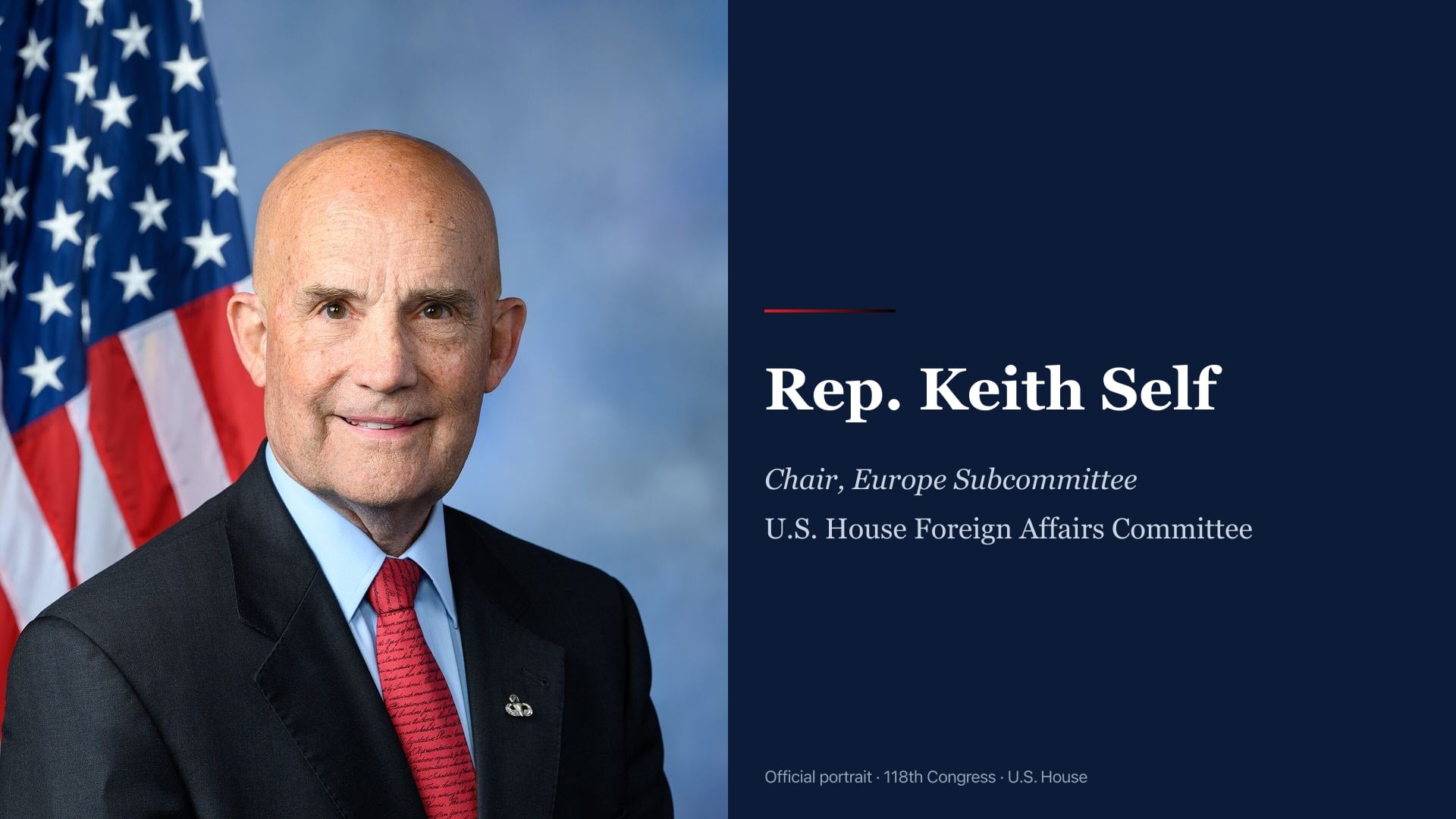
On May 13, 2026, in a US House Foreign Affairs Committee markup, Rep. Keith Self (R-TX), Chair of the Europe Subcommittee, filed an amendment to strike the $1.8 million authorization for International Military Education and Training (IMET) funding to Greece.
The stated reason on the floor: Greece is one of four NATO allies still refusing to recognize Kosovo’s sovereignty, and that refusal is the wall standing between Kosovo and NATO membership.
From the floor speech:
“While robust joint military efforts exist between the United States and Greece, certainly for use of Souda Bay, and during Operation Epic Fury counterterrorism efforts, they remain on the short list of four NATO allies who refuse to recognize the sovereignty of Kosovo. Hence the instability in the Balkans. These NATO partners joined China, Russia, and Serbia in their refusal to recognize Kosovo’s independence.”
Watch the markup
Full markup recording from the House Foreign Affairs Committee (Republican side), May 13, 2026. Self’s IMET-strike remarks come during his statement on the package — scrub to find his block if you don’t want the whole session.
The four NATO holdouts
The amendment is targeted at Greece, but Self named the full list on the record:
| NATO member | Position |
|---|---|
| Greece | Does not recognize Kosovo |
| Romania | Does not recognize Kosovo |
| Spain | Does not recognize Kosovo |
| Slovakia | Does not recognize Kosovo |
These four are joined by Russia, China, and Serbia as the global holdouts. The non-NATO holdouts are unsurprising; the four NATO ones are the structural problem. NATO accession requires consensus among existing members — a single objection blocks the path. As long as any of these four hold out, Kosovo’s NATO seat is locked.
Why Self specifically
Self isn’t a casual observer of Kosovo. From the floor speech:
“I played a role in the planning for Operation Noble Anvil, the NATO bombing mission in Serbia in 1999, where they liberated the Kosovar Albanians from Serbian ethnic cleansing. I can tell you that Kosovo is unmistakably one of the closest and most loyal European partners to the United States.”
Operation Noble Anvil was the US codename for NATO’s 1999 air campaign against the Federal Republic of Yugoslavia — the 78-day bombing operation that ended Slobodan Milošević’s ethnic-cleansing operation in Kosovo and led to the deployment of KFOR.
When the US Congressman now chairing the Europe Subcommittee of House Foreign Affairs cites personal involvement in that planning, the floor speech reads less like a routine markup statement and more like a marker being set down.
Self’s framing of Kosovo
Three claims from the speech that are worth pinning down for any non-diaspora audience encountering this story for the first time:
- Democratic governance. Kosovo has held competitive multi-party elections since 2001 and transferred power across parties without incident.
- Civilian oversight of security forces. The Kosovo Security Force operates under the elected Ministry of Defense.
- Multi-ethnic coexistence. Serbs, Bosniaks, Roma, Turks, and Gorani all have constitutionally guaranteed representation in the Kosovo Assembly.
Self framed these as evidence that Kosovo has earned the NATO conversation. The implicit comparison was with the four NATO members blocking that conversation despite Kosovo meeting the substantive criteria.
Russian influence in the Western Balkans
Self tied the recognition issue directly to a Russia-containment frame:
“The Russian influence in the Balkans is well known, and it is increasing… Kosovo would serve as a necessary counterweight to discourage our adversaries and prevent another global catastrophe from unfolding in the Balkans, as has happened in the past.”
The Western Balkans contain the only non-NATO patches on the European map north of Greece — Bosnia and Herzegovina, Serbia, Kosovo, North Macedonia (until 2020). Russian influence operations have concentrated there because the alliance ends at those borders. Self’s argument: bringing Kosovo into NATO closes one of those gaps.
Eliot Engel — a name that surfaced
In a separate exchange during the same markup, Rep. Eliot Engel — the longtime former House Foreign Affairs Chair from New York who lost his 2020 primary — was honored on the floor. Self referenced Engel’s contradiction of “praising Kosovo’s strongest allies in Washington while failing to fully support Kosovo’s Euro-Atlantic integration and long-term security.”
Engel was named “hero in Kosovo” on the record — a reminder that bipartisan US support for Kosovo recognition has been the historical norm, and the current obstacle is on the other side of the Atlantic, not in Washington.
What this means, practically
The amendment, if passed by the full Committee and then the House, would reduce US IMET funding to Greece by $1.8 million in the relevant fiscal year. That number alone is small relative to total US-Greece military cooperation (Souda Bay, joint exercises, foreign military sales). The signal, however, is large.
Even if the amendment fails, the speech is now in the Congressional Record. That record is what foreign ministries read, what State Department briefings cite, and what future amendments anchor on. The diplomatic argument that “the US position is settled on Kosovo recognition” got a sharper edge today.
What the diaspora can do
Three actions that compound:
-
Call your US Representative. Focus on the House Foreign Affairs Committee roster — if your Rep is on it, ask them to support reintroducing the Self amendment — the committee voted it down on 13 May 2026. Ask any Rep to keep pressing Kosovo recognition through future authorization vehicles.
-
Share the floor speech. Send the video to non-Albanian friends who care about NATO, Russia, or the Balkans more broadly. The recognition issue stops being a niche diaspora topic when it shows up alongside Ukraine-aid and NATO-cohesion conversations.
-
Get counted. Albanian Americans were recorded at roughly 230,000 in recent American Community Survey ancestry data — a figure that almost certainly undercounts the real population by a factor of 3-4. The bigger the verified count of Albanian Americans, the more weight Albanian voices carry in any Congressional office that doesn’t yet know how many constituents care about Kosovo. Get counted on the registry — about three minutes →.
Sources: US House Foreign Affairs Committee markup, May 13, 2026 (video record). Albanians for America summary post. Operation Noble Anvil — US Department of Defense historical record. Kosovo Security Force structure — Republic of Kosovo Ministry of Defense. ACS B04006 Albanian-ancestry data, 2024 vintage. House Foreign Affairs Committee membership — official roster.