
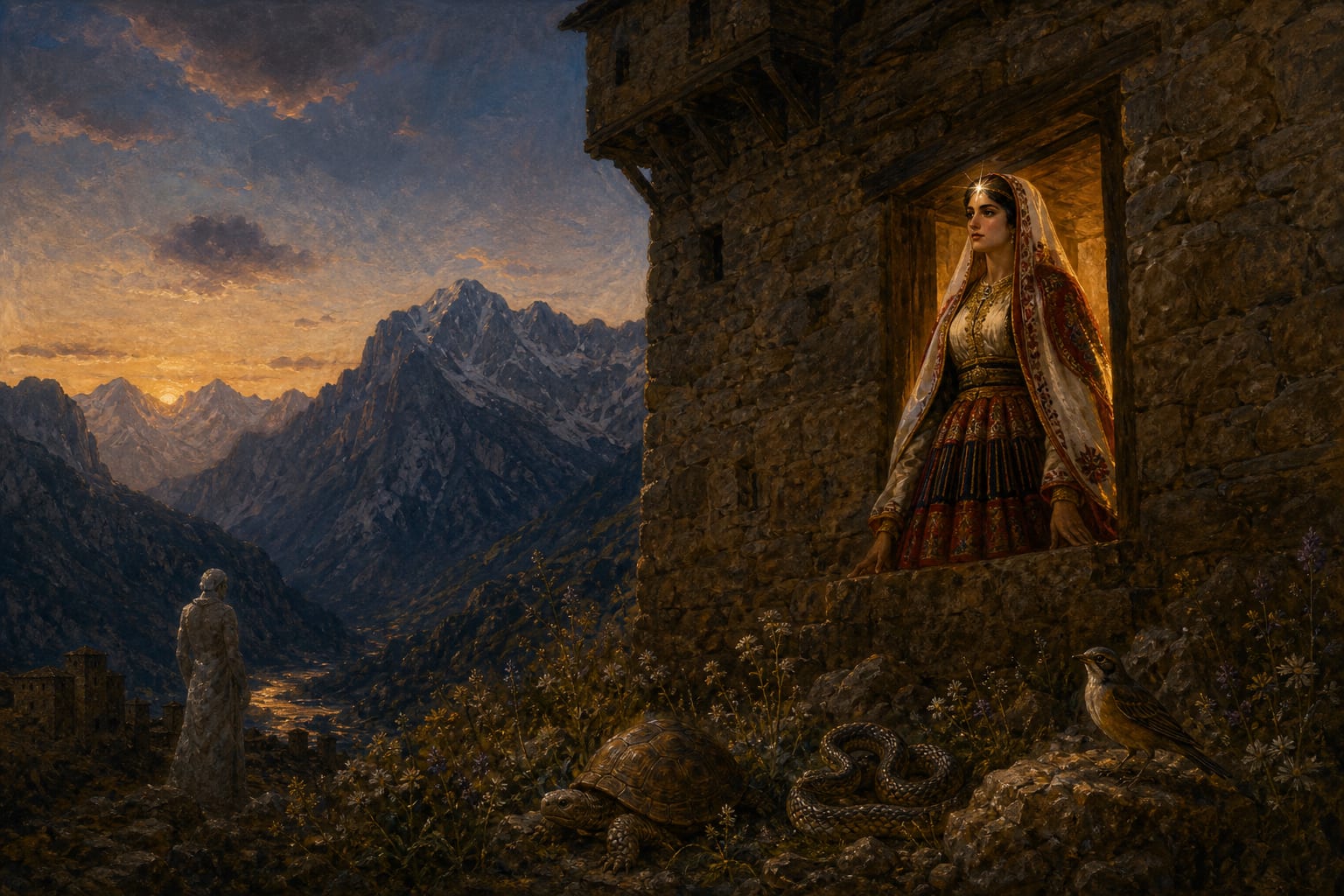
A young man climbs to a tower with rooms on five floors, ringed by rows of old men gone silent. At the top, a window; behind it, a girl with a star on her forehead, white as snow. He has come a long way to reach her. An old woman waits at the threshold, and when he says what he has come for — the Beauty of the Earth — she does not warn him, or argue, or weep. She turns to the spirit beside her and says: “Ngrifto, zana, e bafto gur!” — “Get up, fairy, turn it into a stone!” The young man stops moving. He is the latest of many. “How many of them have gone begging,” the helper in the tale says, “are frozen and stoned?”
This is E Bukura e Dheut — “the Beauty of the Earth” — and the first thing to understand about her is that most men who go looking for her do not come back. The early English folklorists called her the “Beautiful-of-the-Earth”; that is not the form we use. The Albanian name is the canonical one, and the genitive in it is not decorative.
The name, and why the earth is in it
E bukura is “the beautiful one,” feminine. E dheut is “of the earth, of the soil” — a genitive. The construction makes the earth definitional, not ornamental. She is not beautiful and earthly; she is the beauty that belongs to the earth, and the earth in question is as much the ground the dead lie in as the ground that flowers in spring.
The form has a long reach. Çabej, the founder of modern Albanian linguistics, observed that within the Balkan Peninsula she appears only among Albanians, Greeks, and the Aromanians — who call her Musata loclui, the same construction, the same earth; the related Romanian form is Frumoasa pământului. The Italian fairy tale knows her as la bella del mondo. Çabej noted the linguist Paul Kretschmer’s reading: that the use of the positive e bukura, “the beautiful one,” in place of a superlative — not “the most beautiful of the earth” but simply “the beautiful one of the earth” — points to an Oriental source for the figure, one she carried west with her. Whether the root is eastern or older and closer, the Albanian, Greek, and Aromanian variants cluster too tightly to be coincidence. Something traveled, and the earth-genitive traveled with it.
What she is: the quest-object
Çerkezi and Çano (2024) call her one of the most fully realized figures in the Albanian fairy tale, and they give her the deepest single-figure treatment in the literature. Her function is structural. She is the object of the quest — the figure whose attainment is the hero’s life-purpose. To reach her, the hero enters what the tales make of difficulty: the road to her runs through self-sacrifice, bravery, patience, wisdom, and a great deal of dying. The marriage that closes the tale is not a reward tacked on at the end. It is, in Çerkezi-Çano’s phrase, the integration of the hero’s personality — the point at which he becomes the thing he set out to be. He does not win her. He is completed by reaching her.
This is why her beauty is dangerous rather than pleasant. Because she is rare, she lives protected, so that she reaches only the one who deserves her — and only after many sacrifices. Her beauty, the tales say plainly, becomes the cause of disasters. The petrified suitors at her tower are not a horror-flourish. They are the cost of admission, made visible.
The three sides, and the figure inside the turtle
Lambertz, working from the Albanian tale-corpus in 1922, identified three sides to her. First, the sum of beauty — the most beautiful of the world, full stop. Second — and this is where the genitive earns its weight — a goddess of the underworld, set against the beauty of the sky and the beauty of the sea, holding the chthonic third of that triad. Third, the general type of the powerful goddess, the maiden, the beautiful princess: the archetype that Western folklore files under Sleeping Beauty. Çerkezi and Çano carry all three forward (Lambertz 1922, pp. 44–45, 183–189).
The diagnostic detail — the thing that makes her unmistakably Albanian and not a generic dangerous-beauty — is what she does when she is not a girl in a tower. When she does not live in a castle, she appears in zoomorphic and object forms, protected by nature itself: a turtle, a frog, a snake, a beautiful bird. In some tales she is a piece of meat divided into four parts. In others a scale, or cockroaches, or a thing enclosed in the bark and cartilage of wood. The hero does not always find a woman to rescue. Sometimes he finds a turtle, or a piece of meat, and must know that the Beauty of the Earth is inside it. Çerkezi-Çano read these forms — floral (in the wood-bark), object (the meat), animal (turtle, snake, bird), then human — as the traces of older religious strata: animism, totemism, polytheism, layered under the anthropomorphic woman like sediment.
The shirt, the guards, and the tasks of three
Her power is detachable. In many variants it lives in her shirt: take the shirt from her and she loses her mythical property (Albanian Folklore I, Popular Prose Vol. III, 1966). In others it is a ring — remove the ring and her strength is gone and she is helpless and pursued. The strength-in-an-object motif recurs across the corpus, and it cuts both ways: it is what makes her vulnerable, and it is what the hero must protect once he has her.
Reaching her is an architecture of obstacles. The road to the Beauty of the Earth is guarded — by the Lubia at one entrance, by aslans (lions) at another, by vultures, and by ants and bees as the innermost protectors. In one fragment the gates are held by three Kuçedra-sisters, one per gate, who pity the boy with the star on his forehead and tell him the way. Inside, even the palace walls hold protective enchantments the hero must learn to neutralize. The old woman in one tale puts the scale of it flatly: “Don’t lose your head, my son, and your boyhood in vain, because kings with four armies have gone that way, and they couldn’t stop her — you, a thread of loneliness, are asking you to wear” (Prose I, 1963, p. 135). He gets through, when he gets through, by recognizing the guardians as creatures he once helped — the fireflies that did not block his way, the fish that saved him from drowning, the eagle he freed from a snake.
Then, having reached her, he faces the ritual of the tale: three tasks she sets herself, to test him and to bind the union. The tasks recur with the regularity of a structural law. Sweep a field of mixed grain, chaff, and mud and separate it in a single night. Fetch the undead water — the water that raises the dead — from between two mountains that open and close. And hide among eleven identical maidens, all of them covered with a sheet, so that she cannot pick him out. The first he accomplishes through the bees and the ants. The second is impossible without mythic help — which she herself supplies, because by now she has fallen for him as he has fallen for her. The Beauty of the Earth is her own deus ex machina: when the hero cannot do the impossible task, the figure he is questing for steps out of the role of obstacle and into the role of helper, and does it for him.
The Albanian Persephone-Demeter
Here is where the comparison everyone reaches for begins — and a fuller comparative treatment belongs to its own essay, so this is a gesture, not the argument. Çabej (1975, pp. 120–121, 160–161) saw in the Beauty of the Earth a figure closely related to — perhaps not separable from — Homer’s Circe. Both are tied to the lower world; both live in a guarded house; just as Circe turns Odysseus’s men to swine, the Beauty of the Earth, with the help of a witch, turns the braves who come for her to stone. And Circe is the daughter of Helios, the Sun — while in the Albanian and modern Greek tales the Beauty of the Earth, too, appears as the daughter of the Sun, the pinnacle of beauty. Çabej argued that on her journey west from the Orient she found old images that resembled her and merged with them, picking up the Circe-shape as she went. He cited Eliade’s caution that even if Circe and the daughter of the Sun are not the same name, a closeness in essence cannot be denied.
But the Circe parallel is not the whole of her, and Lambertz saw the part it misses. In the tale Arap Uzengjia, the Beauty of the Earth appears in the black skin of an arap — a dark double — which she sometimes takes off. Lambertz read this doubling as mother-earth herself: she is the goddess of the dark underworld and, at the same time, the goddess of the joyous opening of the earth in spring. Çerkezi and Çano name the composite directly: an Albanian Persephone-Demeter. The figure who is dragged below and the figure who returns the world to flower are not two figures here. They are one woman taking her skin on and off. In one rare tale she tickles a man at the waist, laughs, and a flowerpot comes out of her mouth; in others her tears fall on ordinary stones and turn them to jewels. That is not Circe. That is the year turning.
In living tradition
She did not stay in the tales. The genitive that makes her beauty belong to the earth is the same genitive a country’s beauty would need, and it takes little imagination to read E Bukura e Dheut as a stand-in for Albania itself: the desired, the guarded, the thing many have died to reach and few have held. The slippage is easy because it was always there in the construction. A beauty that belongs to the earth, that is held in a tower, that turns the unworthy to stone — the figure was built to carry a country’s image, whether or not any single writer claimed her for it.
Why she matters
Wheeler, writing in 1936, filed her under Sleeping Beauty — “the desired of all desirers,” held in durance in a mountain or the Underworld, freed by a Prince who must first throw a clod of grave-earth in her ear so that she will not wake before he has freed her from her enchantment, the way (he noted) a country robber throws a grave-clod on a roof so the household will not stir. It is a good detail and a thin frame. She is not waiting to be woken. She is the underworld and the spring at once, a turtle and a girl with a star on her forehead, the goddess who sets the impossible task and then performs it herself. She is the deepest single figure in Albanian mythology, and the depth is genuinely visible: the animism in the turtle, the chthonic weight in the genitive, the Persephone in the skin she takes off. That is why she is worth knowing about, even if your grandmother never named her.
Sources
Lexicon, theoretical scaffolding, and all verbatim Albanian-language fragments per Çerkezi & Çano 2024, “Mythical Figures of Albanian Heritage,” Open Journal of Modern Linguistics 14(6), pp. 1075–1098, CC-BY-4.0 — including the incantations “Ngrifto, zana, e bafto gur!” and “Gur u ngrifsh ti!” (reproduced there from Popular Prose II, 1963, p. 283) and the tower-and-tasks fragments (Prose I, 1963, pp. 135, 197; Prose III, 1966). The Lambertz three-side schema (Lambertz 1922) and the Çabej Circe / daughter-of-Helios parallel (Çabej 1975) are cited as mediated by Çerkezi & Çano 2024. Sleeping-Beauty framing and the grave-clod sleep-preserving detail paraphrased from Wheeler 1936, Albanian Wonder Tales, Foreword pp. xvii–xviii (his “Beautiful-of-the-Earth” spelling and dated framing not reproduced). Narrative shape triangulated against the Earthly-Beauty tales in Elsie 2001, Albanian Folktales and Legends (paraphrase only).