
In a fissure of cave-stone, somewhere in the limestone country of the northern highlands, a thin pale worm lies still. It is small enough to be mistaken for a root, or a vein of pale rock, or nothing at all. No human eye finds it. Fifty years pass. The worm is still there. A hundred. Two hundred years after the worm first coiled in the dark, the thing that was a worm preempts a river. It holds a city in fee. It can drink the sea.
This is how the Kuçedra is made. Not born a dragon — become one, by the slow arithmetic of not being seen. It is the single most distinctive fact in the Albanian dragon-tradition, and the most distinctive thing about the Kuçedra is that she is patient.
Name and naming
Kuçedra is the definite form — “the Kuçedra,” the one in the tale. The indefinite is Kuçedër: a Kuçedër might live in any spring, the way a wolf might live in any forest. The plural is Kuçedrat, and the plural matters, because the tales are happy to multiply her — three sisters at three gates, a mother with her cubs.
Post Wheeler, the American diplomat-folklorist who collected Albanian tales in the 1930s and printed them in Albanian Wonder Tales (1936), spelled her “Kuchedra.” That is a historical artifact, not a correction; the column writes her as Kuçedra, the Albanian-canonical form. Wikipedia files her under “Kulshedra,” which is a real regional variant, but Kuçedra is the form the modern Albanian sources use, and it is the form here.
The etymology is contested and should be held lightly. The likeliest line runs through Latin chersydrus — a serpent that lives both on dry land and in water — borrowed into Old Albanian and worn down over centuries. The amphibious sense fits her better than most loanword guesses do, because the Kuçedra is, before anything else, a creature of water. But the deeper substrate is unrecoverable, and the honest position is that her name is older than the records that would explain it.
What she is
She is the chief of the monsters. In the descending scale of hostile beings that crowd the Albanian folktale — the giant Dif, the cyclops Katallani, the Devil-Mother Mämädréqja — the Kuçedra sits at the top. Her form, as Wheeler put it, is reptilian and her shapes are legion. She is the role the dragon plays in Mediterranean and most European folklores; she is also unmistakably not those dragons, and the difference is worth being precise about.
What she does, above all, is stop water. The modern Albanian scholars Edlira Çerkezi and Ana Çano, writing in 2024, name the function exactly: “One of the main mythical beings in fairy tales appears Kuçedra, who in Albanian fairy tales always wants to stop the water, so it has the property of a water demon, and sometimes also of a storm, carrying negative properties.” That is the engine of the whole figure. She is drought given a body. She dams the spring, blocks the watercourse, and the village goes dry until something defeats her or something is sacrificed to her. In the older layer she is the personification of the unfriendly forces — storm, earthquake, the avalanche off a winter ridge, the gorge that swallows a flock. Nature, refusing to be useful.
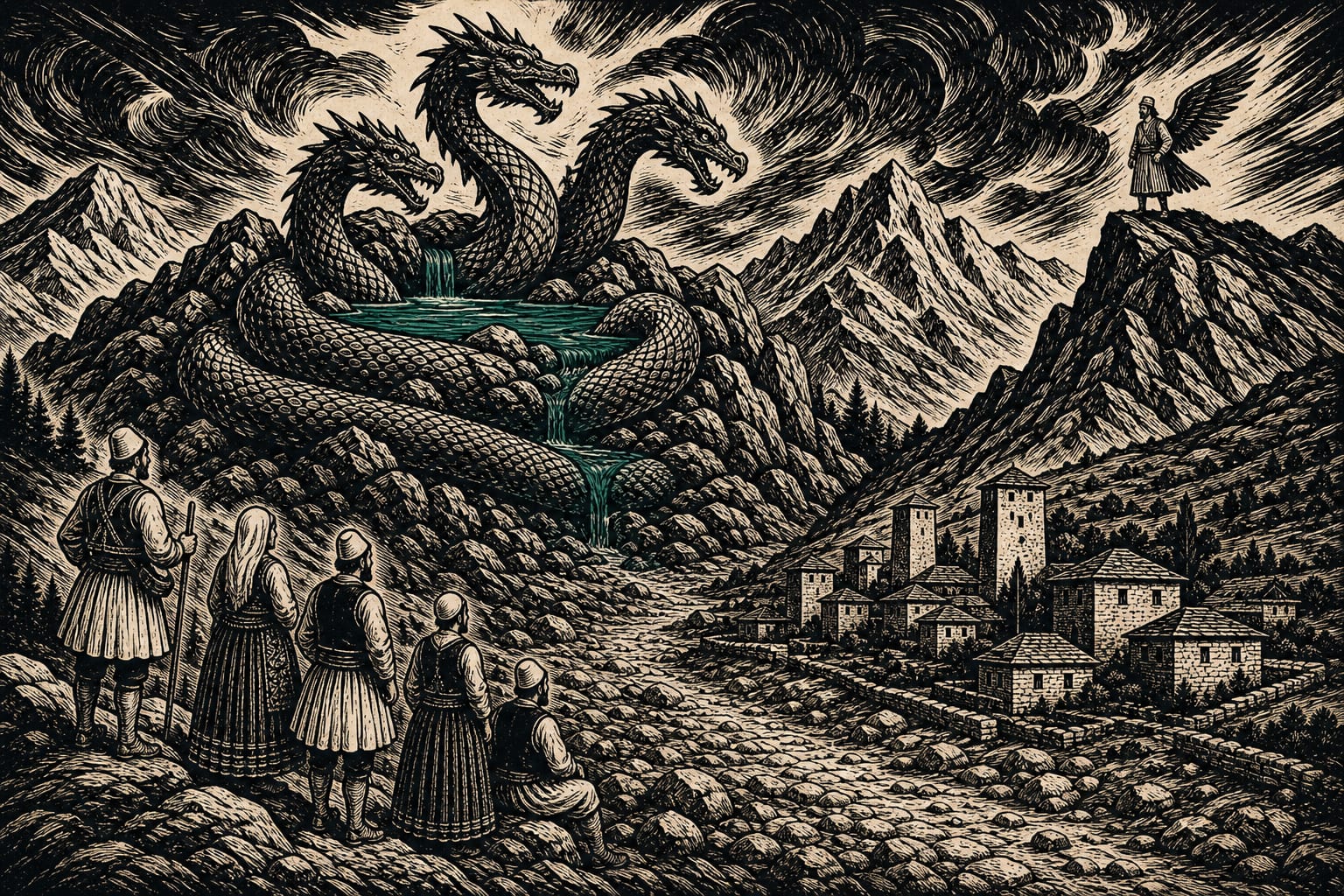
Her heads are not fixed. Çerkezi and Çano lay out the range plainly: “She appears as a being with one head, with three heads (like a cerberus) and with seven heads and more, then with her children and sisters and others.” One head, three, seven, more — the number scales with the danger the tale needs. The three-headed form invites the obvious Cerberus comparison, and the tales make it themselves; in some variants the Earthly Beauty’s palace is “guarded by Kuçedra or a three-headed dog of the type of Cerberus,” as Çabej noted (cited in Çerkezi & Çano 2024). But the comparison is a resemblance, not a derivation. Cerberus guards one threshold and has one job. The Kuçedra does too much for that.
The four stages
Here is the diagnostic detail, the thing no other dragon-tradition in Europe has in this form. The Kuçedra is not born a Kuçedra. She arrives through four named stages, and each stage is a survival.
She begins as the Shlíga — a small blindworm haunting dark caves and the fissures of the ground. This is the worm in the limestone, the thing easy to step over. If it lives fifty years without being seen by a human being, it becomes a Búllar. After a hundred years, an Érshaj. And after two centuries, it is the dreaded and colossal Kuçedra — the dragon that preempts springs and watercourses, holds kings and cities in fee, and can drink the sea (Wheeler 1936, Foreword pp. xiv–xv).
Read the condition again, because it carries the whole figure: without being seen by a human being. The transformation is gated not by feeding, not by combat, not by a curse, but by invisibility maintained across a span longer than any single human life. The Kuçedra becomes terrible by being overlooked. Two hundred years is three or four generations of people who walked past the cave-mouth and noticed nothing. By the time anyone sees her, she has already won.
The four-stage lifecycle is unique enough in the European dragon-tradition that comparison mostly breaks. The Welsh afanc is a monster from the start. The Norse Níðhöggr gnaws the world-tree outside time. The wyrms of medieval European hagiography arrive fully formed, on cue, to be run through by a saint with a lance. They are events. The Kuçedra is a duration. She does not appear; she accrues. Her threat is not that she is strong — though she is — but that she was there the whole time, getting older in the dark, while the village drew its water and forgot the spring had ever needed guarding.
There is a second, stranger note in the modern record. Çerkezi and Çano observe that “in some fairy tale Kuçedra appears in her opposite in the form of a woman in front of her husband and children, pitying the resistance.” The drought-demon, in certain tellings, can wear a domestic face — a wife, a mother, capable of pity. The metamorphosis runs both directions. The thing that becomes a monster by being unseen can also, when seen, become something almost human.
Her antagonist, the Dragúe
There is exactly one being made to fight her, and he is also made slowly, also by a rule about lineage. He is the Dragúe — a man born with tiny wings in his armpits, who from birth has the power of levitation, and whose full supernatural endowment, in the folklore, is known only to God and his mother.
The Dragúe is the Albanian answer to Perseus, and the Kuçedra is the dragon at the center of the local Andromeda story. In that guise she is the chief actor in the Albanian variant of the Perseus-and-Andromeda legend, the one embalmed in some form in nearly every mythology in the world. But the Albanian version sets its own birth-condition for the hero. In the region of Chelza, the Dragúe can be born only of forefathers who through three generations have not been unfaithful to their wives. The dragon-slayer is an embodiment of lineage virtue — a deeply Albanian moral instinct, kin to the Kanun’s reckoning of family honor and the besa, the sworn word that binds. He is a separate study, and he gets his own profile in this column. What matters here is the symmetry: she becomes terrible by waiting unseen; he becomes capable by inheriting three clean generations. Two slow makings, set against each other.
Lesser forms, and the pattern she sits inside
The Kuçedra has a lesser form, the Lubia — the haunter of the forest, the grisly opponent of the Brave Prince when his quest is to free the imprisoned or ensorcelled E Bukura e Dheut, the Beauty of the Earth. Where the Kuçedra holds the spring, the Lubia holds the wood. Wheeler’s word for her is “obscene,” which sanitizes what the Albanian tales carry more frankly: a predatory, sexually monstrous register that the modern translations restore and this column does not soften past adult clarity.
That phrase — the Brave Prince’s quest to free the Beauty of the Earth — places the Kuçedra inside the largest structure in Albanian folktale. E Bukura e Dheut is the supreme quest-object, the figure whose attainment is the hero’s whole purpose, and her palace is defended in layers. Çerkezi and Çano give a tale-fragment in which “at the first gate he finds a guard, i.e. these were three Kuçedras… these ‘Kuçedra’ were three sisters.” Three sisters, one to a gate, each asked the same question, each pointing the hero onward. The Kuçedra is the threshold the Albanian Andromeda story posts at its outer edge. She is what stands between the hero and the thing worth crossing the world for.
In poetry, and in the word itself
The Kuçedra did not stay in the highland tales. Albanian poets took her up as the master-figure of the threatening Other — the invader, the occupier, the drought-of-the-spirit, the thing that stops the flow. In the long arc of Albanian literature she has been read as the Ottoman, the Italian, the internal repression — whatever was damming the river that decade. The figure holds the charge because the original function holds: she is what keeps the water from coming.
And she survives in the plain language. To call something or someone a kuçedër in Albanian is to name a devouring, insatiable force — the word has not gone soft. It is the rare mythological name that is still an insult, still a curse, still understood without footnotes by people who could not tell you a single tale she stars in.
Why she matters
Most European dragons are a problem to be solved on the day they appear. The Kuçedra is a problem that was solving itself for two hundred years before anyone looked. That is the Albanian contribution to the world’s dragon-lore, and it is exact: a monster whose defining attribute is not fire or scale or appetite but time — survived, unseen, accumulated. She is the dragon who had all the time in the world, because no one was watching the worm. You do not need your grandmother to have named her to find that worth knowing.
Sources
The four-stage lifecycle (Shlíga → Búllar → Érshaj → Kuçedra), the Dragúe’s three-generations-faithful birth-rule, and the Lubia as her forest-form are drawn from Post Wheeler, Albanian Wonder Tales (New York: Doubleday, Doran / Junior Literary Guild, 1936), Foreword pp. xiv–xvi. Wheeler’s 1930s framing has been recontextualized; his anglicization “Kuchedra” is noted but not used. Verbatim quotations on the water-demon function, the variable heads, the three-Kuçedra-sisters guardian-fragment, and the woman-form metamorphosis are from Edlira Çerkezi and Ana Çano, “Mythical Figures of Albanian Heritage,” Open Journal of Modern Linguistics 14(6), 2024, pp. 1075–1098 (CC-BY-4.0), which also mediates the Çabej 1975 Cerberus parallel and the Lambertz 1922 framing.