
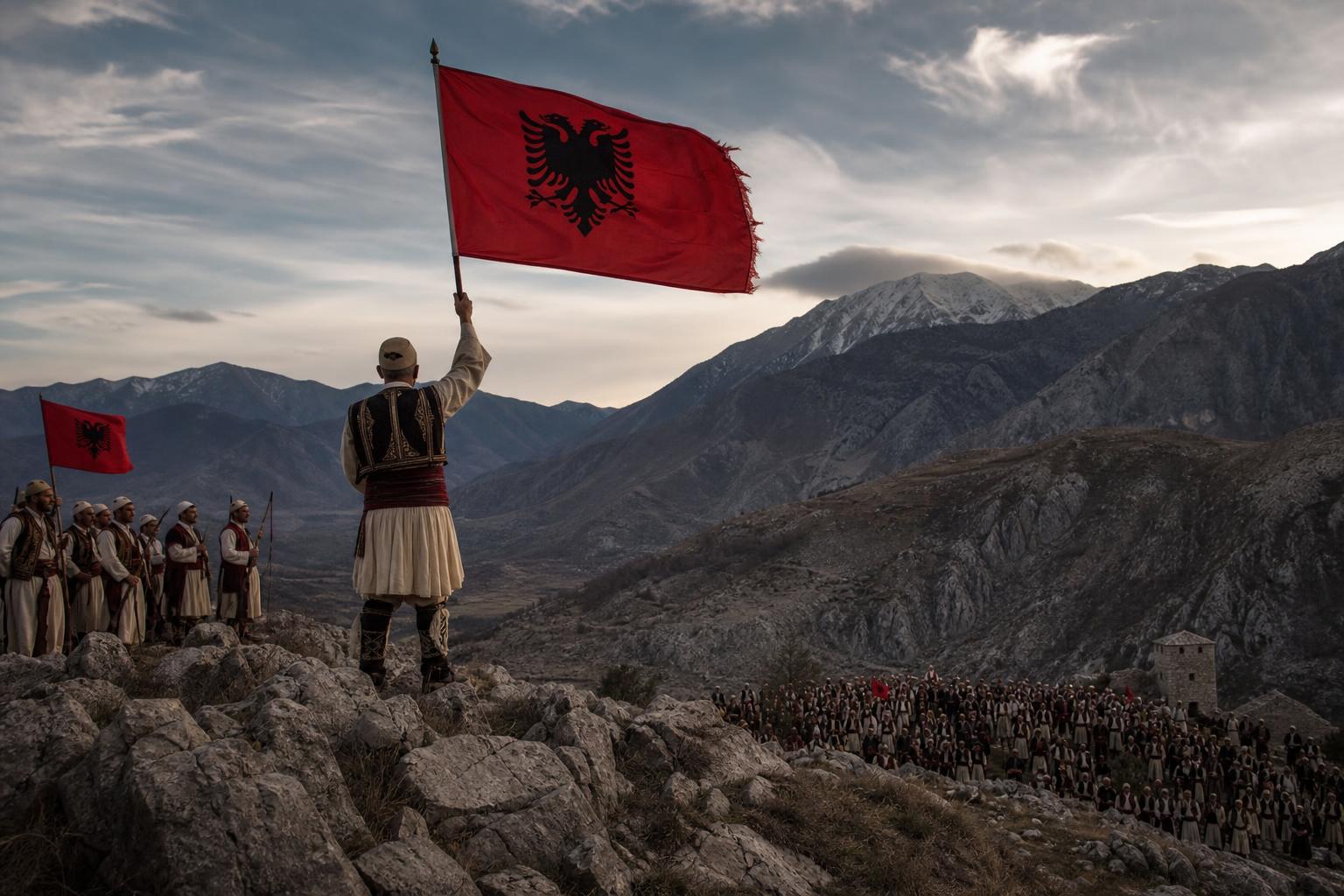
In April 1911, on a stony rise in the Northern Albanian highlands, a Catholic chieftain of the Hoti tribe pulled a red banner with a black double-headed eagle from under his coat and tied it to a staff. The flag had not been raised on Albanian soil since Skanderbeg died in 1468. The man who raised it was Ded Gjo Luli — also written Dedë Gjo’ Luli or Dedë Gjon Luli — and the place was Bratilë, in the tribal lands of Hoti in Malësia e Madhe.
What followed was a small war with consequences far larger than its battles. Within weeks, the highland clans had pinned down Ottoman columns at Deçiq, drawn European attention to the Albanian Question, and forced Constantinople to negotiate. Within nineteen months, on November 28, 1912, Ismail Qemali declared Albanian independence in Vlora.
This piece is for the Albanian American who flies the red-and-black on Flag Day and wants to know where that flag came from before 1912 — not just the medieval banner of Skanderbeg, but the moment in living memory when it returned. Ded Gjo Luli is the bridge between those two flags.
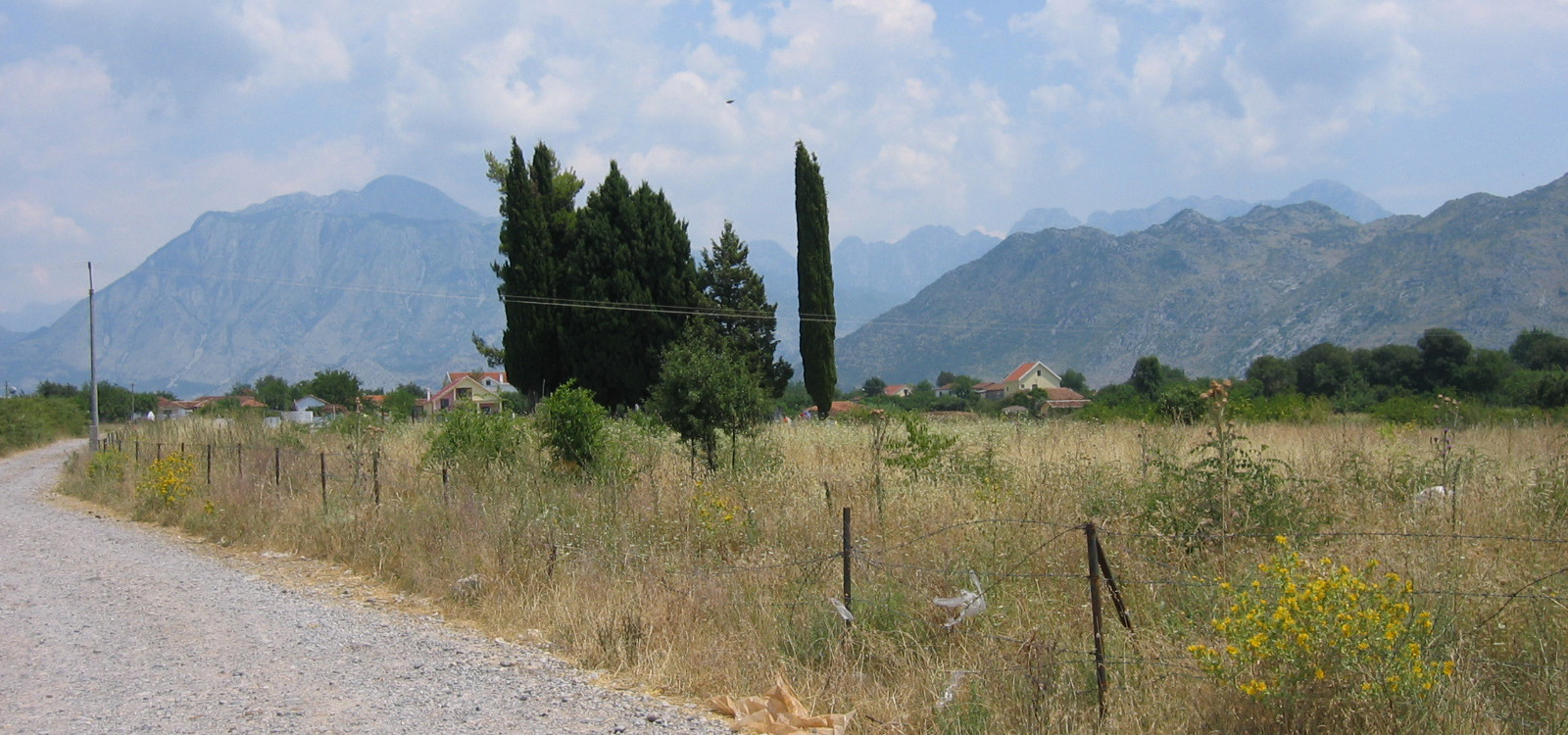 The Albanian Alps from near Koplik, with peaks of the Prokletije range in the distance — the same massif that frames Hoti.
Photo: Albinfo / Wikimedia Commons / CC BY-SA 2.5
The Albanian Alps from near Koplik, with peaks of the Prokletije range in the distance — the same massif that frames Hoti.
Photo: Albinfo / Wikimedia Commons / CC BY-SA 2.5
Who Ded Gjo Luli was
Ded Gjo Luli is commonly held to have been born around 1840 in Traboin, a village in the tribal territory of Hoti, on the Albanian side of what is today the Albania–Montenegro frontier. The exact birth year is not firmly attested in any contemporary record we can cite; biographies vary by a year or two on either side of 1840. He was Catholic, like most of Hoti, and a malësor — a highlander, the term Albanians use for the people of the Northern mountain country.
By the late nineteenth century he had risen to vojvode of Hoti — a war chieftain, a role rooted in tribal custom rather than Ottoman administration. The title came with practical authority over armed men and a recognized place in the council of clan elders that ran day-to-day affairs in Malësia e Madhe.
Malësia, “the great highlands,” is the cluster of mountain tribal regions north and northeast of Shkodër — Hoti, Kelmendi, Shkreli, Kastrati, Gruda, Triepshi, and others. By the early 1900s Hoti’s territory straddled what would become the modern boundary; today the tribe is split between northern Albania and southern Montenegro. We’re not going to argue that boundary in either direction here — Hoti’s historical center of gravity is the highland zone, and that’s where 1911 happened.
By temperament, contemporaries described him as a man of the kanun — the customary law of the Northern Albanian highlands — and of besa, the binding word of honor that held the tribal system together. He was not a modernizer in the European sense. He was a tribal chieftain who became a national figure because the moment demanded one and his neighbors trusted him.
The Ottoman context — why the highlands rebelled
To understand 1911 you need 1908. That year the Young Turk revolution in Constantinople promised constitutional reform across the Ottoman Empire. Albanians initially welcomed it. Albanian-language clubs, newspapers, and schools surged in places like Korça, Manastir, and Shkodër, and the alphabet was standardized at the Congress of Manastir in November 1908.
That goodwill collapsed within two years. The Young Turk government turned out to favor centralization and Ottomanization over Albanian linguistic and political rights. New taxes were imposed. Conscription was extended. The carrying of weapons — a near-universal practice in Malësia — was restricted. Albanian-language schools were closed. By 1910, an uprising had broken out in Kosovo under Isa Boletini and Idriz Seferi, and Ottoman columns under Şevket Turgut Pasha moved through Albanian-inhabited territory burning villages and disarming clans.
The highlands of Malësia e Madhe watched all of this from a few valleys away. The clans had run their own affairs for centuries — the Ottomans had never fully governed the upper highlands, only taxed and conscripted at the edges — and the new policy of forced disarmament was read as an existential threat. Add a famine winter, the loss of grazing access into the surrounding plain, and the open recruiting work of Albanian rilindas (national-revival activists) coming up from Shkodër, and the timing of the 1911 revolt becomes legible. It was not spontaneous. It was the highland response to two years of pressure that had nowhere else to go.
By March 1911 the bajraktars — the standard-bearers, the heads of the tribal subdivisions — of Hoti, Gruda, Kastrati, Shkreli, Kelmendi, and the surrounding tribes were meeting and pledging besa. Ded Gjo Luli was at the center of those meetings as Hoti’s senior vojvode. The agreement reached was that they would rise together.
The flag-raising at Bratilë (April 1911)
The most-cited date for the flag-raising at Bratilë is April 6, 1911. Some sources give late March 1911 or “early April”; the discrepancy is largely a calendar issue — the Ottoman Empire used the Rumi calendar and the Julian (Old Style) calendar at different points, while later Albanian historians often converted to Gregorian (New Style) without flagging the conversion. We’re not going to pick a side. The honest summary is: in early April 1911 (Gregorian), at Bratilë in Hoti, Ded Gjo Luli raised the Albanian flag.
The flag itself was the red banner with the black double-headed eagle — the Kastrioti standard, descended from Byzantine heraldry, carried by Skanderbeg’s house in the fifteenth century, and never officially raised over Albanian territory under Ottoman rule. Albanians had used it on letterheads, in émigré newspapers, in the diaspora in Boston and Bucharest. Raising it on Albanian ground was a different category of act.
The contemporary accounts — passed down through highland oral history and recorded by Albanian writers in the years after — describe Ded Gjo Luli speaking briefly to the assembled highlanders and the flag being received with rifle salutes. We won’t put specific words in his mouth here; the quoted speeches that circulate online vary too much from source to source, and we’d rather hedge than invent. What we can say is what the act did. It declared, in a language every highlander understood, that this revolt was not a tax dispute or a feud. It was national.
Within days the news had reached Cetinje, Shkodër, Constantinople, Vienna, and Rome. Albanian newspapers in the diaspora — including in the United States — reported it as the return of the Skanderbeg flag. The Ottoman press treated it as treason. The European powers, who had been managing the Eastern Question among themselves for decades, suddenly had to factor in an Albanian national movement with a flag of its own.
The Battle of Deçiq
The military centerpiece of the uprising was the Battle of Deçiq, fought in early April 1911 around the heights of Mount Deçiq in Hoti territory. The Ottoman force was a regular column with artillery support, sent up from Shkodër under Şevket Turgut Pasha to break the highland revolt before it could spread to Kelmendi and Shkreli.
The highland defenders were lightly armed by comparison — bolt-action rifles, no artillery, traditional small-unit organization by tribe and bajrak. What they had was terrain, motivation, and the besa that bound the clans to fight together rather than be picked off one tribe at a time. Ded Gjo Luli led the Hoti contingent. Bajraktars and vojvodes of the neighboring tribes — names like Sokol Baci, Mehmet Shpendi, and Prek Cali appear in different accounts — led theirs.
The battle is reported in Albanian historiography as a highland victory: the Ottoman column failed to take the heights, took meaningful losses, and was forced to withdraw toward Shkodër. The exact casualty figures vary by source; what is consistent across them is that Deçiq broke the Ottoman attempt to suppress the revolt by force in its first weeks. After Deçiq, the calculation in Constantinople shifted from “crush this” to “negotiate this.”
For the highlanders themselves, Deçiq became an instant reference point — a small mountain battle that proved the clans could stand against a regular European army on their own ground. It is still the engagement most often cited when the 1911 uprising is taught in Albanian schools.
The Greçe Memorandum and what the malësorë demanded
By June 1911 the active fighting had ebbed and Ottoman emissaries — including the Albanian-Ottoman official Turhan Pasha — were meeting with the highland leaders. The negotiations produced the Greçe Memorandum, presented on June 23, 1911, in the village of Greçe, with twelve articles laying out highland demands.
The twelve points covered, in summary: recognition of the Albanian language and Albanian-language schools across the four Albanian-inhabited vilayets (Shkodër, Kosovo, Manastir, Janina); a general amnesty for participants in the revolt; election of Albanian deputies; appointment of officials who knew the country and the language; restoration of confiscated weapons; reduced taxation calibrated to highland conditions; military service to be performed within the Albanian territories rather than dispatched to distant Ottoman fronts; and a measure of self-administration in the highlands.
These were not maximalist demands. They stopped short of demanding independence. Read in 2026, they read like a constitutional settlement — Albanian language, Albanian schools, Albanian officials, Albanian recruits in Albanian-speaking units. But they were enough to alarm Constantinople, because conceding them would have created in practice the autonomous Albania that the Ottoman government had been trying to prevent on paper.
The Ottoman side accepted parts of the memorandum and rejected others. A partial amnesty was granted. Some weapons were returned. The schools question was deferred. The malësorë took the deal as a pause rather than a settlement. The flag had been raised, the principle established, the demands recorded. The next round was coming.
From 1911 to 1912 — how the uprising opened the door to independence
The conventional Albanian-historiographical reading of 1911 is that it was the opening movement of a longer piece that ended with the November 28, 1912 declaration of independence in Vlora. That reading is contested in some details but mostly accepted in its broad shape, including by Wikipedia’s coverage of the period.
Three things changed because of 1911. First, the Albanian Question was now a European diplomatic file. Austria-Hungary, Italy, and Russia all began to take Albanian autonomy seriously as something they would have to plan around in any partition of the European Ottoman territories. Second, the Albanian leadership across regions and faiths — the Catholic highland vojvodes, the Bektashi southern beys, the Tosk and Gheg literary networks, the émigré societies in Boston, Bucharest, Sofia, and Cairo — had a shared symbol and a shared recent victory to point to. Third, the Ottoman government had publicly admitted, by negotiating, that Albanian demands existed.
When the First Balkan War broke out in October 1912 and Serbian, Bulgarian, Greek, and Montenegrin armies began carving up the European Ottoman lands, the Albanian leadership had a choice: be partitioned with the Empire or declare a separate fact. They chose the second. Ismail Qemali raised a flag in Vlora on November 28, 1912 — the same red-and-black double-headed-eagle flag that Ded Gjo Luli had raised at Bratilë nineteen months earlier — and read the proclamation that Albania was independent.
Ded Gjo Luli was not in Vlora that day. He was in the highlands. But the flag in Qemali’s hand was, in a real and unmetaphorical sense, the flag he had raised first.
The man behind the figure — what we can and can’t know
Hagiography is an occupational hazard for any nineteenth-century national figure, and the Albanian historiographical tradition is no exception. The Ded Gjo Luli of school textbooks and statue plaques is sometimes flattened into a single iconic gesture — the flag at Bratilë — and given speeches he probably did not deliver in the form they’re quoted in.
What we can say with reasonable confidence: he was a Hoti vojvode; he was a central organizer of the 1911 revolt; he led the Hoti contingent at the engagements around Deçiq; he raised the flag at Bratilë in early April 1911; he was a signatory and supporter of the Greçe Memorandum; he survived the uprising and lived through the early years of the Albanian state.
What we should hedge on: the exact birth year (c. 1840 is the safest formulation); the exact wording of his speeches; the precise date of the flag-raising in any one calendar; and the cause of his death in 1915. Some Albanian sources report he was poisoned by political rivals during the chaos of the First World War; others report a death from illness. Both circulate. We are not in a position to adjudicate.
What gets lost when his life is reduced to one moment is the rest of it: a tribal leader who spent decades managing land, livestock, marriages, feuds, and church relations in one of the harshest agricultural environments in Europe; a man who carried the besa of his clan through a generation in which most of his peers never had to convert local authority into national leadership; and a Catholic highlander who became a symbol in a country that, by design and by the convictions of its founders, was not going to be defined by any single religion.
Why this story matters to Albanian Americans today
The Albanian-American community in the United States is a layered migration. The first wave — Tosks from southern Albania, mostly Orthodox, with a smaller number of Bektashi Muslims — arrived in the 1890s and early 1900s, settled in Boston, Worcester, and the mill towns of Massachusetts, and built the institutional core of the diaspora. The Catholic Northern highland wave came in pulses across the twentieth century, accelerating after 1990, and built the New York–Westchester corridor, the Detroit-area communities, and a growing presence in Texas, Florida, and the Midwest.
For families who trace back to Hoti, Kelmendi, Shkreli, Kastrati, Shkodër, and the broader Malësia, Ded Gjo Luli is not a figure from a textbook. He is a vojvode from the next valley over — sometimes literally a great-great-great-grandfather’s neighbor. The 1911 uprising is part of why some of those families came to the United States in the first place: the Ottoman, then Yugoslav, then Communist-era pressures on Catholic highland life pushed cohort after cohort across the Atlantic.
For Albanian Americans whose families don’t come from the highlands — from the south, from Kosovo, from North Macedonia, from Çamëria — Ded Gjo Luli still matters. The flag flown in Boston, the Bronx, Detroit, and Worcester on November 28 every year is the flag he raised at Bratilë. The independence declared in Vlora in 1912 was made possible by what the highlanders did in 1911. The story is a shared inheritance across regions and faiths.
That inheritance is the reason a community-led count exists. The National Albanian Registry is not a government program and not a citizenship office; it’s a tally of who we are in the United States, by name and by region, kept by the community itself. The flag on the wall and the count on the page are the same act in two registers — one symbolic, one statistical.
If you’ve read this far and you haven’t been counted yet, register. It takes about three minutes, and the certificate at the end carries the same flag Ded Gjo Luli raised at Bratilë in 1911.