

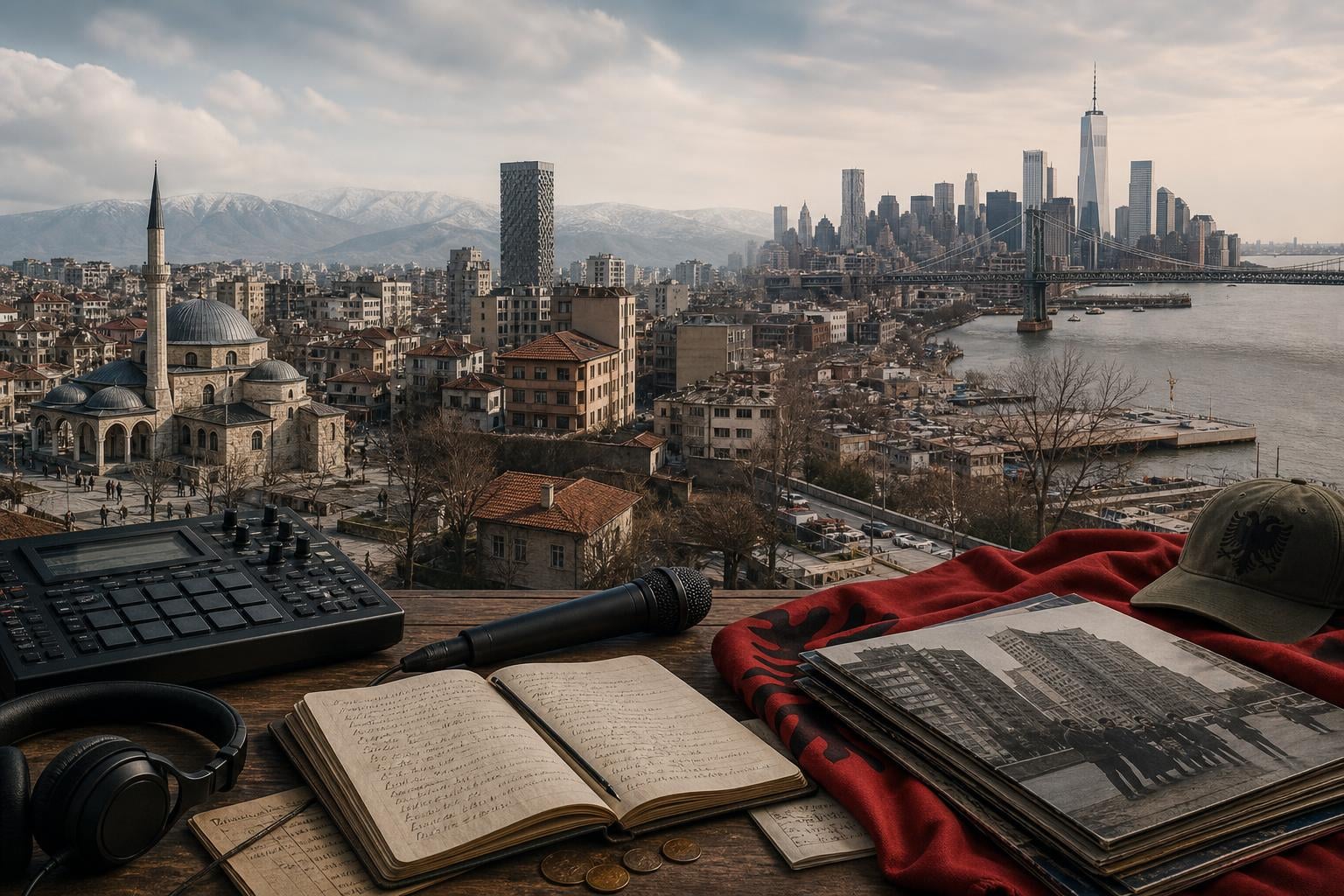
What started as basement tapes circulating among friends in Kosovo in the mid-2000s is now the soundtrack to Albanian-American group chats, wedding after-parties, and high-school cafeterias in the Bronx, Yonkers, Sterling Heights, and Worcester. The genre travels because the diaspora travels with it.
This guide is the long version. It traces Albanian rap from its first Pristina recordings through the mainstream Tirana wave of the mid-2010s, follows the parallel English-language Albanian-American pipeline that produced Action Bronson and Gashi, and closes on what makes the genre’s themes — besa (the Albanian code of honor), family, post-war Kosovo memory, hustle, longing — feel cohesive across countries and languages.
If you are an Albanian American in the US, this is the music your cousins in Pristina are listening to, the music your nephew is rapping along to in the car, and a thread of the diaspora story most outsiders never see. We have organized it the way we’d want to find it: the scenes first, then language, then themes, then the streaming and YouTube infrastructure that made Albanian-language rap commercially viable for a small-population community.
Where Albanian rap started
Albanian-language hip-hop is a 2000s genre. The first generation of Albanian rappers grew up on US East Coast hip-hop — Wu-Tang, Mobb Deep, DMX, Nas — that arrived through MTV, pirated cassettes, and CDs sent by relatives in New York. The grammar was American. The language was shqip.
Two scenes developed at the same time, mostly independently. Pristina — the capital of Kosovo, with a young population coming out of the 1998-1999 war and a strong cultural connection to the New York and German diaspora — produced the earliest Albanian-language rap crews. Tirana — the Albanian capital, opening up after the long post-communist 1990s — produced a parallel underground in the same years. Both scenes were small. Both used home setups, regional studios, and word-of-mouth distribution before YouTube existed as a music platform.
What linked the two was the diaspora. A Kosovo-Albanian kid in Brooklyn was hearing the same New York rap as a kid in Pristina, and both were also hearing each other’s tapes. By the late 2000s the scenes had blurred. By the mid-2010s the commercial center of gravity had shifted to Tirana through the rise of OTR (On The Run), but Pristina kept producing the most distinctive Albanian-language MCs.
The Pristina scene — Tingulli 3nt
Pristina was the cradle. Tingulli 3nt — formed in Pristina in 1996 by Getoar Selimi, Jeton Topusha, and Besa Gashi — is the Kosovar rap group most often cited as the city’s earliest, rapping in Albanian and treating hip-hop as a Kosovo-Albanian art form rather than as a translated import. (West Side Family, often mentioned in the same breath, was actually a parallel Tirana, Albania crew from the same years — not a Kosovar group.)
The cultural context matters. Kosovo in the early 2000s was a society rebuilding after the war. The audience for Albanian-language rap was young, urban, Kosovar, and acutely aware of the recent past. Lyrics referenced the war, displacement, family loss, and the post-war hustle. The aesthetic borrowed from American gangster rap but the references were local — Pristina neighborhoods, Kosovar slang, Albanian-language wordplay that does not translate.
What that scene produced is the template every later Kosovar rapper has worked with or against. Pristina rappers tend toward harder beats, denser Albanian-language flows, and more explicit identity content than their Tirana counterparts. The city’s continued output — Mozzik, Tayna, MC Kresha, Lyrical Son, Don Phenom — runs through that template.
For the diaspora reader: this is the music your Kosovo-Albanian cousins were playing in the early 2000s, and a substantial portion of the older Kosovar rap catalog is now on YouTube. The mid-2000s Pristina recordings sound like what they are — small studios, local production — but the lyricism set a standard that still anchors the scene.
The Tirana commercial wave — Noizy, Capital T, OTR
If Pristina built the underground, Tirana built the commercial machine. The figure at the center is Noizy — born Rigels Rajku in Sukth, near Durrës, Albania, in 1986, raised in London from around age 11 after his family emigrated in 1997, and returned to Tirana as a teenager to start rapping in Albanian. His label, OTR (On The Run), became the largest Albanian-language hip-hop imprint of the 2010s.
Noizy’s albums — Living Your Dream and Alpha among them — set the modern Albanian rap template: trap production, hard hooks, Albanian-language verses, occasional English code-switches, and visual production values matching anything coming out of London or Atlanta. His collaborations with international rap names, including French Montana, signaled that Albanian-language rap could share rooms with the wider Anglophone industry on its own terms.
Capital T — born Trim Ademi in Pristina, Kosovo, in 1992 — was another foundational name in that commercial wave, even though he built his career from Kosovo rather than Tirana. He was among the first Albanian-language rappers to push from underground to commercial radio play in the early 2010s, and his collaboration history with Noizy and the OTR roster runs deep.
The Tirana commercial wave broke through around 2014-2018. Albanian-language rap moved from a niche subgenre to a mainstream presence on Albanian radio, music television (Top Channel, Klan), and YouTube. The audience grew with it — not just inside Albania and Kosovo but across the Albanian-speaking diaspora in Italy, Germany, Switzerland, the UK, and the US.
The diaspora US sound — Action Bronson, Gashi, the English-language pipeline
The US diaspora produced its own parallel scene — and it sounds different because the language is different. Albanian-American rappers based in New York, Detroit, and the wider East Coast rap primarily in English, with Albanian heritage as a thread of identity rather than the working language of the verse.
The most visible name is Action Bronson. Born Ariyan Arslani in Flushing, Queens on December 2, 1983, to an Albanian father (of Kosovar-Albanian heritage) and a Jewish-American mother, Bronson worked as a chef — including at his father’s Mediterranean restaurant in Queens — before turning to rap in his late twenties. His mixtapes Dr. Lecter (2011) and Blue Chips (2012) established him as a heavyweight of New York hip-hop in both senses; his major-label debut Mr. Wonderful landed in 2015. He hosted F*ck, That’s Delicious on Viceland — a food-and-travel show that included Albania and Albanian-American New York neighborhoods on its route. He has shown the Albanian flag publicly, including a tattoo on his hand, and has discussed Albanian heritage across his career. He raps in English. His Albanian connection is identity, not language.
Gashi — born in Tripoli, Libya, to ethnic Albanian parents from Kosovo, and raised largely in Brooklyn from around age 10 — has charted with mainstream US releases and worked with French Montana, Nipsey Hussle, G-Eazy, and others. He also raps in English, with Albanian identity threaded through lyrics, ad-libs, and public statements rather than as the working language of his verses.
The pipeline is geographic. Albanian-Americans cluster in the New York metro (Bronx, Yonkers, Brooklyn, Staten Island), in southeastern Michigan (Sterling Heights, Detroit), and in eastern Massachusetts (Worcester, Boston). The kids who grew up in those neighborhoods came up on US hip-hop the same way every other East Coast kid did — and a small number turned that into a career. The result is a small but real cohort of English-language rappers of Albanian heritage, working inside the US industry, who carry the flag in their bio rather than their bars.
The language layer — Albanian, English, code-switching
Language is where Albanian rap shows its diaspora shape most clearly. Three patterns coexist, and you can hear all three on a single playlist.
Albanian-only. The Pristina-Tirana core — Noizy, Capital T, Tayna, Mozzik, MC Kresha, Lyrical Son — works primarily in shqip (the Albanian language). The verses, hooks, and adlibs are Albanian. Production aesthetics match the international trap sound; the language does not. This is the dominant mode of the Albanian-language scene and the catalog most US-based listeners use to keep their Albanian sharp.
Code-switching. Diaspora artists, and increasingly Tirana-Pristina artists collaborating with diaspora names, toggle mid-verse. Albanian for the brag, English for the punchline. Albanian for the chorus, English for the feature verse. The toggle is itself a flex — shqip as a marker of community, English as a marker of reach. Albanian-American listeners code-switch the same way in conversation; the music mirrors how the diaspora speaks.
English-only with Albanian identity markers. Action Bronson, Gashi, and the broader Albanian-American hip-hop cohort write in English. Albanian shows up in flag references, shout-outs to family, occasional Albanian-language ad-libs, or interview clips rather than in the bars themselves. The work is structurally American hip-hop; the heritage is the bio.
For the Albanian-American reader, the language layer is where the genre’s diaspora identity lives. A Bronx-raised Kosovar-Albanian teen who plays Mozzik in the car and Action Bronson on the walk home is using both as different kinds of identity expression — and neither feels inauthentic.
Themes — besa, family, post-war memory, the hustle
Albanian rap has a consistent thematic palette. Some of it is hip-hop-universal — money, status, neighborhood pride, conflict — and some of it is specifically Albanian.
Besa and family honor. Besa (the Albanian code of honor and sworn word) shows up explicitly in lyrics and as a value structure underneath them. Loyalty to family, brothers, and crew is a constant. Betrayal narratives lean on the cultural weight of breaking a besa, not just on hip-hop’s generic loyalty themes. This is one of the genre’s most distinctive features when compared with mainstream Anglophone rap.
Post-war Kosovo memory. Kosovar rappers reference the 1998-1999 war directly or obliquely — family members lost, neighborhoods destroyed, the displacement years, the rebuild. Younger artists who do not remember the war themselves still write inside that frame, because the audience and the community do. The war is the unspoken context of a lot of Pristina-scene work.
The post-1990s Albania experience. Tirana rappers carry their own historical weight — the chaotic 1990s after communism ended, the 1997 collapse, mass emigration, the slow rebuild of a normal urban life. Hustle narratives in Albanian rap often track the actual hustle of a generation that watched their country reset.
Diaspora longing and return. A meaningful share of Albanian rap is written by or about people living outside Albania and Kosovo. Songs about leaving, sending money home, being half-here-and-half-there, and going back at the holidays are a recurring thread. For Albanian-American listeners this is some of the most emotionally direct material the genre produces — the music says aloud what families do not always say at the dinner table.
Hustle and money. Standard hip-hop territory, with Albanian-specific texture. The hustle in question is often the immigrant hustle — work, sacrifice, the move, the relatives left behind. The money flex is often paired with family pride rather than detached from it.
Women in Albanian rap — Tayna and the small cohort
Albanian rap is male-dominated. The genre’s most prominent female voice is Tayna — born Doruntina Shala in Prizren, Kosovo, in 1996 — who emerged in 2018 with hits like “Columbiana” and, the following year, “Bye Bye” (feat. Dafina Zeqiri) that combined trap production with sharp Albanian-language lyrics. She is the breakthrough female name working squarely inside Albanian rap, and she has been a fixture on Kosovar and Albanian-American playlists since.
Two names that often get grouped with Albanian rap belong more accurately to pop and R&B. Dafina Zeqiri is a Kosovar-Swedish artist whose catalog spans pop, R&B, and dance with occasional rap-adjacent tracks — but the bulk of her work is not rap. Era Istrefi is a pop artist; her global hit “Bonbon” (2016) is a pop record, and her career — including her co-performance of the official 2018 FIFA World Cup song “Live It Up” with Will Smith and Nicky Jam — is pop, not hip-hop. Both artists are part of the broader Albanian-language music scene; both are often miscategorized as rappers. We name the distinction here because it matters for understanding the actual rap cohort.
The underrepresentation of women in Albanian rap mirrors the underrepresentation in hip-hop globally, but it is more pronounced. The genre has produced one breakthrough female solo voice in over twenty years. That is changing slowly — younger Kosovar and Albanian female MCs are coming up — and we expect the next decade to widen the cohort.
The pop-rap blur and the global Albanian sound
The line between Albanian pop and Albanian rap is blurry on purpose. The two genres feed each other.
The most globally visible Albanian-heritage artists — Dua Lipa, Rita Ora, Bebe Rexha — are pop artists, not rappers. Dua Lipa is Kosovar-Albanian, born in London in 1995 to parents from Pristina; her catalog is dance-pop and synth-pop and has produced three Grammys. Rita Ora is Kosovar-Albanian, born in Pristina, raised in London; her catalog is pop and dance. Bebe Rexha is Albanian-American, born in Brooklyn to parents from Debar (in what is today North Macedonia); her catalog is pop with country and dance crossovers. Naming this distinction is not a downgrade — pop has produced the bigger global numbers — but it is the genre line.
What rap and pop do share in the Albanian-language scene is the production team, the studios, and frequently the features. Albanian pop hits routinely include rap verses; Albanian rap tracks routinely include pop hooks. Producers move between the two. The crossover is so consistent that some recent Albanian-language tracks resist genre categorization in any clean way — they are Albanian music first, with hip-hop and pop as the production grammar.
The result, for an outside listener, is a recognizably cohesive contemporary Albanian sound. Hard 808s, trap drum patterns, sung-rap melodies, Albanian-language hooks, and high-gloss video production are common across the rap and pop scenes alike. The shared sound is what travels — and what the diaspora hears as the Albanian sound of the 2020s.
YouTube, streaming, and the diaspora as audience
A small-language music scene faces a basic economic question: who is the audience, and how do they pay? For Albanian rap, the answer has been the diaspora — and the platform has been YouTube.
Albanian-language rap videos routinely cross tens of millions of YouTube views. A single Noizy or Capital T video can outdraw an artist’s entire monthly Spotify listenership by an order of magnitude. The reason is structural. The Albanian-speaking audience inside Albania and Kosovo is roughly seven to ten million. The Albanian-speaking diaspora — in Italy, Germany, Switzerland, the UK, the US, and the Nordic countries — adds several million more. That diaspora was on YouTube before it was on paid streaming, and YouTube is free, mobile-friendly, and doesn’t require a credit card in the home country.
The diaspora also drives the math. Albanian rap shows in New York, Boston, Detroit, London, Frankfurt, Zurich, Milan, and Brussels routinely sell out venues the Albanian-domestic market could not fill. A Noizy show in the Bronx draws Albanian-Americans from all five boroughs, Westchester, northern New Jersey, and Connecticut. The diaspora is not just the audience — it is the commercial floor under the whole industry.
Spotify and Apple Music have grown the catalog meaningfully in the late 2010s and 2020s. Most major Albanian-language rap artists now have working artist pages on both. But YouTube remains the volume platform, and a meaningful share of new releases still premiere there first.
For the Albanian-American reader: this is the infrastructure that lets your nephew in the Bronx and your cousin in Pristina hear the same song the day it lands. The diaspora and the home country are listening to the same music at the same time — and have been for fifteen years.
How to start listening
A starter run, if you have not been keeping up:
- Pristina core: one Tingulli 3nt cut, one Mozzik track, one MC Kresha verse, one Tayna single.
- Tirana commercial: one Noizy single off Living Your Dream or Alpha, one Capital T track.
- Diaspora US: one Action Bronson cut off Blue Chips or Mr. Wonderful, one Gashi single.
- Crossover / pop-rap blur: one Tayna feature, one Albanian-pop hit with a rap verse on it.
Run that sequence in that order and you have toured Albanian rap’s four working modes in roughly an hour. The thread that connects them is the language, the heritage, and the diaspora audience listening to all four on the same playlist.
FAQ — Albanian rap, in short
For quick answers to the most common questions, see the FAQ section below this article. The short version: Albanian rap is two scenes (Pristina and Tirana) plus a diaspora extension (the US, the UK, Scandinavia, Germany, Switzerland, Italy). The language is Albanian at home, English or German or Swedish in the diaspora, and code-switching everywhere. The audience is the diaspora as much as the home country. And the genre’s themes — besa, family, post-war memory, the hustle, longing — sit underneath even the trap-iest production.
Why this matters for the diaspora
Music is one of the most durable forms of cultural continuity in any diaspora. Recipes pass down. Language frays. Music holds.
Albanian rap is the form holding the line for a younger generation that may not read in shqip, may not know every Vaçe Zela song, and may not have been to Tirana or Pristina yet — but plays Noizy and Mozzik and Tayna in the car, knows every word, and uses the music as a way of staying Albanian inside an American life. That is not a small thing.
The National Albanian Registry is a community-led count of Albanian Americans in the United States. The gap between 230,000 Albanian Americans counted by the most recent ACS and the roughly one million community estimate is partly a story about who claims their heritage publicly. Visibility moves the count. When a kid in Yonkers raps along to a Noizy verse at full volume, when an Albanian-American sells out a club in the Bronx, when Action Bronson rolls up his sleeve, the cost of saying “I’m Albanian” falls a little for every other Albanian American watching.
Get counted at /register — the National Albanian Registry’s free, encrypted, community-led roster. The certificate is a recognition document — not government ID, not citizenship, not legally binding — and the count is the point. Adding your name takes about 2 minutes.
The community-led count of Albanian Americans starts with you.