
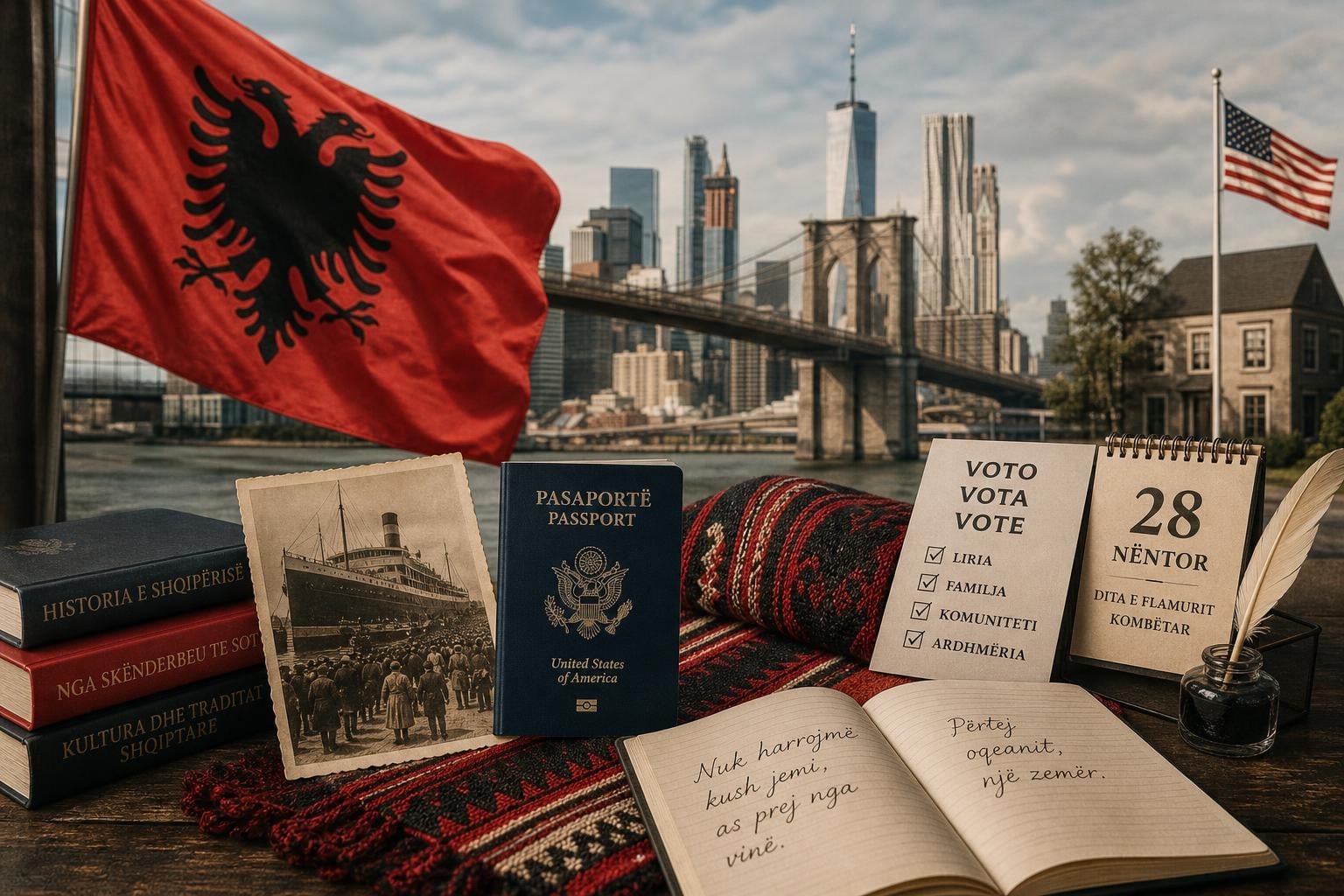
What exists instead is a different shape. Albanian heritage in America is recognized through state and city proclamations, through programs in schools and parishes and community halls, and through observances that gather — almost universally — around late November. That clustering is not random. November 28 is the date Albania declared independence in 1912, and it carries both Independence Day and Flag Day meaning at once. The diaspora has organized its calendar around that anniversary since the year after it happened.
So the honest answer to “when is Albanian American Heritage Month?” is that there isn’t one fixed month, and the people telling you there is are usually rounding up. The more useful answer is that the recognition is distributed: across jurisdictions, across institutions, and across the weeks surrounding November 28. This piece lays out what is actually observed, where the recognition comes from, and how a community can ask for more of it — including the one civic step that makes every other ask stronger.
What “Albanian Heritage Month” actually refers to
When people say “Albanian Heritage Month,” they are usually describing a real practice under a label that overstates how official it is. No US president or Congress has designated a national Albanian American Heritage Month. What they are pointing at is the cluster of heritage recognition that happens around November — local proclamations, flag-raisings, cultural programs, and community dinners — anchored to the November 28 independence and flag anniversary.
This matters for accuracy, and accuracy is the point. NAR is in the business of counting and describing the US Albanian community honestly, which means not inventing a federal holiday that doesn’t exist. The federally recognized heritage months — Black History Month, Women’s History Month, AAPI Heritage Month, Hispanic Heritage Month, and others — each rest on a specific congressional resolution or executive proclamation. There is no equivalent instrument for Albanian heritage at the national level.
That is not a knock on the community. It reflects how heritage recognition actually accrues in the United States: usually bottom-up, jurisdiction by jurisdiction, before — and sometimes instead of — any single national designation. Many ethnic communities mark their heritage primarily through state and municipal recognition for decades. Albanian Americans are firmly in that category, and the recognition they have built is concrete even though it is not centralized.
So the right frame is not “Albanian American Heritage Month is in November.” It is closer to “Albanian heritage in the US is recognized largely through state and city action, and most of that recognition clusters around the November 28 anniversary.” Everything else in this piece builds on that distinction.
The November 28 anchor: independence and the flag
The reason every Albanian heritage observance gravitates toward late November is a single afternoon in 1912. On November 28 of that year, in the Adriatic port city of Vlorë, the Albanian assembly declared independence from the Ottoman Empire and raised the red flag with the black double-headed eagle (Wikipedia: Albanian Declaration of Independence). Ismail Qemali, a former Ottoman official who had spent years in exile, read the proclamation that, after more than four centuries of imperial rule, Albania was on its own.
Because the political act and the flag-raising happened together, the date carries two meanings at once. In Albanian it is Dita e Pavarësisë (Independence Day) and Dita e Flamurit (Flag Day), and the community uses the labels interchangeably. The flag itself — a black double-headed eagle on a deep red field — is older than the modern state, tracing back through medieval Albanian heraldry and the 15th-century banner of Gjergj Kastrioti, known as Skanderbeg. When 1912 nationalists chose a symbol, that one was already waiting.
For shqiptarë — the Albanian self-name, from shqiptar (an Albanian person) — November 28 is the one date that crosses every regional and religious line in the community. Catholic, Orthodox, Sunni, Bektashi, and secular Albanians all observe it. Albanians from Albania, Kosovo, North Macedonia, Montenegro, and the diaspora all mark it. NAR keeps a neutral frame on the various naming and border questions across the region; what matters here is that November 28 is the shared anchor regardless of which part of the Albanian world a family comes from.
That is why heritage recognition pools around the date. A mayor issuing a proclamation, a school staging a program, a parish hosting a dinner — they all reach for the same anniversary because it is the one the community already organizes around. The November anchor is not an official designation; it is the gravitational center the observances orbit.
How the US diaspora observes heritage
Albanian heritage observance in the United States is a set of practices, not a published event calendar. The forms recur from metro to metro even though no central body coordinates them, which is itself a sign of how deep the tradition runs.
The flag goes up. Albanian American households fly the red and black from porches, balconies, and storefronts in the weeks around late November. In neighborhoods with dense Albanian populations, commercial corridors line their windows with small flags. Several US cities with significant Albanian communities have formally raised the Albanian flag at city hall around November 28 in recent years — a visible piece of civic recognition that local organizations request and local officials grant.
Community dinners anchor the social side. Parishes, mosques, regional societies, and umbrella organizations host heritage banquets that range from potlucks to plated galas. The food is recognizable across events — byrek (filo pastry filled with cheese, spinach, or meat), grilled meats, baked dishes — and the toasts run on raki (Albanian fruit brandy). These gatherings double as the moment many organizations announce scholarships, install new leadership, and set the year’s agenda.
Culture is taught, not just displayed. Valle — Albanian folk dance, performed in a hand-linked circle — appears at nearly every event, often led by children. Albanian Saturday schools stage recitations, frequently of Skanderbeg verses and the national anthem, Himni i Flamurit. Kids in folk dress are usually central to the program rather than incidental to it, because passing the heritage to the next generation is the implicit purpose of the whole exercise.
We deliberately do not list specific dates or events to attend here. The practices above are durable; the particular dinners, parades, and flag-raisings shift year to year and are best confirmed through local parishes and community organizations. The pattern is the point: heritage is observed through repeated, intergenerational practice, clustered in late November, organized locally.
Heritage in Albanian American schools and youth programs
The most consequential heritage work in the diaspora happens with children, and most of it runs through Albanian Saturday schools and youth programs rather than the public-school calendar. These are the institutions that decide whether a third-generation Albanian American can read the language, recite the anthem, and place November 28 in history.
A typical Albanian Saturday school combines language instruction with cultural programming. Students learn to read and write Albanian, practice valle, and prepare recitations for the late-November programs. Around the independence and flag anniversary, those schools often stage the recitals and dance performances that anchor the local community’s heritage observance — the children in fustanella and embroidered dress are frequently the centerpiece of the parish or hall event.
Public schools enter the picture less formally. In districts with concentrated Albanian populations, individual teachers and students mark the heritage through class presentations, especially when a child is asked to research their family’s background. A teenager assembling a November presentation on Albanian independence is doing heritage work, even without a designated month telling them to. NAR’s companion piece on 28 Nëntori describes how that search often begins for younger Albanian Americans.
For families that did not grow up with a formal observance — common among second- and third-generation households — the schools are also the easiest entry point. Enrolling a child in an Albanian Saturday school, or simply attending the late-November program, transmits the heritage faster than any explainer. The community does not gatekeep participation; showing up is the qualification.
This is also why a documented community matters to schools. Districts allocate resources and recognition partly by demonstrated demand. A neighborhood that can show a real population of Albanian families has a stronger case for heritage programming, language electives, or simple acknowledgment than one whose numbers live only in memory.
State and city recognition: how the patchwork works
In the absence of a federal designation, the real engine of Albanian heritage recognition in the US is state and local government. A number of US states and cities — particularly those with large Albanian populations — have recognized Albanian heritage or Dita e Flamurit through proclamations and flag-raisings over the years. Because each one is issued by an individual jurisdiction, the result is a patchwork rather than a single coordinated observance.
A proclamation is a formal statement issued by an elected official — a governor, mayor, county executive, or legislative body — recognizing a group, occasion, or cause. It is symbolic rather than binding: it does not change law or appropriate money. But it is meaningful. It puts the community on the official record, gives local organizations something to rally around, and signals to the broader public that Albanian Americans are a recognized part of the civic fabric.
These recognitions tend to cluster in late November for the same reason everything else does — the November 28 anchor — and they tend to appear in the metro areas where the community is densest. Because they are local instruments, they come and go with administrations and with whether a community organization asks for them in a given year. There is no central registry of which jurisdiction has issued what and when, which is exactly why we are careful not to claim specific named proclamations we cannot independently verify.
The honest summary: Albanian heritage recognition in the US is real, it is delivered mostly through state and municipal action, and it is uneven across the map. Where the community is organized and asks, recognition tends to follow. Where it does not ask, the recognition usually does not appear on its own. That makes the next section the practical heart of this piece.
How to request a heritage proclamation
Requesting a proclamation is one of the most direct civic actions an Albanian American community can take, and it is more accessible than most people assume. The offices that issue them do this routinely, and a well-prepared request is rarely refused.
Start by identifying the right office. For a city, that is usually the mayor’s office or the city or county council clerk. For a state, it is the governor’s office, often through a constituent-services or proclamations desk. Most have a proclamation request form on their website; if not, a phone call to the clerk’s office gets you the process.
Prepare a short package. A strong request usually includes:
- The occasion, stated plainly — recognition of Albanian heritage, or Dita e Flamurit on November 28.
- A few sentences of community history, both national (the 1912 independence anchor) and local (when Albanians settled in your area, what organizations exist now).
- The local population you represent — a number carries more weight than “a large community.”
- A draft proclamation, two or three short paragraphs. Offices appreciate a starting text they can edit; it lowers the work for them and keeps the language accurate.
- A specific ask, such as a flag-raising at city hall or a reading at a council meeting, if you want one.
Time it well. Submit four to six weeks ahead of late November so the office can schedule it, and ask whether a representative of your group can attend the signing or reading. That photo and that moment are often more valuable to the community than the document itself.
This is civic action squarely within NAR’s frame — neutral, non-partisan, and community-strengthening. It is not lobbying or political advocacy; it is asking a local government to formally acknowledge a community that is already there. And the single most useful thing you can attach to that request is evidence of how many of you there actually are.
Who Albanian Americans are, by the numbers
Any recognition claim rests on the underlying community, so it helps to be precise about the size and shape of it. About 230,000 people self-identified as Albanian in the 2024 American Community Survey (Wikipedia: Albanian Americans). The largest concentrations are in New York (~52,000), Michigan (~30,000), and Massachusetts (~21,000), with significant communities in New Jersey, Connecticut, Illinois, Pennsylvania, and a fast-growing presence in Florida and Texas.
Those are the recorded figures, and they are almost certainly an undercount. Census ancestry questions are open-ended and self-reported, and many Albanian Americans — particularly those who arrived via Italy, Greece, or other countries, or whose families have been here for generations — do not get captured cleanly. Broad community and heritage estimates that count wider Albanian-origin descent reach toward a million. That figure is a defensible community ceiling, not an official count, and not the central number NAR builds on; the recorded ACS figure is the firm floor, and the truth sits somewhere above it.
The community’s history in America runs deep. Albanians have been immigrating to the United States since the late 19th and early 20th centuries, settling first in industrial cities of the Northeast and Midwest — Boston above all, then New York, the mill towns of New England, and later metro Detroit. Boston was the organizational heart of the early diaspora: the Vatra federation, founded there in 1912, fundraised and lobbied for the independence the homeland declared that same year, and the community has marked November 28 continuously since.
Albanian Americans are religiously diverse in a way that defines the community — Catholic, Orthodox, Sunni Muslim, Bektashi, and secular families share the same heritage and the same November anniversary. They have contributed across business, medicine, academia, the trades, public service, and the arts. The point of counting them is not vanity; it is that a community recognized in the data is a community recognized everywhere else that decisions get made.
Why being counted strengthens recognition
Recognition follows visibility, and visibility, in a country that runs on data, means being counted. This is the thread that ties heritage to civic action. When a mayor’s office weighs a proclamation request, when a school district considers a heritage program, when funders decide where to direct grants, when the Census Bureau reviews how ancestry categories are tabulated — the question underneath all of them is the same: how many of you are there, and can you show it?
A documented count answers that question in a way anecdote cannot. “We are a large community” is easy to wave off. “We are this many households, in these neighborhoods, organized through these institutions” is not. Every recognition described in this piece — the proclamation, the flag-raising, the school program — gets easier to obtain and harder to deny when the community can point to a real number.
That is the gap the National Albanian Registry exists to close. The official ACS figure undercounts the community, and no single source has ever pulled together a community-led count of Albanian Americans across regions, faiths, and generations. NAR is that count: free, private, opt-in, run by a 501(c)(3) nonprofit rather than any government agency, and built so the diaspora can finally see its own size with precision.
Being counted is not a substitute for the heritage practices — the dinners, the dances, the flag on the porch. It is the civic layer underneath them. The culture is what makes the community worth recognizing; the count is what makes the recognition stick.
One honest note about what the count is and is not. When you register, NAR issues a certificate. That certificate is a recognition document — a way to mark that you are part of the community count. It is not a government ID, not proof of citizenship, and not a legally binding instrument, and NAR does not imply otherwise. Its value is exactly what the rest of this piece has been about: making a heritage visible.
If you want your heritage counted toward the recognition this community has spent a century building, add your household to the count at albanianregistry.org/register — it takes about three minutes, and your information stays private.