

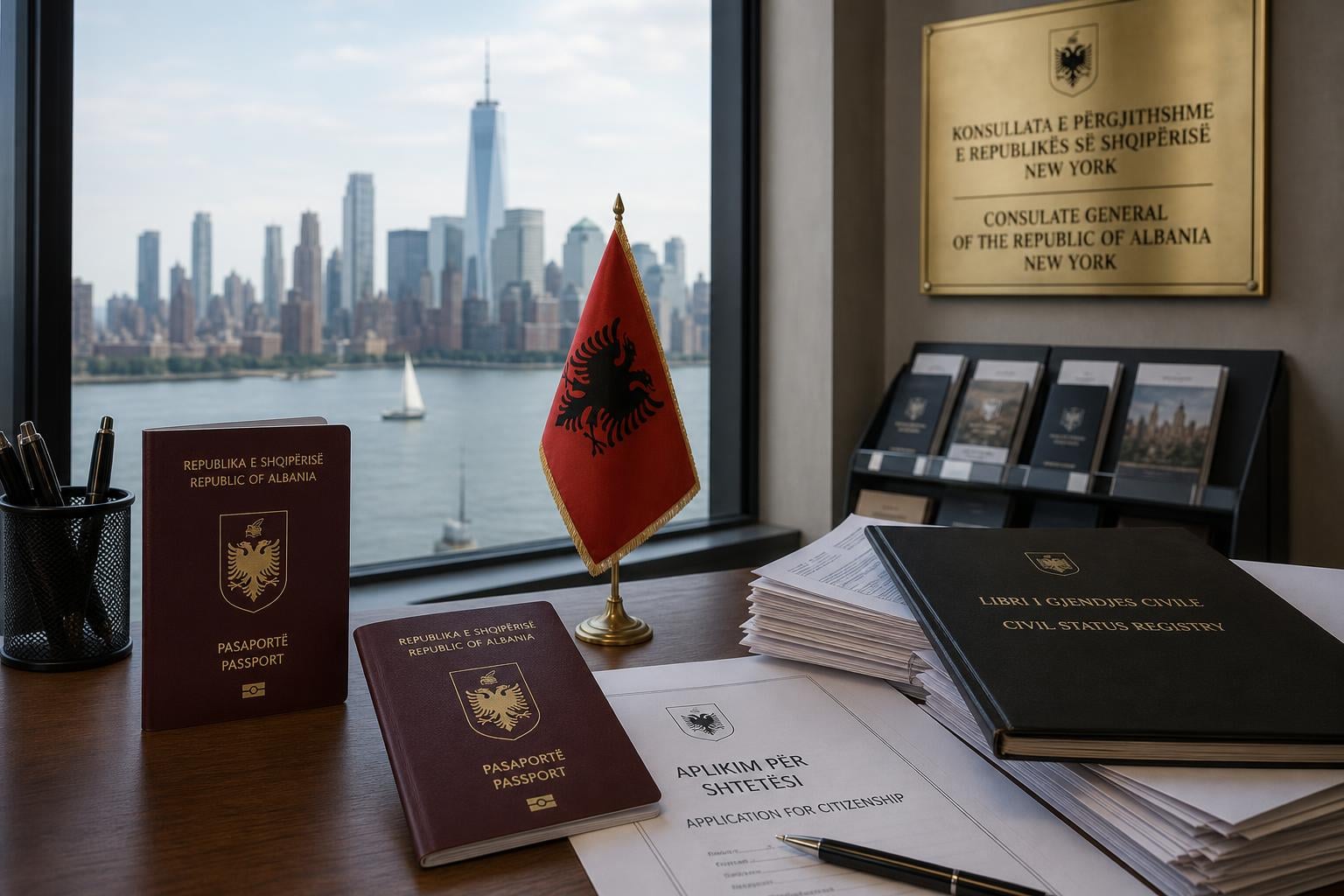
For an Albanian American who needs Albanian government paperwork, the search usually starts the same way: a phone in one hand, a search bar that says “Albanian embassy in New York,” and the assumption that there is a building somewhere in Manhattan with a flag out front where a passport can be renewed.
There is a building. There is a flag. But it isn’t an embassy. The Embassy of Albania in the United States is in Washington, D.C. The Albanian government office in New York City is the Consulate General of the Republic of Albania — and the difference is not just terminology. It changes which office handles which service, which paperwork you need to bring, and where your file ends up if you are applying for citizenship by descent.
This guide is the diaspora version of the org chart. It explains the structure of Albanian diplomacy in the United States, what the New York consulate does, what the DC embassy does, what the 2020 citizenship law looks like from the diaspora side, and where Kosovo’s separate diplomatic presence fits in. Addresses and fees change, so the only sources that can confirm a specific appointment slot or document fee on a given day are e-Albania and the consulate itself. Treat this as a map, not a substitute for the official channels.
We will also be honest about what the National Albanian Registry can and cannot do here. NAR is a community-led count of Albanian Americans — useful infrastructure for the diaspora’s collective work, useless for renewing a passport. Both layers matter; they don’t substitute for each other.
Embassy versus consulate: the structure of Albanian diplomacy in the US
Albania’s footprint in the United States is small relative to the size of the diaspora. There are three principal posts that matter for most Albanian Americans:
- The Embassy of the Republic of Albania, in Washington, D.C. This is the country-to-country mission — it represents the Albanian government to the US Department of State, handles bilateral relations, accredits ambassadors, and coordinates defense, trade, and political matters.
- The Consulate General of the Republic of Albania in New York City. This is the consular workhorse for the East Coast diaspora — biometric passports, ID cards, civil records, notarizations, power of attorney, citizenship-by-descent files.
- The Permanent Mission of Albania to the United Nations, also in New York. This is a UN-facing post, not a diaspora services office. It does not handle passports.
There are also occasional honorary consulates in other US cities. These are headed by honorary consuls, typically prominent local volunteers rather than career diplomats. Their service capacity is limited and varies by city and year. If you have heard about an honorary consulate in your area, confirm what it can actually do for you before you drive there — many cannot perform biometric capture, issue passports, or notarize for Albania.
The functional rule for most diaspora cases is: the embassy in DC handles diplomacy, the consulate in New York handles paperwork. Don’t fly to Washington thinking you’ll skip the New York queue. The DC embassy does not run a walk-up passport counter for the general diaspora.
The Consulate General in New York: location, jurisdiction, role
As of the most recent NAR-verified guidance, the Consulate General of Albania in New York is at 320 East 79th Street, New York, NY 10075, on Manhattan’s Upper East Side, with phone (+1) 212-255-7381 and email consulate.newyork@mfa.gov.al — listed under its own heading, separate from the Washington embassy, in the official contact footer at ambasadat.gov.al/usa. That same building also houses Albania’s Permanent Mission to the United Nations, a distinct diplomatic office with its own phone line and email for UN affairs — if you’re calling about a passport, ID card, or civil-record matter, use the consulate contact above, not the UN mission’s number. Addresses and contact details for diplomatic posts do change. Confirm on ambasadat.gov.al/usa before you travel.
The consulate is the day-to-day office for Albanian citizens and Albanian Americans living in its US jurisdiction. In practice that jurisdiction commonly includes New York, New Jersey, Connecticut, Pennsylvania, Massachusetts, Rhode Island, Maine, New Hampshire, and Vermont, and depending on the service can extend further. Residents of Maryland, Delaware, Virginia, and West Virginia are sometimes routed to New York for biometric capture. Albanian populations in Michigan, Illinois, Ohio, and elsewhere in the US often end up at the New York consulate as well, simply because it is where appointments can be secured.
The closest subway stops are the Q at 72nd Street and the 6 at 77th Street. NJ Transit to Penn Station and Metro-North to Grand Central both connect to the Upper East Side with a single transfer. Plan extra time for the building entrance and for any line that has formed before the office opens. Hours typically fall within standard weekday business windows and shift around Albanian and US public holidays — a wasted trip from Boston, Pittsburgh, or further out because you didn’t check is the most common avoidable mistake diaspora Albanians make.
What the consulate handles for Albanian Americans
The New York consulate’s daily workload is concentrated on a fixed list of services. The labels in Albanian show up on official forms; we gloss them inline for readers who didn’t grow up reading bureaucratic Albanian.
- Biometric passport issuance and renewal — the pasaportë biometrike, Albania’s current ICAO-compliant burgundy travel document, in circulation since 2009. The consulate is one of the limited Albanian missions abroad equipped for biometric fingerprint and photo capture, which is why people fly in from across the country.
- National ID card — the letërnjoftim, the Albanian internal ID card, also issued with biometrics through the same flow.
- Civil status records — birth, marriage, and death certificates from Albania’s civil registry, plus apostille and authentication services. The Albanian term is çertifikatë: çertifikatë lindjeje for birth, martese for marriage, vdekjeje for death.
- Registration of US life events into the Albanian civil registry — your child’s US birth, your marriage in New Jersey, the death of a relative. This matters for inheritance, citizenship transmission, and Albanian pension claims.
- Proof of citizenship — vërtetim i nënshtetësisë, the certificate that proves an individual is an Albanian citizen, often required for property, inheritance, and banking matters in Albania.
- Notary and signature authentication — including powers of attorney (prokurë) that let a relative in Albania act on your behalf to sell property, manage land, or appear in court.
- Document apostille and legalization — both directions. US documents headed to Albania, after they have been apostilled by the issuing US state’s Secretary of State; Albanian documents headed to the US, after their Albanian apostille has been applied by Albania’s Ministry of Justice.
- Citizenship-by-descent files under Law No. 113/2020 — the consulate is the intake point in the US for filings that ultimately get decided in Tirana.
- Visa applications for non-Albanians who need a visa to travel to Albania.
- Emergency consular protection — lost passports, hospitalizations, detentions, repatriation of remains. For travel emergencies, call rather than email.
What the consulate does not do is replace US government services. Your green card, your US passport, your immigration interview — those belong to USCIS and the State Department. The consulate’s universe is Albanian-side paperwork.
The 2020 citizenship-by-descent law and how it flows through the consulate
Law No. 113/2020 — the Albanian Citizenship Law — replaced the 1998 statute and is the controlling law on how Albanian citizenship is acquired, lost, and re-acquired (Albanian nationality law — Wikipedia). Three pieces of the law matter most for the US diaspora:
- Descent eligibility reaches back at least to a grandparent. Albanian ancestry provable to the second degree — at least one Albanian grandparent — qualifies for a reduced residency requirement, and many diaspora families file through more distant ancestors as well. The exact generational cutoff for your specific case is worth confirming with the consulate or a citizenship attorney rather than assuming from a general guide.
- Dual citizenship is allowed. Albanian law lets you hold another nationality without losing Albanian citizenship, so there is no requirement to give up your US citizenship to acquire it.
- No residence requirement for descent applicants. You do not need to move to Albania to claim descent-based citizenship.
The law has continued to be amended since 2020 — including a 2023 amendment (Law No. 77/2023) — so specifics like documentation, testing, and appeals procedures can shift. Confirm current requirements with the consulate or e-Albania rather than relying on any single generation of guidance, including this one. For a full plain-English breakdown, see The 2020 Albanian Citizenship Law Explained.
From the diaspora side, the application flow is consistent:
- Document gathering. US birth certificates, marriage certificates, name-change orders for every generation in the chain. Albanian birth, marriage, or family registry records for the Albanian-born ancestor — the gjyshi i lindur në Korçë (grandfather born in Korçë), stërgjyshi nga Gjirokastra (great-grandfather from Gjirokastër), and so on.
- Apostilles. US documents get apostilled by the US state Secretary of State that issued them. Albanian documents get apostilled in Tirana by Albania’s Ministry of Justice.
- Certified Albanian translations of all US-side documents, by translators authorized by Albania’s Ministry of Justice. Google Translate is not accepted.
- Submission to the consulate. For East Coast residents, that is the New York consulate. The consulate authenticates, notarizes, and forwards the file.
- Decision in Albania. The Ministry of Interior reviews. The President of the Republic signs citizenship decrees.
- Passport issuance. Once citizenship is granted, you start the pasaportë biometrike application back at the consulate, which by then has your biometric record on file.
Processing typically runs six to twelve months once the file is complete, longer when documents are incomplete. The most common stall isn’t a legal problem — it’s a missing or mis-translated Albanian document from a generation ago. For the practical US-side checklist, see Albanian Citizenship by Descent: 2026 US Guide and Albanian Passport Documents Checklist.
What to bring to your appointment
Document expectations vary by service. Bring more than you think you need. The cost of an extra photocopy is nothing; the cost of being turned away and rebooking two months out is real.
A baseline list for most appointments:
- Your current Albanian passport and/or letërnjoftim, even if expired.
- A US government ID — driver’s license, state ID, or US passport.
- Proof of US residence — utility bill, lease, official mail with your name and current address.
- Printed confirmation of your e-Albania application, including the unique application number.
- Receipts for any state fees already paid through e-Albania.
- For minors: both parents’ IDs, the child’s US birth certificate (apostilled if not already filed in Albania), and authorization documents if only one parent is present.
- For citizenship-by-descent files: originals and apostilled copies of your Albanian-born ancestor’s civil documents, plus your own chain-of-descent paperwork.
- Cash and a card for any in-office fees.
For document services, also bring the originals of every document you are asking the consulate to act on. A photocopy alone is not enough for an apostille or authentication.
Common mistakes Albanian Americans make
The same patterns show up over and over in diaspora consular stories. Most of them are preventable.
Showing up without an e-Albania confirmation. Biometric capture is not a walk-in service. Without an active application and an appointment, you will be turned away.
Wrong jurisdiction. If your US driver’s license shows a Detroit address but you booked through the New York consulate, the system may catch it. Confirm your residence-based jurisdiction before you travel.
Missing apostille on US documents. US-issued certificates intended for use in Albania need an apostille from the issuing state’s Secretary of State first. The consulate’s authentication is downstream of that apostille, not a substitute for it.
Missing apostille on Albanian documents. Albanian-origin certificates intended for use in the US need an apostille from Albania’s Ministry of Justice. The New York consulate can certify true copies but cannot replace the Albanian Ministry of Justice apostille.
Translations missing or unofficial. Many Albanian filings require a certified Albanian translation by a Ministry of Justice-authorized translator. US filings often require certified English translations. Sworn translators are not free and not instantaneous.
Expired passport assumed unusable for renewal. Bring it anyway, even decades expired. It often helps with identity verification and with finding your existing civil registry file.
Letting the letërnjoftim lapse. Many diaspora Albanians let their ID card go because they “only use the passport” in the US. The card matters for voting in Albanian elections, property work, and any matter where a national ID — not a passport — is the expected proof.
Assuming the consulate emails back fast. Like most consular offices worldwide, the New York consulate operates under heavy volume. Plan ahead by months, not days, for non-urgent matters.
Confusing the consulate with the embassy. Again — the embassy in DC does not run a walk-up passport counter. Don’t book a flight to Washington to skip the New York queue.
Trusting third-party “consulate services” sites. Several private sites advertise appointments, document expediting, and visa services for Albania. Some are legitimate paid intermediaries; some are not. The only authoritative channels are e-albania.al and the consulate’s official contacts through the Albanian Ministry for Europe and Foreign Affairs at punetejashtme.gov.al. If a third-party site asks you to pay them to “secure” an appointment, walk away.
The Embassy of Albania in Washington and other US-based services
The Embassy of the Republic of Albania in Washington, D.C. is Albania’s primary diplomatic mission in the United States. Its main work is country-to-country: relations with the US Department of State, ambassadorial accreditation, treaty matters, defense and trade coordination, and visits by senior officials. Albania and the United States have maintained diplomatic relations since the early 20th century, with formal relations re-established after the fall of Albania’s communist government in 1991 (Albania–United States relations — Wikipedia).
The embassy’s address, phone, email, and current ambassador are best confirmed on the official Albanian MFA site at ambasadat.gov.al/usa. The embassy does provide some consular services to people in its immediate area, but the operational rule for most diaspora paperwork is to use the consulate in New York or e-Albania first.
For Albanian Americans in the Midwest, the South, or the West Coast where neither DC nor New York is a short trip, the practical options are:
- e-Albania online, for the many services that can be initiated and partially completed remotely.
- Travel to New York or DC for the in-person biometric capture that some services require.
- Travel to Albania, combining a visit with consular work — many diaspora Albanians who plan trips home for the summer or for family events handle their passport, ID, or vërtetim i nënshtetësisë during the trip.
- Honorary consulates in some US cities, for the limited services they are authorized to perform.
For state-to-state matters — visa policy questions, government correspondence, official invitations — the embassy in Washington is the right address. For passports and family paperwork, it almost never is.
Kosovo’s separate diplomatic presence
A note for clarity, because the question comes up often. The Republic of Albania and the Republic of Kosovo are separate states with separate citizenships and separate diplomatic missions in the United States. They are close allies and share a language, but they are not the same country and they do not share consular infrastructure.
- The Embassy of the Republic of Kosovo is in Washington, D.C.
- The Consulate General of the Republic of Kosovo is in New York City.
A Kosovar US citizen who needs a Kosovo passport renewal works with Kosovo’s diplomatic missions, not Albania’s. The two consulates in New York are separate offices with separate appointment systems and separate document requirements.
There is, however, one important crossover. Albania’s Law No. 113/2020 uses the term “i prejardhjes shqiptare” — “of Albanian descent” — and Albania’s Ministry of Interior interprets that to include ethnic Albanians from Kosovo, North Macedonia, Montenegro, and the historically Albanian areas of Greece, regardless of which country issued their birth certificate. A Kosovar applicant pursuing Albanian citizenship by descent files through Albania’s consular system — the Consulate General in New York or the Embassy in DC — not Kosovo’s.
For policy and historical context on Kosovo, see Kosovo-US Relations and Kosovo vs Albania.
Where the National Albanian Registry fits in
The consulate handles the legal, formal side of being Albanian in the US — citizenship, identity, civil records, and the paperwork that connects an individual to the Albanian state. That work is essential and entirely the consulate’s domain. It is the side that gets a passport into your pocket and a property transfer signed in Tirana.
There is a second layer most diaspora Albanians never see, and it is the one the National Albanian Registry exists for. The US Census Bureau records roughly 230,000 Albanian Americans in the 2024 American Community Survey. Community estimates that include ethnic Albanians from Kosovo, North Macedonia, Montenegro, and the Arbëresh of Italy place the real number close to one million. Knowing where the community lives — by state, by metro, by generation — strengthens the case for advocacy, scholarships, language preservation, and the recognition campaigns other diaspora communities have walked. The official count and the community count are different questions; both have answers worth caring about.
NAR’s count is community-run, free, and independent. It is not a government program and does not coordinate with any government. The certificate NAR issues is a community recognition document — not citizenship, not government ID, and not legally binding. Consular paperwork is separate work that only the consulate or embassy can do.
The consulate counts you in Albania. The National Albanian Registry counts you here.