The Bronx holds the densest Albanian-American population in the United States. The 2024 American Community Survey counts roughly 224,000 Albanian Americans nationally (Wikipedia: Albanian Americans), with New York the top state at about 56,000 — the largest single-state count by a wide margin. Community estimates that include ethnic Albanians from Kosovo, North Macedonia, and Montenegro, plus US-born descendants, push the broader figure toward one million people with Albanian heritage in the country. A large share of the New York portion lives in one borough.
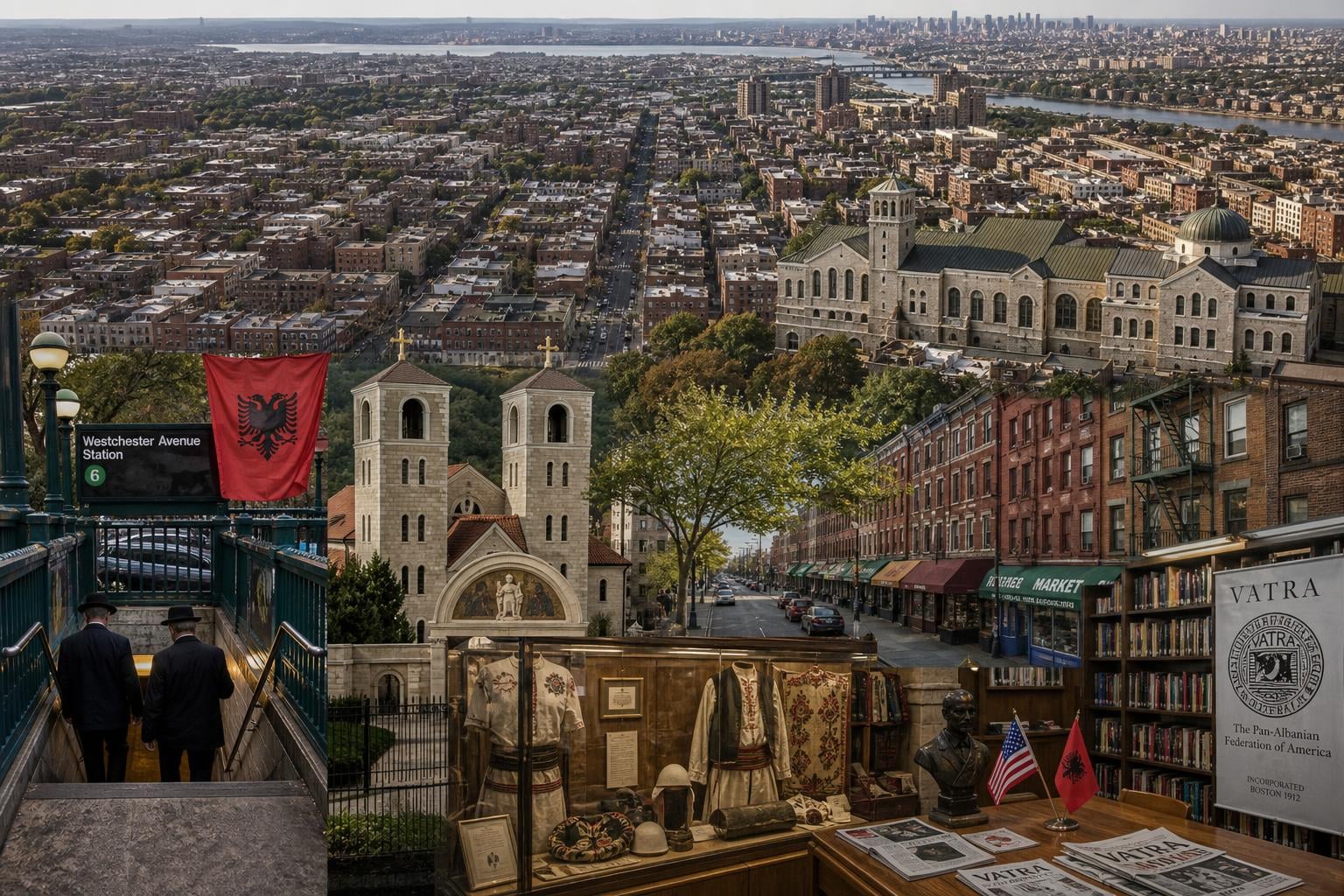
That borough is the Bronx. The corridor running from Belmont and Arthur Avenue east and north through Pelham Parkway, Morris Park, Bronxdale, and out toward Pelham Bay and Throggs Neck is the most concentrated Albanian-American residential and commercial belt in the country. The shqiptar (the Albanian self-name) presence has shaped that stretch of the borough for more than two generations, and the institutions on the ground — the Catholic parish, the Sunni xhami (mosque), the bakery counter, the soccer club, the kafe (coffee shop) — sit within walking distance of one another in a way that doesn’t repeat anywhere else in the country.
This piece is a community-information map of that geography. It covers how the cluster formed, which neighborhoods anchor it, where the religious and cultural institutions sit, what the food map looks like by category, and how the Bronx fits into the broader Albanian-American story. It is written for three readers: the Bronx Albanian who already lives the map every day, the out-of-state Albanian American researching where the community actually concentrates, and the neighbor who has wondered why so many storefronts on Arthur Avenue carry the double-headed eagle.
Why the Bronx? A short demographic history
Albanian arrival in the United States runs in distinct waves. The earliest movement — small numbers from southern Albania and the Ottoman vilayets — settled in industrial New England, especially around Boston and Worcester, in the years before and after the 1912 declaration of independence (Wikipedia: Albanian Americans). New York’s Albanian presence in that period was modest. The Bronx itself had only a handful of Albanian households before World War II.
The visible Bronx community took shape later. From the late 1960s onward, families left Yugoslav-controlled Kosovo, North Macedonia, and Montenegro under sustained political and economic pressure. Most of those families spoke Gheg, the northern Albanian dialect, and most arrived through New York. The Bronx had what they needed: family-sized rental apartments in solid pre-war buildings, working-class wages in construction and food service, and an Italian-American neighborhood in Belmont that was already absorbing newcomers. Albanian families moved in, often a few buildings at a time, and the corridor began to thicken.
A second wave came after 1991, when post-communist Albania opened its borders. New York pulled a large share of that movement, and the Bronx absorbed the bulk of it. A third surge followed the 1999 Kosovo war, when refugee resettlement programs placed Kosovar families with relatives who were already in the borough.
The result is a population layered by region and generation. A typical Bronx Albanian block today holds families with roots in Pejë, Tetovë, Tropojë, Shkodër, Tirana, Korçë, and Ulqin, often in the same building. The 2024 ACS figure of roughly 56,000 Albanians statewide is a floor, not a ceiling — community organizations, parish rolls, and the visible commercial footprint suggest the real Bronx-anchored metro count is closer to 100,000 once ancestry questions, intermarriage, and ethnic Albanians from outside the Republic of Albania are counted in.
The neighborhoods: Belmont, Morris Park, Pelham Parkway, and beyond
The Bronx Albanian map is not a single neighborhood. It is a continuous corridor of about three square miles, with denser and thinner pockets along the way. The names that matter:
Belmont sits between Fordham Road to the north, Crotona Park to the south, the Bronx Zoo to the east, and the Grand Concourse to the west. Most outsiders know it by its commercial spine, Arthur Avenue, the Italian-American food district that has anchored the neighborhood since the 1890s (Wikipedia: Belmont, Bronx). The Albanian community moved into Belmont alongside the Italian one from the 1970s, and the two have shared the strip for two generations. Italian salumeria on one corner, Albanian-owned grocery on the next, century-old Italian bakery doing wedding cakes for both communities — that is what Belmont looks like in 2026.
Pelham Parkway, just northeast of Belmont, is the residential heart. The neighborhood is bordered roughly by Bronx Park East to the west, Williamsbridge Road to the east, and the parkway itself running through the middle. The housing stock — pre-war six-story buildings on the parkway, two-family rowhouses on the side streets — is sized for the multi-generational Albanian household that remains common in first- and 1.5-generation families.
Morris Park extends the corridor south and east. The neighborhood has its own Albanian residential cluster plus PS 105, the elementary school that became one of the first NYC public schools to offer Albanian-language instruction in the late 2010s — a small program with outsized symbolic weight.
Bronxdale, immediately south of Pelham Parkway, holds a layered Albanian and Latino population with Albanian-owned auto shops and small contractors along White Plains Road. Westchester Square, further south and east, has been an Albanian residential outlet since the 2000s, particularly for families moving out of denser Pelham Parkway blocks. Pelham Bay and Throggs Neck, at the borough’s eastern edge, hold a smaller but established Albanian community oriented toward single-family homes and the marine-edge neighborhoods around the bay.
West of Belmont the footprint thins. Bedford Park and the corridor around Fordham Road carry Albanian-owned bodegas, pizza shops, building-trade firms, and supering operations across a neighborhood that is now majority Latino and West African. Many of the building supers, managing agents, and small contractors along the Grand Concourse are Albanian — a piece of the borough’s Albanian economic map that does not always read from the street.
Churches, mosques, and tekkes in the borough
The Bronx Albanian community is religiously plural, and the institutional map reflects it. The 19th-century slogan from Pashko Vasa — “the religion of the Albanian is Albanianism” — was a political line, not a description of household practice. Plenty of Bronx Albanian families are devout Catholic, devout Sunni, devout Orthodox, or devout Bektashi. What the slogan still captures is that, at the community level, denomination rarely decides who counts as family.
Albanian Catholic. Kishe (church) life in the Bronx Albanian community centers on Our Lady of Shkodra, founded in 1969 and widely treated as the largest Albanian Catholic parish in the United States. Its main campus sits just over the city line in Hartsdale, Westchester, but its congregation pulls heavily from Bronx Albanian Catholic families and the parish functions as the spiritual seat of Albanian Catholicism for the metro. It runs Albanian-language Mass, a Saturday school, and a feast-day calendar tied to northern Albanian Catholic tradition. Smaller Albanian Catholic communities meet at parishes across the Bronx, Yonkers, and lower Westchester.
Albanian Sunni Muslim. The Bronx hosts the long-established Sunni Albanian xhami serving the Belmont and Pelham Parkway corridor. Friday xhumaja (Friday prayer) is delivered in Albanian with English translation at most New York Albanian centers. Second- and third-generation congregations are increasingly bilingual or English-first. Several smaller Sunni prayer rooms operate independently across the borough, often anchored by families from a particular region of Kosovo or western North Macedonia.
Albanian Orthodox. The Albanian Orthodox community in New York is smaller than Boston’s and is served regionally by the Albanian Orthodox Archdiocese in America, headquartered at St. George Cathedral in South Boston (Wikipedia: Albanian Orthodox Archdiocese in America). Bronx Orthodox Albanians often attend pan-Orthodox parishes for proximity and gather as Albanians at archdiocese events.
Bektashi. A Bektashi Sufi teqe (lodge) presence exists in the New York metro, smaller than the Detroit-area network anchored by the First Albanian Bektashi Tekke in Taylor, Michigan (Wikipedia: Bektashi Order). The Bektashi tradition operates with its own clerical hierarchy — baba, dervish, kryegjysh — separate from Sunni mosque structures.
A Bronx wedding will routinely pull Catholic, Sunni, Orthodox, and Bektashi family members to the same hall without anyone needing to explain it. That pattern is the everyday version of the Vasa line, and it holds.
Cultural centers and organizations
The Bronx Albanian institutional layer extends past religious congregations. A network of cultural centers, civic associations, sports clubs, and language schools runs alongside the parishes and mosques.
The Albanian American Cultural Center model — covered in more detail in our profile of the organization — is the umbrella for several Bronx and Westchester centers that host language classes, folk dance ensembles, music groups, lecture series, and the major community holidays. Programming typically centers on 28 Nëntori (Albanian Independence Day, November 28), Dita e Flamurit (Flag Day, the same date), and the spring Dita e Verës festival, plus religious calendar events. These centers function as the secular meeting ground that the parish and the mosque can’t fully cover on their own — non-denominational, multi-generational, and open to the spectrum of Albanian families in the borough.
Civic associations operate at several scales. National-level organizations with strong Bronx membership — chambers of commerce, professional associations, advocacy bodies oriented toward Albanian and Kosovar issues in Washington — overlap with neighborhood-level groups organized around a particular region of origin (the Has, Tropoja, Dukagjini, Tetovo, and other regional associations are common). Soccer clubs, especially youth leagues affiliated with broader New York metro Albanian leagues, run programming out of Bronx parks and gym facilities through most of the year.
Language sustainability is a structural concern across all of these institutions. The Bronx variety of Albanian spoken at home is overwhelmingly Gheg — the northern dialect that covers Kosovo, North Macedonia, Montenegro, and northern Albania proper. Standard literary Albanian, finalized in 1972 and based mostly on Tosk (the southern dialect), is the form taught in schools and used in writing. Most Bronx Albanian families code-switch between Gheg at home and standard Albanian or English in school and work. Saturday schools at parishes, mosques, and cultural centers carry the bulk of the language instruction outside the home; the PS 105 program in Morris Park is the public-school exception.
The Albanian-American funeral home network in the Bronx and Yonkers — a small handful of family-run businesses — is the third institutional pillar that doesn’t get talked about but does the load-bearing work of holding a community together across generations and denominations.
The food map of the Bronx
The Bronx Albanian food map runs in three layers. We won’t list specific restaurants here — the dedicated guide at Albanian Restaurants in NYC covers names, addresses, and what to order. What’s worth describing is the shape of the map, because it tracks the borough’s Albanian footprint directly.
Layer one: the Belmont commercial spine. Within a four-block walk of East 187th Street and Arthur Avenue sits the densest cluster of Albanian-owned full-service restaurants in the United States. Most are run by Kosovar-Albanian families and most opened over the past two decades, layered onto a strip that was Italian-American for a century before. The menus lean toward grilled meats — qebapa (small grilled veal-and-beef sausages), shish (skewered grilled meat), tavë kosi (baked lamb with yogurt) — and shared meze plates with ajvar (roasted red-pepper relish), kajmak (clotted-cream cheese), suxhuk sausage, and warm bread. New York Times recognition for several of these rooms in 2023 and 2024 brought outside attention to a corridor that had been hiding in plain sight for a generation.
Layer two: the byrek and bakery counters of Pelham Parkway and Morris Park. Walk Lydig Avenue or Williamsbridge Road on a weekday and you find the everyday food map — byrek (Albanian filo pastry) by the slice for breakfast, strong coffee, lamb shawarma counters with Albanian ownership, small bakeries that supply the neighborhood. These are not destination dining rooms; they are the daily infrastructure that a residential community runs on, and they’re concentrated where the families live.
Layer three: the Arthur Avenue overlap. A substantial share of the Italian-American restaurants and bakeries on Arthur Avenue have Albanian owners, Albanian kitchen staff, or both. The menus stay Italian, but the family running the place is increasingly Albanian. This overlap runs out beyond the borough as well — a meaningful share of New York City pizza shops and Italian-American restaurants in the five boroughs are Albanian-owned, a pattern the Wikipedia entry on the New York Albanian community notes directly (Wikipedia: Albanians in New York City).
The kafe deserves its own mention. The Albanian coffee shop, especially in Belmont and Pelham Parkway, is the social unit men over 50 build their afternoons around. Strong coffee, no rush, the soccer match from Tirana or Prishtina on the TV, the same table that takes shifts through the day. These rooms function the way a kafeneja in the home country would, and they are quietly the most stable part of the Bronx Albanian commercial map.
Generations: from 1960s arrivals to today
The Bronx Albanian community in 2026 holds three generations in active relationship with one another, plus a fourth that is starting to appear. Each generation came in under different conditions, and each carries a different relationship to the borough, the language, and the home country.
The first generation arrived between roughly 1965 and 1985 from Kosovo, North Macedonia, and Montenegro. Many were young men who came alone, took construction or food-service jobs, lived in shared apartments in Belmont or Fordham, sent money home, and eventually brought wives and families over. These households built the institutional layer — the parishes, the early xhamis, the Saturday schools, the first wave of Albanian-owned businesses. The generation now skews into its 70s and 80s. A meaningful share remains in the borough; others moved to Yonkers and lower Westchester as their families grew.
The second generation — the children of those first arrivals — grew up bilingual in 1980s and 1990s Pelham Parkway, Morris Park, and Bedford Park. They went to Bronx and Westchester schools, watched their parents work multiple jobs, and largely entered the building trades, food service, real estate, and small business through their families. A subset went into the professions — law, medicine, finance, education — and now anchors the metropolitan-area Albanian professional network. This generation is in its 40s and 50s, runs most of the businesses, and makes most of the institutional decisions.
The 1990s and post-1999 wave arrived as a parallel cohort. Families from post-communist Albania settled in the Bronx and Yonkers in the 1990s; Kosovar refugees and family-reunification arrivals followed after 1999. Children from these arrivals grew up alongside the second generation but with first-generation parents — a “1.5 generation” pattern that produced a distinct subset within the broader community, often with stronger Albanian-language retention than their American-born peers.
The third generation is now coming of age. These are grandchildren of the 1960s and 1970s arrivals — Bronx-born, often Westchester-raised, more likely to speak English at home than Albanian, more likely to identify as Albanian-American rather than Albanian. Their relationship to the home country is shaped by summer visits, weddings, and family obligation rather than direct memory. The question of how the community holds together as this generation forms families of its own is the central conversation inside Bronx Albanian institutions right now, and the answers are mostly being worked out through the Saturday schools, the cultural centers, and the parishes.
A fourth generation is starting to appear in households whose grandparents arrived in the 1960s. The shape of Bronx Albanian life for the second half of the 21st century will be set largely by what their parents decide about language, neighborhood, and institutional involvement.
How the Bronx fits into the national picture
The 2024 ACS counts roughly 224,000 Albanian Americans nationally, with the top three states New York (~56,000), Michigan (~27,000), and Massachusetts (~21,000). Community estimates that include ethnic Albanians from Kosovo, North Macedonia, and Montenegro, plus second- and third-generation US-born descendants, put the broader figure near one million. The Bronx sits at the center of that national map in three concrete ways.
First, density. No other U.S. county shows the combination of residential concentration and institutional depth that the Bronx-Westchester corridor does. Detroit-area Macomb and Oakland counties hold a comparable absolute count, especially when the Bektashi network and the Albanian Islamic Center in Harper Woods are added in, but the residential cluster is more dispersed. Boston’s Albanian community, anchored by the Orthodox Archdiocese and the older Korçë-origin households, has institutional depth but smaller current numbers. The Bronx is the one place where both density and depth sit on the same blocks.
Second, religious plurality. The Bronx is the U.S. setting where Catholic, Sunni, Orthodox, and Bektashi Albanians all live within driving distance of one another and routinely share family, business, and social space. Detroit’s community is heavily Sunni and Bektashi; Boston’s is heavily Orthodox; the smaller Texas, Florida, and California clusters skew toward post-1991 Albania-born families with mixed denominational backgrounds. The Bronx is the one borough where the full denominational spectrum is institutionally present and active.
Third, the regional-origin mix. The Bronx pulls families from every major Albanian region — northern Albania, southern Albania, Kosovo (including Has, Dukagjin, Drenica, and the Llap valley), North Macedonia (especially Tetovo, Gostivar, Kičevo, and the Polog region), Montenegro (Ulqin/Ulcinj, Plav, and Gusinje), the southern Çamëria diaspora, and Arbëreshë descendants from southern Italy. Other U.S. clusters skew toward one or two of these regions. The Bronx holds them all.
That combination — density, plurality, regional mix — is why the borough functions as the de facto national center of Albanian-American life, even though the formal national organizations are spread across several states. A national meeting of Albanian-American Catholic clergy, Sunni imams, Bektashi baballarë, civic association leaders, or cultural center directors will, more often than not, be held in or near the Bronx. The borough has become the place where the diaspora talks to itself.
The other side of that is what the count misses. The ACS ancestry question captures self-reported ancestry one person at a time, which means it undercounts ethnic Albanians who identify with their country of origin rather than with Albanian ancestry — a Kosovar who answers “Kosovar” rather than “Albanian,” a Macedonian Albanian who answers “Macedonian,” a third-generation Bronx grandchild who answers “American.” Closing that gap is part of why community-led counts like the National Albanian Registry exist alongside the Census. The Bronx number is real and it is also a floor.