
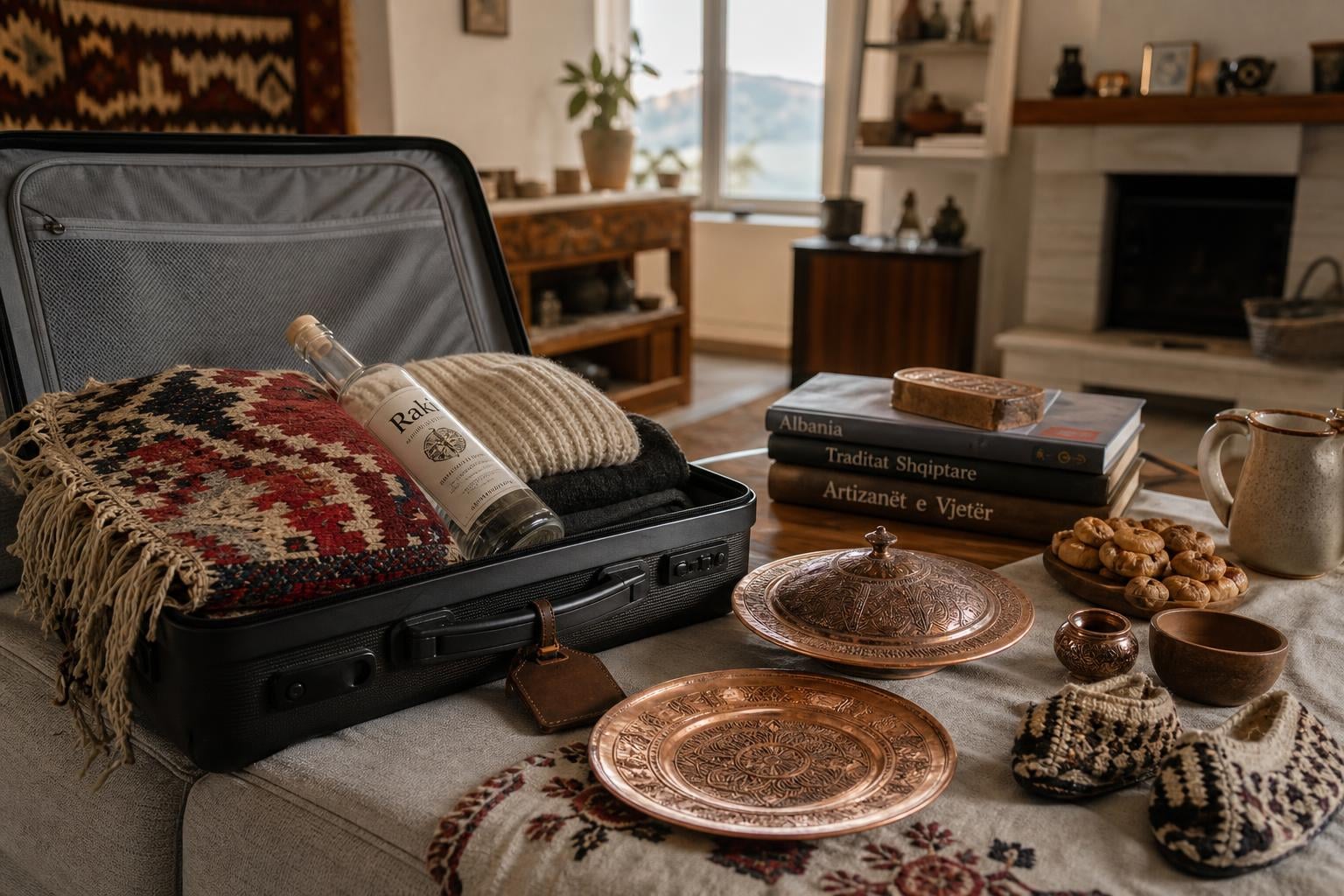
A real Albanian souvenir is not a fridge magnet from the airport. It is a kilim folded into a checked bag, a bottle of raki (Albanian fruit brandy) packed between sweaters, a copper plate hammered by a man whose grandfather did the same job in the same shop in Krujë. The diaspora visitor going back to Albania — or sending a care package to a cousin in Detroit — has a different shopping list than a weekend tourist. This guide is built for them.
This is not a tourism piece. It is a working diaspora reference for what to look for, where to find it, how much to expect to pay, and what US Customs and Border Protection will let you carry through the airport on the way home. The frame is practical: Albanian Americans visiting Tirana, Shkodër, Krujë, Korçë, or Gjakova for the first time in years; second-generation children returning from a grandparent’s funeral with a suitcase to fill; parents in Yonkers or Hamtramck asking what to put in the next box headed across the Atlantic.
We cover the categories that matter — handcrafted textiles, copper and woodwork, ceramics, musical instruments, food and drink, books and music, traditional clothing, and religious items — then walk through where to buy authentic work versus mass-produced tourist goods, and the customs rules that decide what actually makes it through JFK.
Handcrafted textiles: kilims and embroidery
The qilim (Albanian flat-woven wool rug, part of the broader kilim family) is the textile most worth bringing home. Hand-woven on horizontal looms by women across rural Albania and Kosovo, qilim patterns vary by region — geometric in the highlands, more floral and Ottoman-influenced in the south and in Kosovar towns like Gjakova and Prizren. A good qilim outlasts the person who buys it.
Sizes range from prayer-mat-scale pieces (roughly 60 by 90 cm) to room-sized rugs. Small pieces run 50 to 80 dollars in the Krujë bazaar; mid-size hand-woven rugs from named workshops in Korçë or Gjakova run 200 to 500 dollars; a serious room-sized rug from an older weaver can run well above 1,000 dollars. Cheap machine-made “kilims” stamped abroad show up in tourist stalls at suspiciously low prices — the giveaway is uniformly perfect knots and a synthetic backing.
Embroidered linens are the second textile category. Cushion covers, pillowcases, tablecloths, and runners with traditional Albanian motifs — the double-headed eagle, stylized florals, geometric border patterns — are widely available and travel flat. A woman’s paja (trousseau) traditionally included embroidered pieces she had made herself; that craft survives in cooperatives and family workshops, especially in the north and in Kosovo. Ask who made the piece; the strongest souvenirs come with provenance — the weaver’s village, the cooperative’s name, the year.
Copper, wood, silver, and ceramics from the Krujë bazaar
Krujë, the small mountain town north of Tirana that served as the seat of the 15th-century Albanian hero Skanderbeg, has the country’s best-known craft bazaar. The Old Bazaar — Pazari i Vjetër — runs along the cobblestone street leading up to Skanderbeg’s castle and concentrates Albania’s traditional crafts in one walkable strip. Copperware, woodcarving, kilims, ceramics, and folk-craft items dominate the stalls. The atmosphere is touristy, but the quality at the better shops is real.
Copperwork (bakri) is the bazaar’s signature. Hand-hammered copper trays, xhezve (long-handled coffee pots for Turkish-style coffee), wall plates, lamps, and the deep copper pans used for making byrek (savory filled pastry) are stacked in shop after shop. Prices for a good xhezve start around 800 to 1,500 lek (roughly 8 to 15 dollars); a large engraved tray runs 3,000 to 10,000 lek (30 to 100 dollars) depending on size and detail.
Woodcarving — particularly from Shkodër, Krujë, and the highlands — covers walking sticks, carved chests, picture frames, chess sets, and decorative boxes. The traditional motif is the double-headed eagle, often paired with stylized highland scenes. Olive-wood items from southern Albania are a separate category and travel well as smaller gifts: bowls, spoons, cutting boards, and rosaries.
Silver — argjend — is the third category, and the strongest pieces come from Kosovo. Filigree silver (filigran), historically associated with workshops in Prizren and Gjakova, is intricate, lightweight, and lands cleanly in a suitcase. Small filigree pendants and earrings with the double-headed eagle or floral motifs start around 25 to 60 dollars; larger brooches and necklaces climb from there. Filigree reads as distinctively Albanian rather than generic Balkan — one of the few craft signatures the diaspora consistently recognizes.
Ceramics round out the bazaar. Korçë and Berat have produced glazed pottery for centuries; Vlora and the coast lean toward terracotta. Smaller pieces — espresso cups, small bowls, painted tiles — are the practical diaspora category. They double as gifts and they fit between layers of clothing. Larger pieces travel poorly; pack them in the middle of a checked bag wrapped in clothes and accept that some breakage is part of the deal.
Music: çifteli, lahuta, and folk recordings
Two traditional instruments are worth knowing about. The çifteli (a long-necked two-string lute) is the iconic instrument of northern Albanian and Kosovar folk music — used to accompany epic ballads, wedding songs, and the polyphonic vocal traditions of the highlands. A handcrafted çifteli runs roughly 80 to 250 dollars depending on the maker and the woodwork, and they pack flat in a soft case.
The lahuta (a one-string bowed instrument, sometimes called the Albanian gusle) is the older companion — the instrument of the rapsodët, the bards who sang the cycle of Albanian and Kosovar epic poetry, including the songs of Mujo and Halil. A lahuta is more cultural artifact than working instrument for most buyers, but a well-carved one is a serious gift for a heritage collector.
Albanian folk music on physical CD or vinyl is genuinely hard to find in the US — most diaspora listening has moved to YouTube and Spotify, where the catalog is incomplete. Bookstores in Tirana and Pristina carry CDs of iso-polyphony (the southern Albanian multi-voice tradition UNESCO proclaimed a Masterpiece of Intangible Cultural Heritage in 2005 and inscribed on its Representative List in 2008), Kosovo wedding music, çifteli ballads, and Albanian classical and contemporary recordings. For a grandparent who left before streaming, a stack of physical CDs of music from their region is the gift that lands hardest.
Food and drink worth packing
This is where the diaspora packing list narrows hardest, because US customs sets real limits.
Raki, the Albanian fruit brandy, is the category most worth packing. Bottles from Skrapar, Përmet, and Berat are the most celebrated grape rakis (raki rrushi), and Skrapari ships commercial bottlings into the US diaspora supply. A bottle of branded raki runs 800 to 2,500 lek (8 to 25 dollars). Homemade village raki from a known relative is often stronger and tastier than the commercial product, but it travels at your own risk — see the customs section below.
Mountain tea (çaj mali, Sideritis raeseri) is the second packing-essential — the herbal tea of the Albanian and Balkan highlands, brewed long and strong as a daily winter drink. It is genuinely hard to find in the US outside of Albanian and Greek groceries. A bag from a mountain market costs almost nothing and packs flat. Jufka — hand-cut Albanian pasta — is the third. Dried, vacuum-packed jufka lasts months and gives a diaspora kitchen access to a texture that does not exist in American supermarkets. Byrek dough mixes and pre-rolled phyllo fall in the same category.
Mountain honey labeled by region (Tropojë, Has, Korçë), good southern olive oil from a named producer, walnuts, dried figs, and pickled vegetables — turshi — are all worth packing in modest quantities. Albanian dried herbs and spice blends translate directly into diaspora kitchens.
What does not pack well: fresh meats and fresh dairy. Sallam i Tiranës (Tirana salami), suxhuk, and other cured meats are flatly prohibited by US Department of Agriculture rules. Fresh and soft cheeses, including most djathë i bardhë (Albanian white brined cheese), are usually restricted. We cover the customs detail in its own section below.
Traditional clothing: qeleshe, opinga, and embroidered pieces
The qeleshe (white felt cap, also called the plis in much of the north) is the most recognizable piece of Albanian traditional clothing. Hand-beaten from undyed sheep’s wool, a real qeleshe is fitted to a specific head and lasts decades. Quality pieces run 2,000 to 6,000 lek (roughly 20 to 60 dollars). The cap is the right gift for a father, grandfather, or godfather, and a growing number of younger Albanian Americans wear one at weddings and Flag Day events.
Opinga — the traditional Albanian leather sandals with the upturned toe and woven thongs — are mostly ceremonial today but still made in small quantities for folk-dance ensembles and weddings. A pair runs roughly 1,500 to 4,000 lek.
Embroidered shirts, vests (xhamadan), and the woven sash (brez) round out the wearable category. Full traditional women’s costumes — including the bell-shaped xhubleta of the northern highlands, which UNESCO inscribed on its urgent-safeguarding list in 2022 — are rare, expensive, and often borrowed rather than owned. For a wedding or Flag Day gift, a hand-knit pair of çorape (heavy patterned wool socks from the highlands) is an underrated category: cheap, packable, and carrying serious regional identity in their patterns.
Books, art, prints, and religious items
Books in Albanian are one of the highest-value souvenirs for the diaspora and one of the lowest-cost. The major bookstores in Tirana — Bukinist, Adrion, and the independent shops along Rruga e Durrësit — carry the standard Albanian canon: Ismail Kadare, Migjeni, Naim Frashëri, Fan Noli’s translations, and contemporary Albanian and Kosovar authors. A handsome hardback Kadare runs 1,500 to 3,000 lek (15 to 30 dollars). Bilingual editions matter for diaspora households. Children’s books in Albanian are genuinely scarce in the US and very cheap to buy in Tirana.
Art and prints. Reproductions of Onufri’s 16th-century Orthodox icons (the master iconographer of Berat, whose panels live in the Onufri Museum inside Berat’s castle), prints of Kolë Idromeno’s Dasma Shkodrane (his canonical painting of a Shkodër wedding procession), and photography books from the Marubi National Museum of Photography in Shkodër all make excellent gifts. Framed antique-map reproductions sell for 20 to 60 dollars.
Religious craft splits by tradition. Orthodox icons hand-painted on wood in workshops in Berat, Korçë, and around Tirana are the most distinctive category — small pieces (15 by 20 cm) run 30 to 100 dollars. Catholic items — rosaries, small crosses, religious medals — concentrate around Shkodër and the northern highlands. Muslim items including prayer beads (tespih), small Qur’ans, and calligraphy are sold near the Ottoman-era mosques in Tirana, Shkodër, Berat, and Krujë. Bektashi households sometimes buy from the Bektashi World Center in Tirana. Religious gifts are best matched to the receiver’s tradition; when in doubt, secular Albanian craft is the safer category.
A smaller modern category is worth knowing. Tirana’s Pazari i Ri area and the Blloku district host design shops carrying Albanian-made leather bags, jewelry with abstracted folk motifs, and ceramics by working Albanian artists. Prices match Western European design rather than craft-market rates, but the pieces signal a confident contemporary Albania rather than a frozen folk one.
Authentic versus tourist-grade: where to buy
Three rules separate the real from the tourist-grade. First, buy from named makers — a shop that can tell you the artisan’s name, village, and workshop is selling provenance; a stall with “traditional Albanian” stamped across identical objects is not. The Old Bazaar in Krujë has both: the best shops are run by craftsmen who work in the back; the worst are import resellers in the middle of the strip.
Second, use the bazaars as a starting point, not a finish line. Krujë’s Pazari i Vjetër is the most concentrated craft market in the country. Tirana’s Pazari i Ri, in the eastern half of the center, mixes food, antiques, and crafts in a more contemporary setting. For the strongest work, named workshops sit elsewhere — copper in Shkodër, weaving cooperatives in the highlands and in Gjakova, ceramics around Korçë, filigree silver in Prizren.
Third, commission through family when possible. The single strongest move for a diaspora visitor is asking a relative to commission a piece directly from a known artisan — a qeleshe for a wedding, a qilim for a couple setting up a home, a filigree pendant for a goddaughter. Prices are fair, the maker is paid in full, and the object carries provenance the receiver can verify. For diaspora readers shopping from the US without a trip, several Albanian-American businesses in the New York metro, suburban Detroit, Boston, and Worcester import directly from artisans. They charge more than direct-from-Albania prices, but they are reliable for last-minute weddings and holiday gifts.
What US customs lets you bring back
This is the part most travel guides skip and most diaspora travelers learn the hard way at JFK. The rules are managed by US Customs and Border Protection and, for agricultural products, by the US Department of Agriculture’s Animal and Plant Health Inspection Service.
Alcohol. Travelers aged 21 and older can bring one liter of alcohol duty-free for personal use. Additional bottles are allowed but subject to federal duty and excise tax and to the destination state’s rules — some states cap personal imports more strictly than the federal rule. Pack bottles in checked baggage, wrap them in clothing, and keep receipts.
Cheese and dairy. Hard, aged cheeses are usually allowed; soft, fresh, or unpasteurized cheeses are usually restricted. Albanian white brined cheese (djathë i bardhë) and gjizë (fresh whey cheese) frequently fall on the restricted side because of moisture and pasteurization. Always declare dairy on your CBP customs declaration form.
Meat and meat products. Almost all meats from Albania — fresh, dried, cured, or canned — are prohibited under USDA rules because Albania is not on the approved list for those products. That includes sallam i Tiranës, suxhuk, pastërma, and dried lamb. Do not pack them. Detection is routine and the penalty is confiscation plus a possible civil fine.
Produce, honey, tobacco. Fresh fruit, vegetables, and most seeds are restricted or prohibited. Dried herbs, packaged spice mixes, and clean dried teas like çaj mali are generally allowed but should be declared. Honey is generally allowed if commercially packaged and properly labeled. Tobacco: up to 100 cigars and 200 cigarettes per adult duty-free.
Antiques and cultural property. Items presented as antiques or archaeological pieces require export documentation from the Albanian Ministry of Culture. Without it, US customs can seize the item and the seller can be in real legal trouble back home. Do not buy “ancient” coins, fragments, or “antique” icons from anyone who cannot produce export paperwork.
Declare everything on the customs form. Honesty is faster than the alternative.
The diaspora care package
A separate category for the reader who is not traveling but is mailing a box. The care package is a quiet feature of diaspora life — boxes shipped between Albania and the US carry the small objects that hold the relationship together between visits.
What travels from Albania to the US in a care package: çaj mali, jufka, dried herbs, vacuum-packed coffee, books in Albanian, recordings on CD, hand-knit çorape, small filigree pieces, framed icons, and family photos. Raki is subject to commercial-shipping alcohol rules and is generally not viable through standard mail. What travels from the US back to Albania is a separate list — American-branded sneakers, vitamins, baby formula, tools, electronics, designer beauty products, and cash in envelopes. We cover the back-channel in detail in our Albanian gifts guide.
For diaspora readers in the US trying to source Albanian goods locally without traveling, the channels are: Albanian-American groceries in New York, New Jersey, Connecticut, Massachusetts, Michigan, and parts of Texas; diaspora-run online shops that import directly from artisans; and family networks that ship within personal-use limits. The strongest move is usually a combination — a relative ships the çaj mali, the local Albanian grocery covers the cheese and bread, and one annual return trip restocks the kilim and the qeleshe.
The diaspora keeps itself together in objects. A qilim on a Worcester living-room floor, a bottle of Skrapari raki on a Hamtramck kitchen counter, a qeleshe in a Yonkers closet pulled out for Flag Day — these are the small physical proofs that the connection between Albania and the US has not been put down. NAR exists so that the people behind those objects can be counted, named, and connected across state lines and generations. Whatever you bring back, get counted at /register so the next generation can finally see the full shape of the community their parents never had counted.