

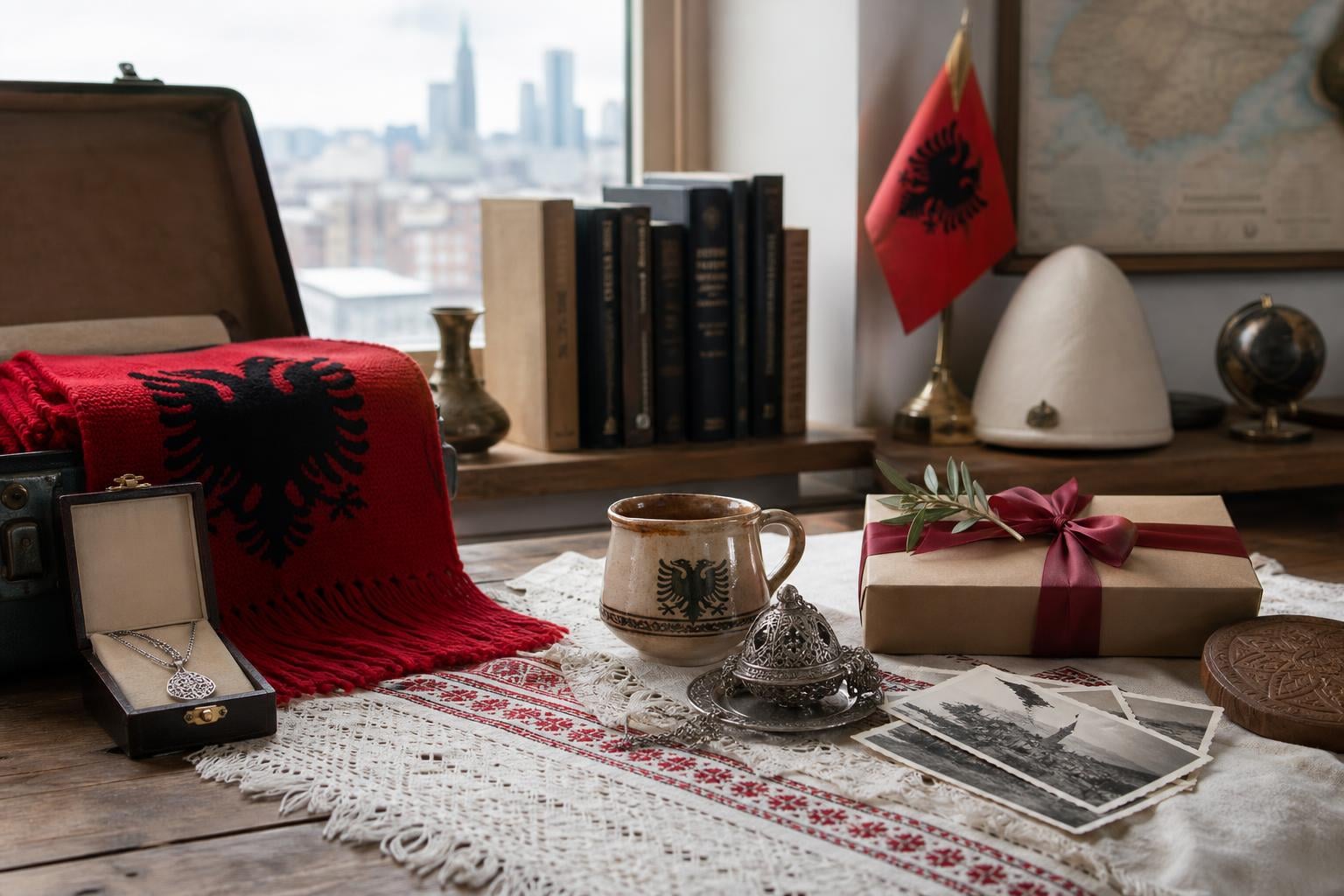
A gift in Albanian culture is not a small thing. The smallest kafe visit between neighbors carries a tray of pastries on the way over and an obligation to return the favor on the way back. A wedding generates envelopes thick with cash, gold chains for the bride, and weeks of planning around who owes whom. A new baby pulls in jewelry, embroidered linens, and a circle of women who have seen this exact moment in their own families.
For a US-based Albanian American, the harder question is rarely whether to bring a gift. The hard part is matching it — to the right occasion, the right person, the right side of the family — without looking like someone who has lost the thread.
This guide is for the diaspora reader trying to do that well. It covers the customs around visit gifts, weddings, births, and reciprocity; the role besa (the Albanian code of honor) plays underneath all of it; what tends to travel best in either direction across the Atlantic; and the categories of Albanian craft that hold up as actual gifts rather than tourist trinkets. It is written for the Albanian American in New York, Michigan, Massachusetts, Texas, or anywhere else in the US who wants the gift to land — whether the receiver is a cousin in Tirana or a college roommate’s mother in Yonkers.
Gift-giving is downstream of hospitality
To understand Albanian gifting, start with the Albanian guest. Albanian culture is unusual in the degree to which hospitality is treated as a near-sacred obligation rather than a polite default. The home is structured around the guest. Coffee appears within minutes. A second course shows up uninvited. Refusing food too firmly is rude; accepting all of it is impossible.
A gift slots into this system as the guest’s half of the exchange. The host gives shelter, food, time, attention. The guest gives a small object that acknowledges the host’s generosity and signals an intention to remain in relationship.
The object does not have to be valuable. It does have to be seen — wrapped properly, presented at the door, mentioned by name when handed over. Showing up empty-handed in an Albanian home, especially for a first visit, registers as a small insult that polite people will absorb and quietly remember.
This logic carries directly into diaspora life. Albanian-American households in Detroit, the Bronx, Worcester, and Houston still expect the visitor to arrive with something — a tray of pastries from the Albanian bakery, a box of Lindt, a bottle of cognac for an older host, flowers for the woman who runs the house. The form has loosened in two generations; the underlying expectation has not.
The corollary matters too. Hosts in the US still send guests home with food, often a wrapped plate of whatever was served plus extras from the kitchen. Refusing the plate misreads the moment. The take-home is part of the exchange; the visitor’s job is to accept it gracefully and reciprocate within a reasonable window.
Besa, honor, and the weight of a given object
A gift in Albanian culture moves inside a much older framework than modern gift-giving etiquette. That framework is besa — the code of honor that obligates a person to keep their given word, defend their guest, and remember their debts. Besa is sometimes translated as “faith” or “pledge,” but neither captures the binding force it has historically carried in Albanian life.
A gift, in this frame, is not a transaction. It is a small piece of besa — a quiet pledge that the giver acknowledges the relationship, owes the receiver something, and intends to remain in the receiver’s life. Albanians of older generations rarely articulate this directly. They simply act as though every gift has weight.
That is why the cheap-looking gift can land harder than the expensive one when the framing is off. A flashy item with a visible price tag can imply the giver is settling a debt rather than honoring a relationship. A modest gift — a jar of homemade fig preserves, a hand-embroidered handkerchief, a book inscribed by hand — carries the opposite signal. The thought is the currency. The object is the receipt.
For diaspora Albanian Americans, this is the part that translates least well into mainstream US gift culture, where the Amazon gift card has become an acceptable everyday currency. Among Albanian relatives — particularly first-generation parents, aunts, uncles, and the older folks back home — a gift card to a chain store can read as effortless in the wrong way. The same dollar amount delivered as cash inside a card, or spent on a thought-through object, lands very differently.
Reciprocity is the other half. A gift received generates an obligation to give back, eventually, in some form. Albanians keep a quiet ledger. Forgetting that ledger is not a moral failure; ignoring it on purpose is.
Visit gifts: pastries, raki, flowers, and the rules around them
The first-visit gift to an Albanian household is the most predictable category and the easiest to get wrong by under-thinking. The default categories work in this rough order:
Sweets travel best. A tray of byrek from the Albanian bakery, a box of kadaif or baklava, a quality chocolate selection, a sleeve of Italian biscotti. Anything that can be put out for guests immediately and shared while the coffee is brewing. The host’s job becomes easy; the gift integrates into the visit.
Drinks come next. A bottle of raki — the Albanian fruit brandy — is an unimpeachable gift for a host who drinks, and southern Albanian raki tends to be especially well regarded. Wine works for most households. Cognac is a respected gift for older men. Coffee — good Turkish-style coffee or Italian espresso — works across the board.
Flowers are appropriate for the woman of the house, particularly on a first visit or on a name-day. Avoid lilies in some Catholic households where they read as funeral flowers. Otherwise, a respectable arrangement signals care.
Small specialty items round out the category. Quality olive oil, a jar of mountain honey from a known source, imported Italian sweets, a tin of butter cookies. Anything edible, modestly packaged, and recognizable as having been chosen rather than grabbed.
What does not travel well: items that imply the host needs help, anything religious that crosses traditions (avoid pork products and alcohol gifts to observant Muslim hosts), and overtly branded American chain-store packaging that reads as careless.
The general guideline among older Albanian Americans is simple: when unsure, bring sweets and flowers. Few Albanian households have ever resented either.
Wedding gifts: cash, gold, and the choreography of envelopes
Albanian weddings are the highest-stakes gifting event in the culture, and US-based Albanian-American weddings preserve the cash-forward model almost entirely. Two channels run in parallel: the registered gift list (mostly aspirational) and the envelope of cash that arrives with the guest.
Cash is the load-bearing gift. The amount generally scales with closeness: a modest, respectable sum for an adult guest who knows the family casually, more from close friends and extended family, and immediate family and wedding-party members typically giving substantially more. The numbers climb in larger metro markets, particularly the New York–New Jersey corridor and parts of Michigan, and they climb further at weddings hosted in upscale venues where the per-plate cost is visible.
The mechanics vary by region of origin and by family. Some families collect envelopes in a satin pouch passed during dance circles, where guests pin or insert cash directly onto the bride and groom during their dance. Others stick to a card-and-envelope format at a guestbook table. Either way, cash is the substance of the gift; the card is the wrapping.
Gold is the second channel. Gold jewelry — chains, bracelets, coins — is a traditional gift for the bride and remains common in Albanian-American weddings, particularly from immediate family. Pieces are often handed directly to the bride during the reception or pressed into her hands by older women. Quality matters; 18- and 22-karat pieces are the standard, not US-typical 14-karat.
For diaspora guests attending a wedding back in Albania, Kosovo, or North Macedonia, US dollars or euros in cash are universally welcome, and many guests choose to bring American items the couple has specifically asked for — kitchen electronics, baby gear if a child is on the way, branded sneakers or watches.
What to avoid: showing up to an Albanian wedding without an envelope, giving a cheap-feeling household item from a registry instead of cash, and forgetting that both sides of the family will note who gave what and remember it for the next family event.
Baby and birth gifts: timing, gold, and the avoidance of pre-birth gifts
Albanian birth-gift customs run on a quiet rule that surprises many American-born partners: gifts generally arrive after the baby is safely born, not before. Many Albanian families avoid baby showers in the American sense, and older Albanian women in particular tend to resist accepting baby items into the home while the mother is still pregnant. The reasoning blends folk superstition with a broader cultural reluctance to assume favorable outcomes ahead of time.
Once the baby arrives, the gift wave starts. Visitors come bearing gold — small gold coins, tiny bracelets, baby earrings for a girl, sometimes a gold-chain pendant with a religious symbol matching the family’s tradition. Cash in an envelope is also standard, especially from extended family who cannot visit in person.
The gold-coin tradition is worth highlighting for diaspora readers. A small 22-karat coin or a delicate bracelet is appropriate at most price points and reads as far more meaningful than a comparable American baby gift. Jewelers in Albanian neighborhoods in the New York metro, suburban Detroit, and the Worcester area carry these specifically.
Practical baby gear matters too — strollers, car seats, premium formula, baby clothes from American brands that are hard to source affordably in Albania. Diaspora relatives sending gifts to a newborn cousin overseas often include a mix: a gold piece for tradition, plus a box of practical American items that mean something specific in the Albanian context, where imported goods can be priced beyond reach.
A common diaspora practice is to delay any major baby gift until after a 40-day post-birth window in some Muslim and Orthodox traditions, or until the baptism in many Catholic households. Asking the family directly is always safe; older relatives expect the question and respect it.
What diaspora Albanian Americans gift back home
The flow of gifts from the US to Albania, Kosovo, and North Macedonia has been a quiet feature of diaspora life for decades, and it has its own logic. Most of what crosses the Atlantic in suitcases or shipping boxes falls into a few categories.
American-branded goods are the consistent winner. Name-brand sneakers — Nike, Jordan, New Balance — are far more expensive at retail in Albania than in the US and remain a prestige gift across generations. Tools, particularly American-made hand tools and power tools, are gifts older male relatives appreciate quietly. Quality vitamins and over-the-counter supplements travel reliably, especially fish oil, prenatal vitamins for relatives expecting children, and joint-support products for older parents.
Electronics — phones, tablets, laptops, headphones — are common but require thought, because newer models are increasingly available in Albania at competitive prices. The diaspora gift edge comes from configuration: a phone with a US carrier history, a laptop with a US keyboard layout if the receiver works in English, or a tablet preloaded with content for a niece or nephew.
Designer or premium beauty products — perfumes, skincare, cosmetics — make excellent gifts for women in the family. American department-store options are reliably welcomed, particularly anything that signals a brand the receiver has heard of but cannot easily access.
Cash, in envelopes, remains the gift that means the most. Older Albanian relatives almost universally prefer cash to objects. The reasoning is plain: the diaspora visitor cannot stay, and the cash converts into anything the receiver actually needs. For weddings, births, and major birthdays back home, an envelope with US dollars or euros is the most respected gift across every religious and regional Albanian tradition.
Avoid one common pitfall: gifts that read as condescending. Used clothes, expired pantry items, low-quality goods, and items that imply the receiver is poor are remembered. The diaspora gift should signal abundance and care, never charity.
Authentic Albanian-themed gifts that hold up
A separate question is what counts as a meaningful Albania-themed gift — items chosen specifically because they carry Albanian craft, heritage, or symbolism. These work well when gifting to second-generation Albanian Americans, non-Albanian friends marrying into the family, or relatives back home who want a piece of diaspora life that still feels rooted.
The qeleshe — the white felt cap worn by Albanian men — is one of the most recognizable craft items in Albanian traditional clothing. It is made by hand from compressed wool felt and shaped to fit the wearer; regional variations differ in height and silhouette across the Albanian-speaking lands. A well-made qeleshe is a serious gift for a father, grandfather, or godfather, particularly at milestone events — and is increasingly worn by younger Albanian Americans at weddings and cultural gatherings.
Qilim — flat-woven wool rugs in the kilim family, with patterns specific to Albanian and Kosovar weaving traditions — make exceptional gifts for couples setting up a home. Sizes range from small prayer-mat-scale pieces to room-sized rugs. Authentic pieces command real prices, and that is the point: a qilim is the kind of gift that gets displayed and remembered.
Filigree silver — filigran — is the signature jewelry craft of Kosovo and northern Albania, particularly the workshops historically concentrated around Prizren. Filigree pendants, earrings, rings, and brooches with the double-headed eagle motif or floral patterns travel well as gifts for women across generations. The craft is intricate, the price points are accessible at the small-piece level, and the symbolism reads cleanly as Albanian rather than generic Balkan.
Raki, honey, and edible heritage rounds out the category. Bottled raki from southern Albania, mountain honey labeled with its region of origin, mountain tea (çaj mali), and quality Albanian olive oil all make appropriate gifts that show the giver has paid attention. Avoid gas-station-grade unlabeled raki; gift-quality raki should look like a gift.
Books in Albanian are an underrated category for the diaspora. A bilingual edition of Ismail Kadare’s work for a relative learning English. A children’s book in Albanian for a niece or nephew growing up in the US. A handsome edition of folk tales, history, or poetry for grandparents. Recordings of Albanian folk music on physical CD or vinyl — çiftelia, polyphonic singing from the south, Kosovo wedding music from the north — also travel well to family members who left the country before streaming made the music universally available.
Practical buying notes for diaspora readers in the US
The hardest part of Albanian gifting from a US base is sourcing. American craft fairs and Etsy listings tend to surface generic Balkan or “ethnic” items that miss the specificity Albanian relatives notice. A few approaches work better.
Buy from diaspora-run shops. Several Albanian-American businesses in the New York metro, the Detroit area, Worcester, Boston, and Connecticut import directly from artisans in Albania and Kosovo, particularly for textiles, jewelry, and food. These shops are the most reliable channel for filigree, hand-knit items, and labeled raki.
Commission through relatives. The single strongest move for a US-based diaspora reader is to ask family in Albania, Kosovo, or North Macedonia to commission a piece directly from a known artisan. Prices are typically fair, the maker is paid in full, and the piece carries provenance the receiver can verify. This works especially well for qeleshe caps, embroidered shirts, and custom filigree.
Use bilingual diaspora online retailers. Several diaspora-facing online shops carry curated selections of Albanian craft, often shipping from the US once items have been imported. They tend to be priced higher than direct purchase but offer reliability for last-minute gifts.
Time international shipping carefully. Shipping from Albania to the US runs slow and customs-heavy at peak seasons. For a wedding or holiday gift, plan four to eight weeks of buffer when sourcing direct.
Document provenance when possible. The Albanian relative receiving a filigree pendant or a hand-woven qilim will appreciate a note that names the artisan and the village. Provenance turns an object into a piece of memory.
A community, gifted
NAR exists to count Albanian Americans and connect them across state lines, generations, and origin countries. Gift-giving is one of the quieter ways the diaspora keeps itself braided together — through envelopes at weddings, gold for newborns, raki across the holidays, and the long memory of who showed up with what. Get counted at /register so the next generation can finally see the full shape of the community their parents never had counted.