
Albania was two years old as a recognized state when World War I began. By the time the war ended, every square kilometer of the country was under foreign military control, its provisional government had ceased to exist, and the Allied Powers had signed a secret treaty proposing to erase it from the map of Europe. That Albania survived at all — that a state recognizable as the one declared at Vlorë in 1912 emerged from the other side — required six years of occupation, a guerrilla war against Italy, and a congress of Albanian delegates who refused to accept the borders the Powers had drawn.
The Principality of Albania under Prince Wied had collapsed in September 1914, leaving no functioning central authority. What followed was not a war Albania chose or fought in as a belligerent. It was a war fought across Albanian territory by other people’s armies, for other people’s objectives, while Albanians — who had no seat at any negotiating table — watched their country turned into a chessboard.
The Secret Treaty of London
On 26 April 1915, Italy signed a secret pact with Britain, France, and Russia. The Treaty of London was the price of Italian entry into the war on the Allied side, and Albania paid most of it.
Article 6 gave Italy “full sovereignty” over Vlorë, the island of Sazan, and enough surrounding territory to defend them. Article 7 envisioned a “small autonomous neutralised State” in central Albania under Italian influence — whatever the Powers decided to leave. The rest would be divided: northern Albania to Serbia and Montenegro, southern Albania to Greece.
The treaty reduced Albania to a remnant — a rump territory with no coast, no significant city, and no real sovereignty, surrounded by neighbors who had been promised its land. The Albanian leaders who learned of the treaty’s existence understood what it meant: the Great Powers that had recognized Albanian independence at London in 1913 had agreed to undo it at London in 1915, behind closed doors, to buy Italy’s guns.
The Serbian retreat across Albania
In the autumn of 1915, a coordinated offensive by Germany, Austria-Hungary, and Bulgaria overwhelmed Serbia. On 25 November, Marshal Radomir Putnik ordered the Serbian army to retreat south and west through Montenegro and Albania toward the Adriatic coast, where Allied ships could evacuate the survivors.
What followed was one of the war’s worst humanitarian catastrophes. Hundreds of thousands of people — soldiers, civilian refugees, prisoners of war — crossed the Albanian highlands in winter. The roads were seasonal tracks. Temperatures dropped below freezing. Food was scarce. Albanian villagers in the north, already impoverished, faced columns of starving soldiers passing through and requisitioning what little they had.
Between November 1915 and January 1916, an estimated 77,000 Serbian soldiers and 160,000 civilians died on the march — from cold, starvation, disease, and attacks by both Albanian irregulars and pursuing enemy forces. Approximately 155,000 survivors reached the Adriatic coast and were evacuated to the Greek island of Corfu by the French and British navies.
The retreat devastated northern Albania. Villages along the route were stripped of supplies. The passage of hundreds of thousands of people through a region with no infrastructure to support them left lasting scars on the population. In Serbian memory, the event is called the “Albanian Golgotha.” In Albanian memory, it is the winter the war arrived in the mountains.
Five armies, no government
By mid-1916, Albania was divided among occupying forces:
Austria-Hungary controlled the north and center. Austro-Hungarian troops pushed into Albania during the Serbian campaign and remained. They administered Shkodër, Elbasan, and Berat, establishing military governance and infrastructure projects — roads, bridges, telegraph lines — primarily for their own logistical needs.
Italy held the south. Italian forces had landed at Vlorë as early as December 1914, initially claiming to protect Albanian neutrality. By mid-1916, Italian troops occupied southern Albania from Vlorë to the Greek border. Italy treated its zone as a protectorate, administering it through Italian officers and building infrastructure around Vlorë.
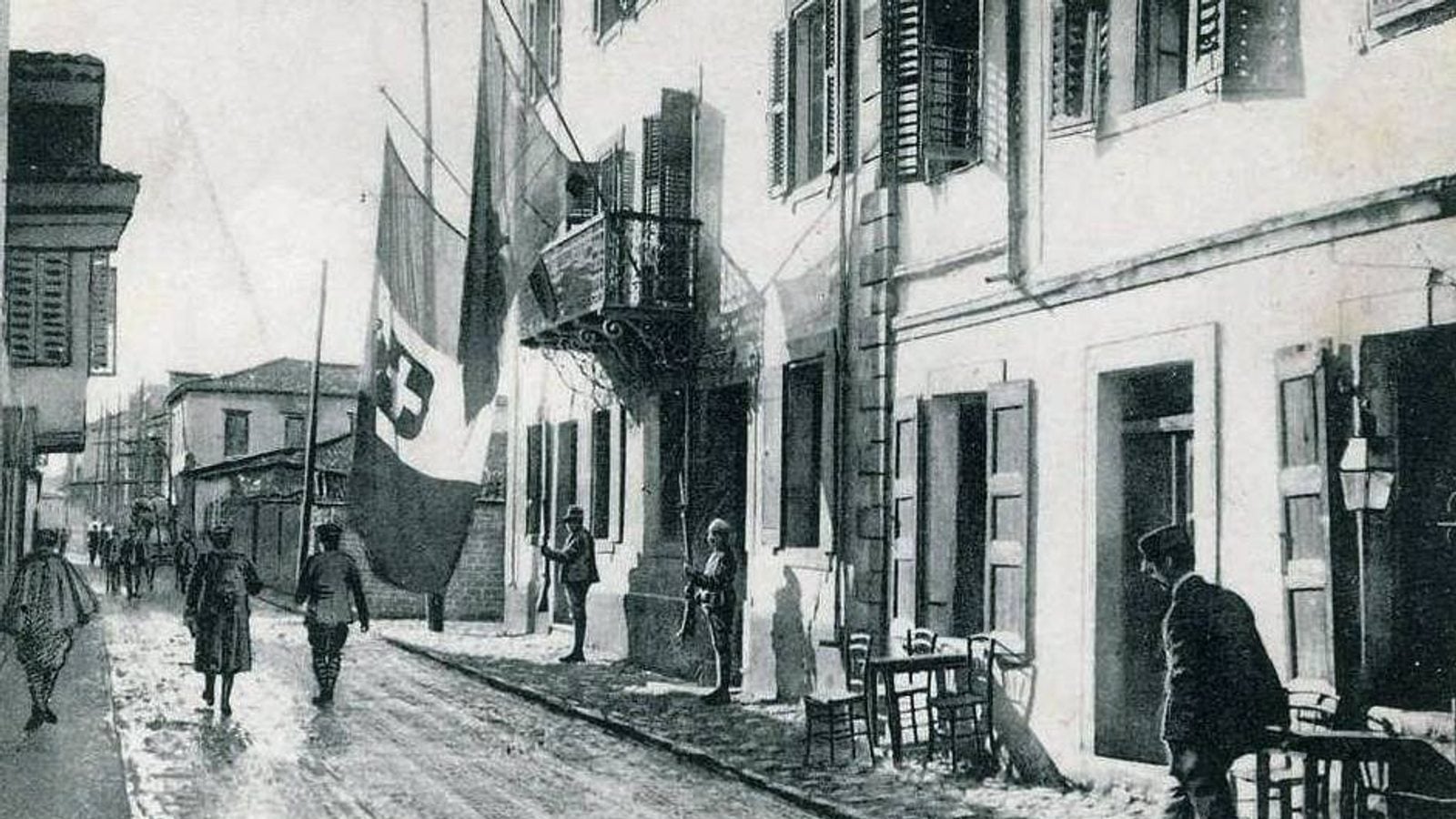
France established a presence in the southeast. French forces entered the Korçë region in late 1916 as part of operations on the Macedonian Front. Unlike the other occupiers, France engaged directly with Albanian political aspirations — creating the Autonomous Province of Korçë in December 1916.
Greece occupied parts of the far south, particularly in the regions it had claimed during the Balkan Wars. Greek administration in these areas continued the Hellenization policies that predated the war — closing Albanian schools, replacing Albanian-language administration with Greek.
Serbia maintained a presence in the northeast, in areas it had occupied during the Balkan Wars and continued to claim.
No Albanian authority operated above the local level. The country existed on no contemporary map as a governed entity. Each occupier administered its zone according to its own laws, in its own language, for its own strategic purposes.
The Autonomous Province of Korçë
The most consequential occupation zone was the smallest. On 10 December 1916, fourteen representatives of the Korçë region signed a protocol with French Colonel Henri Descoins establishing the Autonomous Albanian Province of Korçë under French military protection.
The province was a paradox: a foreign occupation that advanced Albanian interests. Albanian became an official language alongside French. Greek schools — which had been the primary educational institutions during the Greek occupation — were replaced with Albanian-language schools. Themistokli Gërmenji, a local military leader and nationalist, served as prefect of police and became the de facto Albanian political authority in the zone.
The province issued its own stamps, flew its own flag (the Albanian eagle with a small French tricolor), and operated with a degree of administrative independence that no other part of Albania had. For a brief period, Korçë was the only place in the country where Albanian was used as a language of government.
The province’s autonomy diminished over time. After Descoins’s departure in May 1917, successive French commanders reduced Albanian administrative authority. By 1918, the area was under more direct French military control, though French-delegated governors continued to administer it through May 1920. But the province’s years of Albanian-language administration had lasting effects: a generation of Korçë students was educated in Albanian, and the precedent of an Albanian civil administration — however limited — demonstrated that Albanians could govern themselves.
Gërmenji was arrested in 1917 and tried by a French military tribunal in Thessaloniki. He was sentenced to death and executed by a French firing squad in November 1917 — a reminder that the autonomy operated in a contested space where the interests of occupying powers and Albanian nationalists did not always align.
The Paris Peace Conference
When the war ended in November 1918, Albania’s existence was not guaranteed. At the Paris Peace Conference in 1919, Italy pressed its claims under the Treaty of London. Greece demanded southern Albania (which it called Northern Epirus). Serbia sought to retain its wartime gains in the north and northeast.
U.S. President Woodrow Wilson became Albania’s unlikely advocate. Wilson opposed the partition, arguing that it violated the principle of self-determination that the conference was supposed to uphold. At a critical moment in January 1920, Wilson rejected a partition scheme built on the Tittoni-Venizelos agreement — a bilateral Italian-Greek pact signed in July 1919 that divided Albanian territory between Rome and Athens, with Yugoslav claims adding a third front.
Wilson’s intervention was decisive, but it was not sufficient. The conference adjourned without a final settlement on Albania’s borders. The country’s fate remained open.
The Vlora War
Italy did not wait for the conference to decide. By 1920, roughly 20,000 Italian troops still occupied Vlorë and its hinterland. Italy intended to keep the port as a permanent base — the Treaty of London had promised it, and Rome saw no reason to leave.
Albanian resistance began in the spring. In June 1920, armed Albanian irregulars — volunteers from across the country, not a regular army — attacked Italian positions around Vlorë. The fighting lasted through the summer. Albanian forces used guerrilla tactics in the hills and forests surrounding the city, exploiting terrain that favored defenders and negated Italy’s superiority in artillery and air power.
The Italians also faced an enemy they had not planned for: malaria. The lowlands around Vlorë were malarial, and Italian troops died of disease faster than they died in combat. Morale collapsed. Back in Italy, the war had become unpopular; Italian socialists and veterans’ groups demanded withdrawal from an occupation that was producing casualties with no visible purpose.
On 2 August 1920, Italy and Albania signed a protocol. Italy agreed to evacuate Vlorë and its hinterland, retaining only the island of Sazan. By September, the last Italian soldiers left the Albanian mainland.
The Vlora War was the moment Albania stopped being a territory other countries disposed of and started being a state that could defend its borders. The volunteers who fought there — farmers, shepherds, students, veterans of the Ottoman army — did what the Great Powers had never expected: they made occupation more expensive than withdrawal.
What the war cost
Between 1914 and 1920, Albania suffered losses that are difficult to quantify precisely because no functioning government existed to count them. Estimates suggest tens of thousands of civilian deaths from combat, disease, and famine. Agricultural production collapsed in areas crossed by armies. Livestock — the primary capital of highland villages — was requisitioned or slaughtered. The infrastructure that the occupiers built served military needs and was largely abandoned when they left.
The war also produced the first significant waves of Albanian emigration to the United States. Young men fled conscription by occupying armies. Families from the devastated north left for ports they could reach. The postwar economic ruin — six years of occupation had destroyed what little commercial economy existed — pushed entire villages toward departure. Many of these emigrants settled in the factory towns of New England, the Bronx in New York, and the industrial corridor around Detroit. They formed the mutual-aid societies, churches, and cultural organizations that became the institutional foundation of Albanian America.
The Congress of Lushnjë in January 1920 — which reasserted Albanian sovereignty, rejected the partition plans, and moved the capital to Tirana — drew directly on the wartime experience. The delegates who gathered there had lived through six years of evidence that independence declared on paper, as it had been at Vlorë in 1912, meant nothing unless Albanians could defend it on the ground. The congress, and the Vlora War that followed it, were the answers.
A state that survived by refusing to disappear
Albania’s World War I is not a story of battles won or alliances formed. Albania fought no battles as a belligerent and joined no alliance. It is a story of a two-year-old state that was occupied by five armies, promised away in a secret treaty, ignored at a peace conference, and expected to vanish — and did not.
The war left Albania poorer, smaller (the final borders excluded Albanian-majority territories in Kosovo, western Macedonia, and Chameria), and with no functioning institutions. But it left Albania on the map. The Vlora War proved that Albanian resistance could impose costs high enough to make occupation unworkable. The Congress of Lushnjë proved that Albanian political leadership could organize a credible government when the alternative was partition. And the wartime experience — occupation without representation, partition planned without consultation, survival despite everything — became the founding narrative of Albanian statehood.
For Albanian Americans, that narrative is personal. The war years are when many of their families left. The lesson those families carried — that nobody else will defend your existence for you — is one the diaspora has never forgotten.