

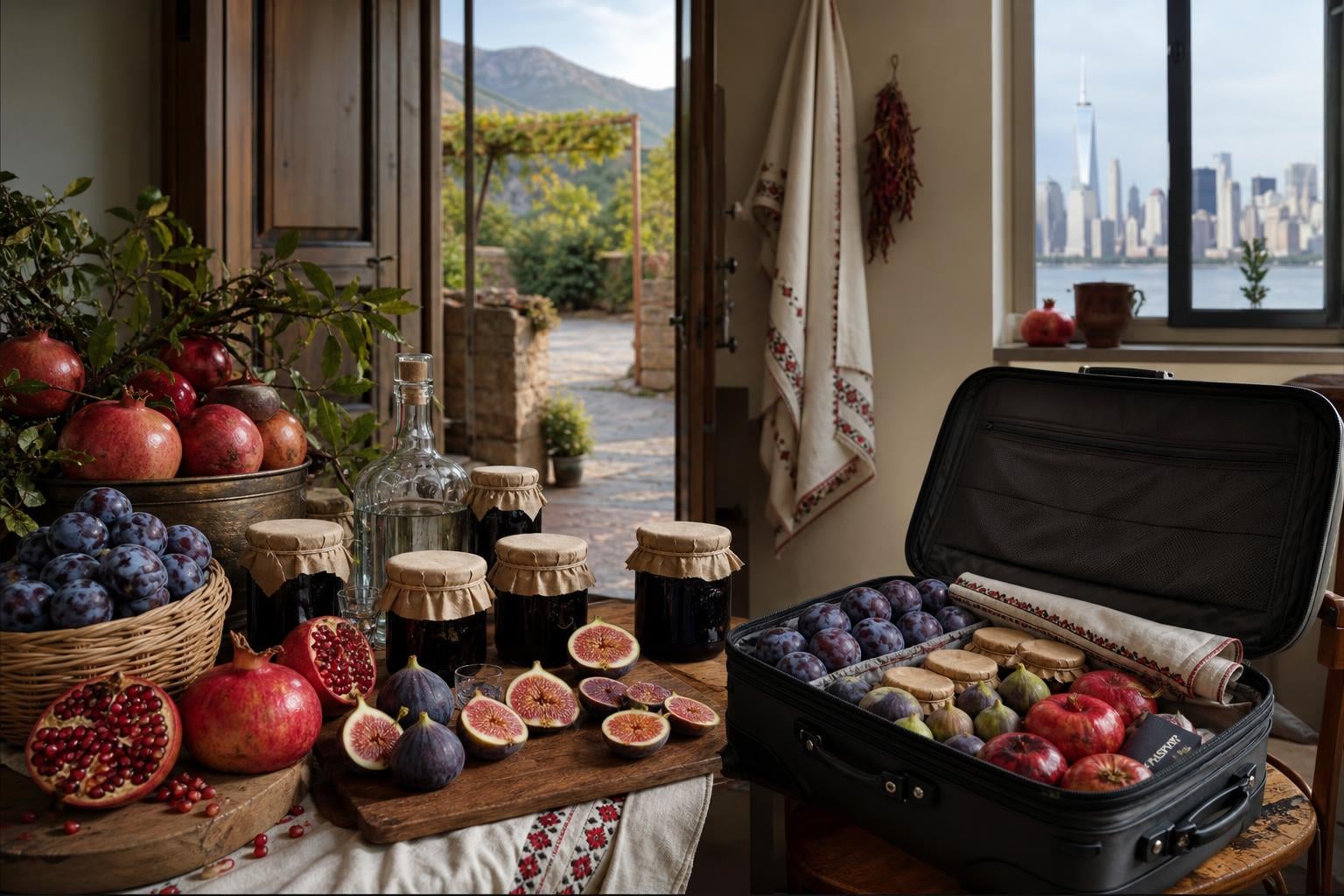
Walk through an Albanian village in late August and a fig tree is dropping fruit on the ground every twenty meters. A pomegranate hangs heavy over a stone wall. A grape vine wraps a courtyard pergola, the bunches turning purple under their own weight. Somewhere a copper still is running — a neighbor distilling last year’s plums into this year’s raki. This is the ordinary calendar of an Albanian agricultural year, and most of what an Albanian household eats and drinks in winter passes through it.
Albanian fruit is not just produce. It is the raw material of a whole pantry — reçel (fruit preserves), kompot (fruit compote), syrups like liko and sherbet, dried figs in strings, raki distilled from plum and mulberry. It is also the raw material of a quiet symbolism. Figs and pomegranates appear in Albanian wedding rituals, Easter and Christmas tables, and folk songs older than any current border on the map.
This piece walks through what grows in Albania, how the fruit travels into Albanian cuisine and ritual, and what happens to the tradition in Albanian-American kitchens that no longer have a fig tree out back. The framing is diaspora-practical: which fruits matter most, what gets recreated in US gardens, and why a sealed jar of reçel is one of the most heavily packed items in a returning cousin’s suitcase.
The Fig: Albania’s Quiet National Fruit
The fig (fiku, plural fiq) carries more cultural weight in Albania than any other fruit. Fig trees grow in nearly every village courtyard from Shkodër to Sarandë. They are drought-tolerant, low-maintenance, and productive enough that a single mature tree feeds a household and the neighbors. Fig trees are so widespread that Albania counts among Europe’s notable fig-producing countries despite its small size.
Fresh figs hit the table in two waves. The early-summer crop (fiq të hershëm) ripens in June; the main crop ripens from August into October. The dominant varieties are the dark-skinned fiku i zi (black fig) and the green-skinned fiku i bardhë (white fig). Both are eaten fresh, dried on woven mats in the sun, or cooked into reçel.
Dried figs (fiq të thatë) are where the Albanian fig economy gets serious. Strings of them hang from kitchen rafters through the winter, eaten as snacks or stewed with walnuts and honey. Albanian dried figs are a traditional export — sold in regional Balkan markets for generations and now shipped to Albanian-American grocers in the US.
Figs carry symbolic weight too. The tree appears in Albanian folk poetry and in the broader Mediterranean reading of figs as a sign of abundance and home. Planting one for a newborn — so the child will have figs by the time they marry — is a quiet tradition that still surfaces in diaspora gardens.
Pomegranate (Shega) in Cuisine and Symbol
The pomegranate (shega) is the fruit Albanians break open on New Year’s Eve. The custom is widespread across the southern Balkans and shows up in Albania across religious lines — Orthodox, Catholic, Muslim, and Bektashi households all observe some version of it. The fruit is thrown or smashed on the threshold; the scattered seeds represent prosperity and as many good things in the coming year as there are seeds in the fruit. Variants involve placing a whole pomegranate on the holiday table, opening it ceremonially with the first cut, or pressing the juice for a toast.
Albania grows pomegranates commercially across the southern half of the country. The fruit is harvested in October and November and stores well into winter. Albanian pomegranate juice (lëng shege) has gained commercial visibility in the last two decades, with several producers exporting bottled juice and concentrate.
In cooking, pomegranate seeds top salads, garnish meze plates, and fold into yogurt. The juice goes into marinades and syrup reductions for meat. Reçel shege — pomegranate preserve — is less common than the fig or quince versions but exists in traditional southern households.
The symbolic register matters in the diaspora. An Albanian-American household that has otherwise drifted from holiday rituals will often still buy a pomegranate at New Year and place it on the table. The image of a split pomegranate spilling its seeds shows up in Albanian embroidery, tombstone carvings, and the visual vocabulary of small Albanian businesses and community organizations.
Plums, Mulberries, Grapes: The Raki Story
Three fruits — grapes (rrushi), plums (kumbull), and mulberries (mani) — are the backbone of Albanian raki production. Raki is the country’s national fruit brandy, distilled from fermented fruit in copper stills, and the choice of fruit defines the style of the resulting spirit.
Grapes (rrushi). Albania grows wine and table grapes across most of the country, with the southern regions around Berat, Skrapar, and Përmet producing the most celebrated wines and rakis. Native varieties include Kallmet (a dark red from the north), Shesh i Zi and Shesh i Bardhë (Tirana–Durrës belt), and Vlosh (a southern red). Grapes are one of Albania’s largest commercial fruit crops. Raki rrushi is the everyday spirit; raki Skrapari is the recognized benchmark.
Plums (kumbull). The second-most distilled fruit. The European plum (Prunus domestica) is widely grown across central and northern Albania. Raki kumbulle is sharper, more aromatic, and more assertive than grape raki, with the stone-fruit character pushing through. The Balkan parallel is Serbian šljivovica and Bulgarian slivova rakia. Plum raki is the choice in many Gheg-tradition households in the north.
Mulberries (mani). The mulberry tree (Morus) grows wild and cultivated across Albania, often along roadsides where the ripe fruit drops black stains on the pavement every July. Raki mani is distilled from the fermented dark berries and produces an unusual, almost wine-like spirit with a deep color when aged. It is a regional specialty of central Albania and parts of Kosovo.
Fresh plums and mulberries also get cooked into reçel, dried for winter, and stewed in kompot. Grapes hang fresh on the table through autumn and are dried into raisins (rrush i thatë) for baking.
Quinces, Apples, Pears, Cherries, and Apricots
Beyond the headline fruits, Albania grows the full temperate-fruit lineup. Each one carries its own kitchen role.
Quince (ftua). The workhorse of Albanian fruit preserves. Hard and astringent raw, the fruit transforms when cooked — its flesh turns pink-red, its flavor sweetens, and it sets into a firm jelly thanks to high pectin content. Reçel ftoi is the most beloved Albanian jam variety, served with strong coffee and offered to guests on a glass dish. Quince also goes into kompot and into meat stews — quince with lamb is a classic Albanian autumn dish.
Apples (molla). Albania grows apples across most of the country, with the highest production in the cooler northern districts around Korçë, Pogradec, and Dibër. Traditional varieties include molla e Korçës — small, red, dense, late-season. Modern commercial orchards lean toward international varieties, but household production still favors the local types.
Pears (dardha). Pears grow across the same regions as apples. The most prized variety is the small, sweet dardha e Korçës. Pears appear fresh, dried, in kompot, and occasionally as a less common raki dardhe.
Cherries (qershi / vishnja). Sweet cherries (qershi) ripen in May and June and are eaten fresh by the bowlful. Sour cherries (vishnja) are the queen of the preserve jar — reçel vishnje is a household staple, used in cakes and as a coffee accompaniment. Sour cherries also make liko — a thick syrup diluted with cold water for a summer drink.
Apricots and persimmons (kajsi and kaki). Apricots ripen in June and July, eaten fresh, dried, and cooked into a golden reçel. Persimmons (kaki, sometimes called rrush kau) ripen in late autumn and hang on bare trees into winter — eaten ripe and soft, sometimes dried.
Wild Fruit That Doesn’t Make It to the Supermarket
A meaningful share of Albanian fruit is not grown but gathered. The wild fruit calendar runs from spring through autumn and produces foods that rarely reach commercial markets but anchor family traditions.
Wild strawberries (luleshtrydhe e egër or dredhëza). Tiny, intensely flavored, ripening in May and June on hillsides and forest edges. A morning’s picking fills a small bowl, but the flavor concentration is many times that of cultivated strawberries.
Wild blackberries (manaferra). Brambles line nearly every Albanian roadside and forest path. The berries ripen black in late summer and are picked for fresh eating, reçel, and liko syrup.
Rosehips (kaçe). The fruit of the wild rose, picked after the first frost when the hips soften. Dried for tea, cooked into a tart reçel, and used as a folk cold remedy. Vitamin C content is high — older households kept rosehip tea on hand as winter immune support. (See Rosa canina.)
Cornelian cherries (thanë). Not a true cherry — the fruit of Cornus mas, a small tree native to the Balkans and the Caucasus. The bright-red, tart, olive-shaped fruit ripens in late summer. Thanë is eaten fresh, cooked into reçel, and distilled into a regional raki thanë in some southern districts.
Wild pears (dardha e egër) and crab apples (mollë të egra). Used mostly for kompot and for fermenting into vinegar.
The wild-foraging tradition doesn’t easily transfer to American suburbs. But Albanian Americans with a backyard in the right zone can still find rosehips, blackberries, and wild strawberries across much of the eastern United States — the species overlap is real.
Olives, Citrus, and Watermelon: The Mediterranean Layer
Three categories sit at the edge of “fruit” in everyday speech but are central to the Albanian agricultural picture.
Olives (ullinj). Botanically a fruit; culturally a category of its own. Albania has a deep olive tradition concentrated in the western and southern coastal belt — the regions around Berat, Vlorë, and the broader southwest. Albania produces roughly 100,000 metric tons of olives in a typical recent year, per figures compiled in Agriculture in Albania — the figure swings significantly from year to year. The dominant local variety is kalinjot, grown above all around Vlorë. Olive oil and table olives are everyday foods, not luxury items — every meal includes olives in some form, and the oil is the default cooking fat.
Citrus (agrumet). The southern coast — the Ionian belt from Vlorë south to Sarandë — supports oranges (portokalle), lemons (limonë), mandarins (mandarina), and the occasional grapefruit. Citrus is a southern microclimate product, grown in households and small orchards rather than at industrial scale. The image of a winter table with oranges, walnuts, and dried figs is a southern cliché in the affectionate sense.
Watermelon and melons (shalqi and pjepër). Watermelon is a high-summer field crop, grown across the Myzeqe plain and other flat agricultural regions. Albanian watermelons are picked at full ripeness, sold by the side of the road in August, and eaten in massive quantities. Cantaloupe-style melons (pjepër) ripen in the same window.
A diaspora reality: US-grown watermelon does not taste like Albanian watermelon. The cultivars are different, the field conditions are different, and many Albanian Americans complain about American watermelon for the rest of their lives once the comparison is set.
Reçel, Kompot, and Liko: How Fruit Becomes Pantry
Albanian fruit goes into the pantry in three main forms.
Reçel (fruit preserve). Fruit cooked slowly with sugar until the syrup thickens and the fruit holds its shape — the Albanian version of jam, closer to a Middle Eastern “spoon sweet” than to British conserve. Common varieties: fig, quince, sour cherry, rose petal, watermelon rind, walnut in syrup, and (in southern households) bitter orange. Reçel is served by the small spoonful on a glass dish, beside a glass of cold water and a cup of Turkish-style coffee. When a guest sits down, the first food on the table is often a spoon of reçel and a glass of water.
Kompot (fruit compote). Whole or sliced fruit cooked briefly in light sugar syrup, eaten warm or sealed in jars for winter. Kompot uses less sugar than reçel and keeps more of the fruit’s structure. Plum, apricot, cherry, pear, apple, and quince are the common varieties.
Liko and saraga (fruit syrups). Thick fruit syrups, traditionally made from sour cherry, blackberry, mulberry, or rose, used as the base for cold summer drinks. A spoonful of liko in a tall glass of cold water makes the Albanian equivalent of a homemade soft drink — sour, bright, and free of the heavy sweetness of American sodas. Saraga is a regional variant. Sherbet, a syrup-based sweet drink, sits in the same family.
Fruit also goes into byrek — yes, sweet byrek exists. Byrek me fruta (filo pastry with apple, quince, or fig) is a less common cousin of the savory byrek tradition, more common in some Korçë-area households and in Arbëresh communities than in the mainstream.
A traditional Albanian pantry in autumn is a small museum of the year’s fruit, sorted by preservation method — strings of dried figs from the rafters, jars of kompot and reçel on the shelves, bottles of raki and liko alongside the wine.
What Grows in Albanian-American Backyards
In the US, Albanian-American gardeners recreate the homeland fruit calendar where the climate allows. The species selection is climate-bound; the impulse is universal.
Fig trees are the single most-planted Albanian fruit tree in the US diaspora. They survive in USDA zones 7 and warmer with no special care, and in zones 5 and 6 with winter wrapping or container growing brought indoors. The Bronx and Yonkers have a long tradition of Italian-American and Albanian-American fig growing; backyards are full of mature fig trees, often wrapped in burlap and tar paper through the winter. Sterling Heights winters are at the cold edge of fig survival; many households grow figs in large pots that move into garages from November through March.
Grape vines and pergolas are the second most-planted feature. A wood pergola with concord or muscadine grapes is the closest American substitute for the courtyard vine of an Albanian village house — shade in summer, grapes for fresh eating in September.
Pomegranates do well in the warmer parts of the US — California, Arizona, Texas, parts of the Southeast — and Albanian-American gardeners in those states often plant one or two. In the Northeast and Midwest they are too cold-sensitive for outdoor growing, so households there buy them from supermarkets in October and November.
Sour cherries, plums, apples, and pears are widely planted Albanian-American backyard trees in the Northeast and Midwest. The varieties are American, but the use is Albanian — fresh eating, reçel, and kompot. Quince trees are rarer but show up in the gardens of older first-generation Albanian Americans who specifically planted them for reçel ftoi.
The species that don’t translate: Albanian wild strawberries, thanë (cornelian cherry), and the specific southern Albanian fig and grape varieties. For those, the diaspora relies on suitcases and care packages.
Why Dried Figs and Fruit Reçel Travel in Suitcases
Walk through customs at JFK or Logan in late summer and Albanian-American travelers carry suitcases that weigh more than the airline limit. Inside, alongside the kaçkavall, are sealed jars of reçel, strings of dried figs, bags of dried apricots, and the occasional bottle of homemade raki (which, depending on the carrier, may or may not survive the trip).
The fruit items that travel most often:
Dried figs (fiq të thatë). Lightweight, shelf-stable, and the closest available match for the village taste. A bag of properly dried Albanian figs — sun-dried, slightly chewy, often pressed flat — costs little and travels easily. They show up at Christmas tables, weddings, and as the small gift offered to a visiting cousin.
Fruit reçel in sealed jars. Quince, fig, sour cherry, and rose petal preserves are the most commonly transported. A commercially sealed jar travels in checked baggage with low risk; a homemade jar in a recycled olive-oil bottle is higher-risk and sometimes gets stopped. US Customs and Border Protection allows commercial shelf-stable preserves with proper declaration; check current CBP rules before traveling.
Dried apricots, plums, and raisins. Same shelf-stable logic as figs. Albanian dried apricots have a slightly tarter profile than the standard Turkish dried apricot sold in US supermarkets, and the diaspora preference shows.
Bottled pomegranate juice and concentrate. Common in checked bags. Glass adds weight and risk, but the products travel.
The reason these specific items dominate the suitcase is straightforward: they are shelf-stable, identifiably Albanian in flavor, and either unavailable or noticeably different in US stores. Fresh fruit, fresh dairy, and uncooked meat do not pass — the US Animal and Plant Health Inspection Service rules are strict, and the agriculture beagles at JFK and Logan are good at their job.
A growing number of small Albanian-American importers now ship dried figs, reçel, and bottled fruit juice in regular containers. Online ordering of Albanian fruit products has expanded substantially in the last decade, and diaspora cooks who can’t fly home every year increasingly source their pantry from the US-side importers instead.
The Diaspora and the Fruit Calendar
Albanian fruit, like Albanian bread or cheese, is one of the small daily things that signal Albanian identity in a US kitchen without anyone having to say so out loud. A bowl of fresh figs on a Yonkers counter in August. A jar of reçel ftoi on the table next to the coffee tray when a guest arrives. A pomegranate placed on the New Year’s table, even in households that have otherwise drifted from the holiday’s older customs. The fruit carries the thread.
The thread runs both directions. Albanian Americans returning from a summer in Albania bring back suitcases of dried figs and reçel. Cousins in Tirana send care packages of raki kumbulle and bottled juice. Albanian-American grocers in Sterling Heights, Worcester, Waterbury, and northern New Jersey stock the imported versions year-round.
The National Albanian Registry exists to make that diaspora visible — to count Albanian Americans accurately and to connect them across state lines. If a jar of reçel and a string of dried figs in your family pantry is part of why you call yourself Albanian American, get counted at /register. It is free, it takes about a minute, and it is how the rest of the work — the count, the language programs, the diaspora map — gets built.
Sources and Further Reading
- FAO Statistics Division (FAOSTAT), country production data for Albania — fao.org/faostat
- Wikipedia: Agriculture in Albania
- Olives101, Kalinjot olive variety
- Wikipedia: Albanian cuisine
- Wikipedia: Rakia
- Wikipedia: Pomegranate, Common fig, Cornus mas, Rosa canina
- US Customs and Border Protection, traveler food guidance — cbp.gov
- US Census Bureau, American Community Survey, B04006 Albanian ancestry estimates