
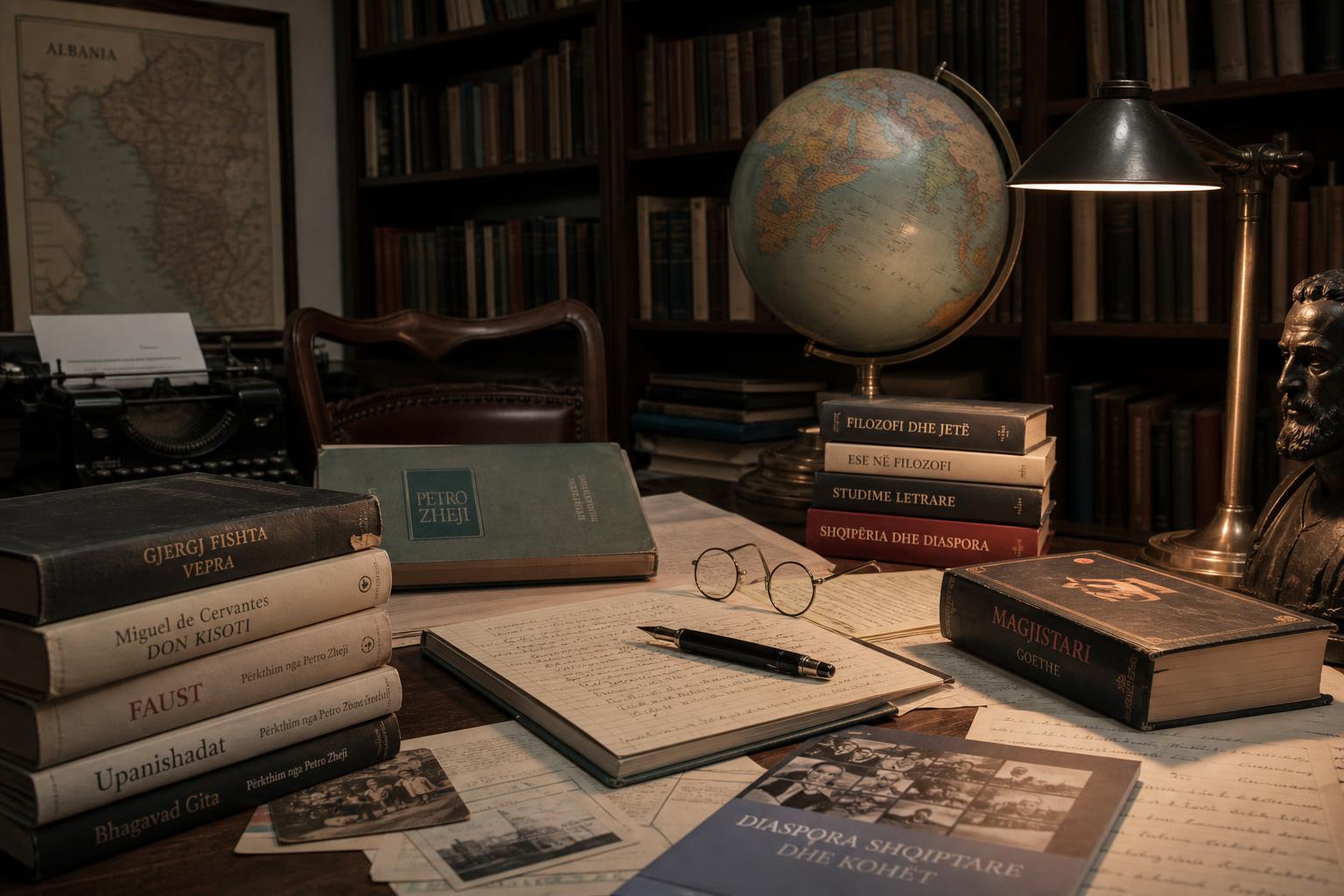
Petro Zheji is not a name most Albanian Americans hear at the dinner table. He should be. He translated Cervantes’ Don Quixote into Albanian. He read Sanskrit. He wrote a nine-hundred-page philosophical book arguing that Albanian preserves an ancient symbolic structure older than the alphabets that record it. The Albanologist Robert Elsie, the most cited foreign authority on Albanian literature, called him “the spiritual father to a whole generation of Albanian intellectuals” (Wikipedia: Petro Zheji).
He spent the second half of his life partly in the United States. After the fall of communism in the early 1990s, Zheji emigrated and settled in Maryland with family, returning to Tirana periodically until his final years. He died in Tirana on 14 March 2015, age 85.
For an Albanian American community still building its institutional memory, Zheji is one of the figures who needs to make it across the ocean. He sits at the intersection of three things the diaspora cares about deeply and rarely talks about together: language, heritage, and the kind of mind communism tried to file away. This is who he was, what he did, and why his work still matters in the United States today.
Who Petro Zheji Was
Zheji was born on 18 October 1929 in Tirana, into a family with roots in the southern village of Zhej, in the mountainous Zagori region of Gjirokastër district. His father was Spiro Ballo Zheji. His older brother, Gjergj Zheji, was also a noted translator. The Zhej name is one of those Albanian surnames that carries a place inside it — a small reminder that the family came from a particular hill and a particular dialect long before they ever lived in the capital.
He studied mathematics and physics in a two-year college program in Tirana, then moved into teaching. He started at his own former secondary school, the Qemal Stafa Gymnasium in Tirana, then taught for a stretch in Gjirokastër — the Ottoman-era stone city of southern Albania that also produced Ismail Kadare and Enver Hoxha. The combination of mathematics and language teaching shaped everything that came after. Zheji approached human languages the way a topologist approaches surfaces: looking for the deep structure underneath the surface forms.
Personally he kept a small footprint. He married the Albanian stage and screen actress Besa Imami; the marriage lasted fifteen years and produced a son, Artur Zheji, who became a journalist and cultural critic in Tirana. Across decades of work, Zheji avoided the public-figure circuits that swallowed many of his peers. He was an intellectual’s intellectual, more comfortable with a manuscript than a microphone.
The Translator at the Highest Level
For most of his working life, Zheji was a staff translator at the two major state publishers in communist Albania: the 8 Nentori Publishing House and the Naim Frasheri Publishing House (named for the great Rilindja poet). Between them, they produced the canon of foreign literature that Albanian readers grew up on. Zheji’s name is on the spine of more than thirty of those volumes (Wikipedia: Petro Zheji).
The list is staggering. He translated the second volume of Miguel de Cervantes’ Don Quixote — the four-hundred-year-old foundational novel of European fiction — into Albanian. He rendered H.G. Wells’ The Invisible Man for an Albanian readership that had no access to Western popular fiction through any other channel. He worked from German, Russian, English, Spanish, French, Italian, and Sanskrit, and was also at home in Hebrew, Ancient Greek, and Latin. Translators of his range were rare in any country in the twentieth century. In a sealed-off communist Albania of three million people, he was almost a one-man bridge to the rest of world literature.
Translation in that context was not a side gig. It was a load-bearing cultural job. A generation of Albanian readers, many of whom emigrated to the US, Italy, and Greece after 1991, met Cervantes, Wells, Saint-Exupery, and Miguel Angel Asturias for the first time through Zheji’s Albanian sentences. When Albanian American parents today put a translated classic in a child’s hands and say “this is how I read it growing up,” there’s a real chance the translator’s name on the title page is Petro Zheji.
The Mathematician and the Philosopher
What set Zheji apart from other translators was the second half of his life. He was a mathematician by training, a teacher by trade, and a philosopher by temperament. He treated language itself as a mathematical object — not a code in the modern computer-science sense, but a deep symbolic system whose surface words were derivatives of an underlying logic.
That cross-disciplinary reach is unusual anywhere. In Albania it was almost unheard of. The country’s intellectual life under communism was siloed by the regime: writers wrote, scientists did science, and the spaces between disciplines were politically suspect. Zheji ignored the silos. He read Sanskrit grammars next to Cervantes, Hebrew etymologies next to Russian novels, and number theory next to Albanian folk speech.
His central argument, developed across decades of private notebooks and finally published late in life, was that Albanian — shqip — is not just one Indo-European language among others. He argued it preserves a primordial symbolic structure, an internal logic of roots and sounds, that opens up readings of older sacred and mythic vocabularies. You do not have to accept the conclusion to see what is interesting about the method. He was treating the Albanian language as a research instrument, not just an inheritance.
This is also why he is hard to place on a Western shelf. He was not a comparative linguist in the academic-journal sense. He was something older and stranger: a philosophical philologist, in the line of figures like Giambattista Vico, who believed languages carry the deep memory of how human beings first organized meaning.
Roli Mesianik i Gjuhes Shqipe
His magnum opus is Roli Mesianik i Shqipes — The Messianic Role of the Albanian Language. The full title adds a subtitle: Renia e Kulles se Babelit, The Fall of the Tower of Babel. The book runs roughly 944 pages in its UET Press edition. It is, by any measure, one of the longest and most ambitious original works of Albanian-language thought published in the twentieth century.
The title is not modest. “Messianic” here is not a religious claim about Albanians as a chosen people — Zheji was not writing nationalist theology. The argument is symbolic and structural: that shqip, by virtue of its unusual position as the lone surviving member of its Indo-European sub-branch (see our piece on the Albanian language), preserves elements of the symbolic substrate that other, more derived languages have lost. The Tower of Babel image, in Zheji’s hands, is about the fragmentation of an older shared meaning. Albanian, in his reading, sits closer to the unbroken floor.
His earlier book, Shqipja dhe Sanskritishtja (Albanian and Sanskrit), was the technical companion. It was the first comprehensive and systematic comparison of Albanian and Sanskrit attempted in Albanian. He completed it in the late 1970s. The Hoxha regime did not want it published. It sat in a drawer for more than two decades and finally appeared in 2001 (Wikipedia: Petro Zheji).
Both books are difficult. They reward slow reading. They are not for someone looking for a tidy thesis statement. What they are, for Albanian American readers in particular, is a living archive of the kind of patient, original, cross-civilizational thinking that Albanian intellectual culture is fully capable of producing — and rarely gets credit for outside the language.
Quiet Dissent Under Communism
Zheji’s relationship with the Hoxha regime was a slow, quiet refusal. He did not publish manifestos. He did not go to prison. He did not defect. He simply did not play.
The most concrete example: he refused to join the Lidhja e Shkrimtareve dhe Artisteve te Shqiperise — the Albanian Writers and Artists League — the official guild through which the regime organized, monitored, and rewarded literary life. Membership was the standard path to publication, status, travel privileges, and a state apartment. Refusing it was a quiet professional suicide. Zheji refused it.
The cost was real. His original work was kept off the publication lists. His Albanian-Sanskrit study, finished by the late 1970s, was shelved indefinitely. His philosophical writings circulated, when they circulated at all, in private. The regime tolerated him because he was an indispensable translator. It refused him as a thinker.
It helps to put this in context. The Hoxha period, from 1944 to 1985, was one of the most closed political environments in twentieth-century Europe. Albania broke with Yugoslavia in 1948, with the Soviet bloc in 1961, and with China in 1978. By the late 1970s the country was effectively alone, with a population of about three million, a state-controlled press, and a security service — the Sigurimi — that took an unusually granular interest in the intellectual class. Writers and translators were not free agents. They were assets the state assigned, monitored, and either promoted or quietly shelved.
Within that system, Zheji took the smaller seat by choice. He kept the staff job that paid the bills and accepted that his real work, the philosophical writing, would not be publishable in his lifetime under that regime. That is a long bet. He made it, and the bet eventually paid off — Shqipja dhe Sanskritishtja finally appeared in 2001, Roli Mesianik later still, both in a free Albania he had outlived the regime to see.
This is a particular kind of resistance — one the diaspora knows well and rarely names. Many Albanian American families remember a grandparent or great-uncle who was not a hero in the textbook sense but who simply declined to volunteer their conscience to the state. Zheji is in that lineage. He kept his own work, in his own room, in his own time. When the regime fell, the work was still there.
Maryland Years
In the early 1990s, after the regime collapsed, Zheji emigrated to the United States. He settled in Maryland with family, where he lived for a stretch of years before returning to Albania more permanently. He kept writing, kept reading, and kept a small intellectual circle around him in the Washington-Baltimore corridor — one of the older Albanian American population centers, with congregations and small associations dating back to early-twentieth-century immigration.
Maryland in the 1990s was not yet the high-density Albanian American region that New York, Michigan, and Massachusetts had been for a century. The 2024 American Community Survey counts roughly 224,000 Americans of Albanian ancestry, with the top three states being New York (about 56,000), Michigan (about 27,000), and Massachusetts (about 21,000). Maryland’s Albanian American population is smaller but real, anchored by parishes and family networks that absorbed several waves of post-1990 arrivals.
The intellectual texture of those years matters. The 1990s were the first decade in which Albanian thinkers could move freely between Tirana and the West, carry manuscripts across borders without consequence, and read the books that had been forbidden at home. For someone of Zheji’s generation, the United States was less a destination than a long-deferred reading room. He had been working on Sanskrit, Hebrew, and comparative etymology for decades inside a country where some of the relevant scholarship was hard to import. Maryland gave him uninterrupted access to libraries, photocopies, and correspondence with foreign scholars.
For Zheji personally, the years in the US were a way of being elsewhere — a return, late in life, to the languages and libraries that the regime had kept partially out of reach. Friends who visited him from Tirana describe a man still working long hours over manuscripts, still sketching out etymologies on legal pads, still translating in his head. He returned to Albania periodically and eventually settled back in Tirana. He died there on 14 March 2015, age 85.
Why He Still Matters in the Diaspora
Three reasons.
The first is intellectual standing. The Albanian American community is in a phase of building institutions: the first community-led count of Albanian Americans, an emerging body of pillar reference content (see our pieces on Ismail Kadare and the Rilindja Kombetare), an evolving network of regional organizations. Communities need a canon. Zheji belongs in ours. He is one of the genuine originals, and he chose, for several years, to live among Albanian Americans in the US.
The second is language. The conversation in Albanian American households about whether and how to teach Albanian to the next generation is one of the most consequential conversations the community has. Zheji’s work — his translations, his philosophical claims about shqip, his lifetime of moving between ten languages — is a permanent argument for taking the language seriously as a serious instrument of thought. Not a heritage costume. A working tool.
The third is the model of quiet dissent. Many Albanian American families carry, somewhere in the family memory, a grandparent who survived communism by simply not surrendering their own mind. Zheji is the most refined example of that posture in twentieth-century Albanian intellectual life. He is a usable model for what it looks like to keep your own work intact when the institutions around you would rather you stopped.
For families who came over after 1991, who watched the regime collapse in real time, his name should be familiar. For second- and third-generation Albanian Americans whose grandparents arrived earlier, he is a way back into a part of the homeland’s twentieth century that the Cold War headlines never covered. Either way, he is worth knowing.
There is also a practical, almost archival reason to surface him now. The first generation of Albanian American intellectual life in the United States — the world of Fan Noli, the Vatra society, and the Boston-based Albanian press of the early twentieth century — has been documented, if unevenly. The post-1991 wave is still being documented. Petro Zheji is one of the figures who connects the two: a thinker formed inside Albania, who lived long enough to do part of his work on US soil, and whose name belongs in any honest list of Albanian American contributions to the life of the mind.
Sources and Further Reading
Primary biographical facts above are drawn from the English Wikipedia article on Petro Zheji and from the Albanian-language obituaries published at his death in March 2015. Robert Elsie’s assessment of Zheji’s influence is widely cited in those obituaries and in Albanian literary commentary.
Recommended starting points:
- Roli Mesianik i Shqipes: Renia e Kulles se Babelit (UET Press) — his magnum opus, in Albanian. A long read, but the central work.
- Shqipja dhe Sanskritishtja (2001) — the technical companion volume on Albanian-Sanskrit comparison.
- His Albanian translations of Cervantes (Don Quixote, vol. II) and H.G. Wells (The Invisible Man) — for readers who want to meet him through his sentences rather than his arguments.
- Wikipedia: Petro Zheji — for canonical dates, family information, and a partial bibliography.
If you are an Albanian American who recognizes a piece of your own family in this story — a grandparent who refused the Writers League, an uncle who carried a battered Albanian translation of Cervantes through three apartments, a parent who kept reading Sanskrit in a Maryland kitchen — get counted on the National Albanian Registry. The community we are building is partly an inheritance of figures like Petro Zheji. It works only if we make it visible.