
Most Albanian Americans can name one figure from the medieval wars against the Ottoman Empire: Skanderbeg. His statue stands in Bronx parks and Michigan halls, his double-headed eagle hangs in restaurants, and his name carries the whole 25-year resistance on its back. That is fair. He earned it.
But a single commander does not hold a fortress, win a field battle, or keep an alliance together for a quarter of a century. Skanderbeg led a league — a coalition of Albanian lords and the captains who fought under them. Those captains had names, lands, families, victories, and failures of their own. Some of them have nearly vanished from popular memory, even among people whose grandparents grew up on these stories.
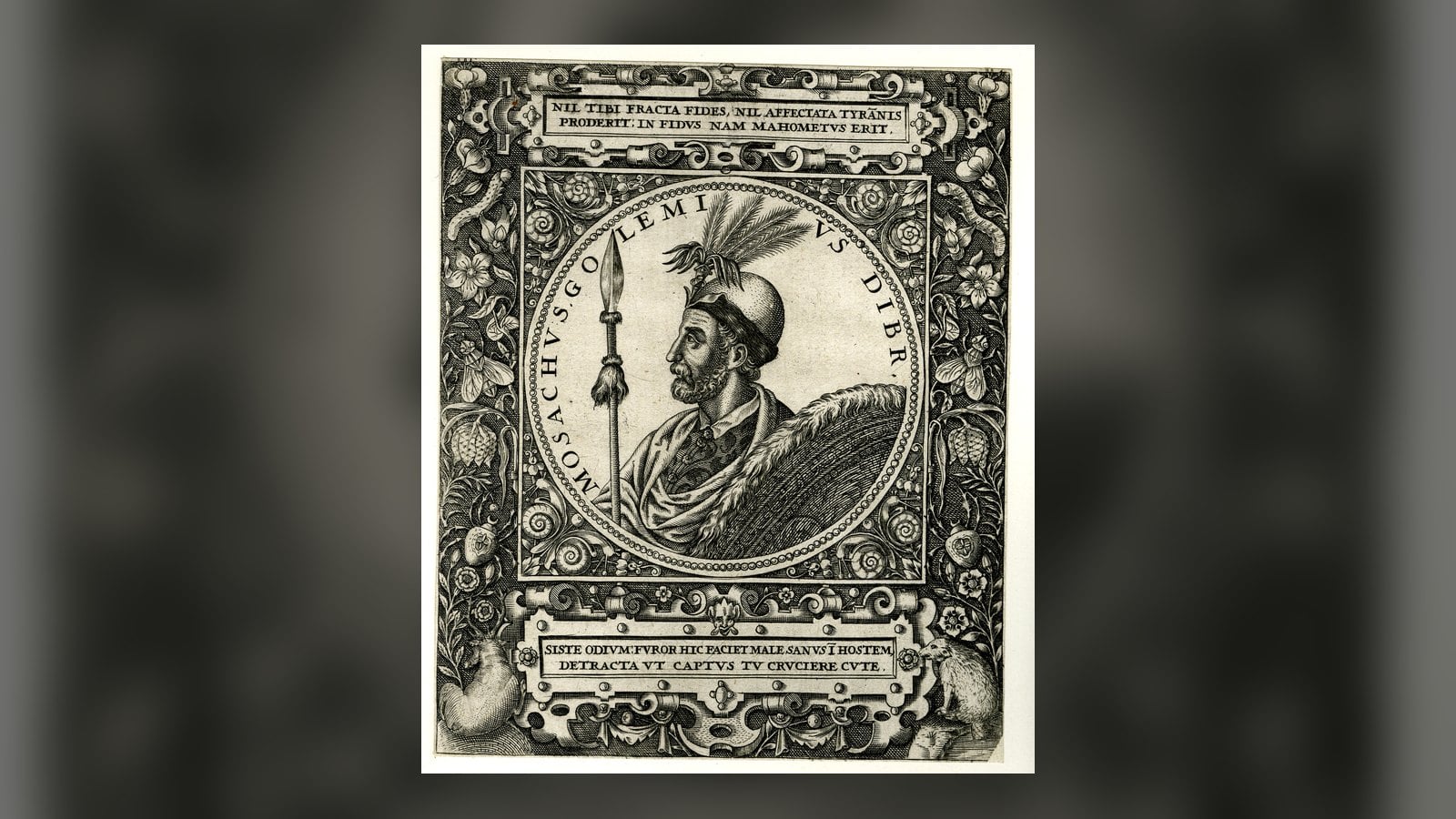
Moisi Arianit Golemi is one of those captains. He was among the closest of Skanderbeg’s commanders, a man trusted with armies. He is also one of the more human figures of the era, because his record includes a fracture most heroes’ biographies leave out: in 1455 he abandoned Skanderbeg and went over to the Ottomans, then returned the following year and was taken back. He died in 1465, captured and executed in a manner the old chroniclers describe in terrible detail.
This article is about the man behind that arc — what the sources actually say, what is well attested, and what belongs more to legend than to the documentary record. It is written for the reader who knows Skanderbeg but has never heard of the men who stood beside him. Think of it as a profile of one of the people around the famous name.
Who he was: the Arianiti connection
Moisi’s full name is usually given as Moisi Arianit Golemi, and that middle element points to one of the great noble houses of medieval Albania: the Arianiti family (Wikipedia: Moisi Arianit Golemi).
The Arianiti were lords of central and southern Albania, the same house that produced Gjergj Arianiti — Skanderbeg’s father-in-law and an early rebel against the Ottomans in his own right. NAR has covered Gjergj Arianiti separately (read that profile); here it is enough to say that the Arianiti name carried real weight among the Albanian principalities of the day.
Some accounts spell out exactly how Moisi fit into that family tree: they name him as the son of Muzakë Arianiti and grandson of Komnen Arianiti, born near Elbasan, with his mother recorded as Goisava — a direct line within the Arianiti house, not just a loose network tie. Even so, this is a recurring problem with 15th-century Albanian figures generally: the documents are thin, the genealogies were reconstructed later from scattered sources, and a father-son-grandfather chain that reads as settled on the page should still be held with some caution.
What can be said with more confidence is the social fact. Moisi was a man of the warrior nobility, not a peasant who rose through ranks. He held a position that let him command troops and sit in the company of lords. When Skanderbeg organized the resistance, men like Moisi were the material it was built from: local notables with armed followings, regional standing, and a stake in whether the Ottomans advanced or were held back.
That is the right frame for reading him. He was not a sidekick. He was a member of the class that made the war possible, attached to one of its named houses.
The League of Lezhë and his role
In March 1444, Skanderbeg gathered the Albanian noble houses at the town of Lezhë on the northern coast and formed the Lidhja e Lezhës — the League of Lezhë (League of Lezhë). It is remembered as the first time the fractured Albanian principalities accepted a single command structure against the Ottoman Empire.
The league was not a modern nation-state and should not be read as one. It was a military alliance among proud, independent lords who agreed — for a time — to pool men and money and to follow Skanderbeg’s lead in the field. Loyalty inside it was personal and conditional, the way alliances were in that century everywhere in Europe.
Moisi Golemi belonged to this world as one of Skanderbeg’s captains. In the accounts of the wars, he appears among the commanders entrusted with leading forces, not merely fighting in them. That is the meaningful detail: he was inside the decision-making circle, a man Skanderbeg relied on to hold a wing of an army or run an independent operation.
The 1440s and early 1450s were the years when the league worked. Skanderbeg’s forces fought the Ottomans to repeated standstills, defended the fortress of Krujë, and built the reputation that would later reach two popes and the courts of Naples and Venice. Captains like Moisi were the working machinery of those years — the men who executed the plans.
It is worth being honest about the limits here too. We know far less about Moisi’s individual battles than about Skanderbeg’s. The chroniclers wrote to glorify the leader; the captains come into focus mainly when something dramatic happens to them. For Moisi, the dramatic thing was his defection.
The 1455 defection to the Ottomans
The turning point in Moisi’s story is the year 1455 and the failure at Berat.
In 1455, Skanderbeg’s forces, with allied support, laid siege to the Ottoman-held fortress of Berat in south-central Albania. The siege ended in a serious defeat — an Ottoman relief force struck the besiegers and broke them. It was one of the worst military setbacks of Skanderbeg’s career, and it left bitterness behind (Wikipedia: Skanderbeg).
Out of that bitterness, according to the sources, Moisi Golemi defected. He left Skanderbeg and went over to the Ottoman side (Wikipedia: Moisi Arianit Golemi).
The motive is where documented fact thins into interpretation. The later biographer Marin Barleti — the Catholic priest from Shkodër who wrote the founding life of Skanderbeg around 1508 — frames the defection in terms of wounded pride: that Moisi felt slighted over command, recognition, or reward after the disaster at Berat. Barleti tells a vivid, moralized story. Modern historians read it cautiously, because Barleti wrote decades later and shaped his material for dramatic and patriotic effect.
What is clearer is what Moisi did next. Having joined the Ottomans, he was given a force and, the following year, led a raid back into Albania against his former comrades. The Ottomans were happy to use a defector who knew the country and the men. This was the gravest version of betrayal in that world — turning your knowledge of an alliance against the alliance itself.
It did not work. Moisi’s expedition into Albania was defeated by Skanderbeg’s forces. The captain who had crossed over found himself beaten on the same ground he once defended.
The return and Skanderbeg’s pardon
Here the story turns again, and it is the turn that makes Moisi worth remembering rather than simply condemning.
After his raid failed, Moisi did not flee into permanent Ottoman service. He returned to Skanderbeg and asked to be received back. And Skanderbeg — who had every reason to make an example of a man who had defected and then invaded — took him back (Wikipedia: Moisi Arianit Golemi).
The pardon is striking. In the harsh accounting of medieval warfare, a returning traitor was usually a dead man. That Skanderbeg restored Moisi to his side suggests something practical and something personal at once: practical, because the league needed every capable captain it could field against the Ottomans; personal, because the bond among these men ran deeper than a single failure.
Albanian tradition reaches for the word besa here — the code of honor, the sworn word and the duty of loyalty and protection that binds a person to their pledge. NAR has written about besa on its own terms (more on besa). It would be too neat to claim the sources spell out Moisi’s return as a besa drama; they do not. But the underlying pattern — a broken bond, a return, a restoration of trust — is the kind of episode through which later Albanians understood loyalty and its repair.
After his return, Moisi resumed his place among Skanderbeg’s commanders. The defection became a closed chapter rather than the end of his career. He fought on in the continuing war, which by now had stretched across more than a decade and showed no sign of ending while either Skanderbeg or the Ottoman sultans drew breath.
This is the part of his life that resists a simple label. He was neither pure hero nor pure traitor. He was a man who broke under pressure, acted on it, regretted it, and was given a second chance — and who then went back to the dangerous work that would eventually kill him.
Capture and execution in 1465
Moisi Golemi’s life ended in April 1465, captured by the Ottomans at the Battle of Vajkal and put to death soon after (Wikipedia: Moisi Arianit Golemi).
The mid-1460s were grinding years in the Albanian-Ottoman wars. In April 1465, a large Ottoman army under the Albanian-born sanjakbey Ballaban Badera met Skanderbeg’s forces at the Battle of Vajkal. The Albanians held the field, but the fight was costly: Moisi Golemi was captured there, along with other officers including Vladan Gjurica and Muzakë Arianiti (Wikipedia: Battle of Vajkal).
For a former defector, capture by the Ottomans carried an extra edge. He had crossed to their side and then crossed back to fight them again — exactly the kind of figure an empire makes an example of. He and the other captured officers were sent to Constantinople, where the traditional account holds he was executed not by a clean death but by being flayed alive.
That detail deserves a careful note, which the next section takes up directly. It is the version Albanian memory preserved, and it comes through the same dramatic source — Barleti — that colors so much of the era’s story. Whether the manner of death is forensic fact or the chronicle’s heightening of a real execution, the bare event is consistent across the record: Moisi was captured and killed by the Ottomans in 1465, ending a career that had run from the founding years of the league through its hardest middle decades.
He died, in the end, on the side he had once left. Whatever the defection had been — pride, grievance, a moment’s collapse — his last act in the historical record is being killed by the empire he spent most of his life fighting.
Legend versus the documented record
Any honest account of a 15th-century Albanian captain has to separate two layers: the thin documentary skeleton, and the rich narrative draped over it by later writers.
The skeleton for Moisi Golemi is roughly this. He was an Albanian commander connected to the Arianiti house. He served as one of Skanderbeg’s captains in the wars against the Ottoman Empire. Around 1455, after the defeat at Berat, he defected to the Ottomans, led a failed expedition back into Albania, and then returned to Skanderbeg and was pardoned. He was captured at the Battle of Vajkal and executed by the Ottomans in 1465 (Wikipedia: Moisi Arianit Golemi).
The narrative layer comes mostly from Marin Barleti’s Historia de Vita et Gestis Scanderbegi, the Latin life of Skanderbeg published around 1508, roughly four decades after Skanderbeg’s death (Wikipedia: Skanderbeg). Barleti shaped the Renaissance image of the whole Albanian resistance, and his book traveled across Europe in many languages. He is also a writer who built scenes, attributed motives, invented speeches, and dramatized — as Renaissance historians routinely did.
So the emotional motive for the defection (wounded pride), the vivid manner of the death (flaying), and the moralized framing all carry Barleti’s fingerprints. Modern scholarship — the same work that trimmed the legend around Skanderbeg himself — treats these details as the tradition’s account, not as settled fact.
This is not a reason to dismiss the story. It is a reason to read it honestly. The defection and return are reported in the sources; the precise psychology is reconstruction. The 1465 execution is firmly placed; the exact method is the chronicle’s vivid version. Albanian Americans inherit the dramatic telling, and there is nothing wrong with carrying it — as long as we know which parts are bedrock and which are the storyteller’s craft.
Saying so is itself an act of respect. A real man does not need exaggeration to matter. The documented arc is dramatic enough.
What he means to Albanian heritage today
For a US-based reader, Moisi Golemi is useful precisely because he is not Skanderbeg.
Skanderbeg is a symbol, and symbols flatten. They become statues and flags and a single sentence repeated at every Flag Day dinner. That is the cost of being the one name everyone knows: the person becomes a monument, and the actual texture of the era disappears behind him. Moisi restores some of that texture. He reminds us that the resistance was carried by dozens of named individuals, each with a story that included fear, ambition, failure, and second chances.
His defection matters here too. A heritage built only on flawless heroes is brittle; it cannot hold the actual range of human behavior, and it leaves no room for the descendants who know they are ordinary. Moisi broke and came back. That is a more usable kind of memory — closer to how real people live, closer to how families actually carry loyalty across hard years and long distances.
For Albanian Americans in particular, the diaspora itself is a long exercise in keeping bonds intact across rupture: leaving a homeland, crossing an ocean, holding a language and a faith and a name through generations that grow up speaking English. The men around Skanderbeg were doing a 15th-century version of the same work — keeping an alliance together through betrayal and repair.
NAR’s view is plain. Albanian heritage is larger than one statue. It is a population, a history, and a set of people worth recording by name — then and now. Remembering Moisi Golemi, defection and all, is part of refusing to let that heritage shrink to a single figure.
Knowing the captains who fought beside Skanderbeg is one small piece of why a community-led count of Albanian Americans matters: people are worth recording, not just symbols. If your family carries this history, you can be counted at /register.