
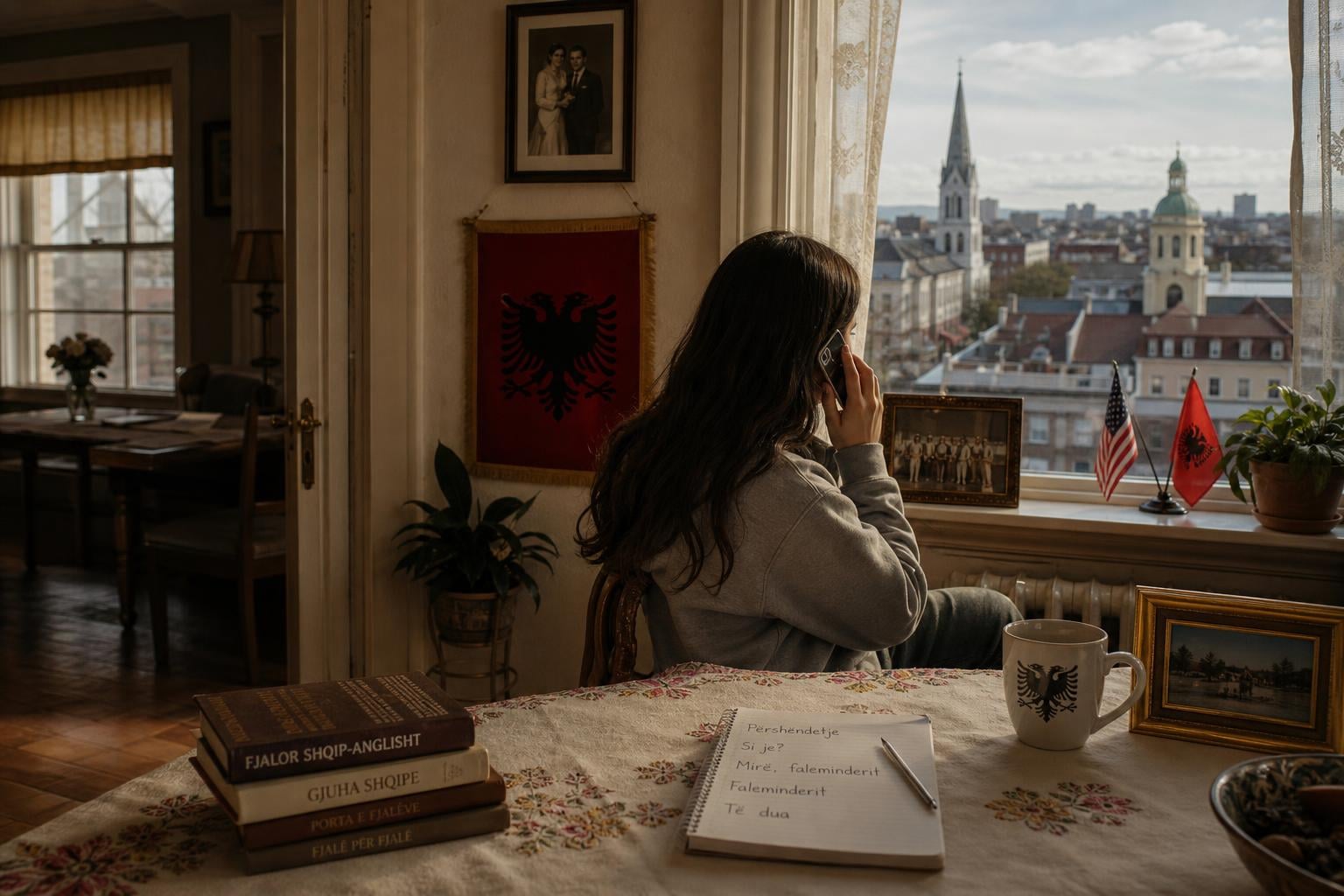
A child in Worcester picks up the phone on a Sunday afternoon. Allo, gjyshe. The grandmother on the other end, in Tirana or Pristina or Shkodër, lights up before the kid has said a second word. The call is twelve minutes of family news in mixed English and Albanian, and at the end the child says the line they have been practicing all week. Të dua, gjyshe. The grandmother answers without missing a beat. Edhe unë të dua, zemra ime. I love you too, my heart.
That phrase — Të dua (TUH DOO-ah) — is the most common way to say I love you in Albanian. A second-grader can use it on grandma. A wedding speaker can use it in front of three hundred people. A diaspora parent can text it to a teenager who answers in English but understands the Albanian.
This guide is a working phrase repertoire — Të dua is the headline, with variants and pronunciation below, then terms of endearment, how to say I miss you, greetings and farewells, hello-and-how-are-you essentials, family vocabulary, special-occasion lines like gëzuar and urime, and the small Tosk-Gheg pronunciation differences. For the alphabet itself, see our Albanian alphabet guide. For the broader Albanian language — its dialects, grammar, and place in Indo-European — see the language piece.
How to say “I love you” in Albanian
The plain answer is Të dua. The fuller picture is four overlapping phrases that Albanian speakers reach for depending on register.
| Phrase | Pronunciation | Meaning | Use case |
|---|---|---|---|
| Të dua | TUH DOO-ah | I love you | The default. Family, partners, close friends. |
| Të dua shumë | TUH DOO-ah SHOO-muh | I love you a lot | Adds warmth. Common to a parent, child, or grandparent. |
| Të dashuroj | TUH dah-shoo-ROY | I love you (literary) | Songs, poetry, formal letters. Rarely said aloud at home. |
| Të do zemra | TUH doh ZEM-rah | My heart loves you | Affectionate variant; common with kids and partners. |
Të dua is built from të (you, accusative) and dua (I want / I love). The verb dua means both want and love depending on context — Albanian does not split them the way English does. Dua një kafe means I want a coffee. Të dua means I love you. Tone and pronoun do the work.
Të dashuroj uses the verb dashuroj (to love), built from dashuri (love). It is more formal and self-conscious — the verb you find in love songs and old letters. Diaspora kids who have only heard the phrase in music sometimes assume it is the standard spoken form. It is not. Stick with Të dua unless you are writing a Valentine.
Të dua shumë is the everyday upgrade. Shumë (very, a lot) intensifies the line without changing the register. A mother says it to a teenager packing for college. A son says it back. Të do zemra — literally the heart loves you — is a sweeter form families use with small children.
Saying it to family
The most useful thing for a diaspora reader to know — in Albanian, expressions of love between family members are routine. A parent ending a phone call with Të dua, bir (I love you, son) or Të dua, bijë (I love you, daughter) is doing what an English-speaking American parent does signing off with “love you.” Not a once-a-year line. Weekly, sometimes daily, normal at every age. Diaspora kids who learn Të dua from love songs can over-romanticize it and freeze when it is time to say it to gjyshja on the phone. Don’t. The phrase fits.
Common combinations:
| Phrase | Pronunciation | Use case |
|---|---|---|
| Të dua, mami | TUH DOO-ah, MAH-mee | I love you, mom |
| Të dua, babi | TUH DOO-ah, BAH-bee | I love you, dad |
| Të dua shumë, gjyshe | TUH DOO-ah SHOO-muh, JEE-sheh | I love you a lot, grandma |
| Të dua shumë, gjysh | TUH DOO-ah SHOO-muh, JEESH | I love you a lot, grandpa |
| Të dua, vëlla | TUH DOO-ah, VUH-lah | I love you, brother |
| Të dua, motër | TUH DOO-ah, MOH-tuhr | I love you, sister |
| Të dua, zemra ime | TUH DOO-ah, ZEM-rah EE-meh | I love you, my heart (to a child) |
In direct address, mami is mom and babi is dad. Bir is son and bijë is daughter when speaking to them; older diaspora speakers may use bir for any young man as a soft term of address.
For friends, Të dua works, but Albanians often reach for the warmer Të kam shumë xhan (TUH kahm SHOO-muh JAHN) — literally I have you in my soul, used as you are dear to me. It is the platonic version, what cousins and lifelong friends actually say. Xhan is borrowed from Persian via Turkish, meaning soul or dear life.
Terms of endearment: zemra, shpirti, jeta
Albanian is rich in pet names. Most are body parts or life words turned into possessives — my heart, my soul, my life, my little one. They get used the way English uses honey, sweetie, love.
| Phrase | Pronunciation | Meaning |
|---|---|---|
| zemra ime | ZEM-rah EE-meh | my heart |
| zemër | ZEM-uhr | heart (vocative; “my heart”) |
| shpirti im | SHPEER-tee EEM | my soul |
| jeta ime | YEH-tah EE-meh | my life |
| bukuria ime | boo-KOO-ree-ah EE-meh | my beauty |
| xhani im | JAH-nee EEM | my dear / my soul |
| xhanan | jah-NAHN | dear (warm, slightly old-fashioned) |
| vogëlushi im | voh-guh-LOO-shee EEM | my little one (to a boy) |
| vogëlushja ime | voh-guh-LOOSH-yah EE-meh | my little one (to a girl) |
| e dashura ime | eh DAH-shoo-rah EE-meh | my beloved (feminine) |
| i dashuri im | ee DAH-shoo-ree EEM | my beloved (masculine) |
Two quick grammar notes. Albanian suffixes its definite article: zemër is heart, zemra is the heart. And the possessive im (my) takes the feminine form ime with feminine nouns — so zemra ime but shpirti im. Match the gender of the noun.
The most common of these is zemra ime. It is used for everyone — a baby, a partner, an aging parent, a grandchild. A lullaby that ends fli, fli, zemra ime (sleep, sleep, my heart) is something an Albanian grandmother in Detroit has likely sung to three generations of children.
How to say “I miss you”
Albanian has a literal way and an idiomatic way to say I miss you, and the idiomatic version is the one you actually want.
| Phrase | Pronunciation | Use case |
|---|---|---|
| Më mungon | muh moon-GOHN | I miss you (literal; you are missing from me) |
| Më ke marrë malin | muh keh MAH-ruh MAH-leen | I miss you (idiomatic; you have taken my mountain) |
| Të kam marrë malin | tuh kahm MAH-ruh MAH-leen | I miss you (idiomatic, reversed pronoun) |
| Më merr malli për ty | muh mehr MAH-lee per tee | I am taken with longing for you |
Më mungon is the textbook line, from mungoj (to be absent). It is the version a translator app gives you — correct, but flatter than what Albanians actually say.
The phrase you hear at family dinners is Më ke marrë malin. Word for word, you have taken my mountain. Mali is mountain; malli (double L) is longing or homesickness — close words that feed each other in the imagination. The image is that the missing person has carried away something the size of a mountain, leaving a gap. Albanians use the phrase to mean I miss you so much it is unbearable.
A diaspora kid hearing Më ke marrë malin from a grandparent on a video call is hearing the strongest version of I miss you the language has. The reverse — Të kam marrë malin — means the same thing with the pronoun flipped. Më merr malli për ty is a more poetic third option.
Greetings and farewells
The biggest source of confusion for diaspora learners is the gap between formal greetings (what schoolbooks teach) and what families actually say. Both are real Albanian.
| Greeting | Pronunciation | Register / use |
|---|---|---|
| Përshëndetje | per-shun-DET-yeh | Formal hello (any time of day) |
| Tungjatjeta | toon-GYAHT-yeh-tah | Older, warm “long life to you” |
| Tung | TOONG | Informal hi / bye (short for tungjatjeta) |
| Mirëmëngjes | MEE-ruh-MUNG-yes | Good morning |
| Mirëdita | MEE-ruh-DEE-tah | Good day / good afternoon |
| Mirëmbrëma | MEE-ruh-MBRUH-mah | Good evening |
| Çkemi | CHKEH-mee | Informal “what’s up / how are you” |
| Si je? | SEE yeh | Informal “how are you” (singular) |
Përshëndetje is the safe choice for any first interaction — a service call to Tirana, a teacher meeting, a wedding receiving line. Tungjatjeta is older and slightly grander, literally long life to you, heard more from older speakers and in northern dialects. The shortened form tung is what younger speakers actually say to friends — informal hi, informal bye, drop into a chat with it.
Çkemi (also written ç’kemi) is the casual what’s up. Literally what do we have. It functions as both greeting and how-are-you. Reply with Mirë, ti? (good, you?) and you have done your part. The time-of-day greetings — mirëmëngjes, mirëdita, mirëmbrëma — work the way they do in Spanish or Italian.
Now the farewells.
| Farewell | Pronunciation | Use |
|---|---|---|
| Mirupafshim | mee-roo-PAHF-sheem | Formal goodbye |
| Tung | TOONG | Casual bye |
| Shihemi | SHEE-heh-mee | See you |
| Shihemi më vonë | SHEE-heh-mee muh VOH-nuh | See you later |
| Natën e mirë | NAH-tuhn eh MEE-ruh | Good night |
| Ditën e mirë | DEE-tuhn eh MEE-ruh | Have a good day |
| Rrugë të mbarë | ROO-guh tuh MBAH-ruh | Safe travels (lit. a successful road) |
Mirupafshim is the standard goodbye — miru (good) + pafshim (let us see again) — and works in every register. Shihemi (we see each other) is closer to see you, used between people who expect to be in touch soon. Natën e mirë is good night. Rrugë të mbarë is the going-away phrase Albanian grandmothers say at the door before a long trip — literally may your road be successful, felt as travel well.
“How are you?” and the polite essentials
Asking how are you in Albanian is the second-most-asked question a diaspora learner has, after how to say I love you. The short version is Si je? — but the polite forms matter.
| Phrase | Pronunciation | Register / use |
|---|---|---|
| Si je? | SEE yeh | Informal singular: friend, sibling, peer |
| Si jeni? | SEE YEH-nee | Formal or plural: elder, group, stranger |
| Si po kalon? | SEE poh kah-LOHN | How are you doing (informal) |
| Si shkojnë punët? | SEE SHKOY-nuh POO-nuht | How are things going |
| Çfarë ka të re? | CHFAH-ruh kah tuh REH | What is new |
| Si je me shëndet? | SEE yeh meh shun-DET | How is your health |
The split between Si je? and Si jeni? is the same split English used to have between thee and you. Je is the second-person singular of jam (to be); jeni is the plural. Use jeni with a group, with an elder out of respect, or with a stranger. A diaspora kid is generally safe defaulting to Si jeni for any adult who is not a peer.
Standard responses: Mirë, faleminderit (good, thank you) · Shumë mirë (very good) · Ashtu-ashtu (so-so) · Jo shumë mirë (not very good) · Po, ti? or Po, ju? (and you?).
The polite essentials Albanian families expect to hear from any guest:
| Phrase | Pronunciation | Meaning |
|---|---|---|
| Faleminderit | fah-leh-meen-DEH-reet | Thank you |
| Shumë faleminderit | SHOO-muh fah-leh-meen-DEH-reet | Thank you very much |
| Të lutem | tuh LOO-tem | Please / you’re welcome (informal) |
| Ju lutem | yoo LOO-tem | Please (formal) |
| Më fal | muh FAHL | Sorry / excuse me |
| Më vjen keq | muh VYEN KEHCH | I am sorry (apology) |
| S’ka problem | SKAH proh-BLEM | No problem |
| Po | POH | Yes |
| Jo | YOH | No |
| Ndoshta | NDOH-shtah | Maybe |
| Edhe | EH-theh | Also / too |
| Asgjë | ahs-GYUH | Nothing |
Faleminderit is the bedrock thank you — adding shumë (a lot) is the usual upgrade. Të lutem and ju lutem both translate as please, with ju lutem the formal or plural version. Të lutem also serves as you’re welcome in informal speech, the way Spanish de nada does double duty. Më fal is the polite excuse-me — what you say in a crowded byrek shop when you need to get past someone. Më vjen keq is the heavier sorry, used when something has actually gone wrong.
Family terms every diaspora kid should know
The vocabulary that comes up at every family dinner. Spelling these correctly on a card matters.
| Albanian | Pronunciation | Meaning |
|---|---|---|
| nëna | NUH-nah | mother (the mother) |
| mami | MAH-mee | mom (direct address) |
| babai | bah-BAH-ee | father (the father) |
| babi | BAH-bee | dad (direct address) |
| gjyshja | JEESH-yah | grandmother |
| gjyshi | JEE-shee | grandfather |
| gjyshja ime | JEESH-yah EE-meh | my grandmother |
| motra | MOH-trah | sister |
| vëllai | vuh-LAH-ee | brother |
| djali | JAH-lee | son / boy |
| vajza | VAHY-zah | daughter / girl |
| fëmija | fuh-MEE-yah | child |
| halla | HAH-lah | paternal aunt (father’s sister) |
| tezja | TEZ-yah | maternal aunt (mother’s sister) |
| xhaxhai | jah-JAH-ee | paternal uncle (father’s brother) |
| daja | DAH-yah | maternal uncle (mother’s brother) |
| kushëriri | koo-shuh-REE-ree | cousin (masculine) |
| kushërira | koo-shuh-REE-rah | cousin (feminine) |
| nipi | NEE-pee | grandson / nephew |
| mbesa | MBEH-sah | granddaughter / niece |
Albanian splits aunts and uncles by side of family, like many Balkan languages and unlike English. Halla and xhaxhai are on the father’s side; tezja and daja are on the mother’s. Albanian families track lineage with care — getting it wrong on a wedding invitation is the kind of small mistake a diaspora reader can avoid by reading this paragraph.
Many of these basic kinship terms — nënë, babë, vëlla, motër — are part of the deepest core of Albanian vocabulary, with no obvious cousins in other Indo-European languages. They are part of the load-bearing evidence linguists cite when arguing Albanian descends from a Paleo-Balkan ancestor. For more, see our Albanian names guide.
Special occasions: birthdays, weddings, toasts
The phrases you reach for at the darsëm (wedding), the birthday party, the New Year’s toast.
| Phrase | Pronunciation | Use |
|---|---|---|
| Gëzuar! | guh-ZOO-ahr | Cheers / happy (used as toast) |
| Urime! | oo-REE-meh | Congratulations |
| Ditëlindje të gëzuar | DEE-tuh-LEEN-dyeh tuh guh-ZOO-ahr | Happy birthday |
| Të lumtë! | tuh LOOM-tuh | Good for you / nice job / well done |
| Përgëzime | per-guh-ZEE-meh | Congratulations (formal) |
| Shumë vite të lumtura | SHOO-muh VEE-teh tuh LOOM-too-rah | Many happy years |
| Edhe njëqind | EH-theh nyuh-CHEEND | And a hundred more (toast for birthdays) |
| Gëzuar Vitin e Ri | guh-ZOO-ahr VEE-teen eh REE | Happy New Year |
| Festa të gëzuara | FES-tah tuh guh-ZOO-ah-rah | Happy holidays |
Gëzuar is the standard toast, raised with raki or wine at any celebration. The verb gëzoj means I rejoice; gëzuar is rejoiced, used as an exclamation. The same word stretches into Gëzuar Vitin e Ri (Happy New Year) and ditëlindje të gëzuar (happy birthday). Urime is the all-purpose congratulations — for a graduation, a promotion, a new baby, a wedding. Adding Edhe njëqind (and a hundred more) to a birthday toast is the warm extra line, like adding many more in English.
Të lumtë is one of the most useful and underused phrases for diaspora learners. It comes from lumtë (may you be blessed) and means good for you, well done, nice job. A grandmother says it to a kid who has done something kind. A coach says it to a player. It is the small praise that keeps Albanian conversation warm. For a traditional Albanian wedding, older relatives often add Trashëgoheni (trah-shuh-GOH-heh-nee) — may you have descendants — said to the couple.
Pronunciation: a working guide
Albanian is a phonetic language. Once a learner knows the 36 letters of the alphabet, they can read most words aloud accurately. A few sounds give English speakers trouble, and the phrases in this guide use them.
The vowel ë. A soft schwa — the unstressed e in English “the” or “sofa.” Tosk and the standard keep it gentle; Gheg often drops it. Tosk Të dua is TUH DOO-ah; Gheg compresses toward T’DOO-ah or T’DU.
The letter ç. Pronounced as the ch in church. Çfarë (what) is CHFAH-ruh; çkemi is CHKEH-mee.
The pair q and gj. Palatal stops with no English equivalent. Q sits between English ky and ch, made by pressing the middle of the tongue against the roof of the mouth. Gj is the voiced version, between gy and j. Gjyshja is JEESH-yah, with a softer J than English.
The letter xh. Like English j in judge. Xhan is JAHN.
Rolled r vs. tapped r. Rr is rolled, like Spanish perro. Plain r is a single tap, like Spanish pero. Most diaspora learners get understood with a single tap for both.
Stress. Albanian usually stresses the second-to-last syllable. The phrases above mark stress with capitals.
Gheg and Tosk: the small differences that matter
A reader whose family is from Kosovo, northern Albania, North Macedonia, or Montenegro grew up hearing Gheg. A reader whose family is from southern Albania or the Arbëresh communities of Italy grew up hearing Tosk. The standard literary form is Tosk-based, set in 1972. Both are real Albanian.
The most visible difference is the final ë — standard Tosk keeps it, Gheg often drops it.
| Standard / Tosk | Gheg compression | Meaning |
|---|---|---|
| Të dua | T’du | I love you |
| Mirë | near-mir | Good |
| Faleminderit | slight schwa loss | Thank you |
Gheg also keeps nasal vowels that Tosk has lost and uses kam me for the future tense where the standard uses do të. For everyday phrases, the practical advice is simple — speak the variant you hear at home, read the standard. A kid who learned T’du from a Kosovar grandmother is speaking real Albanian. So is a kid who learned Të dua in Saturday school. Neither needs correcting. For deeper context, see the language piece and the alphabet piece.
Why these phrases matter — and how to keep them
These phrases are not romantic only because they are about love. Albanian is a warm language by default — the same words used for romance get used for parents, kids, grandparents, lifelong friends. Zemra ime is what a partner says, and what a grandmother says to a grandchild she has not seen in a year. That warmth is the part of Albanian a diaspora kid stands to lose. Grammar can be learned in a textbook. The reflex of saying Të dua to a parent on a Sunday phone call cannot — it has to be modeled, which means it has to be heard.
If your family speaks shqip, even haltingly, keep the phrases moving between generations. Saturday schools and online tutors are real and worth using, but the load-bearing piece is the daily exchange. Si je, gjyshe? on a Sunday afternoon does more than any app. When this generation gets counted, the next gets resourced — the schools, the children’s books, the summer programs all run better when the community can show its size. Get counted at /register, and help keep the language in circulation.