

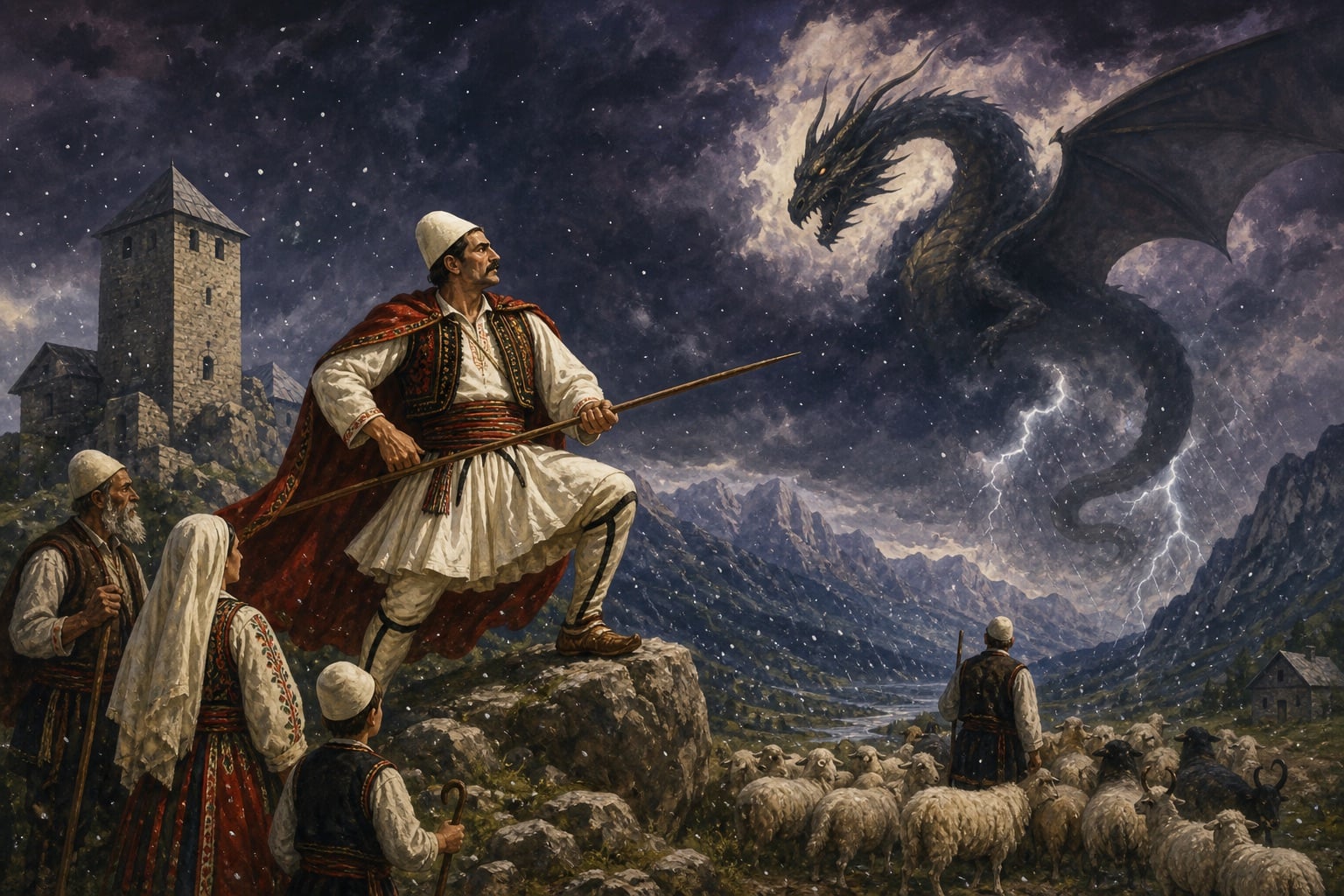
Above Theth, the sky turns the color of a bruise before the hail comes. The shepherds don’t watch the clouds. They watch each other — and they think about the boy two houses down who has gone quiet and heavy-lidded, the one nobody is allowed to wake.
He is a drangue. He may not know it. His own mother may not know it. But when the hail starts, the village understands what is happening overhead: the serpent is loose, and the boy has gone up to fight it.
The shirt he was born in
You can spot a drangue at birth. He arrives wrapped in a caul — a thin film of membrane drawn over the head and shoulders, what the highlanders call the këmishë, the shirt. Some are said to carry small wings, folded and hidden under the arms, that no one sees until they are needed. Often he is a firstborn, or born on a Saturday, marked by some accident of timing the old women kept track of.
The midwife does not throw the shirt away. She dries it, folds it, and locks it in a wooden chest. The drangue’s whole power lives in that scrap of skin. Burn it or lose it, and you are left with an ordinary man who only sleeps strangely during storms.
Robert Elsie, who catalogued these beliefs in his Dictionary of Albanian Religion, Mythology and Folk Culture, found the drangue across the northern highlands — Dukagjin, Malësia, the valleys under the Bjeshkët e Nemuna — and among the Arbëresh of southern Italy, who carried the story across the Adriatic and never set it down.
What he fights with
A drangue does not carry a sword. He fights with whatever the mountain puts in his hands.
He tears oak trees out by the root and swings them. He throws the iron plowshare — the heavy blade that turns the soil — and great stones, and the long bolts of lightning the rest of us only read as weather. Thunder is the sound of the blow landing. The morning after a bad storm, a farmer who finds his plow blade flung half a mile from the field knows what borrowed it in the night.
Maximilian Lambertz, collecting in these mountains in the 1910s, wrote down the same arsenal again and again: trees, stones, the plow’s iron, lightning. The weapons are the storm itself, read backwards.
The serpent on the other side
The thing the drangue is born to fight is the Kuçedra — the many-headed, fire-and-filth serpent who hoards water and brings drought, the worst thing the highlands could imagine in a country that lived or died by its rain. She is the reason the drangue exists at all.
So a thunderstorm is not weather. It is a duel. The drangue rises into the clouds, the Kuçedra rears to meet him, and the hail and the lightning and the felled trees are what reaches the ground from a fight no one below can see. When the storm finally breaks and the rain comes down clean, the drangue has won, and the drought is over.
Why you must never wake him
Here is the quiet, strange center of it.
The drangue does not climb into the sky in his body. He sleeps. He goes heavy and unwakeable, and his soul slips out to do the fighting while the body lies still in the house. This is why, when the hail starts, the family lets the boy sleep, steps around him, and lowers their voices.
Wake him, and his soul cannot find its way back to the war. The fight is lost. The serpent wins, and the crop is gone. A son you cannot rouse, in the middle of the worst storm of the year, is not a worry. He is the only thing between the village and ruin.
A militia of the gifted
One drangue is usually enough. A bad Kuçedra is not.
When the serpent is too strong, the drangue do not fight alone. Several of them converge in the same storm and bring her down as a group. It is a telling detail. In a place with no army, no police, and no rain it could count on, the highlands pictured their defender not as a king or a saint but as the odd boy next door — and his power not as a throne but as a thing he shared with other odd boys when the weather turned.
Edith Durham, who walked these mountains in 1908, recorded how seriously the highlanders treated men said to be marked from birth. Eqrem Çabej, the language’s great etymologist, placed words like this one in a layer older than the Ottomans and older than the churches. Ethnographers still work to record the surviving accounts before the last people who half-believe them are gone.
What is left of him
You will not meet a drangue today. But the shape of him is still in the language, and in the reflex, on a green and ugly afternoon, to look at the hills before the hail.
He was never really about dragons. He was how people with no defense against the sky named the thing that kept the hail off the wheat: not a god, not the state, but one of their own — asleep in a back room, doing in the clouds what no one could do on the ground.