
Most Albanian American families have heard the word Illyrian a hundred times and the word Dardanian maybe twice. That is a gap worth closing.
The Dardanians — in Albanian, Dardanët — were a Paleo-Balkan people who held the central Balkan plateau for roughly five centuries before Roman conquest. Their kingdom sat on top of what is now Kosovo, with limbs reaching into modern North Macedonia, southern Serbia, and eastern Albania. They fought Philip II of Macedon, the father of Alexander the Great. They captured Macedonian cities. They cut a deal with Rome against Macedonia. They held out as a sovereign kingdom until 28 BCE, when Augustus folded them into the empire. Two of the most consequential Roman and Byzantine emperors — Constantine the Great and Justinian I — were born inside their former territory. Two thousand years later, the first president of Kosovo proposed renaming the country Dardania.
That arc deserves more than a footnote.
This guide walks through who the Dardanians were, what the ancient sources do and do not say about them, the kings worth knowing, the wars that defined them, the Roman province that bore their name, and the modern revival of Dardania in Kosovar political and cultural life. Where the scholarship is settled, we say so. Where it isn’t, we say that too. The Albanian-Dardanian continuity question gets handled the way we handle it elsewhere: as a serious hypothesis with serious gaps, not as a closed case and not as a fantasy.
The reader we have in mind is in Brooklyn, Worcester, Sterling Heights, the Bronx, or Yonkers. The line between the deep past and a registration form on this website is what the National Albanian Registry exists to draw, one careful piece at a time.
Who the Dardanians were
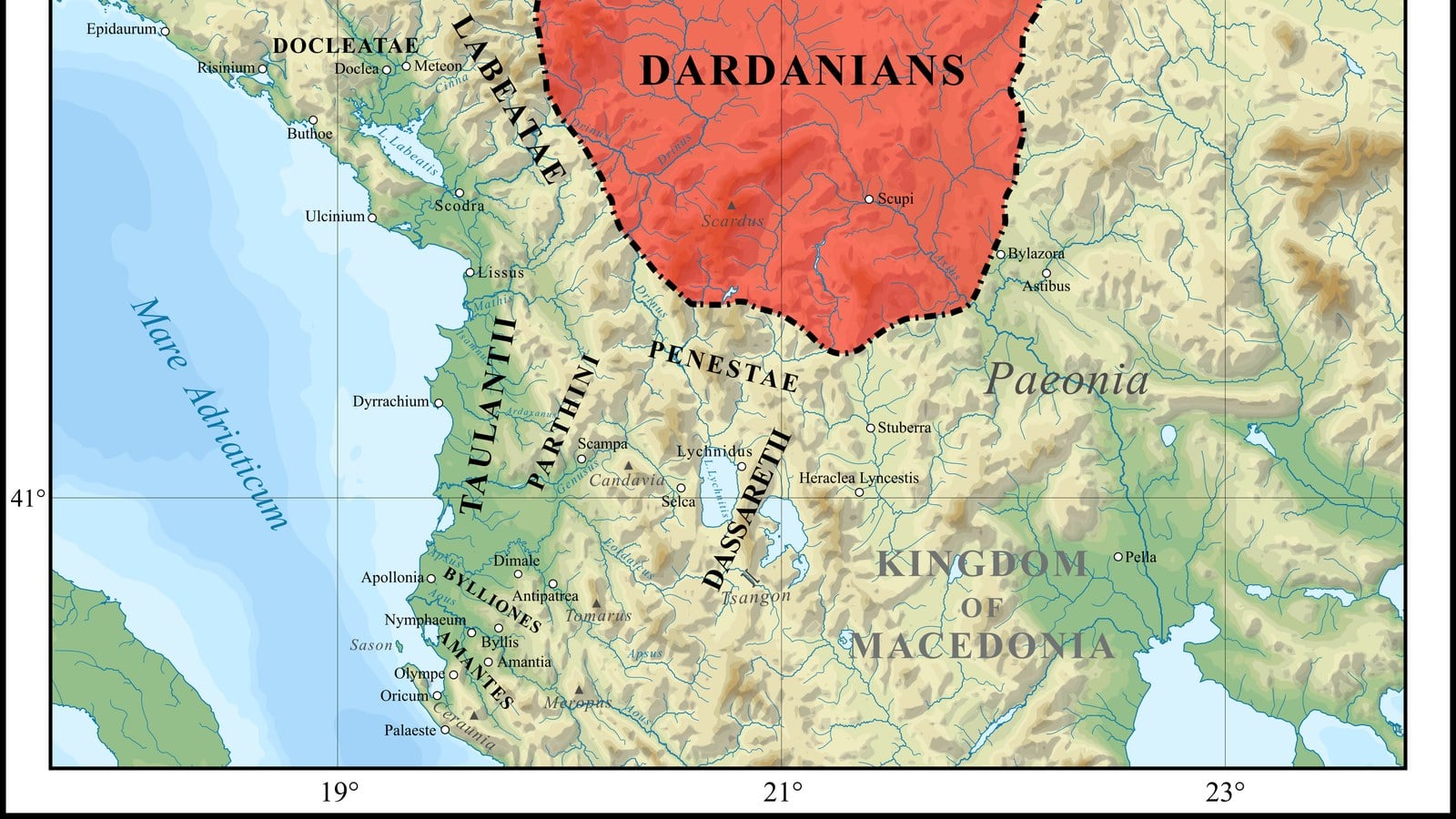
The Dardanians lived in the central Balkans, inland from the Adriatic. Greek and Roman geographers locate them in a zone covering most of modern Kosovo, the northern part of North Macedonia, parts of southeastern Serbia around the Morava and Niš valleys, and the eastern edge of present-day Albania. Their southern neighbors were Macedonia and the smaller kingdom of Paeonia. To the west were other Illyrian groups — the Ardiaei on the Adriatic, the Dassaretae and Taulantii in the Albanian hinterland. To the east lay Thracian populations.
The Greek geographer Strabo, writing in the first century BCE, names the Dardani as one of the three strongest Illyrian peoples, alongside the Ardiaei and the Autariatae. The Roman historian Livy records their wars with Macedonia across his books on the Roman conquest of the eastern Mediterranean. Polybius, Appian, and Cassius Dio all mention them. The ancient evidence is uneven — most of it filtered through writers describing wars rather than the Dardanians themselves — but enough to establish a real, organized people from the 4th century BCE onward (Wikipedia: Dardani).
How did they organize themselves. Like most Paleo-Balkan peoples, the Dardanians were a tribal confederation around a royal house rather than a centralized state. The kings the sources name — Longarus, Bato, Monunius — lead coalitions of related tribes. Their power center sat on the high plateau around modern Pristina, with hill forts and fortified settlements running through the river valleys. They controlled trade routes between the Adriatic and the Aegean and between the central Balkans and the Danube.
The name Dardani itself is older than the kingdom. Greek mythological tradition connected it to Dardanus, the legendary founder of Troy. The historical Dardanians of the Balkans are a separate group from the mythological Dardanians of the Troad in Anatolia. Modern scholarship treats the shared name as coincidence or an old Indo-European root rather than a genuine ethnic link.
The language question — Illyrian, Thracian, or both
The straightforward question is what language the Dardanians spoke. The honest answer is that we don’t know in detail, and the evidence points to a mixed picture.
The personal and place names that survive from Dardanian territory — preserved in Greek and Roman inscriptions and on tombstones — divide along a rough east-west line. Illyrian personal names predominate in the western half, the area covering modern Kosovo. Thracian names appear more often in the eastern half, around modern Niš and the Morava valley in present-day southeastern Serbia. The cluster boundary runs roughly through the middle of the old Dardanian zone (Wikipedia: Dardani).
What does that mean. A few things.
It means older 20th-century scholarship that argued the Dardanians were either Illyrian or Thracian, full stop, was working with too clean a frame. Strabo grouped them with the Illyrians; some early-20th-century German linguists treated them as Thracian; the modern reading is that both elements were present, with the Illyrian element strongest in the west. The boundary between Illyrian and Thracian linguistic zones in the ancient Balkans ran through Dardanian territory, not around it.
It also means that any claim about a direct, single-language descent from the Dardanians to modern Albanian has to deal with a complication. If the Dardanian zone was linguistically mixed, descending from it linguistically does not pick out one language. The Illyrian-Albanian continuity hypothesis, covered in our Paleo-Balkan peoples overview, can absorb Dardanian-Illyrian as a piece of the larger picture. The narrower claim that Albanian descends specifically from Dardanian, distinct from other Illyrian varieties, is harder to support with the evidence we have.
Dardanian was Paleo-Balkan and Indo-European. Beyond that, the linguistic detail is reconstructed from fragments.
The kings worth knowing
Greek and Roman sources name a handful of Dardanian kings across roughly two centuries. The list is short, the dates are approximate, and the attributions are not always clean — older books sometimes assigned kings to “Dardania” who current scholarship now treats as Illyrian rulers of other regions. The figures below are the ones most often associated with the historical Dardanian kingdom in the ancient sources, with the caveats noted.
Bardyllis (c. 4th century BCE). The most powerful Illyrian ruler of the 4th century BCE. In 359 BCE his army killed the Macedonian king Perdiccas III along with 4,000 Macedonian soldiers, an early high-water mark for Illyrian power. Around 358 BCE he was defeated by Philip II of Macedon. Older scholarship called Bardyllis a Dardanian king; he is now more often described as an Illyrian king — the founder of the first attested Illyrian dynasty — whose kingdom was centered near Lake Ohrid, though some sources still tie him to the Dardanians. He matters for the Dardanian story because the political geography he operated in is the same geography the Dardanian kings would inherit (Wikipedia: Bardylis).
Longarus (active c. 230s–220s BCE). The first king clearly identified with the Dardanian kingdom in surviving sources. In 230 BCE he led the Dardanians in capturing Bylazora, the strategic capital of Paeonia. Several Illyrian tribes who had sided with Queen Teuta of the Ardiaei deserted her and joined Longarus, a shift suggesting the Dardanian kingdom was reaching the height of its regional power. He fought Demetrius II of Macedon successfully (Wikipedia: Kingdom of Dardania).
Bato (active c. 201 BCE). The king who pivoted the Dardanians toward Rome. In 201 BCE he allied with the Roman consul Publius Sulpicius Galba, along with Pleuratus III of the Illyrian Labeatae and Amynander king of Athamania, against Philip V of Macedon in the Second Macedonian War. The alliance produced a Roman victory at Cynoscephalae in 197 BCE and a permanent realignment of central Balkan politics in Rome’s favor.
Monunius II (mid-2nd century BCE). A later king whose daughter Etuta married Gentius, the last king of the Illyrian Ardiaei kingdom centered at Shkodra. The marriage links the Dardanian royal house to the broader Illyrian political world in the final generation before Roman conquest. Gentius was defeated by Rome in 168 BCE, the same year the Macedonian kingdom fell.
This handful of names is most of what the ancient record preserves of Dardanian royal politics. What we have is a sketch, not a chronicle. The sketch is enough to establish that the kingdom was active, organized, and consequential for two and a half centuries before Rome arrived in force.
The wars with Macedonia and Rome
The Dardanian kingdom’s foreign policy, from the 4th century BCE through the 1st, was dominated by two relationships — its southern neighbor Macedonia and the rising power of Rome.
The Macedonian rivalry was the older one. Philip II, Alexander the Great, and their successors fought to keep the northern frontier secure against raids from the Dardanian highlands. The kingdom that had killed Perdiccas III in 359 BCE was a permanent strategic concern for the Macedonian court. The Dardanian capture of Bylazora in 230 BCE under Longarus was a serious blow to Macedonian regional power.
The Roman relationship started as a tactical alliance and ended in conquest. When Rome entered the eastern Mediterranean in earnest in the late 3rd century BCE, the Dardanians saw an opportunity. The kings who fought Macedonia from the north now had a wealthy western ally who shared the same enemy. Bato’s alliance with Sulpicius in 201 BCE marked the beginning. Through the Second Macedonian War (200–197 BCE) and the Third Macedonian War (171–168 BCE), the Dardanians were Roman partners rather than opponents.
The partnership did not save them in the long run. After 168 BCE, with Macedonia broken and Illyria divided into Roman protectorates, the Dardanians remained sovereign but exposed. The relationship shifted from alliance to client status, and eventually to direct conquest. The Dardanian kingdom retained nominal independence until 28 BCE, when the emperor Augustus — consolidating Roman power across the Balkans — incorporated Dardanian territory into the Roman provincial system. Two and a half centuries of recorded Dardanian sovereignty ended (Wikipedia: Kingdom of Dardania).
What the Roman conquest did not change was the population on the ground. The Dardanians remained where they were, now Roman subjects. Roman roads and Roman administration arrived. Public life shifted toward Latin in the west and Greek in the east. The countryside, the mountains, and the trade networks remained Dardanian.
Roman Dardania — the province
For roughly three centuries after conquest, Dardanian territory was administered as part of the larger Roman province of Moesia, with Dardania an unofficial region inside it. The decisive administrative change came under Diocletian. His provincial reforms, completed between 284 and 293 CE, carved Dardania out as a separate province within the Diocese of Moesia. Its main centres were Naissus — modern Niš in Serbia — along with Scupi and Ulpiana; the ancient sources don’t name a single provincial capital (Wikipedia: Dardania (Roman province)).
The main cities of Roman Dardania were three.
Naissus (modern Niš) sat at the northern edge, at a strategic crossroads between the Danubian and Aegean trade routes. It was one of the province’s three main centres, a major military base, and one of the wealthier urban centers of the late Roman Balkans.
Scupi (modern Skopje, North Macedonia) anchored the southern edge. It was a Roman colonia founded in the 1st century CE, originally settled with veterans of Roman legions, and grew into a substantial city along the Vardar river corridor.
Ulpiana (near modern Lipjan in Kosovo) was the central administrative town in the heart of old Dardanian territory. It was founded in the 2nd century CE, named for the emperor Trajan whose family name was Ulpius. The Romans developed Ulpiana around the rich silver and lead mining region of central Kosovo — the Municipium Dardanorum, abbreviated Municipium DD, sat nearby. Ulpiana was destroyed by an earthquake in 518 CE and rebuilt under Justinian as Justiniana Secunda.
Mining was the economic backbone. The lead-silver deposits of central Kosovo — the same deposits the modern Trepça mining complex has exploited in the 20th and 21st centuries — supplied Roman mints and Roman armies for centuries. Dardanian silver was real wealth in the Roman economy.
Roman Dardania was not a backwater. It was an organized, urban, productive piece of the empire that produced two of the most consequential rulers in late Roman and Byzantine history.
Constantine, Justinian, and the Dardanian zone
Two emperors were born inside what had been Dardanian territory. Both reshaped the Roman world. Their connection to the province is a geographic fact, not a claim about ethnic descent.
Constantine the Great was born at Naissus around 272 CE, while his father Constantius Chlorus was serving in the Roman military administration there. Constantine became the emperor who legalized Christianity through the Edict of Milan in 313 CE, who moved the imperial capital to Byzantium and renamed it Constantinople in 330 CE, and who ended the persecution of Christians across the Roman world.
Justinian I was born around 482 CE at Tauresium, a village near modern Skopje. He came from a family of Dardanian Romans — his uncle and predecessor Justin I was born at Bederiana, another village in the same zone. Justinian ruled from 527 to 565 CE, codified Roman law into the Corpus Juris Civilis, rebuilt the Hagia Sophia in Constantinople, and reconquered large parts of the western Mediterranean. His legal code is the foundation of most modern European civil law systems.
What does Dardanian birthplace mean. Both emperors came from the same central Balkan plateau, two centuries apart, when the region was a thoroughly Romanized province with mixed Latin- and Greek-speaking populations. Calling either emperor “ethnically Dardanian” reads more into the sources than the sources support. Calling them Dardanian by place of birth is straightforward. The 2024 archaeological work at Ulpiana that produced a monumental inscription naming Justinian as Dardanian-born — discussed in Prishtina Insight and other regional outlets — confirms what the late antique sources already indicated (Wikipedia: Justinian I).
For a US-based Albanian American reader, the takeaway is modest but real. The territory of the old Dardanian kingdom produced two of the architects of the late Roman and early Byzantine world. The continuity from that period to modern Kosovo runs through occupation, language change, religious change, and political change — but the geography is the same.
Did the Dardanians become Albanian
This is where careful framing matters most.
The Illyrian-Albanian continuity hypothesis — covered in our Paleo-Balkan peoples piece — is the leading scholarly account of Albanian origins. It holds that Albanian descends from a Paleo-Balkan language spoken in the western Balkans, most plausibly Illyrian or a closely related variety, and that Albanian-speaking populations have lived in or near their current territory continuously since antiquity. The case is suggestive, not closed.
The narrower question is whether modern Albanians descend specifically from the Dardanians. Here the evidence gets harder to interpret.
The geographic case is real. Modern Kosovo and the Albanian-speaking zones of North Macedonia sit on top of old Dardanian territory. The mountain villages where Albanian has been continuously spoken overlap heavily with what the Greeks and Romans called Dardania. If the continuity hypothesis is correct in its broad form, the Dardanians are part of the chain that runs from antiquity to the present.
The linguistic case is more complicated. The mixed Illyrian-Thracian character of Dardanian territory means that any “Dardanians became Albanians” claim has to specify which part of the Dardanian linguistic mosaic. The Illyrian element in the western part fits more cleanly with the Albanian continuity picture. The Thracian element in the east fits less cleanly and points more toward the broader Daco-Thracian discussion some linguists have advanced.
The archaeological case is similarly mixed. The Komani-Kruja culture of late antique central Albania and Kosovo is one thread scholars pull on when arguing for population continuity between late Illyrian/Roman and medieval Albanian populations. The thread is real but does not, on its own, identify language.
The honest summary: a Dardanian contribution to the population that became Albanian is plausible and consistent with current evidence. A clean, single-line descent from Dardanian to Albanian is more than the evidence currently supports. Nationalist readings — Albanian, Serbian, or other — sometimes overstate the case. The neutral middle is that the Dardanians were part of the Paleo-Balkan world out of which Albanian eventually emerged, and that the geography of that emergence overlaps with old Dardania.
Dardania in modern Albanian identity
The word Dardania almost disappeared from common Albanian usage between the Roman period and the 19th century. The Rilindja Kombëtare — the Albanian national renaissance of the late 19th century — brought it back. Albanian writers and political figures of that era went looking for pre-Ottoman, pre-Slavic, pre-classical references to their own people, and they found the Dardanians waiting.
Personal names came first. Dardan as a boys’ name and Dardana as a girls’ name entered modern Albanian usage in the 19th century and became common in the 20th, particularly in Kosovo. The communist-era Fjalor me emra njerëzish (Dictionary of Personal Names, 1982) included them. Today Dardan is one of the more visible Illyrian-revival names across the Albanian-speaking world. We cover the full naming layer history in our Albanian names guide.
The political revival came later. Ibrahim Rugova, the first president of Kosovo and the central figure in the 1990s nonviolent resistance, formally proposed Dardania as an alternative name for the country. On 29 October 2000, Rugova unveiled a Dardania flag — blue with a red disc, the Albanian double-headed eagle inside the disc holding a ribbon with the word Dardania — and a presidential emblem on the same theme. The proposal aimed to link the modern state-in-formation to the ancient kingdom on the same ground, and to step outside the Yugoslav-era framing of Kosovo as a place defined by its relationship to Serbia (Wikipedia: Flag of Kosovo).
The renaming proposal did not become official policy. When Kosovo declared independence on 17 February 2008, the country adopted the name Kosovo and a new flag designed by competition. The Dardania flag itself was not retired, though — it lives on as Kosovo’s official presidential flag and saw renewed prominence during Vjosa Osmani’s presidency. Rugova’s coffin was draped with it at his funeral in January 2006.
But Dardania persists. It appears in business names across Kosovo, North Macedonia, and the Albanian diaspora. It appears in personal names that are now in their second or third generation of use. It appears in the presidential coat of arms designed under Rugova. It appears in casual Albanian-language usage as a poetic synonym for Kosovo when writing wants to invoke the deep past.
For an Albanian American reader, the revival is a piece of how the diaspora and the homeland share a frame of reference. A Kosovar-American kid named Dardan in Sterling Heights or the Bronx carries a word that started as a Greek and Roman ethnonym, was revived in the 19th century, was raised as a flag in Pristina in 2000, and is now a working modern given name.
Where you can see the Dardanians today
A brief note on where the physical record of the Dardanians is visible — kept brief because tourism is not what this site exists to do.
Ulpiana, near Lipjan in Kosovo, is the most extensive Dardanian-era archaeological site open to visitors. The Roman city built on top of the older Dardanian settlement preserves walls, gates, a forum, basilicas, and a substantial necropolis. Active archaeological work continues, including the 2024 inscription work mentioned earlier. The Museum of Kosovo in Pristina holds artifacts from the site.
The Municipium Dardanorum — Municipium DD, in the inscriptions — was a Roman mining town in the same central Kosovo region, identified at Sočanica near modern Leposavić. The site is less developed than Ulpiana but preserves substantial Roman-period remains.
Late-Roman and early Byzantine inscriptions and small finds from Dardanian territory are also held in the National Museum of Serbia in Belgrade, the Museum of Macedonia in Skopje, and various regional museums.
For most Albanian American readers, the Dardanians will remain a paper-and-screen acquaintance. The point is to know they existed, what they did, and how their name traveled forward.
How NAR fits into the story
The National Albanian Registry is not an archaeology department. It is a community-led count of Albanian Americans, run as a 501(c)(3) nonprofit, with one goal: produce a real number for a population the US Census has historically undercounted. Around 230,000 people self-reported Albanian ancestry in the 2024 American Community Survey. Community-led estimates put the actual number closer to one million when second- and third-generation Americans are included.
What does an ancient Paleo-Balkan kingdom have to do with that number. The same thing the 11th-century Byzantine reference to Albanians has to do with it, or the 1912 declaration of independence at Vlora. Each piece is a link in a chain that runs from a deep past in the western Balkans to a modern community in New York, Michigan, Massachusetts, and twenty other states. The Dardanians belong to that chain, alongside the Illyrians, the Arbanon principality, Skanderbeg, the Rilindja, and every wave of Albanian arrival in the United States.
If the long story matters to you, the short act is simple. Get counted. The certificate NAR issues is a recognition document — not government identification, not citizenship, not legally binding — and the count it builds is a community-led record of who we are in the United States. The Dardanians left inscriptions on stone. We are leaving a registry on the public record.