
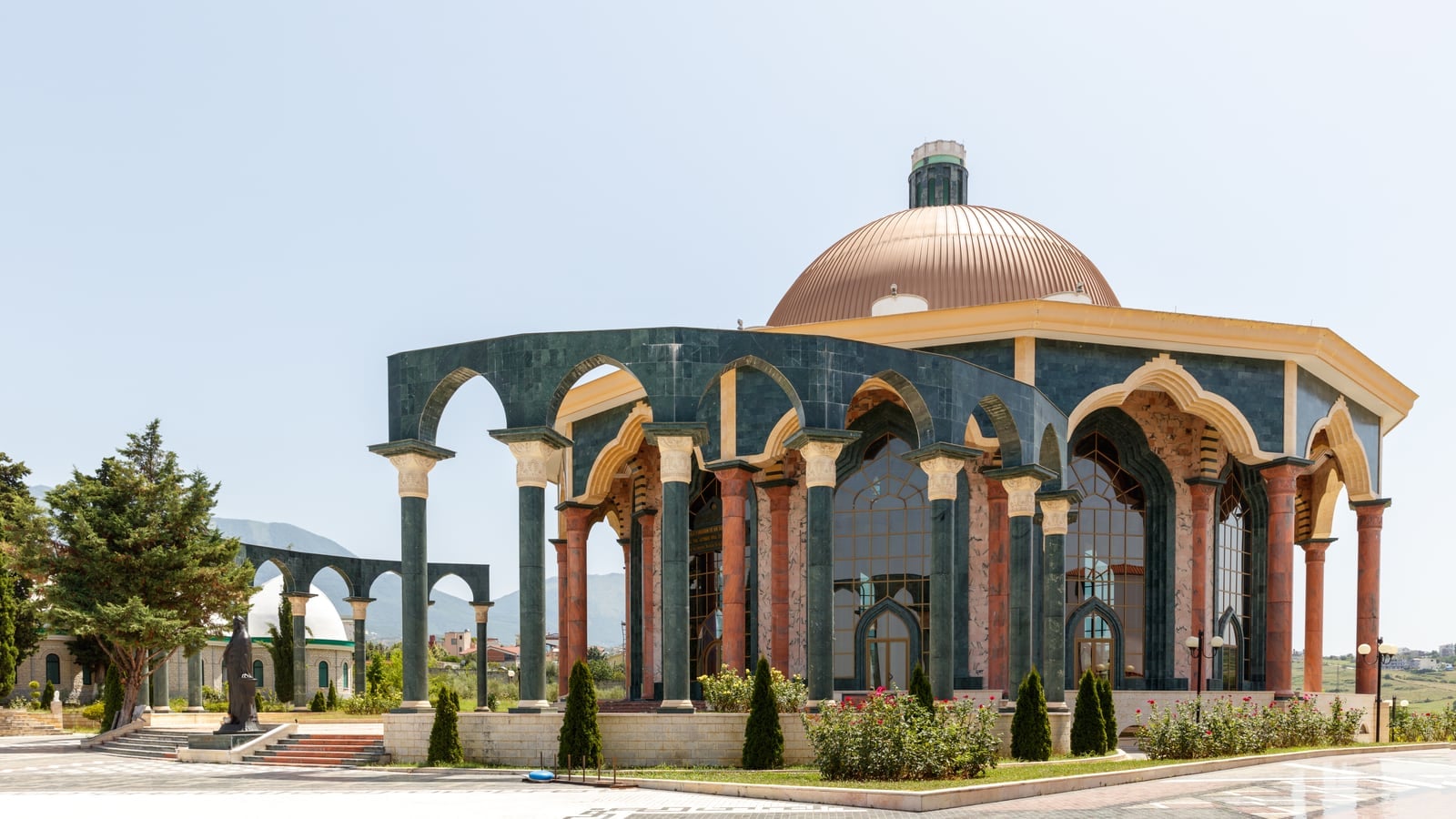
Most of the world’s major religious orders are headquartered where they began. The Bektashi are not. The spiritual capital of this Sufi order — a mystical, famously tolerant strand of Islam born in medieval Anatolia — is a walled complex on the eastern edge of Tirana, the Albanian capital. Its supreme leader, the Dedebaba, lives there. So do its archives, its museum, and its central authority over Bektashi communities from the Balkans to Michigan.
How a 13th-century order from what is now Turkey came to run its world from Albania is a story about exile, national identity, and an unusually open form of faith. It is also a story that reaches across the Atlantic: the first Bektashi lodge in the United States opened in a Detroit suburb in 1954, founded by an Albanian cleric who had fled the same upheavals that reshaped the order at home.
For an Albanian American reading this — Bektashi or not — the point is less theological than civic. Albania is one of the most religiously mixed societies in Europe, and it wears that mix lightly. Catholics, Orthodox Christians, Sunni Muslims, Bektashi, and the nonreligious have lived side by side for centuries, and a well-known literary line holds that what unites Albanians is not a creed but a language and a shared identity. Bektashism is one thread in that fabric. This explainer covers what the order is, why its center sits in Tirana, how it survived an officially atheist state, the 2024 plan to give it a sovereign enclave, and how it took root in America.
What Bektashism is
Bektashism is a Sufi order — a tariqa, or mystical brotherhood, within Islam. It is named for Haji Bektash Veli, a saint traditionally placed in 13th-century Anatolia, and its later rituals were systematized in the 16th century by Balım Sultan. Adherents are called Bektashis (Bektashism, Wikipedia).
The order is best known for being liberal and syncretic. It draws on Sufi mysticism, absorbed influences from Hurufism and the wandering dervish traditions, and carries a strong Shia-tinged veneration of Ali ibn Abi Talib, the cousin and son-in-law of the Prophet Muhammad, along with the Twelve Imams. In practice, Bektashism has historically been more relaxed about formal ritual obligations than orthodox Sunni Islam, and it places heavy emphasis on humanism, social equality, and tolerance (Bektashi, Britannica).
A few terms help, glossed here at first use:
- Tekke (Albanian teqe) — a lodge or monastery, the local house of worship and community.
- Baba — literally “father,” a spiritual leader who heads a tekke and gives guidance.
- Dervish — an initiated member who has taken vows below the rank of baba.
- Dedebaba (Albanian Kryegjysh) — “grandfather” or supreme leader, the order’s highest authority.
- Kryegjyshata — the world headquarters, the seat of the Dedebaba.
The path itself is often described through four “gates” or doors: Sharia (religious law), Tariqa (the mystical path under a guide), Marifa (deep knowledge of God), and Haqiqa (ultimate truth). This is presented here as description, not endorsement; the order’s own teachers explain it far more fully than a heritage article can.
One practical consequence of this outlook is how Bektashism has been received by outsiders. Because the order emphasizes the inner meaning of faith and is comparatively relaxed about outward ritual — it does not, for example, segregate men and women during ceremonies the way many traditions do, and it has long permitted practices that stricter readings of Islam would not — it has frequently been described by scholars and journalists as one of the more liberal currents in the Muslim world. That reputation is part of why Albania has highlighted the order as a symbol of religious coexistence. For a diaspora reader, the useful takeaway is simply that Bektashism is a real and living tradition with its own clergy, calendar, and theology — not a folk curiosity, and not a label that maps neatly onto Western assumptions about Islam.
Haji Bektash Veli and core beliefs
Tradition holds that Haji Bektash Veli was born in Khorasan — in or near Nishapur, in present-day Iran — and that he settled in Anatolia, where he taught a philosophy centered on love of God and love of humanity. Sources disagree on his exact dates, with some placing his life in the 13th century and others extending it into the 14th (Bektashism, Wikipedia).
Bektashis believe in God and recognize the prophets of Islam. What sets the order apart in popular understanding is its character: an emphasis on the inner, spiritual meaning of religion over strict outward form, and a respect for other faiths that has made it, by reputation, one of the most ecumenical movements in the Muslim world. The veneration of Ali and the Twelve Imams gives it a Shia coloring, layered onto a broadly Sufi frame.
The order also has a defined internal structure. After initiation, a member may become a dervish; a dervish may rise to baba and take charge of a tekke; above the baba sits the rank of halife or dede (grandfather). At the top stands the Dedebaba, the great-grandfather, recognized as the order’s supreme spiritual authority (Bektashism, Wikipedia).
A central event in the Bektashi calendar is Nevruz (Nowruz), the spring festival, which the order observes as a major holy day and which recurs throughout this history — the Tirana headquarters has been opened and reopened on or around it. The order also keeps the ten-day mourning period of Ashura, tied to the veneration of Ali and the Imams, again reflecting the Shia-influenced layer in Bektashi devotion.
None of this is offered here as a ranking of faiths or a claim about truth. The aim is simply to describe a tradition that is woven into Albanian history — one of several that are.
Why the world headquarters is in Tirana
For centuries the Bektashi flourished inside the Ottoman Empire, with a famous link to the Janissary corps. The modern relocation to Albania traces to a single political decision in the new Turkish republic.
In 1925, Mustafa Kemal Atatürk’s government banned all Sufi orders and closed the dervish lodges across Turkey as part of its secularizing reforms. The Bektashi, like the other orders, lost their legal home in Anatolia. The order’s center shifted to Albania, where Bektashism was already deeply rooted, especially in the south (World Headquarters of the Bektashi, Wikipedia).
Around 1930, Sali Njazi — the last Dedebaba in Turkey and the first in Albania — established the World Headquarters of the Bektashi, the Kryegjyshata Botërore Bektashiane, in Tirana. He served as Dedebaba from 1930 until his death in 1941. The headquarters complex sits on the eastern edge of the city; its main buildings were completed in 1941, during the Italian occupation, and the site today includes a tekke, a museum, a library, and the order’s archives (Salih Nijazi, Wikipedia).
The current spiritual leader is Baba Mondi, born Edmond Brahimaj in 1959, recognized as the 8th Dedebaba. He was elected in 2011 after the death of his predecessor, Reshat Bardhi, and leads the order from the Tirana headquarters (Baba Mondi, Britannica). That is why, when people speak of the spiritual capital of world Bektashism, they are pointing at a map of Albania.
Bektashism and Albanian national identity
The order’s place in Albania is not only spiritual. It is bound up with the Rilindja Kombëtare, the Albanian national awakening of the 19th century, the movement that built a modern Albanian identity out of language, literature, and shared history rather than religion.
Several leading figures of that awakening were Bektashi. The most celebrated is Naim Frashëri, widely regarded as Albania’s national poet, who came from a family with long ties to the order and wrote works steeped in Bektashi themes (Albanian nationalism in Albania, Wikipedia). Because the Bektashi tradition crossed sectarian lines so easily, it offered a natural home for a national idea meant to unite Albanians of every faith.
That idea is captured in a line often attributed to the 19th-century writer Pashko Vasa: Feja e shqiptarit është shqiptaria — “the faith of the Albanian is Albanianism.” It is best understood as a literary appeal from the national-awakening era, written to keep religious differences from splitting a people who shared a language and a homeland. It is worth handling with nuance: Pashko Vasa himself was a practicing Catholic, and the line was a call for unity, not an argument that Albanians have no religion. Many Albanians are devout in their own traditions; the line speaks to what they hold in common.
For the diaspora, this history matters more than any single doctrine. It is the reason an Albanian Catholic, an Orthodox Albanian, a Sunni Albanian, a Bektashi, and a secular Albanian can all recognize one another as part of the same nation. The Bektashi Order is one expression of that pluralism — prominent, distinctive, and tied tightly to the national story.
Suppression under the atheist state, and revival
Albania’s religious life nearly ended in a single generation. In 1967, the communist government of Enver Hoxha declared the country the world’s first officially atheist state and banned all religious practice. Mosques, churches, tekkes, and shrines were closed, repurposed, or destroyed; clergy of every faith were imprisoned or exiled (Bektashism in Albania, Wikipedia).
The Bektashi were hit hard. Most of the Bektashi tekkes that had existed across Albania before 1967 did not survive the campaign; only a handful of structures came through it, and observances continued quietly, in private, where they continued at all. Clergy were sent into internal exile or imprisoned, and shrines and lodges were razed or repurposed. The same campaign fell on Catholic and Orthodox churches and on Sunni mosques. For more than two decades, public religion of any kind was illegal in Albania, and an entire generation grew up with no formal religious instruction at all.
That ended with the collapse of communism. As the regime fell in 1990–91, religious life returned, and the Bektashi headquarters in Tirana reopened — its Kryegjyshata was reconsecrated in the early 1990s during Nevruz, the spring festival central to the Bektashi calendar. The order began rebuilding tekkes, training new clergy, and reconnecting with Bektashi communities abroad, including in the United States.
This shared history of suppression is part of why religious tolerance is treated almost as a civic value in modern Albania. Every faith in the country went through the same closure and the same revival, within living memory.
The 2024 Sovereign State of the Bektashi Order
The most striking recent development is a proposal to give the order something no Sufi brotherhood has ever had: its own sovereign country.
On 21 September 2024, at the United Nations General Assembly, Albanian Prime Minister Edi Rama announced plans to create the Sovereign State of the Bektashi Order — a microstate enclaved entirely within Tirana, centered on the existing headquarters. Rama framed it as a gesture of religious tolerance and a way to promote a more positive view of Islam (Sovereign State of the Bektashi Order, Wikipedia).
The model invoked is Vatican City. The proposed territory would cover roughly 11 hectares — about 27 acres — which would make it smaller than the Vatican and the smallest sovereign state in the world by area. As described, citizenship would be limited to Bektashi clerics and the officials administering the state, mirroring the Vatican arrangement, and Baba Mondi has spoken in support of the plan (Sovereign State of the Bektashi Order, Britannica).
It is important to be precise about status. This is an announced and drafted plan, with legislation reported to have begun in late 2024. It is not, as of this writing, a completed, internationally recognized state, and the proposal has drawn both support and criticism inside and outside Albania (Edi Rama announces Bektashi microstate, Euronews). Where the idea ends up is still unfolding.
Observers have raised practical and legal questions: how a sovereign enclave would relate to Albanian and international law, what its creation would mean for the separation of religion and state in a constitutionally secular country, and whether the comparison to Vatican City truly holds. Supporters present it as a peaceful, high-profile statement that Islam and tolerance belong together; skeptics worry about precedent. Those debates are ongoing and are noted here without taking a side. What the announcement signals — a country offering to carve out sovereign ground for a Muslim Sufi order as an emblem of coexistence — is unusual enough to have drawn worldwide attention and to have put the Bektashi name in front of audiences who had never heard it before.
Bektashism in the American diaspora
The Bektashi story has an American chapter, and it runs through Michigan.
The first Albanian Bektashi tekke in the United States was founded by Baba Rexheb — born Rexheb Beqiri in 1901 — in Taylor, Michigan, just outside Detroit. Known as the First Albanian Teqe Bektashiane in America, it was the first Bektashi building established in the country and was consecrated on 15 May 1954 (First Albanian Bektashi Tekke in America, Wikipedia). Baba Rexheb had left the Balkans amid the same mid-century upheavals that scattered so many Albanians, and he built the lodge with the support of Albanian Bektashis already settled in the Detroit area.
The tekke became more than a place of worship. Through the 1960s, Albanian Bektashi immigrants arriving from the region around North Macedonia strengthened the community, and the lodge served as a cultural anchor for Albanian Americans of the Bektashi tradition (Baba Rexheb, Wikipedia). Baba Rexheb led it until his death in 1995, and his work was later documented at length by the linguistic anthropologist Frances Trix, who studied with him for years and published a biography of him.
The Taylor tekke matters for the same reason the Tirana headquarters does: it shows the order surviving displacement and rebuilding far from where it began. When Albania’s communist state was crushing religious life at home, a corner of Bektashi practice was being carried on in suburban Detroit. The lodge gave Albanian-American Bektashi families a place to mark Nevruz and other observances, to teach their children, and to keep a thread of continuity that the homeland could not maintain during those decades.
The Michigan connection is not incidental. Michigan is home to roughly 27,000 Albanian Americans, the second-largest concentration in the country after New York. The Detroit-area Bektashi community is one strand of that larger Albanian-American presence — which, like Albania itself, spans Catholic, Orthodox, Sunni, Bektashi, and secular families.
That is the through-line. The diaspora carries the same pluralism as the homeland. An Albanian American whose family is Bektashi, one whose family is Catholic, and one with no faith at all are all part of the same community — defined by language, heritage, and shared history rather than by religion.
Add yourself to the count
That community is far larger than the record shows. The US Census counts about 230,000 Albanian Americans. The real number is closer to a million, because the count misses most of us for structural reasons: mixed country-of-birth answers, skipped ancestry write-ins, and whole branches of a family the form never reaches.
The National Albanian Registry is building a community-led count across every tradition and region, Bektashi families included. Religion is not on the form; telling us you exist is what adds you to the count. Get counted → It is free and takes about two minutes.