The 2024 American Community Survey counts roughly 230,000 Albanian Americans nationally (Wikipedia: Albanian Americans), with New York, Michigan, and Massachusetts holding the largest state totals — estimated at roughly 52,000, 30,000, and 21,000 respectively. Illinois holds a smaller but established cluster — ACS/community-estimate Albanian-ancestry counts for the state run to roughly 14,000-15,000, and community estimates that include ethnic Albanians from Kosovo, North Macedonia, and Montenegro, plus second- and third-generation US-born descendants, run higher.
That cluster has been in Chicago for more than a century. The first Albanian families arrived in the late 1800s and early 1900s, the same window when the larger New England Albanian communities formed. Chicago’s Albanian footprint took shape on the North Side, anchored historically by Lincoln Square and the Albanian Orthodox parish life that grew up there. Later waves layered on top — post-1944 arrivals from Yugoslav-era Kosovo, North Macedonia, and Montenegro; post-1991 arrivals from Albania; Kosovar refugees after the 1999 war. The map today reaches well beyond Lincoln Square: into the Northwest Side, into the near-western suburbs around Berkeley and Hillside, and out to the North Shore.
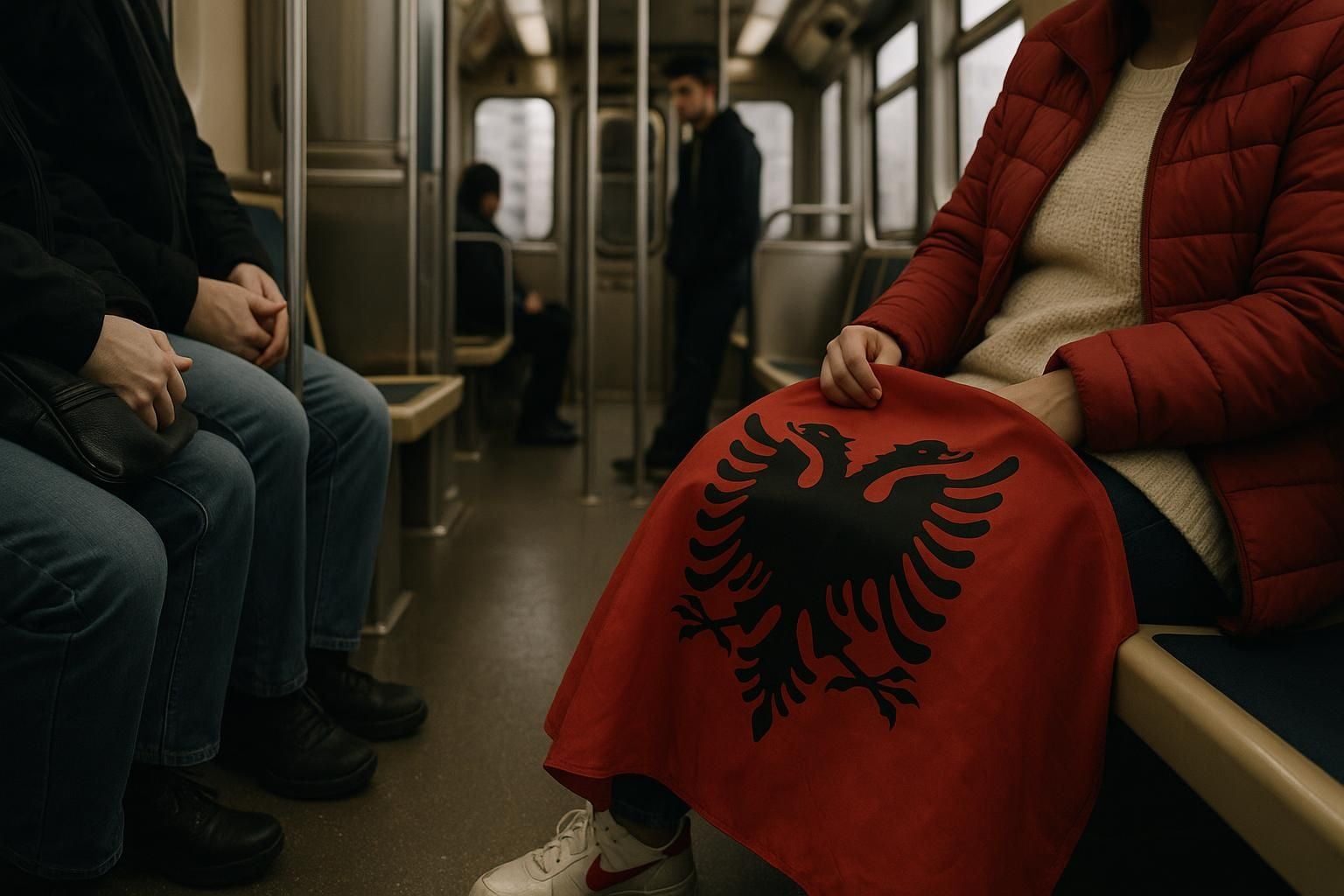
This piece is a community-information map of that geography. It covers how the metro Albanian community formed, where the families live now, which institutions anchor them, what the food map looks like, and how Chicago fits into the broader Albanian-American picture. It is written for the Chicago Albanian who already knows the corridor, the out-of-state Albanian American researching where the community sits, and the neighbor curious about the double-headed eagle in a Lawrence Avenue storefront.
Why Chicago? A short demographic history
Albanian arrival in the United States runs in distinct waves, and Chicago sits inside each one. The earliest movement — small numbers from southern Albania and the late Ottoman vilayets — settled in industrial cities in the years before and after the 1912 declaration of independence. New England absorbed most of that wave; Worcester, Boston, and the southern Massachusetts mill towns hold the oldest Albanian-American institutional history. A smaller cohort traveled further inland to Chicago, drawn by stockyard work, factory jobs, and the city’s broader Southeastern European migration network.
That early Chicago community was small in absolute terms but old in institutional terms. By the interwar period, the city had Albanian fraternal organizations, mutual-aid associations, and a developing Orthodox parish life on the North Side. The Vatra federation — the national mutual-aid body founded in Boston in 1912 — had a Chicago chapter active through the mid-twentieth century, and the city’s Albanian-language press circulated alongside it.
The second wave came after World War II. From the late 1940s onward, families left Yugoslav-controlled Kosovo, North Macedonia, and Montenegro under sustained political and economic pressure. Most of those families spoke Gheg, the northern Albanian dialect, and Chicago drew a meaningful share of the inland Midwest portion of that movement. The third wave arrived after 1991, when post-communist Albania opened its borders, and a fourth after 1999, when the Kosovo war produced refugee resettlement across the United States — including Chicago.
The result is a population layered by region and generation. A typical metro Albanian household today may trace roots to Korçë, Pejë, Tetovë, Tropojë, Tirana, Shkodër, or Ulqin, often within the same extended family. The ACS Illinois count is a floor, not a ceiling.
Where Albanians live in Chicago today
The Chicago Albanian residential map is not a single neighborhood. It is a set of clusters that formed over more than a century, with the historical center on the North Side and newer concentrations in the near-west suburbs.
Lincoln Square is the historical anchor. The North Side neighborhood — running roughly along Lincoln Avenue between Lawrence Avenue and Foster Avenue — held one of the city’s longest-standing Albanian residential clusters and the parish life that grew up with it. Lincoln Square has been a German, Greek, and Albanian neighborhood across its modern history, and the Albanian Orthodox presence there is the oldest piece of the city’s Albanian institutional map. The neighborhood has gentrified sharply since the 2000s, and many of the Albanian families that built the community there have moved north and northwest, but the institutional footprint remains.
The Northwest Side holds the broader contemporary cluster. Albany Park, North Park, Jefferson Park, Portage Park, and Norwood Park carry Albanian households interspersed with other Southeastern European and Latino communities. Lawrence Avenue, Lincoln Avenue, and Devon Avenue carry Albanian-owned businesses across this corridor — bakeries, cafes, restaurants, contracting firms, small professional offices. The footprint is not as visually concentrated as Lincoln Square once was, but the population is larger.
The near-western suburbs are where the suburban institutional core sits. Berkeley, Hillside, Lyons, Cicero, Stone Park, and Melrose Park hold a meaningful Albanian residential presence, with Berkeley as the institutional anchor (see the next section). Families have moved here for single-family homes, larger lot sizes, and proximity to industry, manufacturing, and trade-construction work. The suburban cluster grew sharply through the 1990s and 2000s and continues to grow as second- and third-generation families form households.
The North Shore holds a smaller but established Albanian community — Skokie, Lincolnwood, Niles, Morton Grove, and points further north along the Edens corridor. The North Shore footprint skews toward professional and business-owner households, second- and third-generation, with a quieter institutional presence than either Lincoln Square or Berkeley.
Beyond these four clusters, scattered Albanian households exist across the metro — the western suburbs along the Eisenhower corridor, the northwestern suburbs around Schaumburg and Palatine, and parts of northwest Indiana. The dispersion mirrors the suburbanization other established immigrant communities went through a generation earlier.
The Albanian American Islamic Center and the suburban core
The single largest Albanian institutional anchor in the Chicago metro is the Albanian American Islamic Center in Berkeley, Illinois, a near-western suburb roughly 13 miles west of the Loop. The center has served the community for decades and is widely treated as one of the largest Albanian Muslim institutions in the United States. Its congregation pulls from across the metro — Northwest Side households, near-west suburban families, North Shore commuters — and its Friday xhumaja (Friday prayer) is delivered in Albanian with English translation, the bilingual pattern that holds across most US Albanian xhamis (mosques).
The center functions as more than a prayer space. It runs a Sunday school for Albanian-language and religious instruction, a youth program, weddings and funerals for the broader community, and the major calendar holidays — Bajrami (Eid), Dita e Flamurit (Flag Day, November 28), and other community gatherings. For first- and 1.5-generation Sunni Albanian families across the metro, Berkeley is the gravitational center; for second- and third-generation families, it remains the institution that holds extended-family life across denomination and geography.
The Berkeley center’s location is not accidental. Near-western Cook County had affordable industrial-adjacent housing through the 1970s and 1980s, the right scale for a growing immigrant community, and access to the highway grid that lets a congregation pull from a 30-mile radius. The neighboring suburbs — Hillside, Bellwood, Maywood, Stone Park, Melrose Park, and Cicero — picked up the residential overflow as the institutional center took root. The pattern is familiar from other US Albanian communities: a suburban xhami anchors a residential ring that thickens over a generation.
Several smaller Sunni Albanian prayer rooms operate elsewhere in the metro, often anchored by families from a particular region of Kosovo or western North Macedonia. The Berkeley center is the largest and most visible; the smaller rooms fill the gaps. Together they make up the metro’s Sunni Albanian institutional map.
Albanian Orthodox parishes in Chicago
The Albanian Orthodox tradition in America traces back to the early 1900s, when Bishop Fan Noli began organizing Albanian-language Orthodox worship in Boston and southern Massachusetts. The Albanian Orthodox Archdiocese in America is now headquartered at St. George Cathedral in South Boston, and that Boston-anchored archdiocese remains the institutional center of Albanian Orthodoxy in the country.
Chicago’s Albanian Orthodox presence formed alongside Boston’s, on a smaller scale. A North Side Albanian Orthodox parish — historically associated with the Lincoln Square area — has served the city’s Albanian Orthodox community for the better part of a century. The parish has carried Albanian-language liturgy, the southern Albanian feast-day calendar tied to Korçë and the surrounding region, and the wedding and funeral functions that any immigrant parish performs across generations.
The Chicago Albanian Orthodox community is smaller in absolute terms than Boston’s, smaller than the Sunni community served by the Berkeley center, and smaller than the Catholic community served by parishes scattered across the metro. What it carries is age: the Orthodox parish is the oldest continuously functioning piece of the city’s Albanian institutional life, and it links the early-20th-century arrivals — many of them from Korçë and the southern Albanian Orthodox heartland — to the contemporary community.
Chicago Orthodox Albanians often attend pan-Orthodox parishes for proximity and gather as Albanians at archdiocese-wide events. The pattern is familiar from other smaller US Orthodox Albanian communities: an explicitly Albanian parish at the center, supplemented by Greek, Russian, OCA, and Antiochian parishes that serve the day-to-day commute. The result is a community that is religiously durable even where the residential cluster has thinned.
Albanian Catholic families in the metro — primarily of northern Albanian, Kosovar, and Montenegrin background — typically attend Roman Catholic parishes in their home neighborhood and gather as Albanians around weddings, funerals, and the major feast days. Chicago does not have an Albanian-specific Catholic parish at the scale of New York’s Our Lady of Shkodra, but the Catholic Albanian community is real and the Roman Catholic infrastructure is dense across the metro.
Community organizations and civic life
Beyond the parishes and xhamis, a layer of civic and cultural organizations carries the metro’s Albanian community.
The Vatra federation — Pan-Albanian Federation of America, founded in Boston in 1912 — has had a Chicago chapter active across most of the twentieth century, alongside the Boston headquarters and the New York chapter. Vatra’s role has historically been mutual aid, language preservation, and political advocacy for Albanian-American interests; the Chicago chapter has shifted in scale and focus across decades but the federation’s national footprint includes the city.
The Albanian American National Organization (AANO) and the Albanian American Civic League, both with national reach and primarily New York-anchored leadership, carry programming and members in Chicago as well. Local chapters of business and professional associations, soccer clubs, folk-dance ensembles, and youth groups operate at varying scales across the metro — some attached to the Berkeley center, some to the historic Lincoln Square parish, some independent.
Language sustainability is the structural conversation across all of these institutions. Most of the language instruction outside the home happens through weekend schools at the Berkeley center, the historic Orthodox parish, and a handful of independent community programs. The variety of Albanian most often spoken in the metro skews Gheg in the post-1960s households and standard literary Albanian in formal settings; the older Lincoln Square Orthodox community carried more Tosk (the southern dialect) from its Korçë-region origins. The third generation increasingly speaks English at home, and the weekend schools carry the heaviest load in keeping the language line from breaking.
Albanian-language media — newspapers, radio, and now podcast and social-media channels — reach the Chicago metro from New York, Boston, and Albania directly. The metro is well-covered by the national Albanian-American media ecosystem.
Community-owned funeral homes and small professional firms — legal, accounting, contracting, real estate — round out the institutional layer that does the load-bearing work of holding a community together across generations.
Food, kafe, and the byrek map
The Chicago Albanian food map runs in three layers, each tracking a different piece of the community’s geography.
Layer one: the Northwest Side bakeries and cafes. Lawrence Avenue and the surrounding corridor — Albany Park, North Park, and the edges of Lincoln Square — carry a handful of Albanian-owned bakeries, cafes, and grocery counters where you can find byrek (Albanian filo pastry) by the slice for breakfast, strong coffee, and the everyday food infrastructure a residential community runs on. These are not destination dining rooms; they are the daily food map for families that live nearby.
Layer two: the suburban institutional cluster. Around the Berkeley Islamic center and the near-western suburbs — Hillside, Bellwood, Stone Park, Melrose Park — Albanian-owned restaurants, grills, and grocery stores anchor the suburban food map. Menus lean toward grilled meats: qebapa (small grilled veal-and-beef sausages), shish (skewered grilled meat), tavë kosi (baked lamb with yogurt) where it appears, and shared meze plates with ajvar (roasted red-pepper relish), kajmak (clotted-cream cheese), suxhuk sausage, and warm bread. The suburban map is less dense than New York’s Belmont corridor but it carries the same daily food culture.
Layer three: the pizza-shop and Italian-restaurant overlap. A meaningful share of Chicago-area pizza shops, Italian-American restaurants, and diners are Albanian-owned, particularly in the near-west and northwest suburbs. The menu stays Italian; the family running the place is Albanian. This overlap mirrors the pattern in New York City and reflects the broader story of Albanian families entering the food-service economy through Italian-American kitchens before opening their own places.
The kafe (cafe) deserves its own line. The Albanian coffee shop — strong coffee, no rush, the soccer match from Tirana or Prishtina on the TV — is the social unit men over 50 build their afternoons around in Albanian communities across the United States. Chicago has a quieter version of that map than New York’s Belmont or Pelham Parkway, but the rooms exist, mostly in the Northwest Side and near-west suburbs, and they function the way a kafeneja in the home country would.
Specific names, addresses, and what-to-order detail sit outside the scope of this piece. The food map here is meant as orientation — where to look, not what to order. Local recommendations move faster than any written guide can keep up with, and the strongest sources are the community itself.
How Chicago fits into the broader diaspora picture
Chicago is a meaningful Albanian-American metro but it is not in the top tier alongside New York, Detroit, and Boston. State-level estimates make the ranking concrete: New York (~52,000), Michigan (~30,000), Massachusetts (~21,000). Illinois sits below those three, with ACS/community-estimate Illinois Albanian-ancestry numbers running to roughly 14,000-15,000. Community estimates that include ethnic Albanians from outside the Republic of Albania and US-born descendants push the metro figure higher, but the ordering relative to other US clusters holds.
What that ranking misses is institutional history. Chicago is one of the older Albanian-American footholds in the country, with a Lincoln Square Orthodox presence that predates most of the New York and Detroit institutional layer. The early-20th-century Chicago Albanian community was small but durable, and the institutional through-line — Orthodox parish, fraternal organization, language press — has run continuously for more than a century.
Compared to New York. New York holds the densest residential Albanian-American footprint in the country, anchored in the Bronx and extending into Westchester and Staten Island. Chicago’s footprint is more dispersed and the city does not have a “Little Albania” equivalent. What Chicago has that New York’s secondary clusters do not is a multi-generation Orthodox legacy and a suburban Sunni institutional anchor that pulls from a wide radius.
Compared to Detroit. Detroit’s Albanian community is heavily Sunni and Bektashi, anchored by the Albanian Islamic Center in Harper Woods and the First Albanian Bektashi Tekke in Taylor, Michigan. The community sits primarily in Macomb and Oakland counties and skews toward Kosovar-Albanian and Albanian families from Detroit’s mid-twentieth-century industrial draw. Chicago’s community has a stronger Orthodox component and a deeper Lincoln Square historical layer, while Detroit’s is larger in absolute terms and denser institutionally on the Sunni and Bektashi side.
Compared to Boston. Boston’s Albanian community is the oldest in the country in institutional terms — Vatra was founded there in 1912, the Albanian Orthodox Archdiocese is headquartered there, and the Korçë-origin Orthodox families that built the early American Albanian community arrived through New England ports. Chicago’s Orthodox layer is the spiritual cousin of Boston’s, on a smaller scale.
Chicago’s distinctive contribution to the national picture is the combination of long institutional history and a suburban Sunni anchor in a Midwestern industrial metro. The community is smaller than New York, Detroit, or Boston, but it sits inside the story of US Albanian settlement from the beginning.
How NAR counts Chicago Albanians
The National Albanian Registry runs a community-led, opt-in count that anyone of Albanian heritage living in the United States can join. The registry exists because the ACS undercounts. The ancestry question on the American Community Survey captures self-reported Albanian ancestry one person at a time, which means it misses ethnic Albanians who identify with their country of origin rather than with Albanian ancestry — a Kosovar who answers “Kosovar,” a Macedonian Albanian who answers “Macedonian,” a third-generation Chicago grandchild who answers “American.” Across the metro, that gap adds up.
NAR’s count is meant to sit alongside the ACS, not replace it. Registration is free, takes about three minutes, and the data stays private. NAR is a 501(c)(3) nonprofit, not a government agency, and the certificate issued at registration is a recognition document — it is not citizenship, not legal identification, and not legally binding. Its value is in the count: a community-owned, community-led number that includes the diaspora the Census misses.
For Chicago specifically, the registry is the way to capture the full picture: the Lincoln Square Orthodox families whose Albanian ancestry has thinned to third- and fourth-generation US-born identification; the Berkeley-anchored Sunni community drawn from multiple regions of origin; the Northwest Side households with Kosovo, North Macedonia, and Montenegro roots; the North Shore second- and third-generation families. All of them count, and all of them sit outside the ACS Albanian-ancestry line as currently captured.
Get counted in the Chicago Albanian community
The Chicago metro’s Albanian community sits well above the ACS line, and the gap closes only when the community itself does the counting. If you live in Lincoln Square, on the Northwest Side, in the near-west suburbs, or anywhere else in the metro, get counted — three minutes, free, your data stays yours.