About this event
The Essentials
Boston raises the Albanian flag over City Hall Plaza for Festa e Flamurit — Albanian Flag Day. Here is what you need to know before you go.
- Date: Saturday, November 28, 2026 — the anniversary of Albanian independence.
- Time: Late morning. The City of Boston's plaza flag-raisings typically gather mid-morning; recent Albanian ceremonies ran around 11:00–11:30 a.m. Confirm the exact start time with MAAS Besa, who organize the day, before you head in.
- Place: Boston City Hall Plaza, 1 City Hall Square, Boston, MA 02201 — the open brick plaza in front of City Hall at Government Center.
- Cost: Free. City of Boston flag-raisings are open to the public with no ticket and no registration.
- Weather: Late November in Boston is cold and the plaza is exposed, with little shelter from wind. The ceremony is brief and runs rain or shine; dress for standing outdoors.
Getting There, and the Government Center Catch
City Hall Plaza sits on top of the Government Center T stop, served by the MBTA Blue and Green lines. The station headhouse opens directly onto the plaza, so you can step off the train and be at the ceremony in under two minutes. The Orange Line at State and the Red Line at Park Street are both a short walk away, and North Station and South Station are within reach for commuter-rail riders.
If you drive, this is the catch: there is no event parking at City Hall, and Government Center has some of the most expensive garages in the city. The Government Center Garage and the nearby Boston Common Garage both fill on weekends. Transit is the simpler call for a Saturday-morning ceremony downtown — take the T to Government Center and skip the garage hunt.
What to Expect
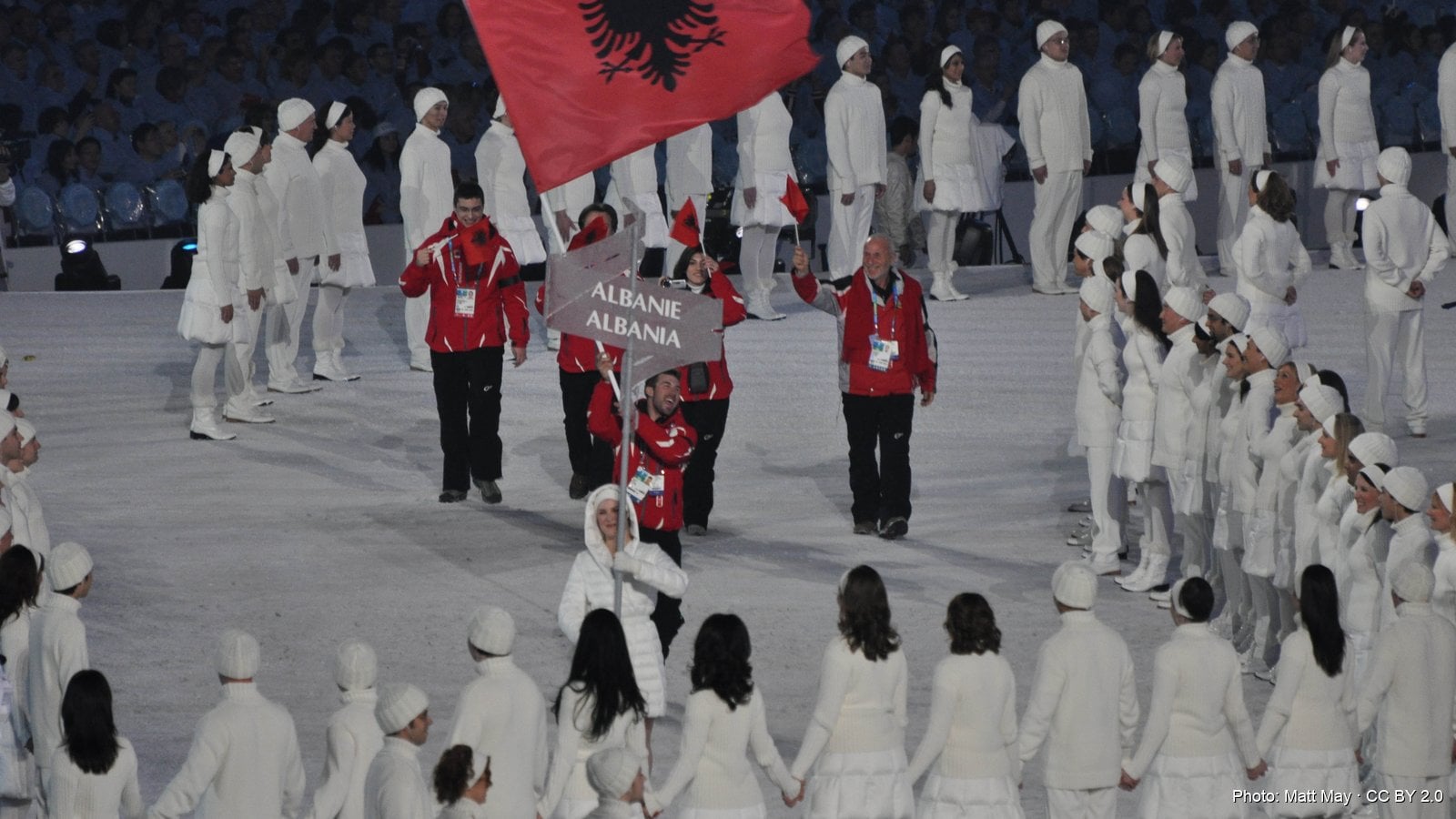
A flag-raising is short and deliberate, not a festival. The Albanian tricolor — the black double-headed eagle on a red field — goes up a pole on City Hall Plaza and flies beside the American flag for the day. In past years the gathering has drawn members of the Albanian community, families with children, and local officials, with remarks marking the meaning of November 28 and, often, the Albanian national anthem sung in the open air. Some years a children's choir or a few dancers from the community's heritage groups take part; MAAS Besa runs a Besa dance group and a heritage school in the area, so the faces on the plaza are often the same ones who teach the language and the steps the rest of the year.
The ceremony itself usually runs under an hour, start to finish. The order is simple: people gather, a few speakers say what the day means, the flag goes up, and the anthem plays. It is the kind of thing a working family can fit into a Saturday morning without clearing the whole calendar — show up, stand together, take the photo, and the rest of the day is still yours.
Many families treat it as the start of the day rather than the whole of it — a photo under the two flags, a few words exchanged in Albanian and English, then on to a community lunch or a larger Festa e Flamurit dinner elsewhere in Greater Boston. Come for the raising, stay for the people; the crowd is where the day lives.
What Festa e Flamurit Marks
The date is exact. On November 28, 1912, Ismail Qemali raised the Albanian flag from a balcony in Vlorë and declared Albania independent, ending more than four centuries of Ottoman rule. An assembly of delegates meeting in Vlorë that day formed a provisional government, with Qemali at its head and a Council of Elders beside him. That is what "Festa e Flamurit" — the Feast of the Flag — names: not a parade theme, but the founding act of the modern Albanian state.
The flag itself carries the story. The red banner with the black double-headed eagle traces back to Skanderbeg, the 15th-century figure who rallied Albanian resistance, and Qemali chose it deliberately in 1912 as the emblem of a nation reclaiming itself. When that same flag goes up over an American plaza in 2026, it is not decoration — it is the continuation of a line that runs through Vlorë.
For Albanian Americans, raising that flag over a U.S. city hall is its own statement. It puts the community on the civic map of the city, in public, beside the American flag — a small annual marker that says: we are here, and we are part of this place. That is the thread that runs from Vlorë in 1912 to City Hall Plaza in 2026.
Massachusetts's Albanian Community and Why the Raising Matters
Massachusetts holds one of the largest Albanian American populations in the country. The Census records about 21,000 Albanian Americans in the state — third behind New York and Connecticut — with the oldest roots running through Worcester, where a community took hold more than a century ago and where one of the first Albanian Orthodox parishes in America was organized in 1911. Greater Boston, Worcester, Quincy, and the old mill towns each carry a piece of that history.
But the Census figure is a floor, not a count. Nationally, the Census records about 224,000 Albanian Americans while the community estimate runs closer to a million — and the same undercount sits over Massachusetts. The Census stays essential; it is the official baseline. The National Albanian Registry is the parallel count built beside it — a free, community-led tally that includes the people the Census misses: half- and third-generation Albanian Americans, Kosovar, Macedonian, Montenegrin, and Çam families, and those who no longer speak the language but still belong. NAR is a 501(c)(3) nonprofit; registering takes about 2 minutes and is not an ID, not citizenship, just your name on the count. A flag over City Hall says the community is here. The registry is how it gets counted.
What to Bring
- Warm layers. A real coat, hat, and gloves — late-November plaza wind is sharp and the ceremony is outdoors.
- A charged phone for photos under the two flags; it is the picture families come back with.
- A small Albanian flag if you have one — many attendees bring their own.
- A transit card (CharlieCard or contactless) for the Blue or Green line to Government Center; skip the downtown garages.
- A stroller or carrier if you have little ones — the plaza is flat brick and easy to roll, but there is no seating.
- A plan for after. The raising is short; line up a community lunch or the larger Festa e Flamurit dinner to make a day of it.