

In December 2025, the Congressional Budget Office published a routine cost estimate for a piece of legislation called the Preshevo Valley Discrimination Assessment Act — H.R. 6411 — projecting that implementing the bill would cost the State Department under $500,000 across the 2026–2030 period.
The bill itself does something narrow. It directs the Secretary of State to produce a report on Serbia’s treatment of its ethnic Albanian minority — roughly 80,000 people in the three southern-Serbia municipalities of Preševo, Bujanovac, and Medveđa, whose addresses, according to a 2021 report from the Helsinki Committee for Human Rights in Serbia, Belgrade has progressively “deactivated” through a process called passivation. A deactivated address means no Serbian ID. No Serbian ID means no vote, no property registration, no health insurance, no pension. Critics call it administrative ethnic cleansing. Belgrade calls it routine residency law. The bill simply asks Washington to find out which it is.
The bill is sponsored by Congressman Keith Self of Texas’s 3rd Congressional District, who chairs the Europe Subcommittee of the House Foreign Affairs Committee. The 3rd District is suburban Dallas — Collin County, McKinney, Plano, Wylie, Frisco — about as geographically far from the Western Balkans as the United States gets.
Why is the United States Congress now formally interested in eighty thousand people in a valley most Americans cannot find on a map?
Because of three suburban Dallas restaurant owners.
The unlikely capital
Albanian-American history in the United States runs through specific cities. Boston, where Korçë-region Orthodox laborers built a community starting in the 1880s. Worcester. The Bronx, especially around Belmont and Morris Park. Detroit, where Gheg-speaking Catholic and Muslim families from Kosovo and North Macedonia settled under Yugoslav pressure starting in the 1960s. Waterbury, Connecticut. These are the diaspora capitals — the places where the U.S. Census actually picks the community up.
Dallas–Fort Worth is not on that list. It should be.
 Downtown Dallas. Via Wikimedia Commons (CC BY-SA 4.0).

The Albanian American Cultural Center of Texas operates out of Lewisville. The Albanian American Heritage Center sits in Bedford. Wylie has a sitting Mayor Pro Tem of Albanian origin. McKinney has a Chamber of Commerce small-business award winner of Albanian origin. The community across DFW spans Kosovar, Macedonian, southern-Albanian, and post-2000 arrivals drawn by Texas’s labor market — and an increasingly cohesive civic infrastructure links them across denominations and dialects.
It is also, like nearly every Albanian-American community in the country, dramatically undercounted in federal data.
The three
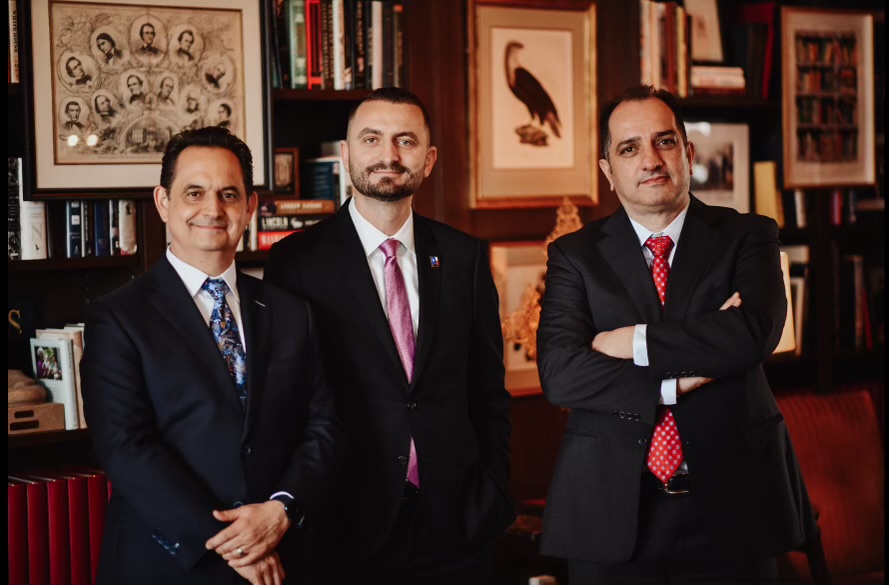
Three names sit at the center of this story.
Doc Vranici owns the Stonebridge Diner in McKinney. He has served on the board of the McKinney Convention and Visitors Bureau, on the board of the DFW International Community Alliance, and on the board of Volunteer McKinney. He graduated from Leadership McKinney in 2010 and earned a Nonprofit Management Certificate from the Center for Nonprofit Management in Dallas in 2008. He is a founding member of Albanians For America (AFA) and the executive director of the Albanian American Cultural Center. He is, by any operational definition, a deeply integrated American civic actor. He is also Albanian.
Gino Mulliqi, originally from the city of Peja in Kosovo, arrived in the United States in 2002 as a seventeen-year-old exchange student, three years after the NATO air campaign that ended a war he survived as a child. He landed at JFK, spent seven months with a host family in Oregon, eventually moved to New York, met his wife, and settled in Wylie in 2013. He owns Napoli’s Italian Restaurant and Starwood Café and is a founding member of Albanians For America (AFA). He was elected to the Wylie City Council in 2023 — the first Albanian-American elected to public office in the State of Texas — and was re-elected unopposed for a second term in 2026. He currently serves as Mayor Pro Tem.
Gezim Rushiti is a Texas businessman with a portfolio of companies in the restaurant and hospitality sector, a founding member of Albanians For America (AFA), and a long-standing figure in the same DFW Albanian-American civic network that produced the other two.
None of these men are lobbyists. None hold law degrees. None work in foreign policy or for advocacy organizations. They are constituents.
The method, in plain language
What the three of them did is not complicated. It is the textbook American civic engagement playbook — the one civics teachers describe and almost no one executes.
Identify the representative. Vranici, Mulliqi, and Rushiti all live in Texas’s 3rd Congressional District. The seat is held by Keith Self, a retired U.S. Army lieutenant colonel who served twenty-five years in airborne, special forces, and joint assignments — including Joint Staff postings at U.S. European Command and at NATO Military Headquarters in Belgium. The alliance that ran Operation Allied Force in 1999 — the air campaign that ended the war Mulliqi grew up under — is institutional ground Self knows from the inside. The constituent base and the representative had, in principle, an unusual depth of relevant biographical overlap. In practice, no one had connected them.
Reach out. They did. Persistently, and with the credibility of multi-year civic track records in McKinney and Wylie rather than as one-off petitioners. A congressional office receives thousands of constituent contacts. The vast majority are single-issue, single-message inquiries. Three sustained civic actors with documented local standing are a categorically different kind of contact.
Bring the expertise to the table — but don’t pretend to be it. The three connected Self with the established national Albanian-American advocacy infrastructure: Albanians For America (AFA), and through it the older institutions built over decades by the Albanian American Civic League, the National Albanian American Council, and the Albanian American Relations Council. According to coverage in the Albanian-American press, they brought Self to New York for direct briefings from the people who have been working these policy questions for forty years. The Texas constituents were not trying to be Balkan policy experts. They were the ones who could make the introduction credibly, in their own district, on their own civic standing.
Sustain the engagement. This is the step most advocacy attempts fail. The Texas effort didn’t end with the New York meeting. It continued through Self’s elevation to Chair of the House Foreign Affairs Europe Subcommittee, through a formal subcommittee hearing titled Flashpoint: A Path Toward Stability in the Western Balkans on December 2, 2025, and through a steady cadence of legislative activity that, by spring 2026, includes:
- H.R. 6411, the Preshevo Valley Discrimination Assessment Act — introduced December 3, 2025 by Rep. Self, currently pending before the House Foreign Affairs Committee. Directs a State Department report on the treatment of ethnic Albanians in southern Serbia.
- A House Resolution on Kosovo’s NATO integration — introduced April 30, 2026 by Rep. Self with Reps. Mike Lawler (NY-17) and Ritchie Torres (NY-15). Expresses the sense of the House that Kosovo’s integration into NATO advances U.S. national security interests in Southeast Europe, and calls on the four NATO members that have not recognized Kosovo — Greece, Romania, Slovakia, and Spain — to reconsider.
- Western Balkans amendments introduced by HFAC Chairman Brian Mast to H.R. 5300, encouraging Albania and Kosovo to expand their defense industrial bases in alignment with NATO funding goals and affirming the strategic importance of the continued U.S. military presence in Kosovo.
- H.R. 5274, the Western Balkans Democracy and Prosperity Act — introduced by Rep. Bill Keating (D-MA) with Reps. Nicole Malliotakis (R-NY) and Daniel Goldman (D-NY). A broader policy framework for U.S. engagement across Albania, Kosovo, Bosnia and Herzegovina, Montenegro, North Macedonia, Serbia, and Croatia.
A pattern worth noting: this legislative cluster crosses the aisle. Self and Lawler are Republicans. Torres, Keating, and Goldman are Democrats. Mast chairs the full committee as a Republican; Keating is its former chairman as a Democrat. Civic engagement worked here because it was civic, not partisan.
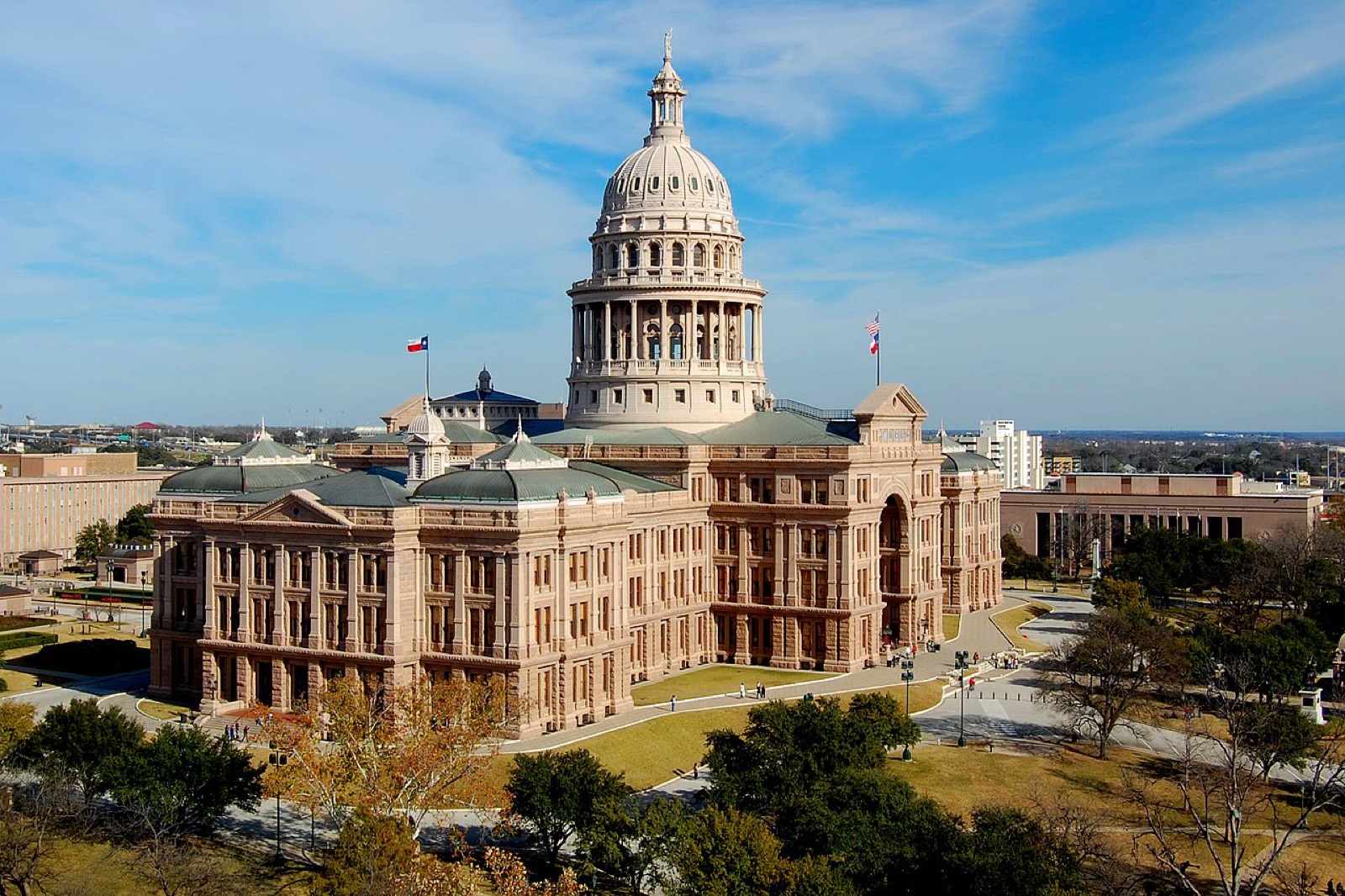 Texas State Capitol, Austin. Via Wikimedia Commons (CC BY-SA 3.0).

None of these items are sweeping standalone laws. They are, mostly, sense-of-Congress declarations and reporting requirements. That is not a weakness in the story. That is precisely how a foreign-policy issue moves from outside Washington’s working radar to inside it. The reports become the evidentiary base for the next round of policy. The resolutions create the political cover for ambassadors and assistant secretaries to act. The hearings become the on-record positions that future administrations either uphold or repudiate. This is the slow procedural machinery by which American foreign policy changes direction — and three Texas constituents are now part of how it moves.
Why this is replicable, not exceptional
There is nothing tactically exceptional about what Vranici, Mulliqi, and Rushiti did. They identified their representative, established standing as constituents who already contributed to civic life in his district, made the introduction to national-level advocacy infrastructure, and stayed in the conversation.
Every immigrant community in the United States has at some point learned the same lesson. Italian-American institutions built in the early twentieth century produced the relationships that supported post-1945 immigration reforms. Polish-American advocacy networks spent forty years shaping U.S. positions on Solidarity. The Cuban-American community in Miami converted local civic presence into federal voice within twenty years of Mariel. Korean-Americans are doing it now around comfort-women historical memory legislation. None of these communities did anything that Albanian-Americans cannot do.
The arithmetic is in the diaspora’s favor. There are 535 voting members of Congress. There are, by the community’s own estimate, somewhere near one million Albanian-Americans in the United States. That ratio works — but only if the community is organized and visible enough that the office of every member of Congress knows it exists in their district.
The data problem
Every Albanian-American advocacy story eventually runs into the same wall.
The U.S. Census recorded approximately 224,000 self-identified Albanian-Americans in its most recent ancestry data. The community estimates the true figure is roughly four times that. The reasons for the gap are familiar. People from Kosovo, North Macedonia, and Montenegro often answer the ancestry question with their country rather than “Albanian.” The ancestry question is optional and easily skipped. Second- and third-generation respondents drift. Long-form Census distribution shrank after 2010. Whatever the cause, the operational consequence is identical: a congressional office’s district-research staff sees the federal number, not the real one.
When the Texas effort first reached out to Congressman Self’s office, federal data did not show that Texas’s 3rd Congressional District contained a meaningful Albanian-American constituency. The relationship had to be built from zero, in person, on the strength of years of district-level civic credibility. That worked — but it scales poorly. The next Albanian-American constituent in the next congressional district starts the same conversation from the same baseline.
A counted community is a fundamentally different kind of constituent.
A House office that knows ten thousand of its constituents share an ancestry, a set of policy concerns, and an organized civic infrastructure is a House office that takes the meeting before the meeting is requested. Counted communities get briefings. Counted communities get standing invitations to subcommittee hearings. Counted communities get the kind of routine access that does not depend on three exceptional civic actors finding the right door at the right moment.
What three Texans accomplished by force of personality is what every Albanian-American community in this country could accomplish by force of arithmetic — if the arithmetic existed.
The takeaway
The story of H.R. 6411 and the April 2026 Kosovo–NATO resolution is, on its surface, a story about Balkan policy. It is more usefully read as a story about how American democracy works for the communities that participate in it.
Three Albanian-American men in suburban Dallas — none of them famous, all of them rooted in their towns, all of them constituents in good standing — produced a measurable shift in U.S. foreign-policy attention to the Western Balkans. They did so by treating their congressman as a representative who could be reached, informed, and engaged with over time. They were proven correct.
The lesson is the kind any nonpartisan civics curriculum would recognize. Constituents who organize, who establish credibility in their districts before they ask anything of their representatives, and who build sustained relationships rather than one-off requests, get heard. This is true in Texas. It is true in every district in the country.
The precondition is being visible enough to be heard in the first place. That is what counting is for.
Be counted. The National Albanian Registry exists to close the distance between the Albanian-American community as it is and the Albanian-American community as it appears in federal data. Registration takes sixty seconds. The next time a constituent in your district walks into a House office, the data should already say what the community has always known. Register at albanianregistry.org.
Sources & further reading
- Congressional Budget Office, H.R. 6411, Preshevo Valley Discrimination Assessment Act — cost estimate, 2026.
- Congress.gov, H.R. 6411 (119th Congress); H.R. 5274 (Western Balkans Democracy and Prosperity Act); H.R. 5300 (State Department reauthorization, Mast amendments).
- House Foreign Affairs Committee, Flashpoint: A Path Toward Stability in the Western Balkans — Europe Subcommittee hearing, December 2, 2025.
- Helsinki Committee for Human Rights in Serbia, Albanian Minority on Hold, 2021.
- Congressman Keith Self introduces H.R. 6411 — official press release.
- Dielli / The Sun, coverage of the Texas advocacy effort, 2025–2026.
- In & Around magazine, “Living the American Dream” (profile of Gino Mulliqi), July 2024.
- Wylie News, “May election incumbents unopposed,” February 19, 2026.