

What a burrneshë is, in one paragraph
A burrneshë — plural burrnesha — is a biologically female person who, under the customary law of the Albanian highlands, took an irreversible oath of lifelong celibacy in order to live socially as a man. The Albanian word comes from burrë (“man”) and is sometimes translated as “manly” or “woman-man.” The English label is “sworn virgin.” Burrnesha wore men’s clothing, took men’s names, were addressed in the masculine, sat on village councils, carried weapons, inherited and managed family property, and headed households. The institution survived in roughly its highland form for some 600 years and is now nearly extinct: recent estimates put the living burrnesha at about a dozen, mostly in their 70s and 80s, in northern Albania and Kosovo.
It is one of the most distinctive social institutions in the Balkans, and a clearer window than most into the everyday workings of the Kanun, the customary code that governed highland society for centuries. The burrnesha did not exist despite the Kanun’s patriarchal rules. They existed because of them. The role was the only Kanun-recognized way for a woman to escape the strictest of those rules without disgracing her family.
This explainer covers what a burrneshë was, why the tradition existed, what changed at the oath, what the historical record says, and what is left now. We follow the Wikipedia entry on Burrnesha, Edith Durham’s High Albania (1909), and Antonia Young’s Women Who Become Men: Albanian Sworn Virgins (2000) as the primary sources. The intent is anthropological, not romantic. For the diaspora, the institution is a piece of cultural memory worth keeping accurate.
What a burrneshë was
A burrneshë was a person assigned female at birth who, before twelve village or tribal elders, swore a bes-bound oath (“bes” is the Albanian honor-pledge — a given word, binding to the death) to remain celibate for life and to live as a man. The oath was treated as irreversible. Under traditional Kanun enforcement, breaking it was punishable by death. The trade was reciprocal: in exchange for celibacy and the loss of the possibility of marriage and motherhood, the burrneshë received the legal and social rights the Kanun reserved for men.
The ceremony was serious and simple. Twelve elders — heads of households, the same body that adjudicated blood feuds and witnessed besa pledges — heard the oath. After it was spoken, the woman cut her hair, put on men’s clothes, and took a man’s name. From that day forward, the village addressed her as a man. Pronouns shifted — she was referred to as “he.” In Slavic-language regions where the practice also existed (Montenegro, parts of Kosovo), she was never again referenced in the grammatical feminine.
The transformation was social, not biological. The Kanun did not require any change of body — only a change of legal and social standing, permanent once made.
The privileges were substantial in a society that gave women almost none. A burrneshë could inherit and own property; head a household; sit at men’s tables in the kullë (the highland tower-house); drink raki; smoke; carry a rifle; participate in blood-feud reprisals; vote in tribal councils; and move freely in public spaces — taverns, markets, mountain pastures — otherwise closed to women. The responsibilities matched: defense of family honor by force if necessary, including the obligation to take part in gjakmarrja (blood vengeance) when the tribe required it.
Edith Durham, traveling in the northern highlands in 1908, photographed and described several burrnesha in High Albania. She wrote about them with the matter-of-factness of someone documenting a working institution. They were an established legal category — uncommon, but unremarkable to their neighbors.
Why the tradition existed
The burrneshë institution was a Kanun-shaped solution to Kanun-shaped problems. Three pathways were dominant, each a direct response to a constraint the customary law placed on women.
No male heir. The Kanun was patrilineal in the strictest sense. Property — land, the family house, livestock — passed from father to son. Daughters did not inherit. If a family had no son, the patriline ended, the property went to male relatives outside the immediate household, and the family’s social standing collapsed. In a region where blood feuds frequently killed off the male generation faster than it could be replaced, this was not hypothetical. Antonia Young’s fieldwork records cases in which a daughter — sometimes selected by the father, sometimes self-selected — took the oath specifically so the household would have a recognized male heir. The burrneshë’s male standing made her a legitimate inheritor under Kanun law. Without her, the property and the name would have been lost.
Avoidance of arranged marriage. Marriages in Kanun-era highland society were arranged in childhood, sometimes in infancy, between heads of households. A betrothal was itself a besa — a pledge between families that could not be broken without dishonor and, often, retaliation. A young woman who refused her arranged marriage broke her father’s word, an existential problem for the family. The burrneshë oath was the only Kanun-recognized escape. If she swore celibacy, she was no longer marriageable to anyone. The original betrothal was dissolved with honor on both sides. The receiving family had no grounds for a feud, because no one had taken her from them — she had withdrawn from marriage entirely. Edith Durham noted this pathway in 1909. It is the most cited motive in modern accounts.
Widowhood without sons. A widow with sons could run her husband’s household through them. A widow without sons had narrower options under the Kanun: return to her birth family, remarry, or become a burrneshë. The third was the only one that let her stay in her home, keep her position, and continue to manage the household’s affairs.
A fourth pathway, less common, was personal: women who did not want the life the Kanun assigned to women. The institution allowed it, but the public framing was almost always one of the first three — those were the motives the Kanun recognized as legitimate.
The underlying logic is the same in every case. The Kanun gave women very little. The burrneshë role was the one door it left open.
The Kanun framework
The Kanun of Lekë Dukagjini — Kanuni i Lekë Dukagjinit — is the customary law associated with the 15th-century Albanian nobleman Lekë Dukagjini and codified into a 1,262-article written text by the Catholic priest Shtjefën Gjeçovi, published posthumously in Shkodër in 1933. It governed family structure, property, marriage, hospitality, debt, conflict, and reconciliation across the northern Albanian highlands and parts of Kosovo and Montenegro for several centuries. In the absence of a state the highlanders fully recognized, it was the operating system of the region.
On women, the Kanun was unambiguous and severe. A woman was, in legal terms, the property of her father until marriage and her husband after. She could not inherit land. She could not refuse a betrothal her father had made. She could not vote in tribal councils. She could not, in many places, smoke, drink in male company, or carry weapons. Her honor was tied to her sexual conduct, and her father’s or husband’s honor was tied to hers. The document is consistent that a woman’s standing was derivative of the men she was attached to.
The burrneshë institution sits inside that framework as a single, narrow exception. By taking the oath, a woman exited the legal category “woman” and entered the legal category “man” — for everything except marriage and reproduction, which the celibacy clause permanently closed. She gained inheritance, voting, property, authority. She lost the possibility of family of her own. The Kanun treated this as a fair trade.
The institution was not a feminist reform. It was not an opening of the category “woman” to property and authority. It was a workaround that left the underlying rules intact. The Kanun continued to deny those rights to every other woman in the village. The burrneshë became, in legal terms, a man — and the rules for women stayed where they had been.
Historical evidence and accounts
The earliest Western descriptions of burrnesha come from 19th-century Balkan ethnographers traveling in Ottoman-era northern Albania and Montenegro. The institution was already well-established; the travelers were documenting, not discovering. The most influential English-language account is Edith Durham’s High Albania (1909), based on her 1908 travels. Durham, a British ethnographer unusually familiar with highland society, photographed and interviewed several sworn virgins and described the institution without sensationalism. Her account was the standard Western reference for most of the 20th century.
The next major step was Antonia Young’s Women Who Become Men: Albanian Sworn Virgins (Berg, 2000), the first systematic academic study, based on fieldwork in northern Albania in the 1990s. It documents living burrnesha, traces the three pathways, and works through the institution’s relationship to the Kanun, to communism, and to the changes after 1991. We rely on it heavily here.
Photographer Jill Peters brought the tradition to a wider visual audience with portrait series shot in the 2010s — formal, restrained, faces in plain light. Italian writer Elvira Dones’s novel Sworn Virgin and the 2015 film of the same title (directed by Laura Bispuri, starring Alba Rohrwacher) dramatized the late-life experience of a burrneshë who emigrates and returns to a female social role. Alice Munro’s 1994 short story “The Albanian Virgin” had already brought the institution into Anglophone literary fiction.
The numbers, as best the literature can estimate: in the 1920s, perhaps 1,000 or more active burrnesha across northern Albania, Kosovo, and Montenegro. By the 1990s, roughly 100 in Albania alone. National Geographic in 2002 reported under 102. By 2022, scholarly estimates converged on about 12 living, mostly over 70. New initiations effectively stopped decades ago. The institution is in its terminal generation.
The transformation in practice
What changed for a woman after the oath, in concrete terms:
Name. She took a man’s name — Sokol, Mark, Lulash, Pashk. Names varied by region and family. The female name she had been born with was retired.
Dress. Men’s clothing. In highland practice, that meant trousers (rather than the xhubleta, the bell-shaped skirt of the Malësia), a man’s jacket or vest, a leather belt that could carry a knife or pistol, and the plis — the white felt cap, conical or flat-topped depending on region, that was the visual signature of the highland Albanian male. From a distance, a burrneshë was indistinguishable from any other man on the path.
Pronouns. Masculine, in conversation, formal address, and public reference. In Slavic-speaking border regions, the grammatical feminine was dropped entirely.
Privileges. She could now smoke, drink raki, sit at men’s tables at celebrations and funerals, vote in tribal councils, head her household, inherit property, carry a rifle, work in male-only occupations — shepherding, hunting, trading — enter taverns, and travel without a male escort.
Responsibilities. She was now bound by male obligations under the Kanun. She could be called on for blood-feud reprisal. Her death in feud counted as a full male death, rather than the half-life the Kanun assigned to women, with all the reciprocal obligations that entailed. If the household was attacked, she fought.
The boundary. Marriage and sexual relationships were closed to her — the price of the trade. Some accounts suggest celibacy was not always absolute in private practice, but the public rule was strict, and most kept it for life.
This was a social transformation. The Kanun cared about the role she played in the household, the council, and the village; it did not concern itself with internal psychology. Some burrnesha appear to have moved fully into male identity in their self-understanding; others maintained aspects of feminine self-conception privately. Antonia Young documents the variation without flattening it.
The decline of the tradition
The burrneshë institution declined for the same reasons most Kanun-bound institutions declined: the conditions that produced it stopped existing.
Communist suppression (1944–1991). The regime under Enver Hoxha was hostile to the Kanun in principle and in practice. Highland customary law was identified as a feudal residue and suppressed. Tribal authority structures — the council of twelve elders that heard a burrneshë’s oath, the same body that arbitrated feuds and besa pledges — were dismantled or driven underground. The state asserted its own legal monopoly. New oaths became rare.
Modernization and women’s rights. Under communism, and again under post-1991 Albania, women gained the rights the Kanun had denied them: the right to inherit, refuse a marriage, vote, hold property, be educated. The three traditional pathways narrowed sharply. A daughter without brothers could now inherit. A daughter could refuse a marriage in court. A widow could hold property and stay in her household without a male intermediary.
Migration and the diaspora. Migration out of the highlands — internal to Albanian cities, then external to Italy, Greece, the U.S., Germany, the U.K. — removed extended-family pressure from many of the women who in earlier generations might have considered the oath. The diaspora carried the cultural memory of the Kanun. It did not carry the village council that enforced it.
The pipeline closed. The current burrnesha are largely women born before 1960, often well before. The institution has not been producing new members at any meaningful rate for at least a generation. When the last of the present cohort dies, the tradition ends as a living practice.
Living burrnesha today
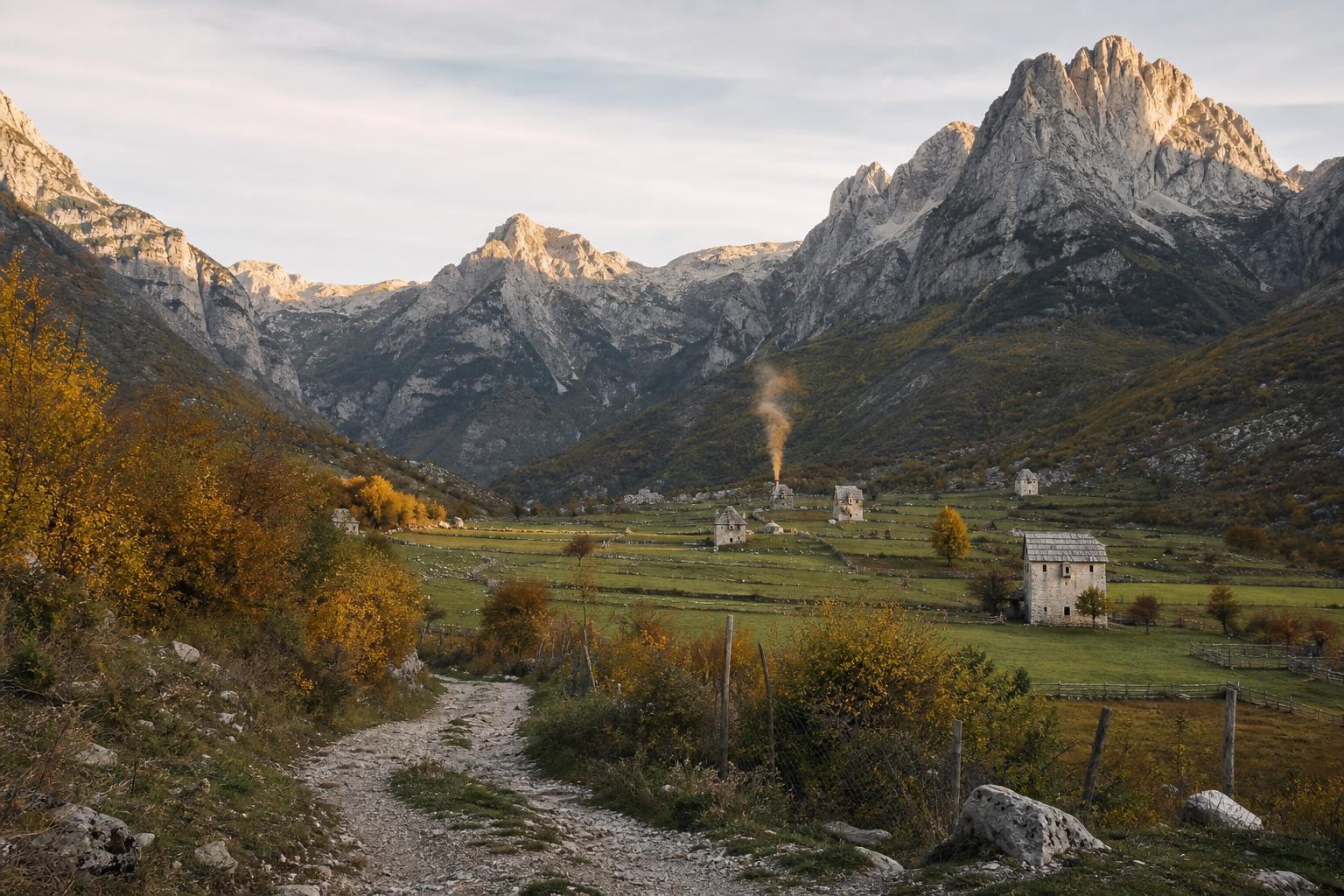
The few remaining live primarily in the highland villages of northern Albania — Tropojë, Dukagjin, Mirdita, parts of Malësia e Madhe — and in highland Kosovo. Most are over 70. A handful have given interviews to Western journalists and photographers; some have appeared in documentary work. Many prefer privacy and have not been profiled.
The most-cited modern figure outside Albania was Stana Cerović, widely identified as the last burrneshë in Montenegro. Other names appear in the literature — Tone Bikaj, Mikaš Karadžić, Stanica-Daga Marinković — but the count is small and the records uneven.
The Kanun-era social structure that produced the burrnesha is gone. The villages they live in look different from the villages of 1908 or 1948. The councils that heard their oaths have not met as legal bodies in their original form for most of a century. What remains is the people themselves, mostly elderly, mostly private, carrying a social role that no longer has a society around it.
Legacy and modern interpretation
The institution can be read several ways, and each reading captures something real.
As historical anomaly. The institution was unusual even by Balkan standards. Few customary codes in Europe produced an equivalent legal category. Read this way, the burrnesha are a footnote to the Kanun — evidence of how creative pre-modern legal systems could be at working around their own restrictions.
As pre-modern non-binary identity. Some scholars and journalists have framed the burrnesha as an early, non-Western parallel to what Anglophone discourse now calls non-binary or third-gender identity. The social category was real, the role permanent, and the recognition complete. But the institution was not built for the same purposes as modern non-binary identity. It was a Kanun-shaped legal workaround, not a personal-identity affirmation. The parallels are partial and best held at arm’s length. Antonia Young is careful on this point, and we follow her.
As patriarchal escape valve. Read most clearly, the burrneshë institution was the safety valve that kept the Kanun’s patriarchal pressure from blowing the system apart. By offering one narrow door out, the Kanun could maintain a system that gave women almost nothing else. The institution let exceptional women — heirs without brothers, daughters refusing marriages, widows without sons — exit the female social role without forcing the Kanun to change its rules for women in general.
For the Albanian-American diaspora, the burrnesha are part of cultural heritage, not living practice. Diaspora communities did not export the institution. What they carried out was the bes, the hospitality code, the family structure, the language. The burrneshë category did not travel. The cultural memory of the tradition — not the practice itself — is what the diaspora has, and what it will have to keep when the last living burrneshë is gone.
A note on getting counted
Tradition lasts as long as the community remembers it. The burrneshë institution will, in living form, end inside the next two decades. What remains depends on whether the community keeps the record — accurately, without sensationalism, without erasing the Kanun context or the women themselves.
That kind of memory is part of what a community-led count looks like. The National Albanian Registry is a register of who we are now: the 224,000 Albanian-Americans the U.S. Census documents and the roughly one million we estimate in total. The traditions we carry — besa, mikpritja (hospitality), the Kanun-era social history that produced the burrnesha — are what makes the count more than a number.
If you are Albanian-American, you can get counted. The registry exists because no one else has built one, and because cultural memory is easier to keep when the community has a record of itself.