
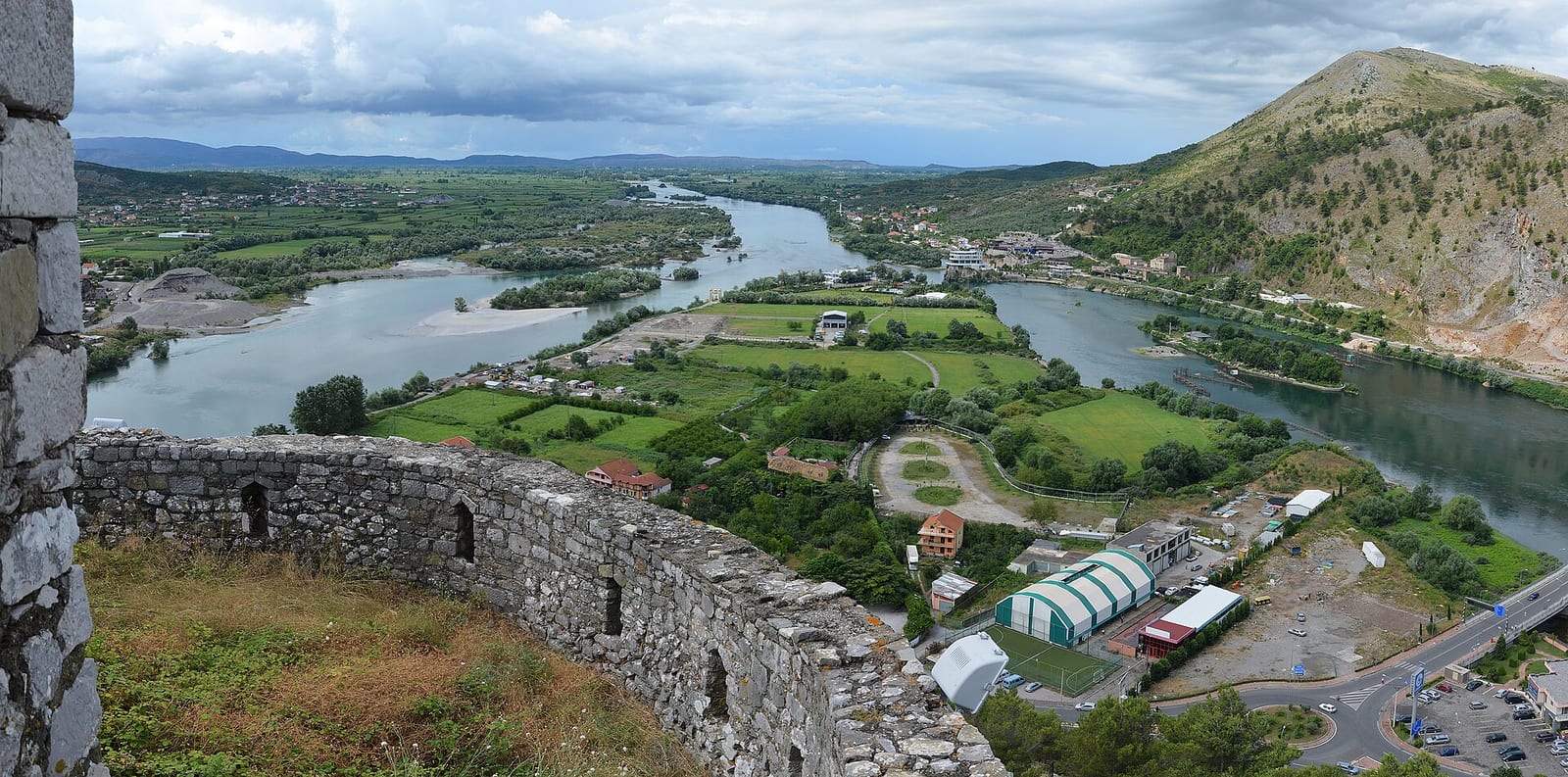
Above the confluence of the Drin and Bojana, the limestone shoulder of Rozafa Castle holds the western edge of Shkodër. Local guides point to a damp seam in the lower wall and tell visitors a young mother is inside it, her right breast left exposed to nurse a boy who would be fifteen centuries old by now. The stone there sweats in summer; the guides call it her milk.
The Story as Shkodrans Tell It
Three brothers labor on the walls of a fortress above Shkodër. Each day they raise the stone; each night the work collapses. An old man — in some versions a wandering dervish, in older versions an unnamed plak — tells them the walls will hold only if they wall in the wife who brings their midday meal the next day. The brothers swear an oath to say nothing to their wives. Two break the oath. The youngest keeps it.
The youngest brother’s wife arrives with bread and a clay jug. When the masons explain what must be done, she does not run. She asks only that her right eye, right hand, right foot, and right breast be left outside the wall so she can see, stroke, rock, and nurse her infant son. The masons agree. The walls rise around her and hold.
Robert Elsie, in Albanian Folktales and Legends, places the tale among the most widely recorded Albanian legends of the nineteenth and twentieth centuries, collected in variants from Shkodër, Mirdita, and the Dukagjin highlands. Mitrush Kuteli’s retelling in Tregime të moçme shqiptare fixed the version most Albanian schoolchildren now read, with the youngest wife unnamed in the oldest tellings and called Rozafa only later, after the castle itself.
The Castle and Its Layers
Rozafa Castle sits on a 130-meter hill where the Drin meets the Bojana, two kilometers southwest of central Shkodër. The site has been fortified since at least the third century BCE, when the Illyrian Labeates held it as the capital of King Gentius before the Roman conquest of 168 BCE. Venetian masonry from the fifteenth century overlays Byzantine work, which overlays Illyrian foundations. The Ottomans took the castle in 1479 after a siege Marin Barleti chronicled in De obsidione Scodrensi.
The legend attaches itself to the lowest, oldest courses of stone — the Illyrian layer, the part no visitor can date by eye. This matters. The story explains why the walls have stood through Roman, Slavic, Venetian, and Ottoman sieges. It is a foundation myth in the literal sense: a myth about what is under the foundation.
“The castle holds because she holds it. Take her out and the stones fall.” — recorded by Edith Durham from a Shkodër guide, High Albania, 1909
The Balkan Pattern and What Is Albanian About It
The walled-in woman is not unique to Albania. The Romanian Meșterul Manole walls his wife Ana into the monastery of Curtea de Argeș. The Serbian Building of Skadar — collected by Vuk Karadžić — walls a woman into the foundations of the same fortress, told from a different ethnic vantage. The Greek Bridge of Arta and the Bulgarian Struna nevesta carry the motif into bridges and towers. Folklorists since the nineteenth century have grouped these under the Aarne-Thompson-Uther tale type 1553*, the “immurement” or “building sacrifice” legend.
What distinguishes the Albanian Rozafa is the detail of the four exposed parts: eye, hand, foot, breast. The Serbian and Romanian versions wall the woman in whole or leave only her breasts exposed. The Albanian version insists on continued motherhood as a condition of the sacrifice. She is not killed. She is converted into infrastructure that still functions as a mother.
Eqrem Çabej, in Studime gjuhësore, argued that the four-part exposure reflects a pre-Christian Illyrian substratum, related to ritual offerings in which the victim remains partially animate. Maximilian Lambertz, who collected variants in the 1910s for Albanische Märchen, noted that the Albanian version is the only one in which the walled woman speaks at length after the wall closes — bargaining, not screaming.
The Besa Inside the Legend
The brothers swear an oath not to tell their wives. Two break it. The youngest keeps it, and his wife dies for his keeping it. This is the besa — the given word, the pledge that binds a man past his own interest — operating at its sharpest edge.
Margaret Hasluck, in The Unwritten Law in Albania, recorded besa as the structural beam of northern Albanian customary law under the Kanun of Lekë Dukagjini. A besa held against family was the highest form; a besa broken brought marre, shame transferable across generations. The Rozafa legend reads, in this frame, as a parable about which oaths cost what. The youngest brother’s besa kills his wife and saves the fortress. The two older brothers’ broken besa saves their wives and would, without the youngest, have left Shkodër undefended.
The legend does not resolve which choice was right. It only records what each cost. This is closer to the moral grammar of the Kanun than to Christian or Islamic ethics: an accounting, not a verdict.
The Mother as Foundation
The exposed breast is the part of the legend that has been most frequently reinterpreted. Nineteenth-century Albanian nationalist writers — Pashko Vasa among them — read Rozafa as the mother-nation, her milk feeding the Albanian people from inside the stone of the homeland. The image appears on stamps, on the 1965 film Rozafa directed by Hysen Hakani, and on the bronze relief inside the castle’s small museum.
The reading is sentimental, and the legend is not. The original tale is closer to horror than to allegory. A woman is bricked alive into a wall and asked to keep nursing. The masons do not weep. The husband does not intervene. The infant is brought to the wall each day until he weans. Then, presumably, she dies — though the legend does not say so, and some Mirdita variants insist the milk flowed for years.
Kuteli’s twentieth-century version softens none of this. He keeps the mason’s hammer, the wet mortar, the wife’s calm. The calm is what unsettles modern readers most. She does not protest the logic. She asks only for the four openings.
What the Limestone Actually Does
The “milk of Rozafa” is a calcium carbonate seep. Limestone walls in the Shkodër basin, exposed to seasonal rainfall on the Drin floodplain, dissolve and redeposit calcite along seams. The white streak below the inner wall of the lower courtyard is the same chemistry that builds stalactites in the nearby caves of Puka and Pukë. Visitors are told to rub the wet stone for fertility. Akademia e Shkencave folklore surveys from the 1980s recorded the practice in continuous use since at least the Ottoman period.
The geology explains the streak. It does not explain why this particular streak, on this particular wall, in this particular castle, gathered to itself a story about a woman walled in alive. The streak is on the inside, in a chamber tourists reach by descending a short flight of stone steps. To find it you have to go down into the wall.
How the Legend Is Used Now
Shkodër markets Rozafa to visitors as a love story and a story of maternal devotion. The castle’s interpretive panels, last revised in 2018, use the words sacrifice, family, and eternal. Tour guides recite a clean version: the wife agrees willingly, smiles, blesses her son, and is sealed in peace.
The older recorded versions — Lambertz 1922, Durham 1909, the Mirdita variants in the Akademia archive — do not describe her smiling. They describe her negotiating terms. The difference matters. A woman who smiles is a symbol. A woman who negotiates the precise geometry of her own immurement is a person, and the legend is about what is done to a person under the logic of besa, fortress, and stone.
“I do not refuse. But leave my right eye, that I may see him. Leave my right hand, that I may stroke his hair. Leave my right foot, that I may rock his cradle. Leave my right breast, that I may feed him.” — composite of variants recorded by Lambertz and Kuteli
What Remains
The Rozafa story is one of the few Albanian legends to have survived the Ottoman, communist, and post-communist periods without major censorship or rewriting, because each regime found something usable in it. The Ottomans read it as proper female submission. The communists read it as the worker’s body given to collective construction. The post-1991 state reads it as national continuity through maternal sacrifice. Each reading takes a different cut of the same woman.
The legend predates all of them. It belongs, in its oldest form, to a layer of Albanian belief in which buildings require lives, oaths bind past death, and the line between a mother and a wall is thinner than it should be. The stone above the Drin seeps. The guides still point. The story is working.